





Deep Network Observability Improves 5G Mobile Subscriber User Experience
Case Study

Key Results
80% Hardware Reduction
80% reduction in Deep Packet Inspection (DPI) hardware footprint and power usage
Real-Time Monitoring
Real-time monitoring of QoE and SLAs
Cost Optimization
Cost optimization at every stage
Seamless Integration
Seamless integration & interoperability
Business Problems to Be Solved
Organizations face multiple challenges in managing network observability and analytics due to fragmented systems, infrastructure changes, and increasing traffic demands. Key challenges include:
Fragmented Systems & High Costs
Many existing systems operate in silos, leading to inefficiencies. Lack of unified data processing increases complexity and operational costs. Consolidating systems is essential to reduce the operational burden and development expenses.
Integration with Existing Infrastructure
A seamless solution is required to integrate with existing 4G/LTE and 5G NSA/SA infrastructure, Cisco ACI Fabric for 5G-SA U-Plane (encapsulated in IPv4 VXLAN), Mobile Core NFs for 5G-SA C-Plane (encapsulated in GRE), and Voice Networks (encapsulated in IPv6 VXLAN). Additionally, it must support analytics tools leveraging Kafka while ensuring consistent and reliable data processing, regardless of the captured signal. Standardizing data output specifications across all sources will improve interoperability and simplify operations.
Infrastructure Changes & System Dependencies
Frequent changes in core network equipment create and increase repair costs. A system designed to be less dependent on changes in core equipment and capture points can enable faster operations and cost-effective maintenance.
Scaling for Increased Traffic
With growing communication volumes, maintaining current data analysis capabilities is a challenge. The solution must ensure continuous analyzability or even improve data sampling rates without performance degradation.
End of Service Life (EOSL) & Frequent Upgrades
Short EOSL cycles lead to frequent system upgrades, escalating development costs and operational overhead. A long-term, stable solution is required to minimize version upgrade frequency and ensure cost efficiency.
Addressing these challenges with a unified, scalable, and future-proof system will drive operational efficiency, reduce costs, and enhance network analytics capabilities.
Aviz Solution to Deliver Scalable and Efficient Network Observability
"Collaborating with Aviz, we successfully implemented a scalable, high-performance network observability solution that seamlessly integrates with existing infrastructure. This deployment has significantly enhanced network observability, reduced operational complexity, and ensured long-term cost efficiency for our customers."
— Keisuke Miura, Deputy General Manager, Itochu Techno-Solutions Corporation
Solution Architecture
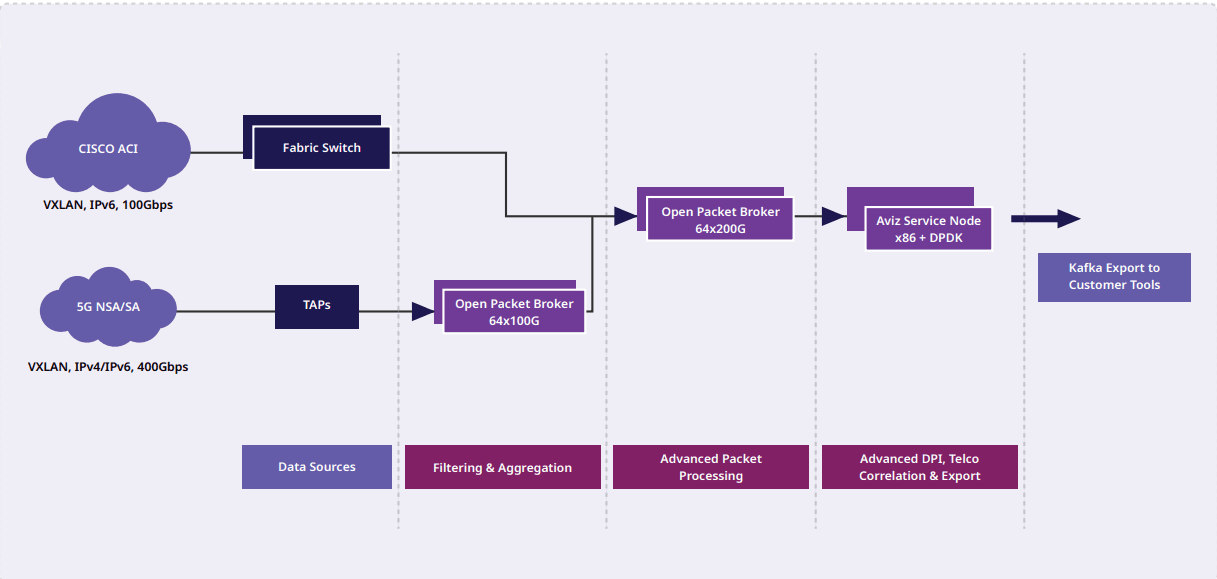
Deployment Overview
The solution comprises the following key components:
Data Sources
-
5G NSA/SA: Captures VXLAN traffic (IPv4/IPv6) at 400Gbps, covering both Control Plane (C-Plane) and User Plane (U-Plane) data from vTAPs (Ericsson and Samsung) and BIDI TAPs.
-
Cisco ACI Fabric: Handles telco control traffic encapsulated in VXLAN (IPv6) at 100Gbps.
Filtering & Aggregation
-
Aviz Open Packet Broker NOS (OPBNOS) runs on white-box switches using Broadcom and NVIDIA ASICs, supporting 10-400Gbps to ensure only relevant traffic enters the processing pipeline. This optimizes performance by minimizing processing overhead while preserving critical data flow.
Advanced Packet Processing
-
Open Packet Broker leverages ASIC programmability for advanced functions, including: VXLAN header stripping, encapsulation, and decapsulation; Symmetric traffic load balancing of GTP-C and GTP-U based on inner headers. This ensures efficient processing of control and user-plane packets, enhancing performance and correlation.
Advanced DPI, Data Correlation & KPI Computation
-
Aviz Service Node (ASN), running on commodity x86 hardware, delivers high-performance packet processing using DPDK-optimized deep packet inspection and metadata extraction. GTP Correlation correlates Control and User sessions across 4G-LTE, 5G-NSA, and 5G-Core networks. KPI Computation measures latency and bandwidth utilization with 5-second granularity for real-time analytics and SLA enforcement. Metadata Extraction provides KPI insights, IP information, GTP session details, and application payload analysis. Kafka Export Processed data is streamed via Kafka to customer analytics tools for visualization, reporting, and anomaly detection.