

Aviz Logo
Contact
Modern network stack built for the AI era.
Build AI Factories
Start here: Neocloud, sovereign AI, and private AI cloud users
Network Automation with ONESToken Economics with AI ParserAgentic Operation with AI-NOCPOC Validation with FTAS
Modernize your Network
Start here: Cisco, Arista, Juniper network users; Gigamon and Netscout observability users
Autonomous Agentic AI PlatformNetwork CopilotAviz Packet BrokerAviz Service NodeVirtual Aviz Service Node / vTAP
SONiC & AI Experience Hub
Validate open networking and AI-driven infrastructure with real-world, multi-vendor testing environments.
Partner with Aviz Networks
Join our ecosystem of channel and technology partners. Together we deliver open networking solutions that drive innovation and growth.
Make Networks for AI. Introduce AI in your Networks.
End-to-end solutions, any NOS, any switch, any ASIC, any LLM, any application , backed by partner best practices, proven tech, and SLAs.
Explore why Aviz is the best partner to modernize your network with.
Explore Case Studies, TCO and ROI Calculators, Certifications, Community and News room
Aviz Training and Certification
Learn and Certify in SONiC and AI
24/7 World-Class SONiC Support & Proven Services.
Our dedicated team delivers round-the-clock, world-class SONiC support with unmatched quality, scalability, and efficiency, keeping your network optimized, secure, and always running at its best.
Hamburger
Aviz Logo

Prove your AI Factory works end to end.

Fabric Test Automation Suite · AI Factory Integration Testing
FTAS brings the selected GPU, DPU/NIC, network fabric, storage, and host-orchestration stack together on representative physical infrastructure. Aviz Forward Deployed Engineers help bring it up, test every integration, validate Day 0–Day 2 operations, and document what is ready, and what still needs to be fixed.
Skip the browsing. Ask AI.
Hello! How may I help you today?
End-to-end integrationCompute, DPU/NIC, fabric, storage, and orchestration.
Day 0–Day 2 validationBring-up, tenants, lifecycle, and operations.
FDE-led engagementTest plan, troubleshooting, and evidence.

The components may work. The AI Factory still may not.

AI Factory failures often appear between systems, not inside a single product. GPU servers, DPUs/NICs, east–west and north–south fabrics, storage, and host orchestration can all be individually supported and still fail as one operational stack.

The question is simple: does the selected design work end to end?

01

Versions and policies move independently

Firmware, drivers, NOS, storage, and orchestration dependencies can break the complete data path or control path.

02

No single component owns the integration

The issue may sit between the GPU host, DPU/NIC, fabric, storage system, and orchestrator.

03

Issues surface too late

Interoperability and operational gaps are often discovered during a customer PoC or early production.

Assemble the selected stack. Test it as one system.

FTAS uses a vendor-neutral physical lab to validate the exact combination the customer plans to deploy. The test covers connectivity, interoperability, tenant workflows, storage attachment, observability, and Day 0–Day 2 operational readiness.

The selected AI Factory stack assembled and tested as one system
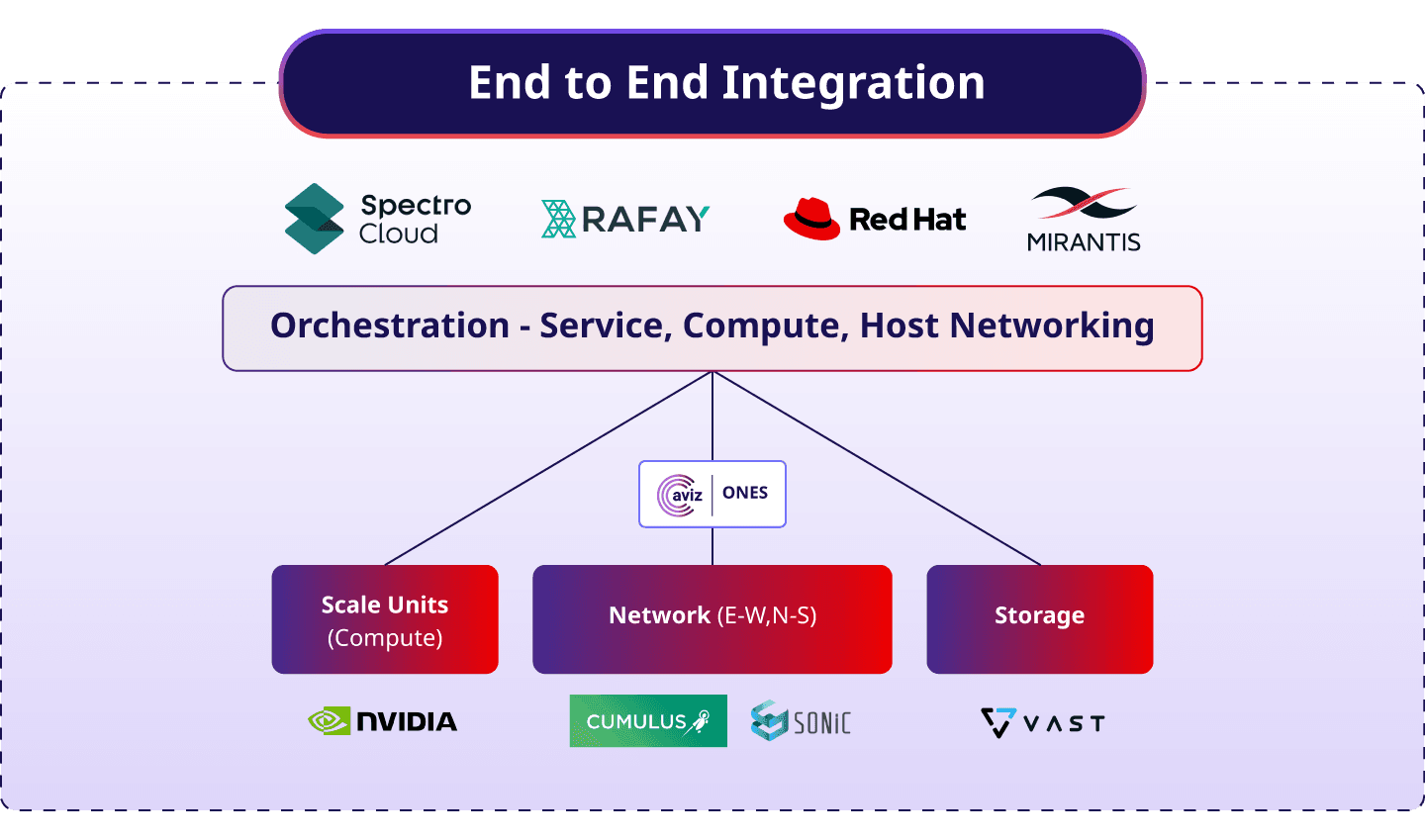
GPU ComputeGPU servers and repeatable scale units, including DGX/HGX/NVL-class designs.
NICs & DPUsSelected NIC and DPU combinations, including ConnectX and BlueField families.
E/W & N/S FabricsGPU backend, front-end, border, and storage fabrics tested together.
Network OSSONiC flavors, Cumulus, and optional InfiniBand designs.
Host OrchestrationService, compute, host-networking, and tenant provisioning integration.
Storage & OperationsStorage attachment, monitoring, lifecycle workflows, upgrades, and change control.

From component list to validated design.

01

Define design and gates

Lock the components, versions, topology, scale, and acceptance criteria.

02

Assemble the physical stack

Bring together GPU servers, DPUs/NICs, fabrics, storage, and host orchestration.

03

Bring up Day 0 and Day 1

Validate cabling, adjacency, underlay, RoCE, tenants, isolation, and storage attachment.

Aviz Forward Deployed Engineers work with the customer and participating vendors to define the test gates, assemble the environment, troubleshoot failures, and deliver the final evidence package.

04

Exercise Day 2 operations

Test monitoring, alerts, maintenance mode, upgrades, audit, and drift detection.

05

Publish the evidence

Deliver the Reference Architecture, config pack, integration report, known issues, and cadence.

Physical Integration Lab

Representative AI Factory infrastructure is assembled around the selected component set, topology, versions, and operating model.


Direct Access to Aviz FDEs

Work hands-on with Forward Deployed Engineers on test planning, cross-vendor troubleshooting, remediation, and the final technical readout.

Complementary role: NVIDIA DSX Air supports high-fidelity digital simulation. FTAS validates the assembled physical stack and its Day 0–Day 2 behavior; it is not positioned as a digital twin or a “build it before you build it” platform.

Test the integrations customers depend on.

FTAS validates how the physical stack behaves when it is operated as a shared AI infrastructure platform.

Isolation

Tenant segmentation

Validate host-based DPU isolation or network-based VXLAN/EVPN, with VLAN and VRF options.

Orchestration

Host and tenant workflows

Verify service, compute, host-networking, tenant creation, and overlapping-IP workflows.

Storage

Storage attachment and data path

Test storage connectivity, routing, policy, read/write access, and failure visibility.

Services

Application exposure

Validate gateways, NAT, route leaking, peering, and Layer 4 service exposure where selected.

Telemetry

End-to-end observability

Check port, ASIC, buffer, RoCE, topology, device-health, and workload-path telemetry.

Day 2

Lifecycle operations

Exercise maintenance mode, upgrades, audit logs, RBAC, tenant RBAC, RMA, backup, and restore workflows.

A validated design, not just a test result.

Each tested combination produces a customer-selectable Reference Architecture and evidence package tied to the exact components, versions, topology, scale, and operational baseline.

  • Physical topology and role-based templates
  • Component and version baseline
  • Scale-unit sizing: GPUs to leaf/spine
  • Tenant, DPU, and storage integration model
  • Underlay, overlay, and RoCE policy intent
  • Monitoring and alert baseline
  • Day-2 upgrade, RMA, backup, and restore playbooks
  • Integration report, known issues, and remediation guidance

Validate east–west and north–south as one system.

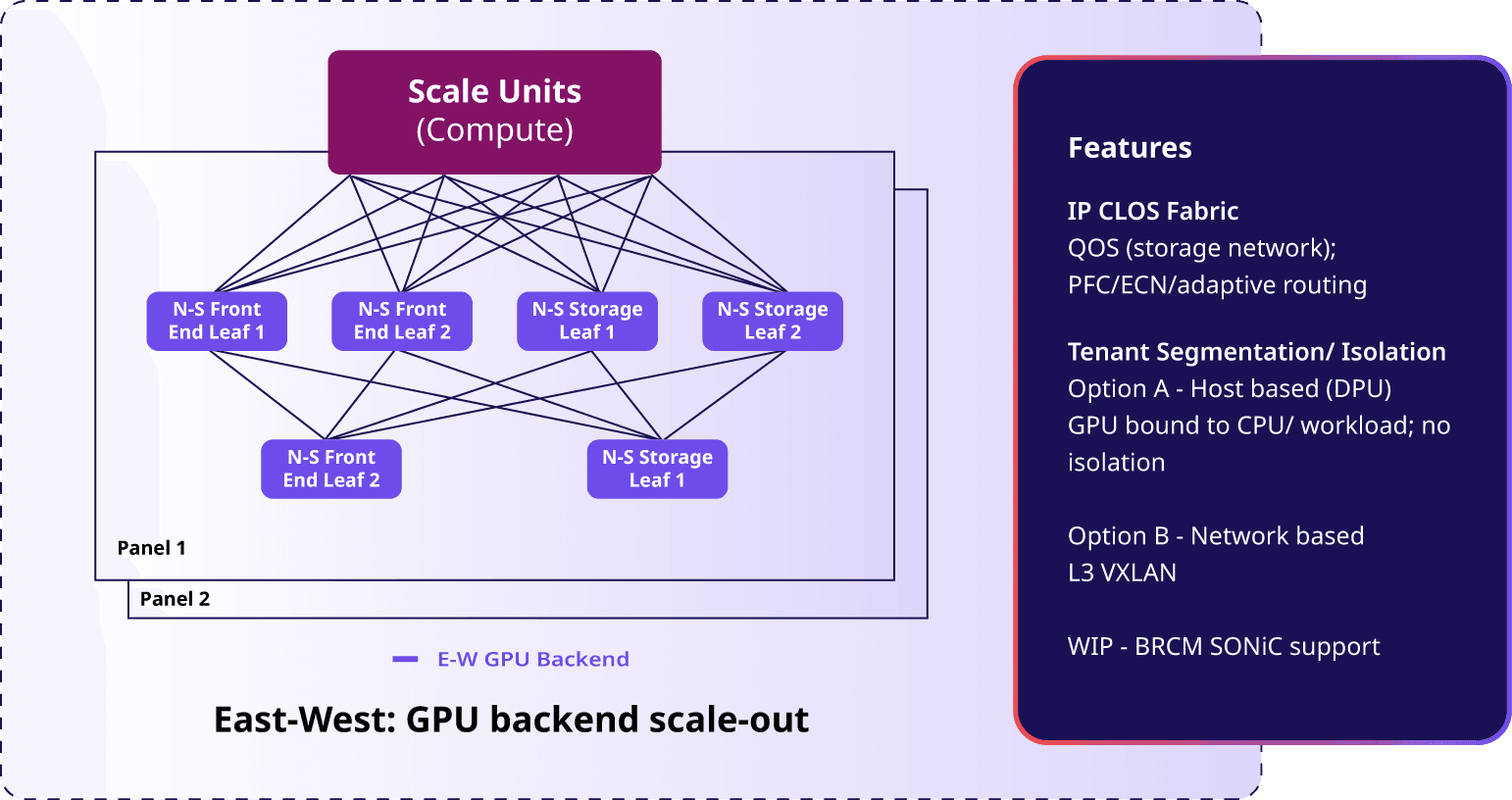
Front-end, storage, border, and GPU backend fabrics are tested with the compute, DPU/NIC, storage, orchestration, policy, and isolation model the customer plans to use.
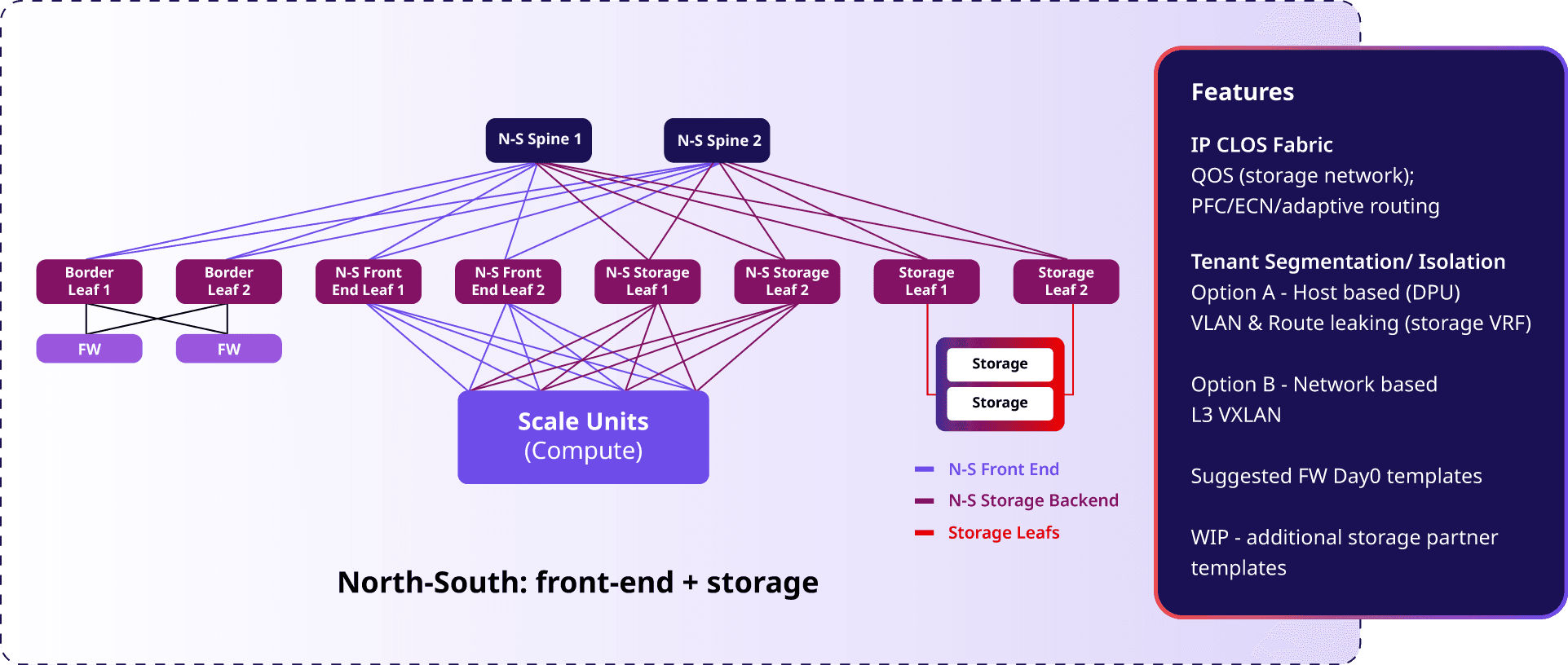
Topologies N-S

North–South: front-end + storage

Topologies E-W

East–West: GPU backend scale-out

Keep the validated stack tested as the ecosystem changes.

After the initial physical integration test, FTAS can rerun the design as software, firmware, configurations, and partner components change.

Reporting cadence

  • Continuous regressionActive runs, pass/fail status, and configuration or behavior drift.
  • Monthly failure digestFailure summary, suspected root cause, reproducible evidence, and FDE review.
  • Quarterly validation reportA plugfest-style report for customer, partner, engineering, and solution teams.
  • Partner remediation loopFailed tests can be shared with the responsible vendor and imported into its internal test cycle.

The stack you can bring for testing:

01
Compute
  • NVIDIA DGX/HGX/NVL72-class systems
  • Representative physical scale units
02
NICs / DPUs
  • ConnectX and BlueField families
  • Selected partner NIC/DPU combinations
03
Fabrics
  • Multi-vendor leaf/spine designs
  • North–south and east–west roles
04
Network OS
  • SONiC flavors
  • Cumulus and optional InfiniBand
05
Orchestration
  • Rafay and Spectro Cloud
  • Expandable host/tenant integrations
06
Storage
  • VAST Data
  • Expandable partner storage matrix
07
Operations
  • Aviz ONES and FTAS dashboard
  • Day 0–Day 2 workflows
08
Outputs
  • Reference Architecture PDF
  • Config pack and integration report

Bring the design you need tested.

FTAS validates supported combinations and publishes the exact components and versions that passed together.

Confirm the complete control path and data path work.

FTAS runs a lightweight workload to verify scheduling, GPU access, fabric correctness, storage read/write, and telemetry across the selected physical stack.

ftas - validation run
example validation flow$ launch workload through the selected orchestrator$ verify GPU and DPU/NIC access$ verify east–west and north–south connectivity$ verify storage read/write path$ capture fabric + host telemetry
Acceptance
  • Workload schedules and completes
  • No adjacency, MTU, or isolation correctness issues
  • Storage path and telemetry remain intact
  • Logs, checkpoint, and evidence bundle are produced

Not included: AI performance benchmarking. FTAS proves functional integration and design correctness; it does not compare model, GPU, or training performance.

What FTAS does, and what it does not.

FTAS does not

Digital simulation or AI performance benchmarking.

  • It does not replace or compete with NVIDIA DSX Air
  • It does not use "build it before you build it" as the FTAS positioning
  • It does not rank GPU, model, or training throughput
  • It does not turn a functional smoke test into a performance claim

FTAS for AI Factory FAQs

What is FTAS for AI Factory?

FTAS is Aviz's vendor-neutral physical integration-testing environment for complete AI Factory stacks. It validates whether a selected combination of GPU compute, DPUs/NICs, east–west and north–south fabrics, network operating systems, storage, host orchestration, and Day 0–Day 2 operations works end to end.

When should I use FTAS?

Use FTAS when you need to know whether a selected physical AI Factory design works end to end, when multiple vendors must be integrated, or when a component, firmware, software, or configuration change needs regression validation.

How is FTAS different from NVIDIA DSX Air?

NVIDIA DSX Air supports high-fidelity digital simulation. FTAS focuses on physical, end-to-end integration testing in a vendor-neutral lab with Aviz Forward Deployed Engineers. FTAS validates the assembled stack and operational workflows; it is not positioned as a digital twin or a "build it before you build it" platform.

How do Aviz Forward Deployed Engineers work with my team?

Aviz FDEs help define the selected stack and acceptance gates, coordinate the physical bring-up, troubleshoot cross-vendor integration failures, document known issues and remediation, and lead the final technical readout.

Where does validation run?

Validation runs in a controlled Aviz lab on representative physical infrastructure assembled around the selected component set, topology, versions, and operating model.

What does the customer receive?

The core package includes a customer-selectable Reference Architecture, topology and role-based templates, component and version baselines, configuration artifacts, an integration validation report with known issues, and a monthly or quarterly reporting cadence where applicable.

Does FTAS benchmark AI performance?

No. FTAS validates design correctness, end-to-end integration, and operational readiness. A lightweight workload smoke test confirms that the workload schedules, accesses the selected network and storage paths, completes, and produces expected telemetry; it is not an AI performance benchmark.

Bring the stack. Aviz FDEs will test the integration.

Share the target components, versions, topology, and operating model. We will define the gates, assemble the physical environment, run end-to-end Day 0–Day 2 validation, and return the evidence package.