




Aviz Networks + Clastix
Bare-metal Kubernetes with tenant networking from server to switch to edge
Overview: Kubernetes Infrastructure Meets AI Network Automation
Clastix manages Kubernetes environments across infrastructure, including bare metal. Aviz automates the network fabric that connects GPU compute, tenants, and services. Together, they give AI Cloud providers, telcos, sovereign clouds, and enterprises a Kubernetes platform that runs directly on the servers they own, with tenant networking, connectivity, visibility, and operations built in.
Clastix kMetal runs Kubernetes on bare metal with no separate hypervisor layer. Inside each Kubernetes cluster, the CNI keeps workloads isolated. Aviz extends that same tenancy beyond the Kubernetes cluster, into the physical fabric and out to the edge: Aviz ONES, integrated with kMetal, builds and segments the fabric. Optionally, Aviz Service Gateway connects each tenant to the outside world, AI Parser shows what each tenant consumes, and AI NOC helps operate it all.
The result is one stack, from bare metal to tenant service, with no hypervisor in the middle and no manual network work behind every new tenant.
The Challenge: Tenancy Doesn't Stop at the Kubernetes Cluster
Operators are moving AI and GPU workloads to Kubernetes on bare metal to give workloads the whole server and to drop a virtualization layer they no longer need. Inside each Kubernetes environment, the CNI and network policies keep workloads isolated, and that stays the same. What changes is everything below and beyond the Kubernetes cluster: the switches that connect each tenant's servers, and the edge that connects each tenant to the outside world. In a virtualized cloud, the hypervisor stack carried that tenancy with virtual switches, NAT, floating IPs, and firewall policy. On bare metal, the same tenancy has to extend from the CNI into the physical fabric and out to the edge, and most teams still build that part by hand.
The Joint Solution: One Stack, Layer by Layer
Each layer of the platform has one owner. Clastix owns the Kubernetes layer on bare metal; Aviz owns everything the network has to do around it.
| Layer | Delivered by | What it does |
|---|---|---|
| Kubernetes on bare metal | Clastix kMetal | Provisions and manages tenant Kubernetes environments directly on the provider's servers. |
| Fabric and multi-tenancy | Aviz ONES | Bootstraps and orchestrates the AI fabric, and places each tenant's servers on their own segment. |
| Tenant connectivity (optional) | Aviz Service Gateway | Gives each tenant its own routing domain, NAT, elastic IPs, and L3/L4 policy at the edge. |
| Inference visibility (optional) | Aviz AI Parser | Shows token usage, latency, and throughput by tenant and application. |
| AI operations (optional) | Aviz AI NOC | Agentic AI with SRE skills for troubleshooting and operational workflows. |
kMetal and Aviz ONES are connected through the ONES API: when kMetal brings servers into or out of a tenant's environment, Aviz ONES makes the matching change in the fabric. Service Gateway, AI Parser, and AI NOC are optional Aviz products. They extend the same tenancy to the edge and add visibility and operations, without requiring any integration with kMetal.
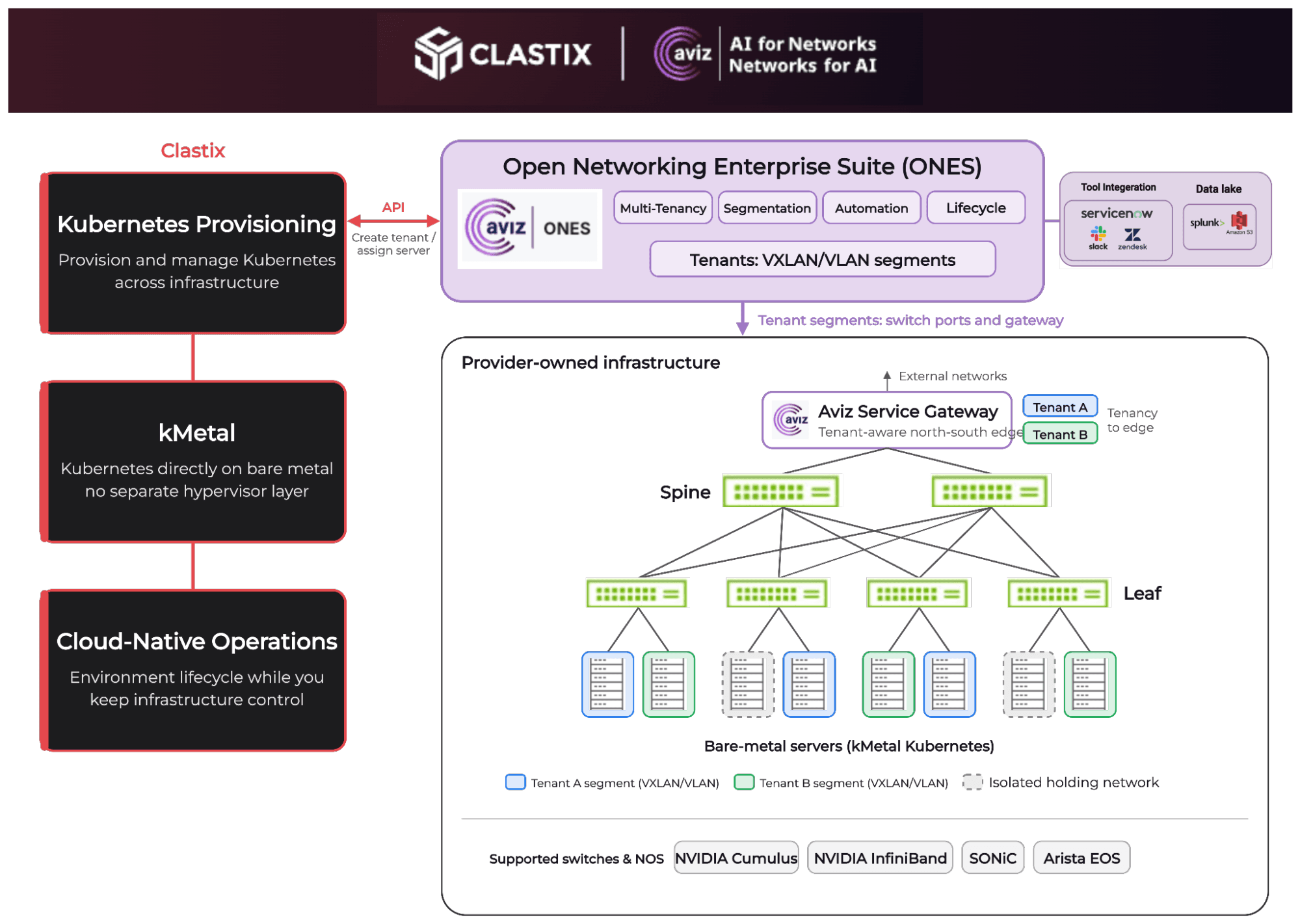
Figure 1: Aviz ONES + Clastix kMetal Joint Architecture: Kubernetes on Bare Metal, Isolated from Server to Switch to Gateway
What Each Partner Brings
Clastix kMetal Platform: Kubernetes infrastructure management
| Capability | Description |
|---|---|
| Kubernetes provisioning and management | Provision and manage Kubernetes environments across infrastructure, including bare-metal deployments. |
| kMetal | Clastix's platform for provisioning and managing Kubernetes directly on bare metal, with no separate hypervisor layer. |
| Cloud-native infrastructure operations | Support the Kubernetes environment lifecycle and cloud-native workloads while retaining control of the underlying infrastructure. |
Aviz AI Factory Portfolio: Network automation, connectivity and operations
| Product | Description |
|---|---|
| Aviz ONES | NVIDIA-certified network automation to bootstrap, orchestrate, and enable multi-tenancy across AI network fabrics, on SONiC, NVIDIA Cumulus Linux and InfiniBand, and Arista EOS. Integrated with kMetal. |
| Aviz Service Gateway (optional) | Software-defined tenant connectivity using BGP/EVPN, VRF/VXLAN, NAT, elastic IPs, and stateful L3/L4 policies. |
| AI Parser (optional) | Token-level visibility into inference usage, latency, and throughput by tenant and application. |
| AI NOC (optional) | Agentic AI operations with customizable SRE skills to support troubleshooting and operational workflows. |
How It Comes Together
The joint stack follows a tenant from the day the fabric is built to the day it is running in production.
Why It Matters for Operators
Use Cases
| Use case | Business challenge | Resulting value to customers |
|---|---|---|
| Moving AI workloads off the hypervisor | Teams want GPU workloads on Kubernetes without a virtualization layer, but rely on it today for tenant networking. | kMetal runs Kubernetes on bare metal, and Aviz ONES takes over tenant segmentation in the fabric, with Service Gateway as an option for edge connectivity. |
| Sovereign and private AI clouds | Operators must keep infrastructure, tenants, and operational data under their own control. | Kubernetes and the fabric run on owned infrastructure with no hyperscaler dependency. |
| Kubernetes as a Service for AI Cloud providers and telcos | External tenants expect their own Kubernetes environment with isolation and, often, public reachability. | kMetal delivers the tenant environment, and Aviz ONES isolates it in the fabric. Service Gateway can optionally publish it with elastic IPs and policy. |
| Enterprise inference platforms | Platform teams serve many internal applications and need to show who consumes inference capacity. | Adding AI Parser reports token usage and latency by team and application, on the same platform that runs the workloads. |