





Ransomware & Threat Visibility In Healthcare
How packet-derived evidence powers detection, response, and forensic defensibility for hospitals, payers, and life sciences organizations
Healthcare ransomware is winning because the visibility isn't there
Ransomware attacks against healthcare organizations more than doubled between 2023 and 2025. The Change Healthcare incident exposed PHI for 192.7 million individuals - nearly two-thirds of the U.S. population - through a single business associate compromise. Hospital systems across the U.S., U.K., Ireland, Australia, and continental Europe have all reported major incidents in the same period. The pattern is consistent, and the structural reasons behind it are no longer in dispute.
Modern healthcare networks span hospital data centers, branch clinics, ambulatory surgery centers, telehealth platforms, cloud-hosted EHRs, and a vast fleet of connected medical devices. Ransomware does not enter through the front door. It arrives via phishing, exposed remote access, compromised business associates, or unpatched edge systems and then it moves laterally, workload to workload, segment to segment, for hours or days before encryption begins. By the time endpoint tools detect the impact, the attacker has already moved through PHI-handling systems that the institution must report under the Breach Notification Rule.
The detection layer NDR, XDR, SIEM, and threat-hunting platforms knows how to identify these patterns. What they need is visibility into them. That visibility is structurally absent in most healthcare networks.
Where Aviz fits in the ransomware defense architecture
Aviz does not perform ransomware detection. Aviz produces the packet-derived evidence that NDR, XDR, SIEM, and threat-hunting platforms consume to detect ransomware, contain it, and reconstruct what happened. The Aviz Deep Network Observability pipeline - Aggregate, Optimize, Enrich, DPU-Native Acceleration, Distribute delivers two outputs that strengthen every layer of the ransomware defense stack:
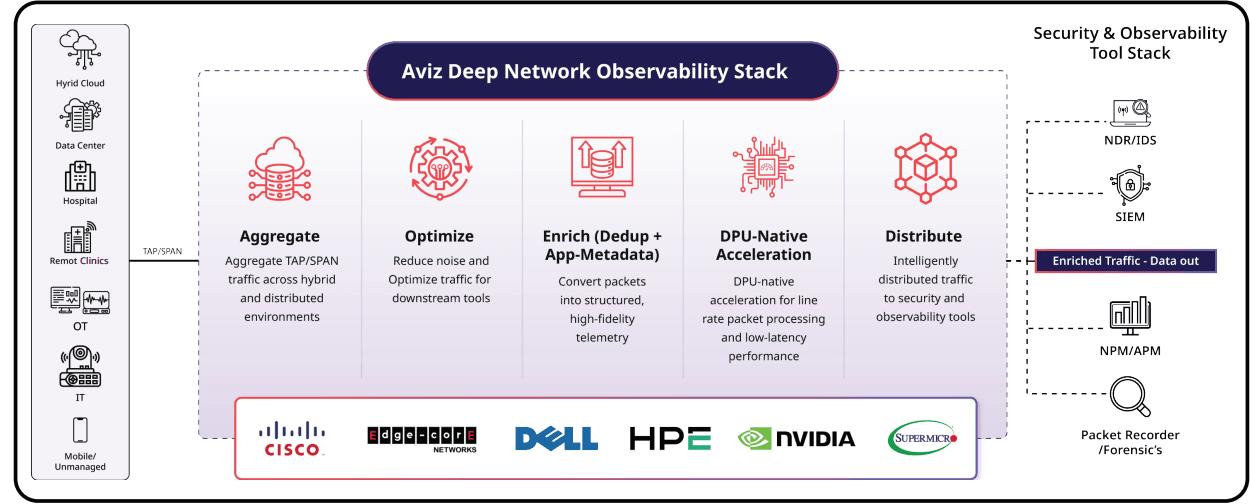
Optimized packet streams, delivered to NDR and threat-hunting platforms across hybrid cloud, on-premises, branch, and Kubernetes environments. The detection platforms get the East-West visibility that their analytics depend on, without the institution deploying agents on workloads that cannot accept them.
Enriched packet metadata, streamed in open formats (JSON, Kafka) into the SIEM, XDR, and forensic evidence store. Every flow, every TLS session, every DNS query, every HTTP transaction recorded with full context - timestamp, source, destination, protocol, application, bytes, headers captured out-of-band and immutable from the moment the session crosses the wire.
Where Aviz strengthens ransomware detection
1. Perimeter Initial Access and Command-and-Control
Modern ransomware does not arrive at the network perimeter as a recognizable threat. It arrives as a Word document, a phishing link, or an exploited remote service - and within minutes, the compromised host is talking to attacker infrastructure. The early communications are deliberately designed to blend in with legitimate web traffic: HTTP requests to public IPs, encrypted TLS handshakes, and DNS queries for innocuous-looking domains. The detection signals are not in any single packet. There are anomalies in the metadata.
Consider a real SSLoad infection chain documented by Palo Alto's Unit 42 team in April 2024 - the precursor loader used to deliver Cobalt Strike, which is the post-exploitation framework behind nearly every major healthcare ransomware incident in the past five years. The very first HTTP request from the compromised host carries five separate anomalies in its headers:
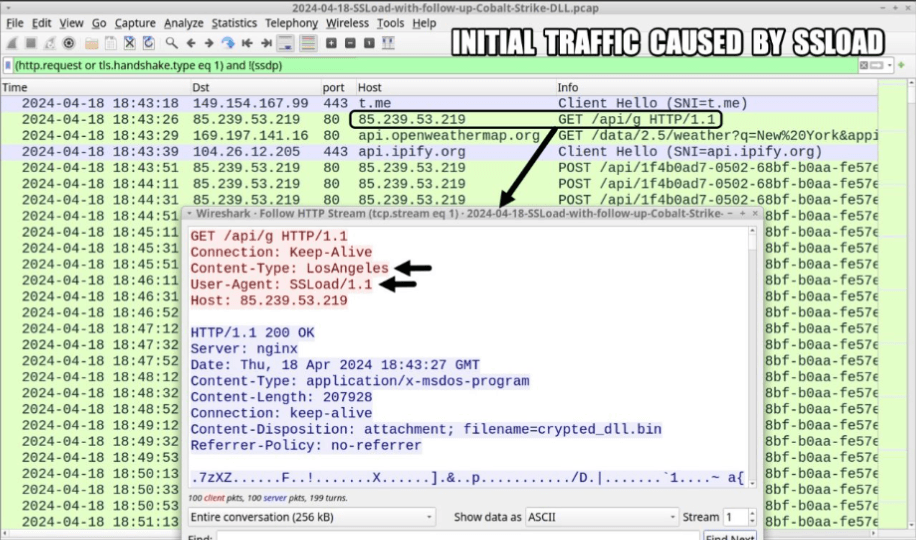
First SSLoad C2 callout captured at the network layer. The HTTP request to 85.239.53.219 carries five anomalies in a single packet - a raw-IP destination, the literal malware name in the User-Agent (SSLoad/1.1), an invalid Content-Type (LosAngeles), a meaningless URI (/api/g), and a low-reputation destination. Any one signal would justify investigation; together, they justify immediate incident response.
Aviz captures every HTTP header on every flow across the network including the User-Agent string, Content-Type, destination IP, URI path, and TLS handshake characteristics. The detection platform consuming Aviz metadata can fire a critical alert on the very first packet the malware sends, before any encryption or lateral movement has begun.
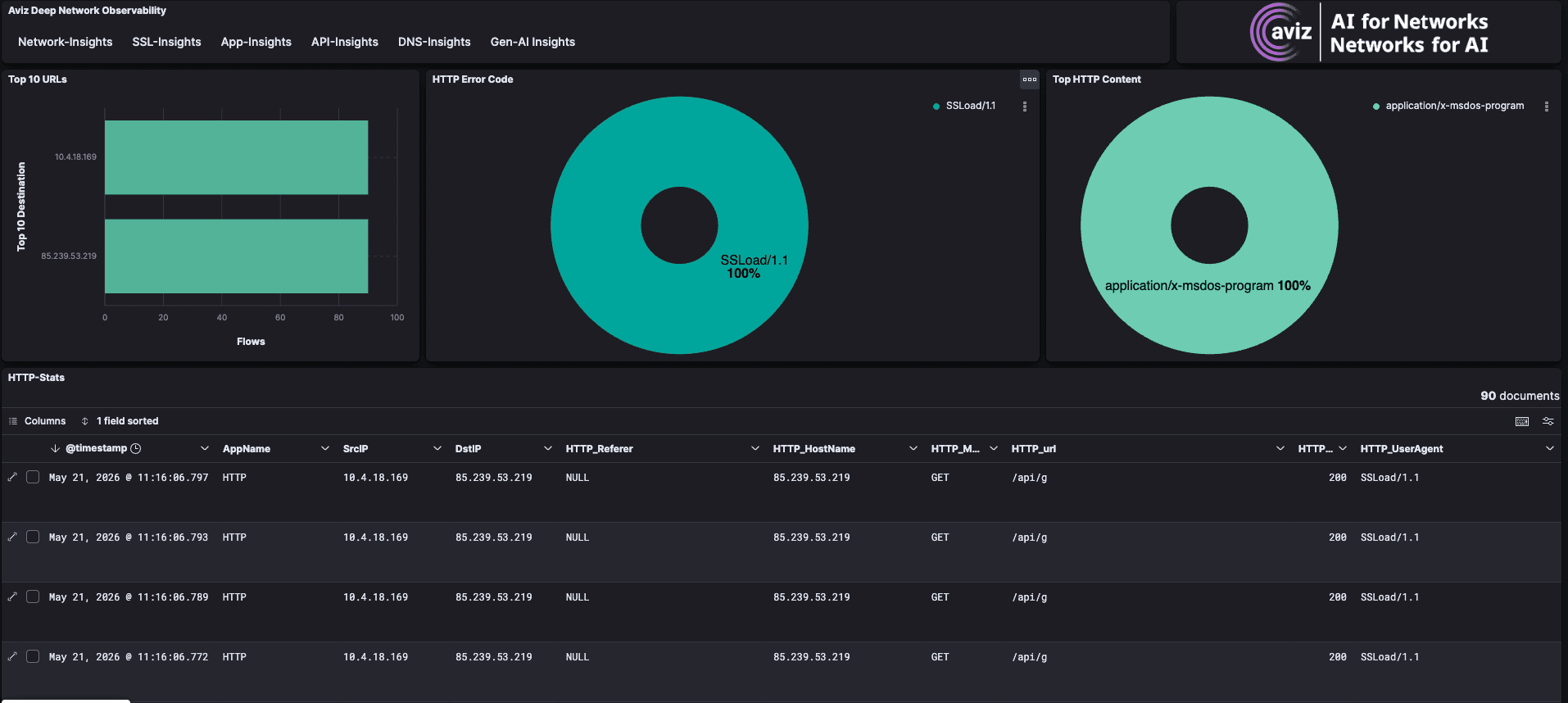
Aviz ELK dashboard surfacing untrusted User-Agent strings from packet-derived metadata. The dominant signal (SSLoad/1.1) is the malware identifying itself in plaintext - caught by a single negative-match detection rule running against Aviz-delivered network metadata.
Lateral East-West Movement After the Foothold
Lateral movement is where ransomware programs spend most of their dwell time, and where most detection programs fail. WAFs and perimeter firewalls see only North-South traffic. Endpoint agents see only the workloads they're installed on - and most clinical workloads, medical devices, and OT systems cannot accept agents. Application logs see only what the application chose to write.
Aviz captures every East-West flow across the entire environment - workload to workload, segment to segment, container to container, on-premises to cloud. The metadata streams continuously into NDR and threat-hunting platforms that perform the actual lateral-movement detection. Three patterns particularly matter in healthcare: outbound calls from clinical systems to unexpected internal destinations, anomalous access patterns from one PHI-handling system to another, and unusual flow rates against EHR or imaging systems.
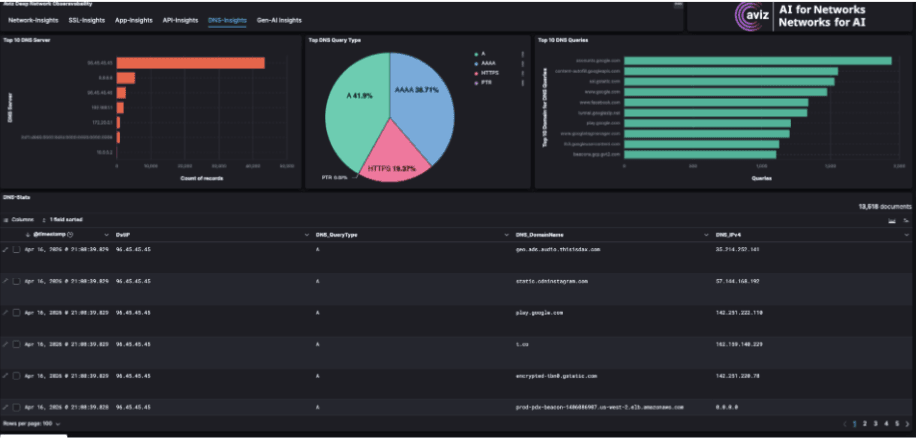
Aviz Network-Insights flow-level visibility across hospital IT and OT protocols (HL7, S7comm, Modbus). The dashboard surfaces lateral and East-West traffic patterns across clinical systems, medical devices, and facility OT, with every flow recorded for forensic and audit use.
Exfiltration Outbound Data Movement Before Encryption
Modern ransomware actors exfiltrate data before encrypting it. The exfiltration is the leverage. They want to be able to threaten public release of PHI, intellectual property, or sensitive operational data, even if the institution refuses to pay for decryption.
Outbound exfiltration is visible at the network layer - unusual data volumes to external destinations, traffic to newly seen domains, encrypted tunnels to consumer-grade cloud storage, and DNS tunneling patterns. The same SSLoad infection chain shows the second stage of an attack moments after the initial foothold: a malicious DLL delivered as Content-Type: application/x-msdos-program with the filename crypted_dll.bin, followed by a sustained beacon to the attacker's C2 every 60 seconds, then a Cobalt Strike DLL retrieved from a second C2 server GET /8080.dll from a completely different IP.
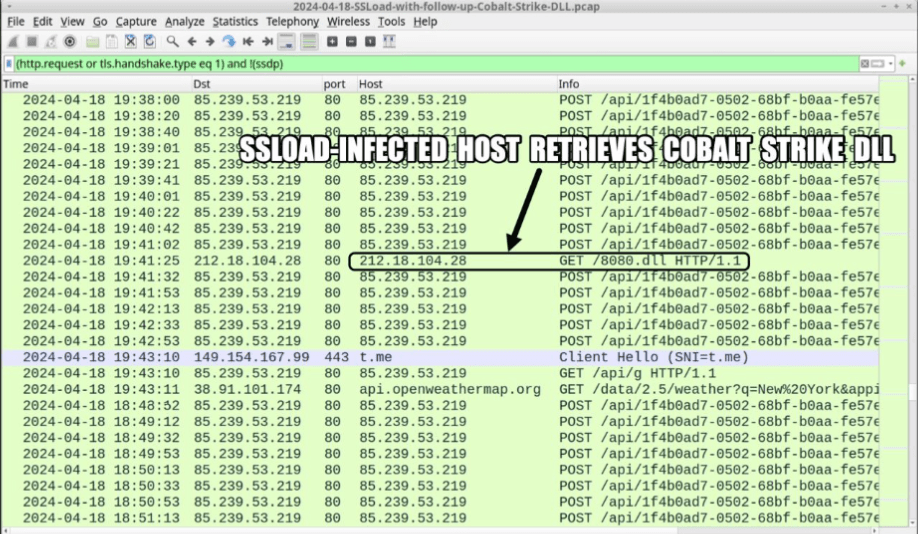
SSLoad-infected host retrieving the Cobalt Strike Beacon DLL from a second C2 server. The filename "8080.dll" is the Cobalt Strike convention the DLL is named after the Beacon's C2 port. From this point on, the operator has full interactive remote access to the compromised host.
Aviz produces continuous outbound flow metadata across managed and unmanaged devices, including BYOD on hospital Wi-Fi. The same evidence that supports HIPAA business associate oversight also surfaces the exfiltration patterns that signal pre-encryption ransomware activity.

Forensic Evidence That Survives the Compromise
When ransomware succeeds, the institution must produce forensic evidence: what happened, when, how, what data was touched, what the dwell time was, what lateral path the attacker used. The Breach Notification Rule's 60-day reporting window depends on this reconstruction. OCR investigations probe the provenance of the evidence increasingly aggressively.
The problem most incident-response teams know but rarely say out loud: the systems compromised are also the systems whose logs become unreliable. Application logs can be modified. Endpoint agents can be disabled. Audit trails on a compromised workload cannot be defended in regulatory proceedings.
Aviz produces packet-derived forensic evidence captured out-of-band independent of any workload, immutable from the moment the session crosses the wire, continuously streamed to the SIEM and forensic evidence store. When an incident occurs, the IR team cannot reconstruct from compromised logs. They are querying an independent, tamper-resistant evidence layer captured at the network. Available for the 60-day Breach Notification window and beyond, structured for export, defensible in any OCR investigation or counsel proceeding.
What this means for your ransomware defense program
NDR, XDR, SIEM, and threat-hunting platforms are the right answer for detection, response, and containment. They are not the right answer for the visibility foundation those platforms run on - that visibility either exists or it doesn't, and most healthcare networks today are operating with structural blind spots in the East-West and connected-device layers where ransomware actually moves.
A ransomware defense program that pairs Aviz Deep Network Observability with its detection and response platforms gets:
East-West and lateral movement visibility
across hybrid cloud, on-premises, branch, and Kubernetes including workloads and devices that cannot host agents
Outbound flow evidence
that surfaces exfiltration patterns before encryption begins
DNS, TLS, and HTTP metadata
are continuously streamed to detection platforms
Forensic-quality packet evidence
captured out-of-band, immutable, and defensible in OCR proceedings
Hybrid and cloud consistency
so the detection layer does not break at the cloud or container boundary
One traffic foundation
feeds detection, response, and forensic reconstruction simultaneously