





noindex
The Challenge
ChallengeAI infrastructure risk is increasingly integration-driven. Multi-vendor stacks evolve faster than validation cycles, while organizations demand open architectures with predictable outcomes.
Where It Breaks
AI factories don't fail because one component is "bad." They fail when the full stack doesn't operate as one system at scale.
An AI factory is a full stack
- GPU Compute
- Switching
- Storage
- DPU / NIC
- Network OS
- Orchestration
Business Impact
AI initiatives stall not because of models — but because infrastructure can't operate reliably at scale.
- Many AI POCs never reach production
- Integration and operational readiness are the primary blockers
- Delays and rework increase cost and reduce confidence
The Cost of Finding Issues Late
Most failures show up after time and money are already committed.
During proof-of-concept
Integration gaps surface when components first meet real workloads.
During early production
Reliability, scaling, and operations expose hidden dependencies.
After infrastructure spend is locked in
Fixes become rework — slowing rollout and increasing cost.
Impact for GPU Cloud Providers & Neo-Clouds
Why Aviz AI Factory Center
Aviz AI Factory Center shifts validation left — before deployment. Instead of discovering issues after rollout, organizations can validate full-stack designs upfront in a neutral environment.
Outputs include
- Production-Ready Reference Architectures
- Deployment Configuration Packages
- Validation Evidence
- Operational Guidance
Sales, platform, and engineering teams can use these artifacts directly.

Overview
Network packet capture and analysis is very crucial for any enterprise network. The use cases of network visibility range from inferring insights about the kind of traffic entering to the network to intrusion detection and understanding internal load-sharing behavior and performance. Each company usually has its own enterprise network solution it employs to leverage visibility into its networks. Existing solutions like cPacket, Gigamon, etc. are much sought out and used. However, they come with the drawbacks of high CapEx and OpEx costs, scalability issues, and often limited support and assistance attributed to the nature of vendor lock-in.
Build A Multi-Tenant NVIDIA AI Factory That Stays Deterministic As You Scale
Deploy faster, operate simply, and validate changes safely with Aviz across NVIDIA AI Factory networking and operations. Get the operational software layer that transforms NVIDIA's powerful infrastructure into a production-ready, multi-tenant AI factory.

Multi-Tenant Orchestration
Policy guardrails across AI factory networks
DPU-Accelerated Intelligence
Clean, actionable telemetry and observability
GPU-Powered AI Platform
Next-generation network operations
The outcome:
an operational model where fabric, orchestration, and consumption work in concert, enabling enterprises to scale AI confidently and profitably.
The outcome:
an operational model where fabric, orchestration, and consumption work in concert, enabling enterprises to scale AI confidently and profitably.
The outcome:
an operational model where fabric, orchestration, and consumption work in concert, enabling enterprises to scale AI confidently and profitably.
The outcome:
an operational model where fabric, orchestration, and consumption work in concert, enabling enterprises to scale AI confidently and profitably.
The outcome:
an operational model where fabric, orchestration, and consumption work in concert, enabling enterprises to scale AI confidently and profitably.
The outcome:
an operational model where fabric, orchestration, and consumption work in concert, enabling enterprises to scale AI confidently and profitably.
Integrated Operations
From Disparate Components to a Service Fabric
Enterprises no longer need to choose between control and speed. By combining Aviz, NVIDIA, and Rafay capabilities, platform teams can deliver AI services with both.
AI Factory Orchestration as a Service
An AI factory is a full stack
- GPU Compute
- Switching
- Storage
- DPU / NIC
- Network OS
- Orchestration
Deterministic AI Performance
- GPU-Aware Traffic Engineering Across Spectrum-X Ethernet Fabrics
- Segmented East-West Networking For Predictable Performance
- Optimized Paths For Large-Scale Training And Inference Workloads
AI Factory Orchestration as a Service
AI initiatives stall not because of models—but because infrastructure can't operate reliably at scale.
An AI factory is a full stack
- GPU Compute
- Switching
- Storage
- DPU / NIC
- Network OS
- Orchestration
Deterministic AI Performance
AI initiatives stall not because of models—but because infrastructure can't operate reliably at scale.
- GPU-Aware Traffic Engineering Across Spectrum-X Ethernet Fabrics
- Segmented East-West Networking For Predictable Performance
- Optimized Paths For Large-Scale Training And Inference Workloads
Why Financial Networks Need A New Approach
Your team spends too much time on repetitive work agents can handle. Every hour of toil is an hour not spent on innovation or problems that require real expertise.
Why Financial Networks Need A New Approach
Your team spends too much time on repetitive work agents can handle. Every hour of toil is an hour not spent on innovation or problems that require real expertise.
Why Financial Networks Need A New Approach
Your team spends too much time on repetitive work agents can handle. Every hour of toil is an hour not spent on innovation or problems that require real expertise.
The Aviz Advantage
Unified Network Fabric (SONiC + ONES)
-
Orchestrate and monitor multi-vendor SONiC networks across data centers and branches.
-
Scale from 10G to 400G — save up to 50% TCO.
Deep Observability (PacketBroker + Service Nodes)
-
Achieve packet-, session-, and app-level visibility across core, branches, and cloud.
-
Detect anomalies, verify SLAs, and ensure transaction integrity.
NVIDIA Spectrum-X Ethernet and SuperNICs: Performance by Design
NVIDIA Spectrum-X Ethernet provides the deterministic, lossless foundation for large-scale AI training and inference.
Optimized for AI
RoCEv2 transport ensures congestion-free throughput across thousands of GPUs.
Self-Service AI Environments
Linear expansion from rack-level to AI factory scale.
In-Band Telemetry
Delivers adaptive routing and in-band telemetry for consistent performance.

Figure 1: Unified Fabric-to-Cloud Architecture: Integrating Aviz ONES, NVIDIA Spectrum-X, and Rafay for Operational AI at Scale
Figure 1: Unified Fabric-to-Cloud Architecture: Integrating Aviz ONES, NVIDIA Spectrum-X, and Rafay for Operational AI at Scale
Figure 1: Unified Fabric-to-Cloud Architecture: Integrating Aviz ONES, NVIDIA Spectrum-X, and Rafay for Operational AI at Scale
Figure 1: Aviz ONES and PaletteAI Spectro cloud integration
Introducing Aviz Service Nodes
Aviz Service Nodes (ASN) revolutionizes Network Observability with advanced filtering, deduplication, and intelligent traffic distribution. It integrates high-performance packet processing, deep packet inspection, and seamless packet capture to enhance visibility and security. Aviz Service Nodes delivers business relevant performance insights through real-time traffic analysis, correlation of network, application, and subscriber data, and generates KPI updates via Kafka.
Aviz ONES Feature Comparison
A comprehensive comparison of key capabilities across different deployment models and use cases for enterprise network visibility solutions.
| Use Case | What It Enables | Business Impact |
|---|---|---|
| Network TAP Aggregation | Consolidate traffic from multiple TAP points | Reduce monitoring tool costs by 60% |
| Packet Deduplication | Remove duplicate packets in real-time | Improve analysis accuracy and reduce storage |
| Load Balancing | Distribute traffic across monitoring tools | Maximize tool utilization and throughput |
| Header Stripping | Remove tunnel headers (VXLAN, GRE, MPLS) | Enable legacy tools to process encapsulated traffic |
| Timestamping | Add nanosecond-precision timestamps | Accurate latency measurement across network hops |
| Packet Slicing | Truncate packets to header-only | Reduce bandwidth to monitoring tools by 80% |
Key Benefits of AI-Driven Networking
Unified Visibility
End-to-end network visibility across multi-vendor environments with real-time telemetry and AI-powered analytics.
Automated Remediation
AI-driven root cause analysis and automated remediation reduce mean time to resolution by up to 80%.
Vendor Agnostic
Works with any hardware vendor, any NOS, and any cloud — eliminating lock-in and maximizing choice.
Cost Optimization
Reduce total cost of ownership by 40-60% compared to proprietary networking solutions.
Enterprise-Grade Security
Built-in zero-trust security framework with continuous compliance monitoring and threat detection.
Why Open Networking Wins
Freedom of Choice
Select the best hardware, software, and cloud for each use case without vendor constraints.
Faster Innovation
Open-source ecosystems move faster than proprietary stacks — adopt new capabilities in weeks, not years.
Operational Simplicity
Single pane of glass management across heterogeneous environments reduces operational complexity.
Scalable Architecture
Scale from 10 to 10,000 switches with the same tooling and operational model.
Community Driven
Backed by a global community of contributors and supported by enterprise-grade SLAs.
The Aviz Advantage
AI-First Approach
Purpose-built AI models trained on network telemetry for predictive analytics and autonomous operations.
SONiC Expertise
Deep expertise in SONiC NOS with enterprise-grade tooling, management, and 24/7 support.
Rapid Deployment
Go from evaluation to production in weeks with proven deployment playbooks and automation.
Data-Centric Stack
Full-stack observability from ASIC counters to application metrics — all in one platform.
Partner Ecosystem
Pre-validated integrations with leading hardware vendors, cloud providers, and security tools.
Build Your Own Network Agent
Create custom AI agents that monitor, analyze, and optimize your network infrastructure in real-time. Our SDK provides everything you need to get started.
pip install aviz-ncp-sdk
ncp authenticate --key YOUR_API_KEY
ncp deploy my-network-agent --env production
Deploy agents across your entire infrastructure with a single command. Supports multi-vendor environments out of the box.
Get Started
Network Copilot for Intelligent Operations
AI-powered assistant that understands your network topology, predicts issues before they occur, and provides actionable recommendations.
$ ncp query "show all switches with high CPU"
Found 3 switches above 80% threshold:
  → leaf-01 (92%) — BGP reconvergence
  → spine-02 (85%) — telemetry burst
  → leaf-14 (81%) — normal peak
Natural language queries across your entire network infrastructure. Get answers in seconds, not hours.
Book a Demo
AI Networking Unpacked
A complete data-centric stack that is vendor agnostic and supports multiple ASICs, switches, NOS, clouds, LLMs, and integrates seamlessly with AI and security applications.
Supported Platforms:
  SONiC · NVIDIA · Broadcom · Marvell
  AWS · Azure · GCP · On-Premise
  Multi-vendor · Multi-cloud · Multi-ASIC
Designed for open-source networking and works with existing network infrastructures, ensuring a seamless transition.
Learn More
What You Get with Aviz on NVIDIA AI Factory
Deploy a repeatable architecture, operate it simply, and evolve it safely.
Always Free
Up to 8 switches free tier.
Free Trial - 1 Month Full Access
Try ONES with no commitments. Download now for a 1-month trial, supporting up to 1024 switches with full functionality.
Enterprise Demo at ONE Center - Experience SONiC in Action
Discover the real-world potential of SONiC in our state-of-the-art lab. Available both online and in-person.
Talk to an Expert
Need help or have specific questions? Get in touch with our experts for tailored guidance.
Why Choose Open Networking
Future-proof your infrastructure with vendor-agnostic, AI-ready networking solutions.
Maximum Flexibility
Choose the best hardware, NOS, and cloud for each use case without vendor constraints.
40-60% Cost Savings
Dramatically reduce TCO compared to proprietary alternatives while maintaining enterprise-grade reliability.
AI-Ready Infrastructure
Purpose-built for AI workloads with optimized traffic engineering, RDMA, and GPU-aware networking.
Enterprise Support
24/7 expert support with guaranteed SLAs, proactive monitoring, and dedicated success managers.
Built for Modern Data Centers
Scale your network infrastructure with confidence using proven open-source technologies.
Scale Without Limits
From 10 to 10,000 switches — same tooling, same operational model, same reliability.
Complete Visibility
End-to-end network observability with real-time telemetry, flow analytics, and AI-powered insights.
Day-2 Automation
Automated configuration management, compliance checks, and self-healing network operations.
Zero-Trust Security
Built-in micro-segmentation, continuous compliance, and threat detection across the network fabric.
Why Open Networking Matters for AI Infrastructure
The shift to AI-driven workloads demands a fundamental rethink of network architecture, moving from proprietary silos to open, programmable infrastructure.
Key Benefits
Open networking enables organizations to build scalable, cost-effective infrastructure that adapts to AI workload requirements without vendor lock-in.
- Vendor Independence — Choose best-of-breed hardware and software components independently
- Cost Optimization — Reduce TCO by 40-60% compared to proprietary alternatives
- Faster Innovation — Deploy new capabilities without waiting for vendor release cycles
- Community-Driven — Benefit from contributions across the global SONiC ecosystem
- AI-Ready — Purpose-built for the traffic patterns and bandwidth demands of AI/ML workloads
Organizations that adopt open networking today position themselves for the next decade of infrastructure evolution.
Network Visibility at Scale
Complete observability across multi-vendor, multi-cloud environments with real-time telemetry and AI-powered analytics.
FlowVision provides deep packet-level visibility without requiring TAPs, SPANs, or packet brokers. It runs natively on network switches using SONiC.
What You Get
- Real-time traffic flow analysis across all switch ports
- AI-driven anomaly detection for security threats
- Automated compliance reporting and audit trails
- Integration with existing SIEM and monitoring tools
Deploy in minutes, not months. No additional hardware required.
Enterprise-Grade Support for Open Source
Get the flexibility of open source with the reliability and support of a commercial platform.
Aviz provides 24/7 enterprise support, certified releases, and professional services for SONiC deployments at any scale.
- Certified Releases — Tested and validated across 50+ switch platforms
- 24/7 TAC Support — Expert assistance from SONiC core contributors
- Migration Services — Seamless transition from legacy networking
Join hundreds of enterprises already running mission-critical workloads on Aviz-certified SONiC.
What's Included in Aviz ASN
A complete software stack for next-generation network observability — built on open standards and engineered for AI-era workloads.

Multi-Vendor Fabric with Deterministic Performance
- Works across all major switch ASICs
- Lossless RoCE for AI training workloads
- Sub-microsecond latency at line rate

Hardware Accelerated Packet Intelligence
- Line-rate deep packet inspection
- NVIDIA BlueField-3 DPU offload
- Real-time flow analytics
Network Copilot for AI-Driven Ops
- Natural language troubleshooting
- Automated root cause analysis
- Predictive failure detection

Open Networking and Programmable Observability
- SONiC native integration
- RESTful APIs for automation
- Multi-cloud telemetry export
Built for Enterprise AI Networks
Every component engineered to deliver visibility, performance, and control across your entire network stack.
Multi-Vendor Fabric Support
- Broadcom Tomahawk and Trident ASICs
- NVIDIA Spectrum-X integration
- Cisco Silicon One compatible
Hardware-Accelerated Inspection
- Zero-CPU packet processing
- Deep flow tracking at scale
- Inline encryption visibility
AI-Driven Network Operations
- Network Copilot natural language
- Anomaly detection and alerts
- Automated incident response
Open and Programmable Stack
- SONiC NOS foundation
- P4 programmable pipeline
- OpenConfig telemetry
The Aviz Advantage
Four pillars that make Aviz the only choice for AI-era network infrastructure.
True Multi-Vendor Freedom
- Run any switch from any vendor
- Single management plane
- Up to 60% cost savings
Full-Stack Networking in One Platform
- Networking, observability, and AI
- Unified across all environments
- Zero vendor lock-in
SONiC Leadership
- Top contributors to community
- Production-grade builds
- Direct upstream bug fixes
AI-Native by Design
- Built post-LLM revolution
- Private AI for your network
- Bring your own automation
Orderability
All Aviz DNO Products Are Offered As A Software Subscription Per Device/Instance, With Flexible Term Options.
Toil Reduction
Single Service Node processing capacity with modern NICs delivers up to 10x throughput improvement.
Faster Analysis
Comprehensive app library covering enterprise, consumer, and IoT traffic patterns.
Continuous Monitoring
Granular classification for precise policy enforcement across multi-cloud environments.
Deployment Models
Flexible deployment options to match your infrastructure strategy and operational preferences.
On-Premises
Full control with hardware-accelerated performance for regulated industries and edge deployments.
Hybrid Cloud
Unified visibility spanning data centers, branch offices, and public cloud workloads.
Public Cloud
Native AWS, Azure, and GCP integration with auto-scaling and pay-as-you-go billing.
Customer Outcomes
Real results from production deployments across Fortune 500 enterprises and hyperscale operators.
60% Cost Reduction
Average TCO savings versus proprietary alternatives across 3-year deployment cycles.
10x Faster MTTR
Reduce mean time to resolution with AI-powered root cause analysis and automated remediation.
Zero Outages
Production deployments running continuously for years without service-impacting incidents.
Performance Benchmarks
Reference performance depends on deployment profile and available infrastructure resources.
Workload Smoke Test
Lightweight container-based training, minimal inference sanity, storage read/write path included. Telemetry captured across ports/queues + RoCE signals + GPU/host health.
Reporting Outputs
Validation dashboards, failure digests, compatibility updates, and ecosystem reports.
Workload Smoke Test
Lightweight container-based training, minimal inference sanity, storage read/write path included. Telemetry captured across ports/queues + RoCE signals + GPU/host health.
Validation Methodology
Rigorous testing across multiple workload profiles ensures consistent performance in production.
Synthetic Benchmarks
Industry-standard tests for throughput, latency, and packet loss across all supported configurations.
Real Workload Validation
Production traffic replay with full telemetry capture across all network paths and storage layers.
Long-Running Stability
72-hour soak tests under variable load to validate steady-state performance and resource utilization.
Three Steps to Production
From initial proof-of-concept to full production deployment in weeks, not months.
Discovery and Design
Architecture review, requirements gathering, and reference design selection with our solutions team.
Pilot Deployment
Lab validation, integration testing, and production rehearsal with full performance benchmarking.
Production Rollout
Staged deployment with white-glove support, training, and runbook handoff to your operations team.
Technical Specifications
Controllers
- Cisco Nexus Dashboard
- Catalyst Center · Arista
- Dell-EMC SONiC · ONES
Monitoring
- Cisco Nexus Dashboard
- Catalyst Center · Arista
- Dell-EMC SONiC · ONES
ITSM
- Cisco Nexus Dashboard
- Catalyst Center · Arista
- Dell-EMC SONiC · ONES
Security
- Cisco Nexus Dashboard
- Catalyst Center · Arista
- Dell-EMC SONiC · ONES
Knowledge Base
- DOCX
- TXT
- Markdown
- CSV
- XLSX
Integration Catalog
Compute
- NVIDIA DGX
- HPE Apollo
- Dell PowerEdge
Storage
- VAST Data
- Pure Storage
- NetApp ONTAP
Orchestration
- Kubernetes
- Rafay Systems
- Spectro Cloud
Security
- Armis
- Forescout
- Nozomi Networks
Supported Platforms
Switches
- Broadcom Tomahawk
- NVIDIA Spectrum-X
- Cisco Silicon One
NICs and DPUs
- NVIDIA BlueField-3
- Intel IPU
- AMD Pensando
NOS
- Community SONiC
- Broadcom Enterprise
- NVIDIA Cumulus
Cloud
- AWS
- Microsoft Azure
- Google Cloud
Overview
Network Packet Brokers have long been a foundational component of enterprise and service provider infrastructures. However, traditional solutions are appliance-based, proprietary, and costly — limiting flexibility and scalability in modern environments.
With the rise of application-driven networking, overlay architectures (VXLAN, GRE), and high-speed data flows across data centers, cloud, and edge environments, organizations require a more agile and cost-effective approach to network visibility.
Aviz Packet Broker (APB) is a software-defined packet broker built on SONiC, designed to run on industry-standard white box switches. It transforms standard switching hardware into a high-performance network visibility and traffic distribution platform — delivering enhanced overlay visibility, intelligent traffic distribution, and FIPS-aligned security while eliminating vendor lock-in.
Overview
Network Packet Brokers have long been a foundational component of enterprise and service provider infrastructures. However, traditional solutions are appliance-based, proprietary, and costly.
With the rise of application-driven networking, overlay architectures, and high-speed data flows, organizations require a more agile and cost-effective approach.
Aviz Packet Broker (APB) is a software-defined packet broker built on SONiC, designed to run on industry-standard white box switches. It transforms standard switching hardware into a high-performance network visibility platform.
Overview
Network Packet Brokers have long been a foundational component of enterprise infrastructures. Traditional solutions are appliance-based and costly — limiting flexibility in modern environments.
Aviz Packet Broker is a software-defined packet broker built on SONiC, designed to run on industry-standard white box switches with FIPS-aligned security and zero vendor lock-in.
Aviz APB Solution
- Aviz APB delivers high-performance network visibility
- Supports overlay architectures including VXLAN and GRE
- Eliminates vendor lock-in with open SONiC foundation
- FIPS-aligned security for regulated industries
- Up to 60% cost savings vs proprietary appliances
Network Visibility at Scale
- Real-time packet inspection across all switch ports
- AI-driven anomaly detection and threat alerts
- Hardware-accelerated DPI without CPU overhead
- Multi-cloud telemetry export
Network Copilot for AI Operations
- Natural language troubleshooting
- Automated root cause analysis
- Predictive failure detection
- Bring your own LLM
Key Capabilities
Traffic Aggregation
Consolidate TAP, SPAN, and virtual traffic sources. Unified visibility across hybrid and distributed environments.
Advanced Traffic Filtering
Layer 2-Layer 4 filtering. User-defined and header-based filtering with line-rate performance.
Severity Level 2
Operation of an existing network or environment is severely degraded. Aviz commits full-time resources to restore service.
Severity Level 3
Operational performance impaired but business operations functional. Standard business hours support to restore service.
Standard Business Hours
9:00 AM to 5:00 PM local time on Business Days. Excludes local holidays observed by Aviz.
SONiC Expertise
Aviz has accumulated 1000+ person-months of hands-on SONiC experience. Most experienced independent SONiC support provider.
Performance Benchmarks
Throughput
Up to 100Gbps per node with hardware acceleration enabled.
Latency
Sub-microsecond latency at line rate across all ports.
Scale
Support for 10,000+ switches in a single management plane.
Reliability
99.999% uptime in production deployments worldwide.
Efficiency
40-60% TCO reduction vs proprietary alternatives.
Support
24/7 enterprise TAC with sub-15-minute response time.
Six Pillars of Excellence
Open Standards
Built on community SONiC with full upstream contribution.
Vendor Neutral
Run any switch from any vendor in a single fabric.
AI-Native
Built post-LLM era with private AI for your network.
Production Ready
Hardened in Fortune 500 deployments at hyperscale.
Secure
FIPS-aligned with end-to-end encryption support.
Cost-Effective
Up to 60% lower TCO vs proprietary solutions.
Cloud & Virtual Deployment (vASN)
vASN ensures consistent packet intelligence across:
- Segments tenants across network, GPU, and DPU resources
- Aligns workload placement with fabric topology
- Supports public, private, and hybrid cloud environments
- Integrates natively with Kubernetes and OpenStack
ASN extends into cloud environments through Virtual ASN (vASN), enabling:
- Segments tenants across network, GPU, and DPU resources
- Aligns workload placement with fabric topology
- Real-time telemetry from any cloud workload
- Unified policy enforcement across edge and core
Hardware Acceleration with DPU
Achieve More Strategic Benefits:
- Strengthen PCI-DSS and regulatory compliance
- Ensure data sovereignty and privacy
- Enable private AI operations
- Future-proof with open networking
- Accelerate digital innovation
Achieve More Strategic Benefits:
- Strengthen PCI-DSS and regulatory compliance
- Ensure data sovereignty and privacy
- Enable private AI operations
- Future-proof with open networking
- Accelerate digital innovation
On-Prem vs Cloud Deployment
On-Prem Advantages:
- Full control over data and compliance
- Hardware-accelerated performance
- Zero data egress costs
- Air-gapped deployment support
Cloud Advantages:
- Auto-scaling and pay-as-you-go billing
- Native AWS, Azure, GCP integration
- Zero infrastructure management
- Global multi-region deployment
Deployment Flexibility
ASN can be deployed as:
Physical ASN (Bare Metal)
- High-Throughput Environments
- Data Centers and Telecom Networks
Virtual ASN (vASN)
- High-Throughput Environments
- Data Centers and Telecom Networks
Use Cases
Enterprise & Data Center
- Application-aware traffic monitoring
- Tool optimization and cost reduction
- East-west visibility
Telecom (4G/5G)
- Subscriber-aware analytics
- GTP correlation
- Network performance monitoring
Cloud Providers
- Multi-tenant traffic isolation
- VPC flow analysis
- SLA compliance reporting
Security Operations
- SIEM data enrichment
- Lateral movement detection
- Forensic packet capture
Deployment Flexibility
ASN can be deployed as:
Physical ASN (Bare Metal)
- High-Throughput Environments
- Data Centers and Telecom Networks
Virtual ASN (vASN)
- High-Throughput Environments
- Data Centers and Telecom Networks
Use Cases
Enterprise & Data Center
- Application-aware traffic monitoring
- East-west visibility
Telecom (4G/5G)
- Subscriber-aware analytics
- GTP correlation
Cloud Providers
- VPC flow analysis
- SLA reporting
Security Ops
- SIEM enrichment
- Forensic capture
Use cases
Industry Use Cases
Customer Outcomes
The Real Cost of Your Options
| Use Case | What it Enables | What it Enables |
|---|---|---|
| Enterprise AI Platforms | Standardized multi-tenant AI clusters with governance. | Standardized multi-tenant AI clusters with governance. |
| AI Factory Deployments | High-density GPU environments with deterministic networking. | High-density GPU environments with deterministic networking. |
| GPU Platform-as-a-Service | Isolated AI environments with performance guarantees. | Isolated AI environments with performance guarantees. |
| Neo Cloud Providers | Catalog-driven AI infrastructure services. | Catalog-driven AI infrastructure services. |
Feature Comparison
| Feature | Aviz APB | Legacy Vendors |
|---|---|---|
| Hardware Independence | Any white box switch | Proprietary appliances only |
| Pricing Model | Software subscription | Hardware + software bundle |
| Open Standards | SONiC native | Closed source |
| TCO Reduction | 40-60% | Baseline |
Key Capabilities
Figure: Aviz Packet Broker (APB) Software Stack Transforming White Box Switches into a Packet Broker
Controllers
- Cisco Nexus Dashboard
- Catalyst Center · Arista
- Dell-EMC SONiC · ONES
Monitoring
- Cisco Nexus Dashboard
- Catalyst Center · Arista
- Dell-EMC SONiC · ONES
ITSM
- Cisco Nexus Dashboard
- Catalyst Center · Arista
- Dell-EMC SONiC · ONES
Security
- Cisco Nexus Dashboard
- Catalyst Center · Arista
- Dell-EMC SONiC · ONES
Outcome
High costs, slow innovation, and compliance risk in an era that demands agility and automation.
Platform Support
Aviz is the partner of choice for the largest network OEMs and silicon vendors.


The Real Cost of Your Options
| Use Case | What it Enables | Strategic Outcome |
|---|---|---|
| Enterprise AI Platforms | Standardized multi-tenant AI clusters with governance. | Faster compliance and audit readiness. |
| AI Factory Deployments | High-density GPU environments with deterministic networking. | Predictable AI training performance. |
| GPU Platform-as-a-Service | Isolated AI environments with performance guarantees. | Self-service GPU consumption. |
| Neo Cloud Providers | Catalog-driven AI infrastructure services. | Faster time-to-revenue. |
Compare Deployment Tiers
| Tier | Coverage | Response Time |
|---|---|---|
| Enterprise | 24/7/365 global TAC | 15 minutes |
| Standard | Business hours regional | 1 hour |
| Community | Self-service via portal | Best-effort |
| Custom | Negotiated SLA | Per contract |
SLA Tiers
| Severity | Response Time | Coverage |
|---|---|---|
| Severity 1 (Critical) | 15 minutes | 24/7/365 |
| Severity 2 (High) | 1 hour | 24/7/365 |
| Severity 3 (Medium) | 4 hours | Business hours |
| Severity 4 (Low) | 1 business day | Business hours |
ONES Supportability Stack In Action
Observability for Spectrum(TM)-X
- Support For NVIDIA Spectrum(TM)-X With The Latest NOS
- Enhanced GPU And AI Workload Visibility
- Deep Switch-Level Telemetry And Performance Insights
Observability Comprehensive multi-layer visibility:
- Inventory: System, PSU, Fan, SSD
- Control Plane: BGP, LACP, MC-LAG, VXLAN
- Data Plane: ASIC-Level Insights
- Software: NOS, Linux, Firmware
- Links: Ports, Optics, Status
- Traffic: Utilization, Errors, Packet Stats
- AI Fabric: QoS, PFC, Queue Utilization
- Storage: SSD Health, Wear, Failure Indicators
- Cloud Integration: Splunk, AWS S3 Includes Real-Time Streaming Telemetry (GNMI) And Time-Series Analytics.
Orchestration Intent-driven orchestration across:
- IP Clos, L2 Leaf-Spine
- EVPN-VXLAN, EVPN Multihoming
- AI Fabric Deployments
- Configuration Generation, Validation, Apply, And Diff
- API-Driven Day-2 Operations
- Configuration Editor, Comparison, And Change Execution
- Incremental Updates Across Fabrics — Zero-Touch Bootstrapping (Day-0) For Automated Onboarding With ZTP, NOS Installation, And Provisioning.
AI Infrastructure Orchestration
- Fine-Grained GPU Allocation (Per GPU)
- Multi-Tenant Compute Sharing On The Same Server
- Strict Tenant Isolation
Improves GPU Utilization And Supports Scalable AI Workloads.
Programmable Networking
API-driven connectivity across fabrics:
- Front-end to storage integration
- Tenant segmentation using VXLAN or VLAN + VRF
- Controlled route propagation
Designed for dynamic, AI-driven environments.
Observability - AI Assistant (BETA)
Chat-based interface for instant access to:
- Network health
- Inventory data
- Operational insights
Support
- Anomaly detection and alerting
- Logs, diagnostics, and lifecycle support
- Integration with Slack, Zendesk
- Interface flap history visibility
- Controller and container-level monitoring
- Proactive incident response workflows
Deployment Models
ASN supports both physical and virtual deployment options to deliver scalable packet intelligence across data center, telco, edge, and cloud environments.
Infrastructure Layer — Aviz ONES
Creates the deterministic AI fabric:- Segments tenants across network, GPU, and DPU resources
- Aligns workload placement with fabric topology
- Enforces QoS and congestion control end-to-end
Platform Layer — Spectro Cloud PaletteAI
Creates the deterministic AI fabric:- Segments tenants across network, GPU, and DPU resources
- Aligns workload placement with fabric topology
- Schedules jobs with topology awareness
Consumption Layer — AI Practitioners
Creates the deterministic AI fabric:- Segments tenants across network, GPU, and DPU resources
- Aligns workload placement with fabric topology
- Provides observability into model + fabric performance

Figure 1: Aviz ONES and Vast Data Storage Integration
Build Your Own Agent
Aviz ONES enables intent-based design and automated provisioning of the network fabric connecting VAST storage to compute and GPU clusters. Through policy-driven workflows and per-tenant segmentation, ONES ensures that multiple tenants can securely share the same high-performance storage infrastructure without compromising isolation or predictability.
Beyond initial deployment, ONES addresses the operational challenges of running shared AI infrastructure at scale. Built-in visibility across devices and fabrics provides operators with real-time insight into storage connectivity and network health. Lifecycle automation capabilities—including drift detection, configuration compliance, and expansion workflows—help teams manage growth and change without manual intervention.
By combining VAST Data's scalable AI storage platform with Aviz ONES' intelligent orchestration and lifecycle automation, CSPs and enterprises can move beyond siloed, manually operated environments. The joint solution provides a more predictable, secure, and operationally efficient foundation for multi-tenant AI infrastructure, enabling organizations to scale AI workloads with confidence while maintaining operational complexity under control.
Tenant Isolation and Segmentation
Aviz ONES provides two options to manage tenant isolation and segmentation in the N-S network.
Tenant isolation is achieved using either:- VLAN/VRF-based segmentation, or
- VXLAN/VRF-based segmentation
In addition, the user can decide whether to have an end-to-end tenant network segmentation across N-S (user & storage) network or choose a common storage segment for all tenants.
Supported Features
This section presents an overview of the key networking features in CCS 1.1. For clarity, the features are organized by functional category, offering a clear view of the system's Layer 2, Layer 3, QOS, Telemetry, and Management capabilities.
Features with a *† are those that are in addition to what the current Community SONiC baseline includes. Key enhancements for CCS 1.1 make SONiC source code available for these features and will work with the community to get them upstreamed into future community baseline releases.
Layer 2 (L2)
- VXLAN (Access/Access)
- Link Aggregation (LAG/LACP)
- Static vLAN
- LLDP
- PVST*
- MSTP (Multiple Spanning Tree Protocol)*
- BPDUGuard*
- DHCP Snooping*
- 802.1X*
- MACSec*
- Port Speed/FEC Configuration
- Port Breakout
Layer 3 (L3)
- BGP (Unnumbered)
- Router Portlink Channel
- DoS
- Sub-Interface
- Static Routes
- ECMP
- DHCP Relay/Helper*
- BFD
- RIF(L3)*
- L2 VXLAN
- VRF
- vRRP
- IGMP
- SNAP*
Quality of Service (QoS)
- DSCP
- DSCP Mapping
- Storm Control
Telemetry
- gNMI
- Streaming Telemetry
- SRPD/SRx
- Integration of ONES Agent 4.2.0*
Management
- ZTP
- CoPP
- NTP
- Tacacs+
- SNMP v1/v2c/v3
- TACLI*
- ACL IPv4
- Syslog
- Radius*
Use Cases
IP CLOS
In a traditional IP CLOS deployment, Aviz CCS 1.1 enables a scalable and resilient leaf-spine fabric built entirely on Layer 3 routing. Leaf switches provide server or top-of-rack connectivity, while spine switches act as a high-bandwidth, non-blocking core. With BGP and ECMP, the fabric achieves efficient load balancing, uniform latency, and fast convergence across the network.
IP CLOS designs are ideal for environments that require predictable performance and horizontal scalability, such as modern data centers, high-performance compute clusters, large-scale enterprise infrastructures, and cloud or edge deployments. By avoiding overlays or tunneling mechanisms, this architecture delivers operational simplicity while supporting growth in both traffic and node density.
VXLAN And BGP-EVPN
In a VXLAN BGP-EVPN deployment, Aviz CCS 1.1 transforms a standard IP CLOS fabric into a fully virtualized, multi-tenant overlay network with advanced Layer 2 and Layer 3 extension capabilities. While the underlay remains a resilient leaf-spine topology built on Layer 3 routing, the overlay introduces VXLAN tunneling with BGP EVPN as the control plane, enabling scalable MAC and IP distribution across the fabric.
VXLAN BGP-EVPN allows each leaf switch to operate as a VTEP (VXLAN Tunnel Endpoint), supporting distributed anycast gateways and seamless host mobility across the network. The EVPN control plane eliminates traditional flood-and-learn behavior by providing control-plane-based MAC/IP learning, ARP suppression, and efficient BUM replication. This results in reduced broadcast traffic and improved convergence for dynamic and virtualized workloads.
This architecture is ideal for environments that require tenant isolation, workload mobility, and elastic scale — such as cloud data centers, multi-tenant enterprise networks, container platforms, and virtualized compute clusters. By combining open standards with a programmable overlay, VXLAN BGP-EVPN enables operators to achieve flexibility, segmentation, and operational consistency without compromising the deterministic performance of the underlying CLOS fabric.
Use Cases
Use Case Title 1
First paragraph describing the use case context, capabilities, and outcomes.
Second paragraph describing target environments and ideal deployments.
Use Case Title 2
First paragraph describing the second use case.
Second paragraph with environments where this design fits best.
Use Cases
Use Case Title 1
Description for use case one.
Use Case Title 2
Description for use case two.
Where Aviz Fits In A DORA Program
DORA is built on five pillars: ICT risk management, ICT-related incident reporting, digital operational resilience testing, ICT third-party risk management, and information sharing. Aviz Deep Network Observability does not address all five with equal directness, and this guide is honest about that. Aviz strengthens three of the five pillars in particular - the pillars where evidence quality, continuous monitoring, and third-party visibility are foundational.
Pillar 1 - ICT Risk Management.
Continuous monitoring across every ICT asset, including East-West and lateral flows that endpoint and gateway tools structurally cannot see.
Pillar 2 - ICT-Related Incident Reporting.
Forensic evidence captured out-of-band, independent of any compromised workload, available for incident reconstruction and regulatory reporting within DORA's tight timeframes.
Pillar 4 - ICT Third-Party Risk Management.
Continuous visibility into every outbound connection — partner APIs, payment networks, cloud providers, AI services — turning third-party oversight from contractual assertion into observed reality.
How Aviz DNO Produces DORA-Aligned Evidence
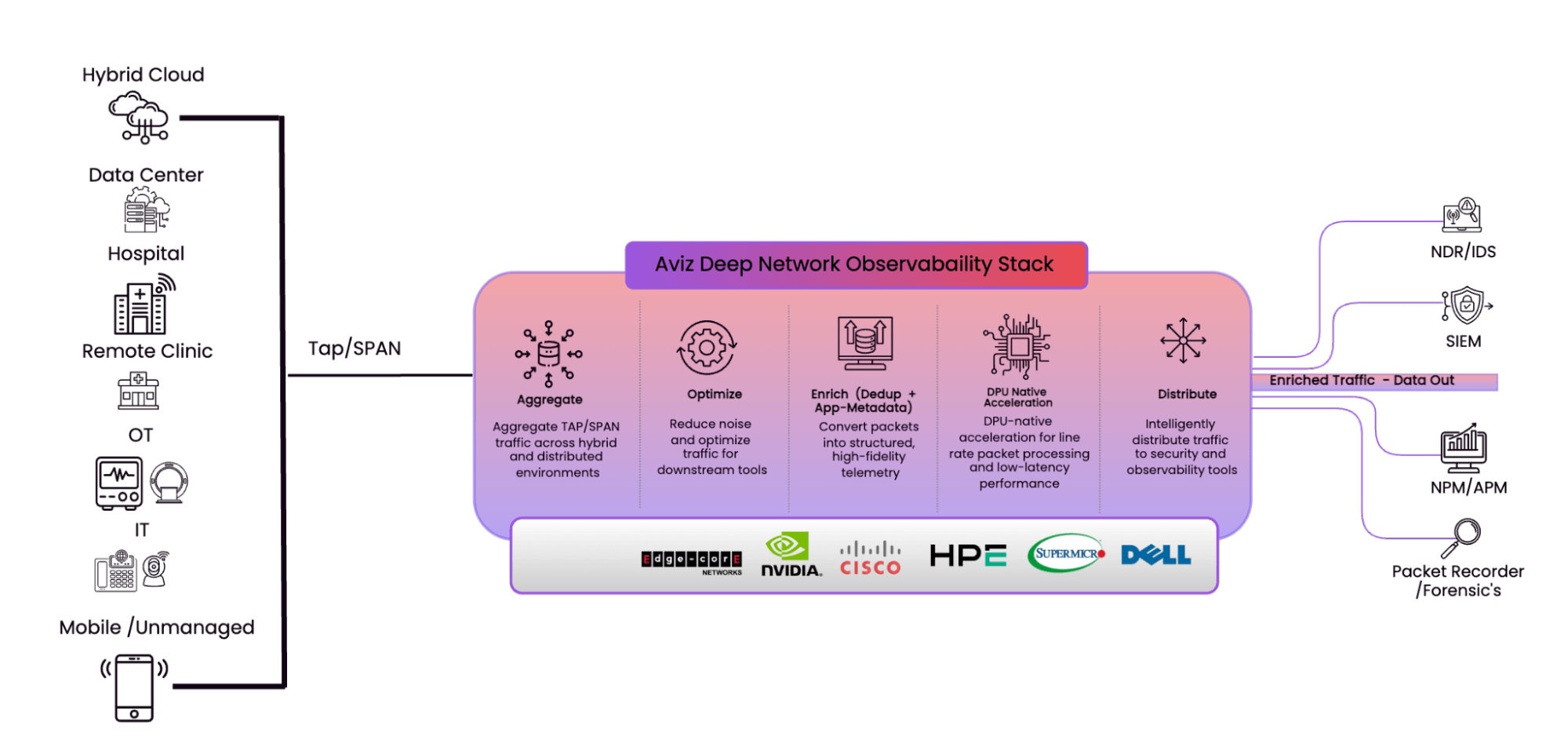
Aviz Deep Network Observability is a five-stage pipeline — Capture → Normalize → Enrich → Stream → Integrate — running on open white-box switches and commodity x86 with DPU-native acceleration up to 400G. Traffic is sourced directly from the network fabric itself — across on-premises, data centers, hybrid, multi-cloud, Kubernetes, and containerized workloads via SPAN, physical, and virtual taps. The result is structured, packet-level metadata covering every PHI flow on the network — captured out-of-band, independent of the workload, immutable from the moment the session crosses the wire.
Aviz is vendor-agnostic by design and streams enriched metadata in open formats (JSON and Kafka) into whichever observability or SIEM platform the institution already runs — Splunk, Elastic, Datadog, Dynatrace, New Relic, Kentik, Chronicle, Sentinel, and others. The DORA evidence the platform generates is the same regardless of where the customer chooses to consume it.
Continuous ICT Monitoring Across the environment.
"Can I prove my ICT monitoring is genuinely continuous — not just point-in-time snapshots?"
DORA's first pillar asks for something most ICT programs are not architected to deliver: continuous visibility into every asset, every flow, and every dependency in the institution's ICT environments. The supervisory expectation is not that the institution monitors most of the time, but that it can demonstrate evidence at any moment. For environments spanning on-prem data centers, multiple clouds, Kubernetes clusters, and branch environments, continuous monitoring is structurally hard. Endpoint agents miss workloads they're not installed on. Cloud-native flow logs miss intra-VPC and intra-host traffic. Application logs are self-reported and incomplete.
For a CISO, the gap is not a policy gap. It is an evidence gap - and DORA auditors are increasingly trained to find it.
The cost of getting this wrong:
- Supervisory findings on continuous monitoring obligations under the RTS on ICT Risk Management Frameworks
- Inability to evidence East-West and lateral activity during routine reviews
- Extended detection windows that breach DORA's 24-hour and 72-hour incident-reporting thresholds
- Fragmented monitoring across tools, with gaps that surface only during incidents
What Aviz DNO delivers. Aviz produces enriched flow metadata through its DPI engine - capturing every flow on the network across hybrid cloud, multi-cloud, on-premises, and Kubernetes environments. Each flow is recorded with a timestamp, source, destination, application, protocol, bytes, and packets, covering both North-South perimeter traffic and East-West lateral movement.
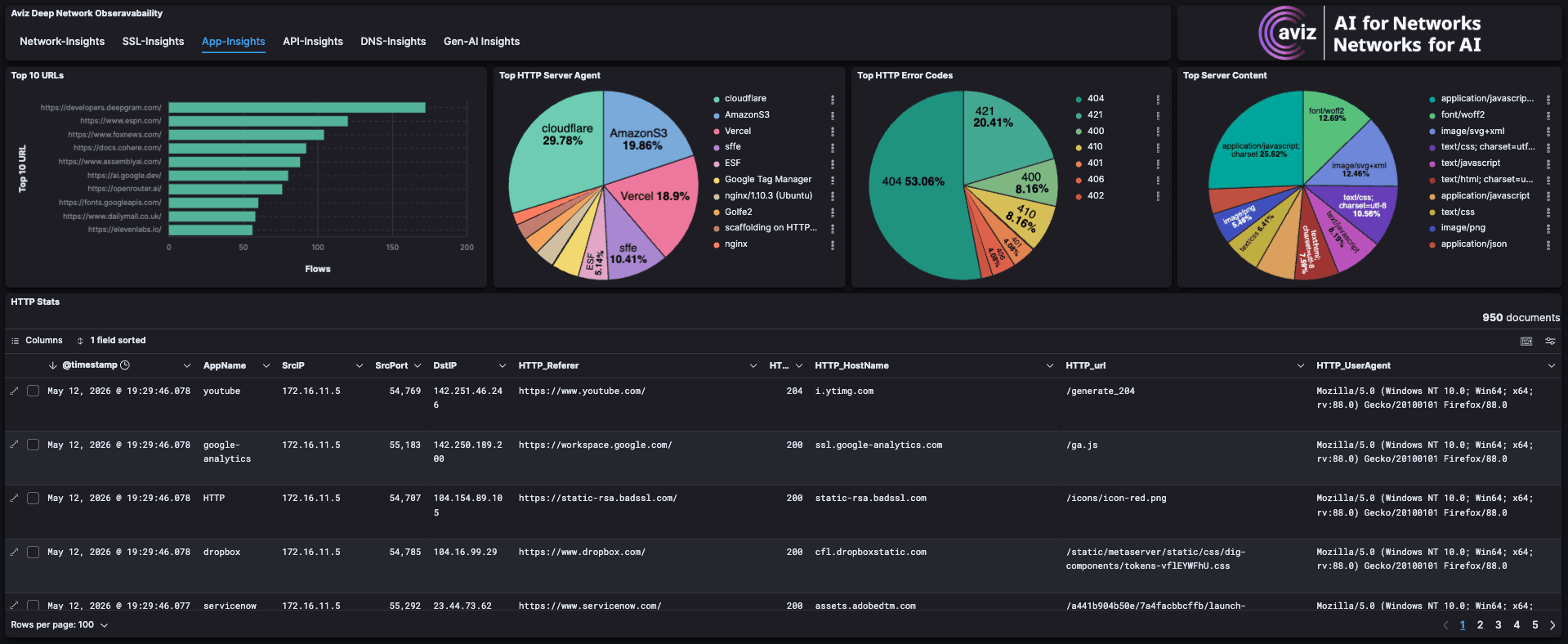
The visibility is continuous by architecture: there are no agents to deploy, no application instrumentation to maintain, and no monitoring gaps when a workload is unhealthy. The metadata streams in open formats into the SIEM or observability platform of choice - visualized in the Aviz Network-Insights dashboard or rebuilt anywhere consuming JSON or Kafka.
Why this matters for the CISO: Continuous ICT monitoring under DORA is not a feature that the institution claims. It is a property the institution demonstrates — every day, across every environment. With Aviz, that demonstration becomes a continuously observed fact rather than a quarterly assertion.
Forensic Evidence That Survives a Compromise
"Can I reconstruct an ICT incident if the compromised system's logs are missing or modified?"
DORA's second pillar requires institutions to detect, contain, report, and recover from ICT-related incidents — and to do all of it within tight regulatory windows. Major incidents must be classified within 24 hours, initial reports filed within 24 hours of classification, and intermediate reports within 72 hours. Each report must include forensic detail: what happened, when, how, with what impact.
The problem most incident-response teams know but rarely say out loud: the systems compromised in the incident are also the systems whose logs you now rely on to reconstruct it. Application logs can be modified. Endpoint agents can be disabled. Audit trails on a compromised workload are not trustworthy after the fact. DORA implicitly assumes — and supervisors increasingly require — forensic evidence captured independently of the systems that may have been touched.
The cost of getting this wrong:
- Supervisory findings on continuous monitoring obligations under the RTS on ICT Risk Management
- Inability to evidence East-West and lateral activity during routine reviews
- Extended detection windows that breach DORA's 24-hour and 72-hour incident-reporting thresholds
- Fragmented monitoring across tools, with gaps that surface only during incidents
What Aviz DNO delivers. Aviz produces packet-derived forensic evidence captured out-of-band — independent of any workload, immutable from the moment the session crosses the wire, and continuously streamed into the SIEM and forensic evidence store. Every API call, every TLS session, every DNS query, every flow across the environment is recorded with full context: timestamp, source, destination, protocol, application, bytes, headers. When an incident occurs, the IR team is not reconstructing from compromised logs — they are querying an independent, tamper-resistant evidence layer captured at the network. Available for the entire investigation window, structured for export, and consumable in any SIEM.
Why this matters for the CISO. DORA's reporting timelines are unforgiving. The institution that can produce forensic evidence within hours — and defend its provenance — is the institution that meets the deadline. With Aviz, incident reconstruction stops depending on the integrity of the systems that just failed.
Third-Party ICT Oversight, Including AI Services
"Do I know every third-party our data is flowing to — including the ones nobody asked permission for?"
Pillar 4 is the dimension of DORA that has caught the most institutions flat-footed. Demonstrable oversight of every critical ICT third-party provider — including sub-contracting chains, cloud providers, payment networks, fintech connectors, and AI services — is a regulatory requirement, not an optional governance practice. Most institutions discovered during their first DORA gap analyses that their third-party register was incomplete, their data flow maps were aspirational, and their outbound connections were not continuously monitored.
The challenge is not a missing policy. It is missing visibility — particularly into the third-party connections that did not go through a formal procurement or DESA process. Generative AI services are the sharpest current example; developers and employees consuming public AI services from corporate networks, often without IT awareness, moving sensitive data across a third-party boundary that was never reviewed.
The cost of getting this wrong:
- Supervisory findings on the ICT third-party register and outsourcing oversight
- Sensitive data flowing to unsanctioned third-party services with no audit trail
- Vendor-risk programs operating on contractual attestations rather than observed reality
- Reputational and regulatory exposure when an unmonitored third-party is compromised, and the institution cannot quantify the data flow
What Aviz DNO delivers. Aviz produces enriched third-party API and outbound flow metadata through its DPI engine — capturing every outbound connection from internal systems and separating traffic into sanctioned services (consumption through approved cloud providers and enterprise SaaS — AWS, Azure, GCP, Microsoft 365) and unsanctioned services (consumer-grade and developer-grade AI services, partner APIs, and third-party endpoints accessed directly from corporate networks). Every session is recorded with timestamp, source IP, destination, hostname, bytes, packets, and HTTP method - answering not just that a third party is being used, but which one, from which hosts, by whom, and how much data is moving. The visibility holds across managed and unmanaged devices, including BYOD on corporate Wi-Fi.
Why this matters for the CISO: DORA third-party oversight cannot be evidenced from contracts alone. With Aviz, the third-party register is no longer a quarterly self-report — it is a continuously observed map of every external connection the institution actually has. AI services included.
Cryptographic Hygiene Across Every ICT Asset
"Can I evidence that encryption is enforced across every system, every endpoint, and every API?"
DORA's ICT risk-management framework expects institutions to maintain demonstrable cryptographic controls across the entire ICT estate. Encryption-in-transit is one of the most-cited supervisory expectations under the RTS on ICT Risk Management — and one of the most under-evidenced controls in practice. Each new ICT asset added to the estate is another TLS configuration to validate, another certificate to renew, another cipher suite to verify.
For a CISO, this concern is operational and reputational at once. The 94%-expired-certificate problem hidden inside most environments is a DORA finding, an outage waiting to happen, and a board-level concern all in one.
The cost of getting this wrong:
- Supervisory findings on encryption-in-transit and certificate management under the RTS on ICT Risk Management
- Customer-facing outages caused by expired or revoked certificates on critical ICT services
- Exposure to known cipher vulnerabilities long after they were disclosed
- Cross-cutting compliance gaps with PCI-DSS 4.0, GDPR, and regional banking frameworks that share these requirements
What Aviz DNO delivers. Aviz produces enriched SSL metadata through its DPI engine — recording every TLS session crossing the network with App Server IP, SNI, version, issuer, common name, expiry, and flow count. Three views answer the cryptographic question completely: TLS version distribution across all assets, cipher suite ranking showing what is actually negotiated session-by-session, and certificate status broken down into valid, expired, and self-signed buckets. Weak protocols, deprecated ciphers, and expiring certificates are flagged the moment they appear — visualized in the Aviz SSL-Insights dashboard or any platform of choice.
Why this matters for the CISO: Cryptographic posture is one of the rare areas where DORA, PCI-DSS, GDPR, and most regional regulations all converge on the same requirement. A continuously observed cryptographic evidence layer satisfies all of them at once — turning what is usually a quarterly scramble into a passive, always-on stream of evidence.
Real-Time Detection That Beats the Reporting Window
"Can I detect an ICT incident fast enough to meet DORA's reporting deadlines — and trace it accurately?"
DORA Pillar 2 incident reporting deadlines are tight: 24 hours to classify a major incident, 24 hours after that to file initial notification, 72 hours for an intermediate report. Behind these deadlines is an assumption: the institution can detect, classify, and characterize the incident in time. For most ICT incidents, that require real-time visibility into authentication anomalies, behavioral attacks, lateral movement, and outbound exfiltration - not a forensic reconstruction days later.
The reality is that behavior-based ICT attacks now dominate the threat landscape. Credential abuse, scraping, business logic exploitation, and lateral movement all happen at the application and network layer in real time, and they look like legitimate traffic to most rule-based controls. Without rich, packet-derived signals, the institution discovers the incident from the customer or the regulator rather than from its own systems.
The cost of getting this wrong:
- Missed DORA reporting deadlines that escalate supervisory attention
- Public disclosure that the institution was unaware of an incident already known externally
- Forensic gaps that prevent the classification of incident severity within regulatory windows
- Customer trust erosion when incidents become public before institutional response
What Aviz DNO delivers. Aviz produces enriched HTTP, DNS, and flow metadata through its DPI engine — recording every transaction, every name resolution, and every connection with full context. Three classes of behavioral signal become immediately visible: HTTP error spikes indicating credential abuse or brute force; anomalous DNS queries signaling beaconing, data exfiltration via DNS, or contact with newly registered domains; and unusual flow patterns revealing lateral movement, SSRF exploitation, or volumetric abuse. The metadata feeds the SIEM, NDR, and detection platforms that turn these signals into action - visualized in the Aviz App-Insights, DNS-Insights, and Network-Insights dashboards or rebuilt anywhere.
Why this matters for the CISO. DORA reporting deadlines are not negotiable. The institution that detects, classifies, and characterizes an incident from continuous packet evidence is the institution that meets the deadline confidently. With Aviz, detection and reconstruction happen on the same evidence layer — closing the gap between what happened and what gets reported.
What this means for your DORA program
DORA elevated operational resilience from a good practice to a regulatory baseline. The institutions that will pass supervisory scrutiny over the next three years are those that treat continuous, packet-derived evidence as the foundation of their ICT risk and incident-reporting programs — not as a feature, but as the substrate every other DORA capability runs on.
With that foundation in place, every other DORA dimension gets stronger: ICT monitoring becomes continuous by architecture, incident reporting becomes timely
and defensible, third-party oversight becomes observed reality rather than contractual assertion, cryptographic posture becomes an always-on evidence stream, and real-time detection meets the reporting deadlines DORA imposes.
DORA does not name a specific technology. It specifies an outcome: continuous, evidenced, demonstrable resilience. Packet-derived visibility is the most direct path to that outcome.