





How VXLAN-Enabled Open Packet Brokers Transform Data Center Monitoring

Introduction
In today's fast-changing IT world, having network solutions that are scalable, flexible, and efficient is more important than ever. As companies increasingly use virtualization to better manage resources and handle complex systems, technologies like VXLAN (Virtual Extensible LAN) have become essential. VXLAN is unique because it extends Layer 2 networks over Layer 3 infrastructure, providing unmatched scalability and flexibility. This guide explores the basics of VXLAN, its importance in modern data centers, and how it works with Aviz Open Packet Broker (OPB) to transform network packet brokering.
What is VXLAN
VXLAN (Virtual Extensible LAN) is a cutting-edge network virtualization technology that enables the seamless extension of Layer 2 overlay technology to operate over a Layer 3 network. It enhances network scalability and flexibility by encapsulating Ethernet frames within UDP packets, allowing for the creation of large, isolated virtual networks across multiple locations, making it ideal for modern data centers and cloud environments. Each overlay is referred to as a VXLAN segment, and these segments are distinguished by a 24-bit segment ID, known as the VXLAN Network Identifier (VNI).
Key Benefits of OPB with VXLAN
- Centralized Traffic Management:
OPB uses VXLAN to gather and manage traffic from various sources. By encapsulating traffic in VXLAN tunnels and efficiently route packets to the correct monitoring or security tools.
- Flexible Traffic Monitoring:
VXLAN allows OPB to monitor traffic across different network segments, giving a complete view of network performance and security, crucial for detecting and addressing issues in real-time.
- Seamless Integration with Virtualized Environments:
VXLAN's ability to overlay Layer 2 networks on top of Layer 3 enables OPB to work smoothly with virtualized environments, like data centers or cloud services, ensuring efficient traffic management.
VXLAN and Open Packet Broker
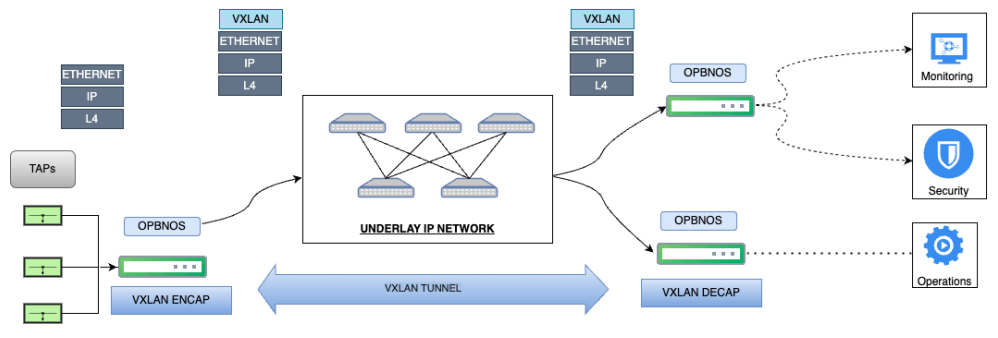
VXLAN mechanism is basically divided into two operations, one is encapsulation and the other is decapsulation.
Encapsulation
Encapsulation is a process that involves wrapping original Ethernet frames within a new header to create a VXLAN (Virtual Extensible LAN) packet. This technique enables Layer 2 networks to be extended over a Layer 3 infrastructure, essentially creating a virtual Layer 2 network on top of an IP-based network. Incorporating VXLAN within OPBNOS, a specialized network operating system designed to enhance packet brokering, not only improves the scalability and efficiency of packet brokering but also enables efficient handling, routing, and monitoring of network traffic across distributed environments.
How VXLAN Encapsulation Works
- Receiving the Original Ethernet Frame:
The process starts when OPB receives the tapped packet that needs to be inspected. The packet can be any packet with a standard Ethernet frame from the network.
- Filtering the Required Packet:
With Packet monitoring rules, OPB helps user to filter and qualify only the specific packets that user requires to encapsulate.
- Adding the VXLAN Header:
Qualified packets are then wrapped within a VXLAN header. This header includes the VXLAN Network Identifier (VNI) that uniquely identifies the VXLAN segment.
- Encapsulation with IP/UDP Headers:
After adding the VXLAN header, OPB further encapsulates the packet with a new IP header and a UDP header for routing across Layer 3 infrastructure.
- Transmission Across the Network:
Once fully encapsulated, the packet is transmitted across the Layer 3 network. The encapsulation allows the packet to traverse any IP network.
- Delivery to the Destination VTEP:
The encapsulated packet is sent to the destination Virtual Tunnel Endpoint (VTEP), which is responsible for receiving and preparing it for decapsulation.
Benefits of Encapsulation in OPB
- Traffic Isolation and Security:
By encapsulating Ethernet frames into VXLAN packets, OPBNOS ensures that different virtual networks remain isolated from one another, enhancing security and reducing the risk of cross-traffic leaks.
- Efficient Traffic Management:
Encapsulation enables OPB to optimize the routing and handling of traffic across complex network topologies, ensuring that packets reach their intended destinations efficiently.
Decapsulation
Decapsulation in OPB refers to the process of removing the VXLAN encapsulation from incoming network packets. This step is crucial for analyzing and routing traffic within a network, particularly in environments where VXLAN is used to extend Layer 2 networks across a Layer 3 infrastructure.
- Receiving the VXLAN Packet at the Virtual Tunnel Endpoint (VTEP)
- Stripping the VXLAN header when VNI and MAC address match
- Processing the inner Ethernet frame based on network policies
- Forwarding to monitoring tools, security appliances, or network segments
How VXLAN Decapsulation Works
- Receiving the VXLAN Packet:
OPB receives VXLAN-encapsulated packets at the VTEP. These packets contain a Layer 2 Ethernet frame wrapped within a Layer 3 IP/UDP header, along with a VXLAN header that includes the VNI.
- Stripping the VXLAN Header:
The decapsulation process begins by stripping away the outer IP/UDP header and the VXLAN header when the VNI and MAC address are specifically destined for the device.
- Processing the Inner Ethernet Frame:
Once decapsulated, the inner packet with Ethernet frame is treated by OPB based on network policies and configurations set within the system.
- Forwarding to the Appropriate Destination:
After decapsulation, OPB forwards the packet to its intended destination within the network, whether that be a monitoring tool, security appliance, or another network segment.
Benefits of Decapsulation in OPBNOS
- Enhanced Traffic Visibility:
Decapsulation allows OPB to monitor and analyze traffic that traverses VXLAN tunnels, providing deeper insights into network performance and potential security threats.
- Support for Complex Network Architectures:
Decapsulation enables OPB to seamlessly integrate with complex, multi-tenant network environments where different segments of traffic need to be kept isolated yet monitored comprehensively.
Configuration
Aviz Open Packet Broker provides a robust CLI and GUI based configuration system, giving users greater flexibility in selecting which packets to encapsulate or decapsulate. This process involves creating a tunnel and linking the tunnel interface to either a tool port or a network port, depending on whether you want to perform encapsulation or decapsulation.
VXLAN Header Stripping
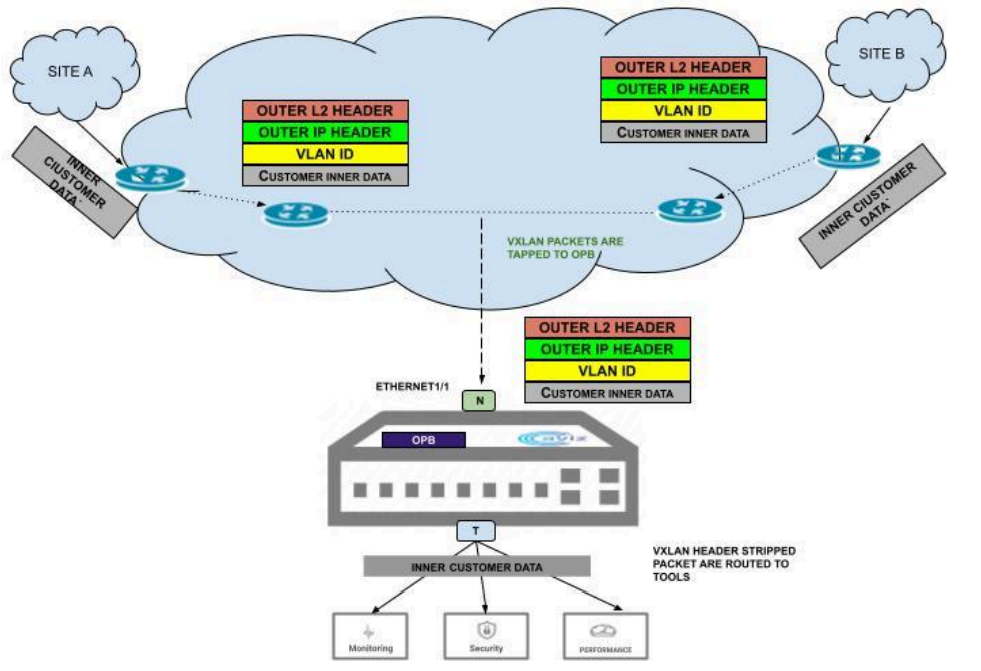
The VXLAN header stripping functionality can identify and remove headers from the VXLAN packets that are tapped from the VXLAN-based networks. This functionality is useful for directly tapping into VXLAN enabled enterprise networks without the need to setting up VXLAN tunnels in the packet monitoring Fabric. Aviz Open Packet Broker is configured with the required traffic intelligence rules to strip the VXLAN header from the incoming packets. It then sends the inner payload to the tools based on the map rules configured.
The Unique Advantage of VXLAN Stripping
- Handle Monitoring-Specific Packets:
This feature handles VXLAN packets marked specifically for monitoring purposes. In traditional packet brokering, such packets could be overlooked, posing security risks. OPB ensures these packets are decapsulated and made available for monitoring.
- Dual IPv4 and IPv6 Support:
Support for simultaneous IPv4 and IPv6 VXLAN packet stripping. This dual support allows for seamless handling of both types of packets within the same network environment.
- Custom ASIC Programming:
Supporting VXLAN stripping requires custom programming of ASICs for line rate processing of network monitoring. Aviz Open Packet Broker NOS have created custom parsing logic for ASICs to achieve this functionality.
Summary
In summary, VXLAN is crucial for scalable, segmented, and flexible network environments in data centers, and its integration with advanced packet monitoring tools is necessary to maintain visibility and control over the network traffic. Aviz Open packet broker can aggregate, filter, and distribute VXLAN-encapsulated traffic to monitoring tools. This capability is critical for maintaining comprehensive network visibility and ensuring that monitoring systems can effectively analyze traffic in modern, highly virtualized environments.
Contact us to Schedule a Demo
See the power of our VXLAN-Enabled Open Packet Broker in action! Schedule a personalized demo today and witness firsthand how it can transform your data center operations.
Schedule Demo