





How Packet-Derived Evidence Closes the PCI-DSS 4.0 Gap in Financial Services
A compliance walkthrough for banks, payment processors, and fintechs
From compliance to continuous proof
For years, PCI compliance was treated as a checklist exercise - prepare for an audit, gather logs, pass, and move on. That model no longer works.
PCI-DSS 4.0 is the most evidence-heavy version of the standard ever written. Continuous monitoring (10.4.1.1, 11.3.1.1, 12.10.5), documented cipher inventories (12.3.3), certificate validity (4.2.1.1), and targeted risk analysis (12.3.1) all require one capability: that you can prove, on any given day, what is actually happening inside the systems that store, process, or transmit cardholder data. Encryption must be verifiable at all times. User activity must be monitored continuously. Network behavior must be observable - not inferred.
At the same time, financial environments have fundamentally changed. Transactions no longer stay within a single data center. They move across hybrid cloud, APIs, partner ecosystems, branches, and even IT/OT systems. Visibility, however, has not kept up. This creates a gap that financial institutions keep hitting: you are responsible for proving security across systems you can't fully see.
Why MELT and endpoint data aren't enough
Most compliance programs rely on two sources of evidence: MELT data - metrics, events, logs, and traces from applications and systems - and telemetry from network and security components like firewalls, reverse proxies, and endpoint agents. Both are necessary. Neither is sufficient.
MELT data is self-reported. It records what the system chose to log, and assumes the system is healthy, configured correctly, and the logs are intact.
None of those assumptions survives a real incident. When a system fails, logs are delayed or lost. When a system is compromised, logs are among the first things an attacker modifies - which is exactly why PCI-DSS 4.0 Req 10.3.3 requires audit logs to be backed up promptly to a separate, tamper-resistant location. Network and security components help, but each has its own scope and blind spots.
Packet-derived evidence closes both gaps. It is captured out-of-band, independent of the workload, and streamed to the evidence store the moment a session crosses the wire. Aviz sits at the network layer and captures both North-South and East-West traffic - the external flows most tools already monitor, and the lateral flows inside the environment that most tools miss.
How Aviz Deep Network Observability (Stack) produces the evidence
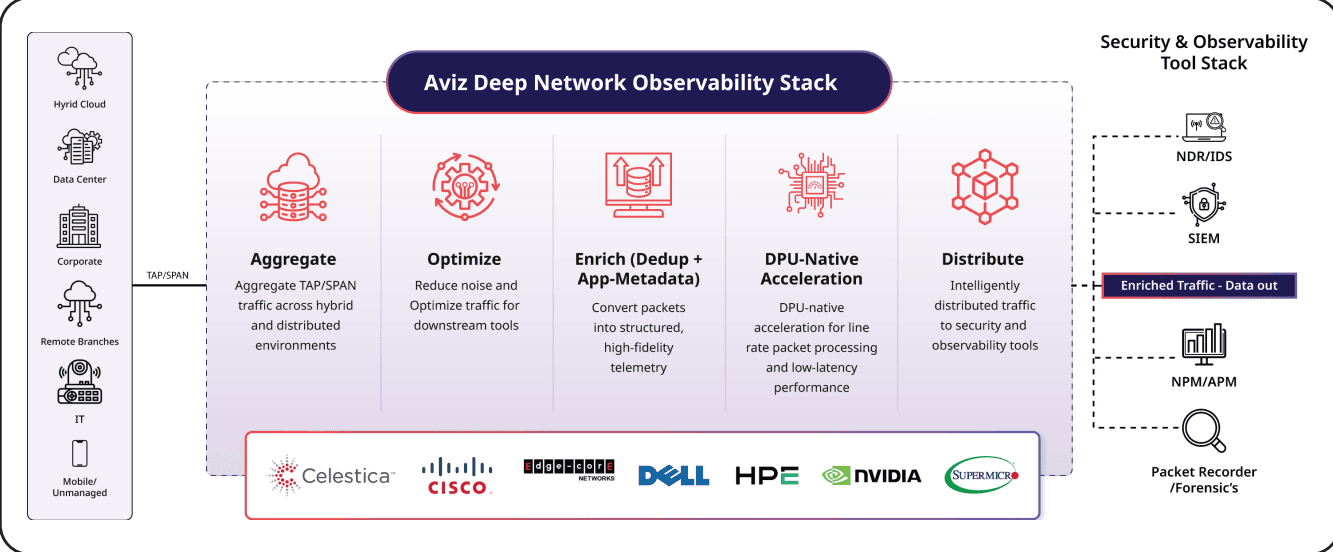
Aviz Deep Network Observability is a five-stage pipeline → Aggregate → Optimize → Enrich Accelerate → Distribute - running on open white-box switches and commodity x86 with DPU-native acceleration up to 400G. TAP or SPAN traffic from hybrid cloud, data center, branch, and IT/OT is normalized, enriched with Deep Packet Inspection, and converted into structured, packet-level metadata - the real output of the platform.
What matters is the evidence itself. Aviz is vendor-agnostic by design and streams enriched metadata in open formats (JSON and Kafka) into whichever observability or SIEM platform you already run, such as Splunk, Elastic, Datadog, Dynatrace, New Relic, Kentik, Chronicle, Sentinel, and others.
The dashboards shown in this blog can be rebuilt natively in any of these platforms - the visualizations are downstream of the metadata, not the other way around.
For customers who want a turnkey experience, Aviz also offers an Elastic Node visualization platform bundled with the pipeline - the dashboards shown in this blog are from that environment. Use it, or use your own. The packet-derived metadata and the compliance evidence it produces are the same either way.
| Requirement | What it demands | Aviz DNO Evidence (Packet-Derived App Metadata) |
|---|---|---|
| 1.2.6 / 2.2.5 | Detect insecure services and protocols | Network-Insights: live protocol and application distribution |
| 4.2.1 | Strong cryptography in transit | SSL-Insights: TLS version and cipher suite per session |
| 4.2.1.1 | Certificate inventory and validity | SSL-Insights: issuer, common name, expiry |
| 5.2.2 / 5.3.2 | Detect malware behavior on the network | DNS-Insights: raw DNS query telemetry feeding NDR / SIEM detection |
| 6.4.1 | Public-facing web app protection | Public-facing web app activity / App-Insights: HTTP error, URL, server, and session telemetry |
| 8.3.2 | Strong cryptography for authentication | SSL-Insights: TLS posture on auth endpoints |
| 10.2 / 10.3 | Audit logs for all access | Timestamped flow, session, query records |
| 11.5 | Intrusion detection on the network | Enriched telemetry streamed to SIEM & Optimized traffic to NDR/IDS |
| 12.3.1 / 12.5.2 | Targeted risk analysis and scope review | Gen-AI Insights: Shadow AI vs. sanctioned AI traffic visibility |
| 12.3.3 | Document cipher suites and protocols in use | SSL-Insights: continuous cipher inventory |
SSL-Insights: Strong Cryptography for Data in Transit (Req 4)
Addresses: 4.2.1 (strong cryptography in transit), 4.2.1.1 (certificate inventory and validity), 8.3.2 (strong cryptography for authentication), 12.3.3 (documented cipher inventory)
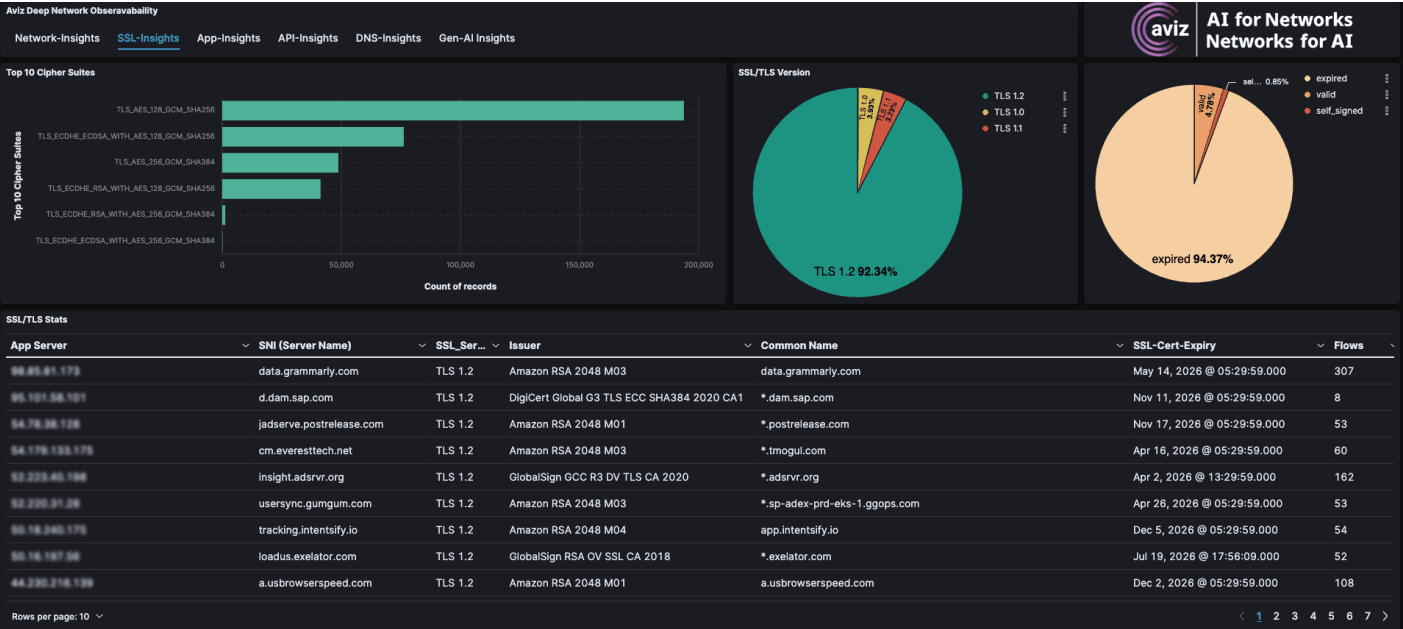
This is the single most important tab in the dashboard for a PCI audit. It provides a live, continuously updated answer to the most-asked question in every audit review: can you prove strong cryptography is in use, and can you prove deprecated protocols and expired certificates are not?
This is where most PCI audits begin and fail
App-Insights: Secure Systems and Audit Logging (Req 6 & Req 10)
Addresses: 6.4.1 (public-facing web application activity), 10.2 (audit log content), 10.3 (audit log details and integrity)
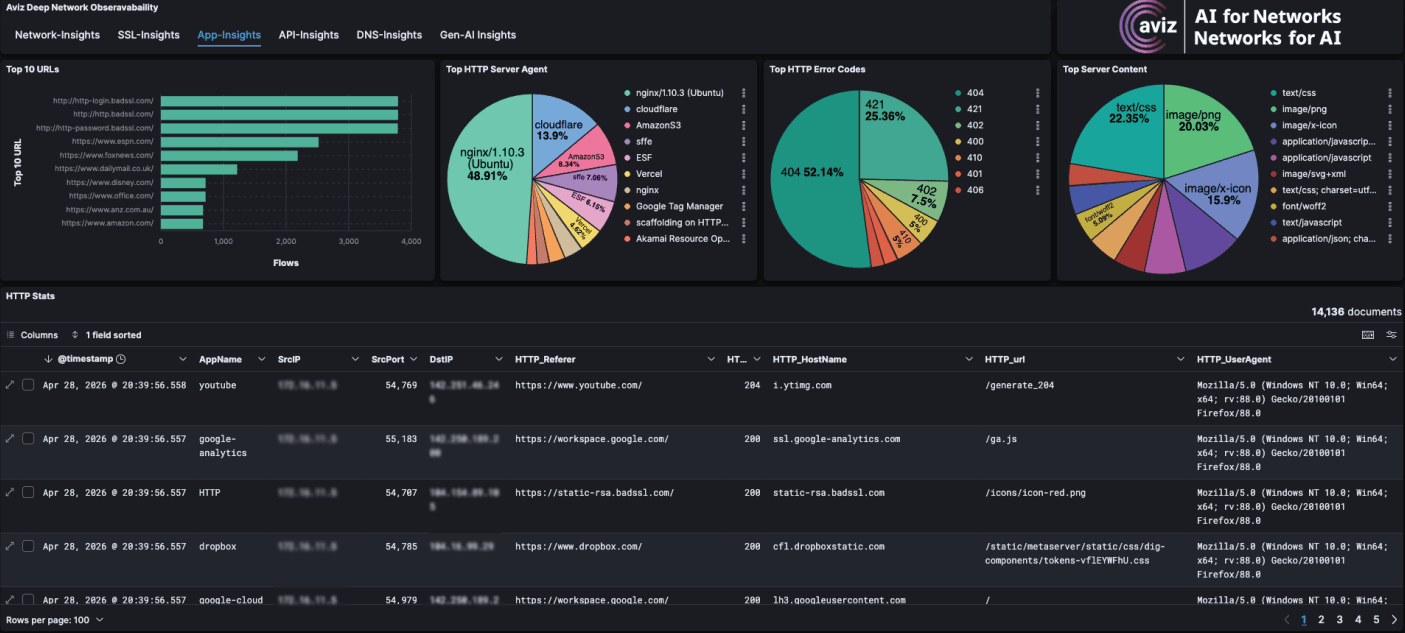
Req 6.4.1 requires protection for public-facing web applications - online banking portals, mobile API gateways, and card payment pages. Aviz App-Insights delivers a network-layer view of every HTTP transaction on the monitored path: top URLs, dominant HTTP server agents, response code distribution, and content-type mix.
For PCI evidence, two patterns matter: HTTP error spikes (a sudden rise in 401s or 403s can signal credential-stuffing against a payment page) and unexpected server agents (a new Server: header inside the environment can indicate shadow infrastructure).
The HTTP Stats table records every transaction with timestamp, source IP, hostname, URL, response code, and user agent - Req 10.2 and 10.3 audit logging at the network layer, with zero application-side instrumentation.
DNS-Insights: Malware Detection and Access Monitoring (Req 5 & Req 10)
Addresses: 5.2.2 (anti-malware coverage), 5.3.2 (continuous behavioral analysis), 10.2 (audit log content), 11.5 (network intrusion detection)
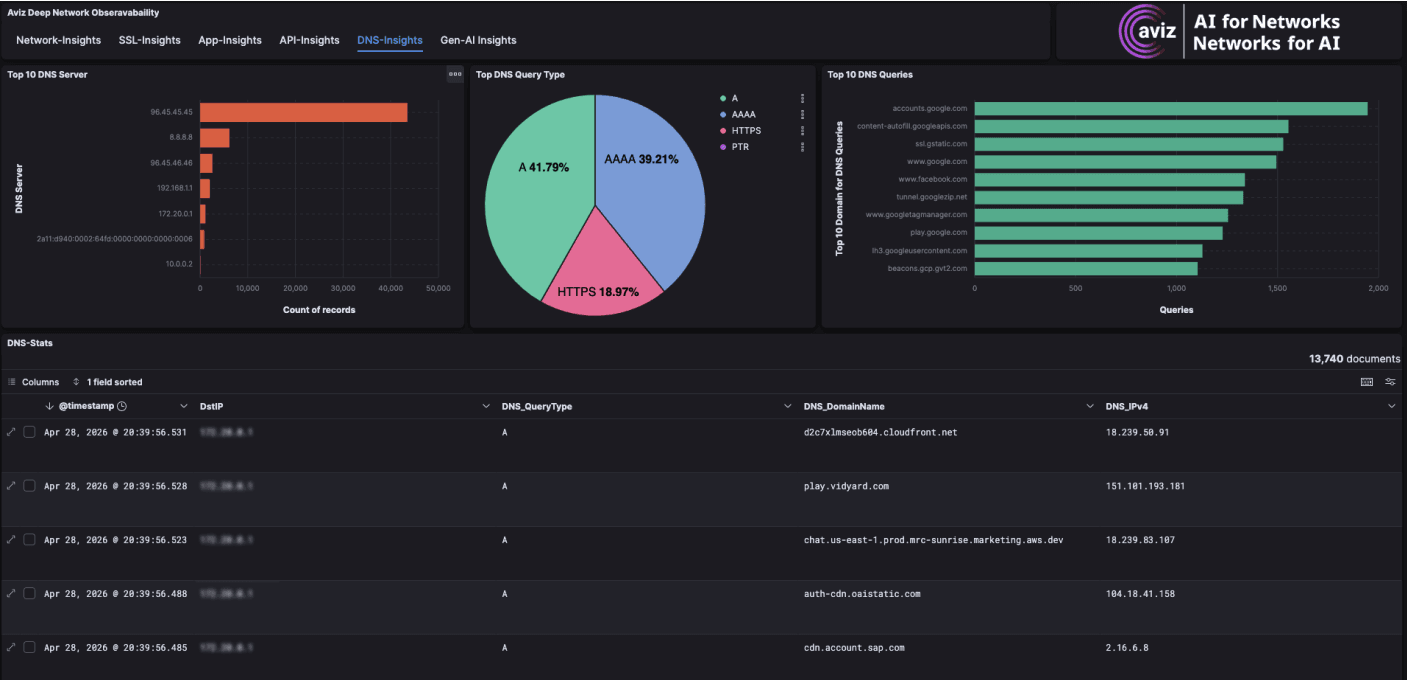
DNS is the protocol every attacker uses, and almost no PCI programme actively monitors. Most malware uses DNS for command-and-control. Most data exfiltration begins with a DNS query to an attacker-controlled domain. Req 5 anti-malware controls are usually treated as endpoint-only, but the network sees what the endpoint misses.
Aviz DNS-Insights records every query crossing the network: query type, resolver used, domain requested, and resolved IP. Anomalies surface naturally: a spike in queries to an unfamiliar resolver, an internal host bypassing the corporate resolver, or a sudden burst of queries to newly registered domains all stand out against an established baseline. Each pattern is an immediate Req 11.5 signal that gets streamed straight to the SIEM or NDR.
The DNS-Stats table is a continuous log of every outbound name resolution from inside the environment: timestamp, destination IP, query type, domain name, and resolved IPv4. That is Req 10.2 and 10.3 evidence for the one protocol that rarely appears in conventional audit log streams.
Network-Insights: Network Security Controls and Scope (Req 1 & Req 2)
Addresses: 1.2.6 (security features for insecure protocols), 2.2.5 (justifying insecure services), 10.2 (audit log content), 11.5 (network intrusion detection), 12.5.2 (annual scope review)
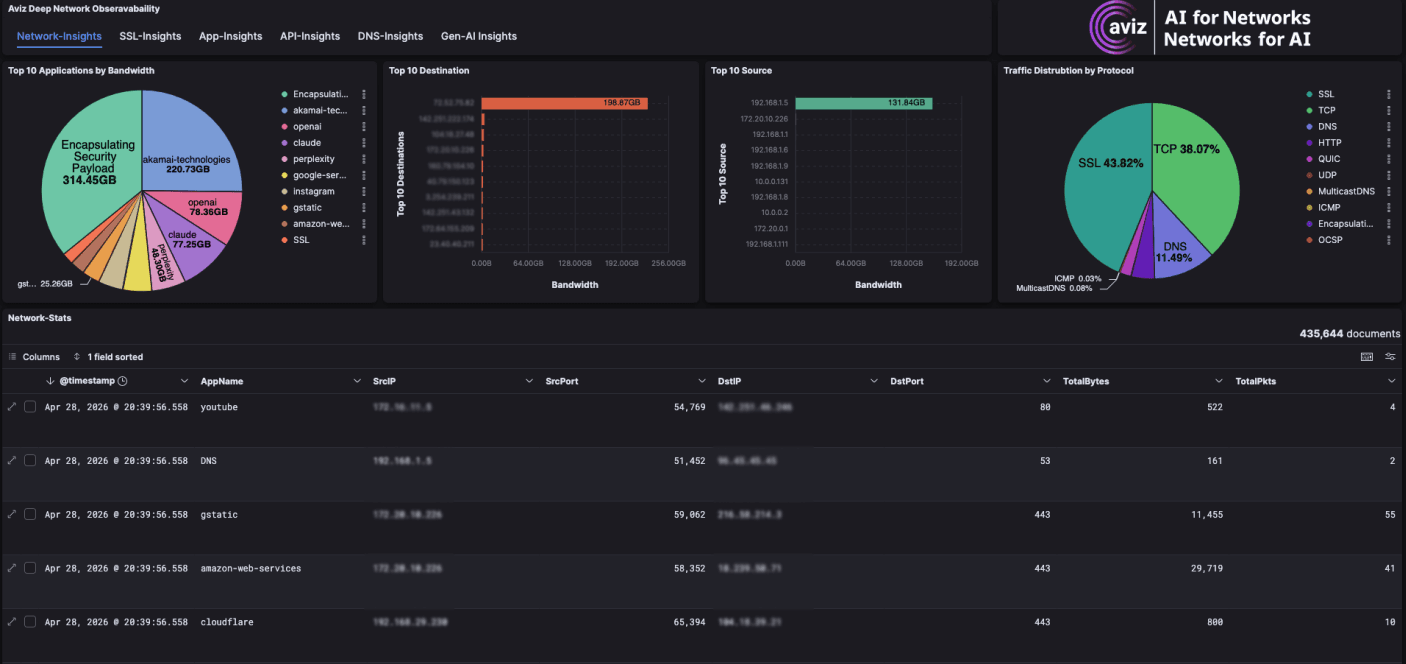
Installing network security controls (Req 1) and applying secure configurations to system components (Req 2) are the foundational requirements of PCI-DSS 4.0 - controlling which services and protocols are allowed into and out of the environment, and justifying any insecure ones still in use. Network-Insights shows live traffic distribution by application and by protocol alongside top sources and destinations, giving a real-time picture of what is actually flowing across the network. The protocol-distribution view is especially valuable:
it highlights the dominant transport mix at a glance and makes any unexpected protocol stand out immediately. An unfamiliar protocol in the mix - cleartext FTP, SMBv1, Telnet from inside the environment - is an immediate Req 2.2.5 finding. Bandwidth baselines turn anomalies into alerts. The Network-Stats table is continuous Req 10.2 evidence at scale, recording every flow with timestamp, source, destination, application, bytes, and packets.
Gen-AI Insights: Shadow AI as a PCI Risk Surface
Addresses: 12.3.1 (targeted risk analysis), 12.5.2 (scope review), supporting 4.2.1 (data-in-transit hygiene)
PCI-DSS 4.0 does not name generative AI by name. But Req 12.3.1 (targeted risk analysis) and Req 12.5.2 (annual scope review) both apply the moment an employee, application, or partner integration sends sensitive data - including PII & cardholder data - to an external Large Language Model. For most financial institutions in 2026, this is no longer a hypothetical: it is happening every day, on the corporate network, and most security programs cannot see it.
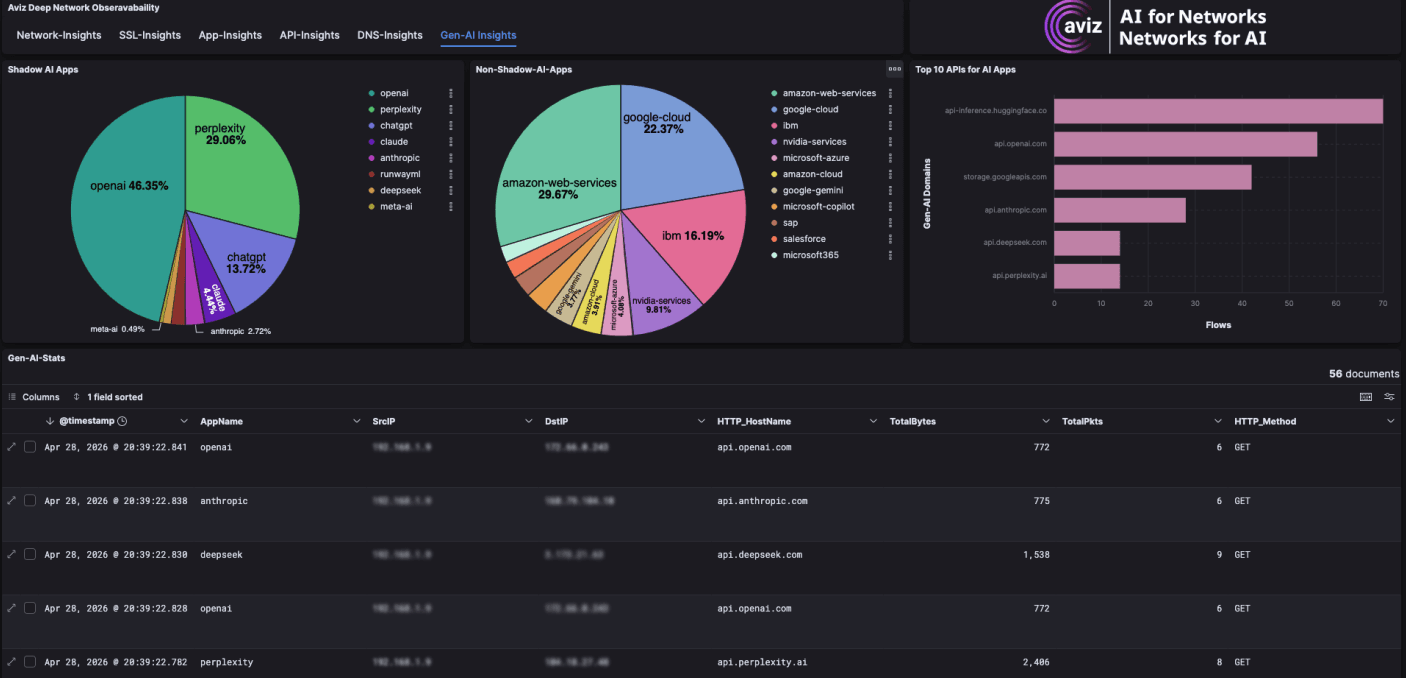
Gen-AI Insights is the dashboard built for this risk surface. It separates AI traffic into two cleanly labeled categories. Shadow AI Apps captures unsanctioned consumer and prosumer AI services - the public LLMs employees access directly from corporate networks, often without IT or security awareness. Non-Shadow AI Apps capture sanctioned enterprise AI consumption through approved cloud providers and SaaS platforms.
The distinction matters. Sanctioned AI on an enterprise cloud account has contracts, data handling commitments, and audit trails. Shadow AI does not. A line of cardholder data pasted into a public LLM session is, under PCI-DSS scope rules, a transmission of cardholder data over an open public network - to a third party with no contract, no data-handling commitment, and no audit trail. That is a Req 12.3.1 finding waiting to happen.
Top APIs for AI Apps ranks the actual AI service endpoints being called from the network - public LLM APIs and enterprise cloud AI services alike - by flow count. The Gen-AI Stats table records every AI session at the network layer, with timestamp, application, source and destination IP, hostname, bytes, packets, and HTTP method. That is the audit artifact that closes the loop: not just that AI is in use, but which services, from which hosts, and how much data is moving.
For institutions building targeted risk analyses under Req 12.3.1, this is the only evidence layer that sees the problem comprehensively. Endpoint DLP catches some of it. Cloud access security brokers catch some of it. The network sees all of it, regardless of endpoint, regardless of browser, regardless of whether the user is on a managed device or a personal one connected to corporate Wi-Fi.
For the controls Aviz does not directly address - Req 3 (stored data), Req 7 (access control), Req 9 (physical access) - Aviz integrates with the IAM, encryption, and physical security platforms that handle them.
The packet-derived evidence Aviz produces enriches those tools, not replaces them.
What this means for your next audit
PCI-DSS 4.0 raised the bar from checking quarterly to checking continuously. Aviz Deep Network Observability delivers the evidence that meets that bar - every TLS session for cryptography requirements, every HTTP transaction for system and logging requirements, every DNS query for malware and monitoring requirements, every flow for network security requirements, and every AI session for risk analysis requirements. All without agents on the workload, without changes to the application, and without proprietary appliances anywhere in the stack.
The strength of the evidence is what makes the difference. Packet-derived metadata is captured out-of-band, immutable from the moment it crosses the wire, and complete across both North-South and East-West traffic.
It produces the audit artifacts continuously, in the format auditors actually want, streamed into the SIEM or observability platform you already run.
The next audit is not the goal. The goal is the audit after that - when continuous monitoring is the default, every cipher and certificate is accounted for in real time, and the question changes from “can we prove this?” to “what else can we see?”