





Future-Proofing Networks for AI : Building AI Fabric with SONiC and RoCE for Optimal Performance and Cost Efficiency

Key Takeaways
-
Multi-vendor networking for AI
Including GPUs, DPUs & switches
-
AI network topology
Nonblocking design for 16K GPUs
-
Implementing RoCE design
Orchestration and optimization for AI networks
-
Total Cost of Ownership (TCO) savings
Gain up to 40% savings using an open and automated AI networking architecture
Abstract
This white paper provides a comprehensive guide for architects and engineers looking to optimize GPU-driven AI workloads through the effective design and deployment of network fabrics using SONiC (Software for Open Networking in the Cloud) with RoCEv2. By implementing the recommended best practices and leveraging advanced features such as PFC, ECN, oversubscription management, and fat-tree topology, organizations can unlock the full potential of their AI infrastructure while ensuring scalability, reliability, and Performance. It also demonstrates how significant Total Cost of Ownership (TCO) savings of 40% or more can be achieved with SONiC and open hardware.
As the demand for high-performance computing continues to surge in AI-driven applications, the design and optimization of network fabrics become paramount. This white paper explores best practices in leveraging SONiC (Software for Open Networking in the Cloud) with RoCEv2 (RDMA over Converged Ethernet version 2) to optimize AI workloads, focusing on features like Priority Flow Control (PFC), Explicit Congestion Notification (ECN), oversubscription management, and fat-tree topology. Through various use cases, this paper demonstrates how these technologies can be effectively deployed to maximize the performance and efficiency of GPU-driven workloads in AI environments.
Introduction
The convergence of AI, Big Data, and high-performance computing (HPC) has led to the emergence of complex AI workloads that demand exceptional network performance. Traditional networking solutions often struggle to meet the stringent requirements of these workloads, necessitating the adoption of innovative approaches such as SONiC with RoCEv2. According to recent studies, the volume of data generated by AI workloads is expected to double every three months, necessitating new high-performance network infrastructure capable of handling this exponential growth.
The rapid expansion of AI applications across industries, from autonomous vehicles to healthcare diagnostics, has led to an unprecedented surge in data volumes and computational requirements. Traditional networking infrastructures, designed for conventional workloads are often inadequate to meet the demands of these AI workloads. As organizations strive to process and analyze massive datasets in real-time, they encounter challenges related to network bandwidth, latency, and scalability. This necessitates the adoption of advanced networking technologies such as SONiC with RoCEv2, which offer the flexibility and performance required to support the evolving landscape of AI applications.
Understanding SONiC and RoCEv2
SONiC is an open-source network operating system developed by Microsoft and the Open Compute Project community. It provides a modular and programmable platform for managing network switches and routers, offering features such as centralized management, telemetry, and automation. SONiC's open architecture enables seamless integration with diverse hardware platforms, allowing organizations to build scalable and agile Network infrastructures tailored to their specific requirements.
RoCEv2 (Remote Direct Memory Access over Converged Ethernet version 2) is a protocol that extends the benefits of Remote Direct Memory Access (RDMA) to Ethernet networks. By leveraging RDMA capabilities, RoCEv2 enables low-latency, high-bandwidth communication between servers and GPU accelerators, facilitating efficient data transfer for AI workloads. SONiC's modular architecture allows for seamless integration with diverse hardware platforms, enabling organizations to leverage RoCEv2's RDMA capabilities across their network infrastructure for accelerated data transfer between GPUs and storage resources.
Designing an AI Network Fabric
Designing an AI network fabric requires careful consideration of various factors to ensure optimal performance and scalability. SONiC serves as the foundation for network management, providing capabilities for centralized configuration, monitoring, and automation. By leveraging SONiC's modular architecture, organizations can implement custom network policies and workflows to meet the specific requirements of AI workloads.
Integration of RoCEv2 into the network fabric enables efficient data transfer between GPU nodes and storage resources. With RoCEv2's support for RDMA, organizations can achieve low-latency, high-bandwidth communication, minimizing data transfer overhead and maximizing GPU utilization. Additionally, features such as Priority Flow Control (PFC) and Explicit Congestion Notification (ECN) play a crucial role in managing network congestion and ensuring smooth operation of latency-sensitive AI applications. By configuring PFC priorities and ECN thresholds, organizations can prioritize critical traffic and react to congestion events proactively.
Intelligent oversubscription management further enhances network efficiency by dynamically allocating bandwidth based on workload demands and traffic patterns. Finally, adopting a fat-tree topology, such as a leaf-spine architecture, minimizes network latency and maximizes throughput, providing a scalable and resilient foundation for AI workloads.
-
A. Leveraging SONiC for Control & Management
Centralized management and orchestration of network resources. Dynamic configuration and provisioning to accommodate changing AI workload requirements. Standard Routing protocols for interop and horizontal scaling.
-
B. Integration of RoCEv2
Enabling RDMA capabilities for efficient data transfer between GPUs and storage. Leveraging RoCEv2's low-latency and high-bandwidth characteristics to minimize communication overhead.
-
C. Implementing PFC and ECN
Prioritizing traffic to prevent congestion and ensure smooth operation of latency-sensitive AI applications. Utilizing ECN to provide congestion feedback and improve network efficiency.
-
D. Managing Oversubscription
Implementing intelligent oversubscription management strategies to optimize network utilization without sacrificing performance. Dynamic allocation of bandwidth based on workload demands and traffic patterns.
-
E. Fat-Tree Topology
Designing a streamlined network topology to minimize latency and maximize throughput. Utilizing leaf-spine architectures to provide scalable and resilient connectivity for AI workloads.
Use Cases for GPU Workloads
Let's consider a scenario where an organization is deploying a distributed deep learning training platform for training complex neural networks on large datasets. In this use case, SONiC with RoCEv2 can significantly accelerate the training process by providing low-latency, high-bandwidth communication between GPU nodes. By prioritizing communication between critical nodes using PFC and optimizing network topology to minimize inter-node communication delays, organizations can achieve faster convergence and reduce time-to-insight.
Similarly, in applications requiring high-performance storage access, such as real-time data analytics or video processing, SONiC with RoCEv2 enables efficient data transfer between GPU nodes and storage resources. By leveraging RDMA capabilities, organizations can access remote storage with minimal latency, accelerating data access and processing tasks.
Furthermore, in real-time inference applications where low-latency communication is essential for timely decision-making, SONiC with RoCEv2 ensures responsive network performance, enabling organizations to meet stringent latency requirements and deliver real-time insights to end-users.
-
A. Distributed Deep Learning Training
Utilizing RoCEv2 for fast and efficient communication between GPU nodes during distributed training. Implementing PFC to prioritize communication between critical nodes and prevent bottlenecks.
-
B. High-Performance Storage Access
Leveraging RDMA capabilities of RoCEv2 to access remote storage with minimal latency. Implementing ECN to ensure reliable data transfer and congestion avoidance.
-
C. Real-Time Inference
Designing a low-latency network fabric to support real-time inference applications. Utilizing fat-tree topology and oversubscription management to minimize inference latency.
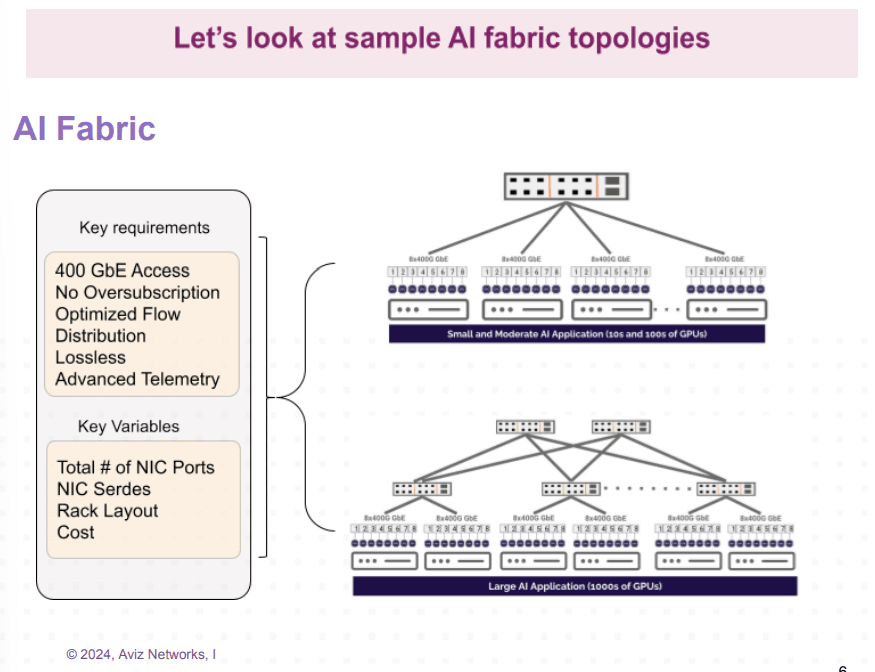
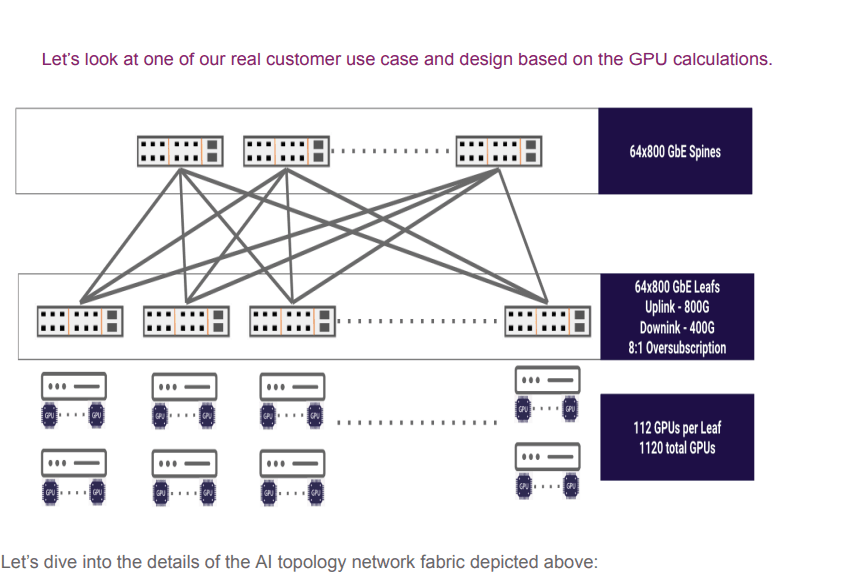
AI Network Architecture and Topology
The diagram represents a multi-layered network fabric designed for AI workloads, featuring a non-blocking design for managing 16,000 GPUs with optimal performance and scalability.
AI Fabric Network Components
- Spine Layer: 64x800GbE Switches, with 800G Downlink towards the leaf nodes
- Leaf Layer: 64x800GbE Switches, with 800G uplink and 400G downlink towards the GPU NICs
- GPU Servers: 8xGPUs per server with dedicated NICs
Network Topology Advantages
- Scalability: The modular design allows easy scalability by adding more switches or GPUs. As AI workloads grow, additional GPUs can be seamlessly integrated into the fabric.
- High Bandwidth: The use of high-speed links (e.g., 800G) ensures ample bandwidth for data transfer. GPUs can communicate with minimal latency, enhancing overall performance.
- GPU Distribution: The fabric evenly distributes GPUs across switches. This prevents GPU bottlenecks and ensures optimal utilization.
- Redundancy and Resilience: Multiple switches provide redundancy. If one switch fails, traffic can be rerouted to other switches, minimizing downtime.
- Low Latency: The design minimizes hop counts between GPUs. Low latency is critical for AI workloads, especially real-time applications.
- Efficient Uplinks: The 2x400G breakouts and 4x2x800G uplinks efficiently connect switches. Uplinks handle traffic between switches and the broader network.
- Cost-Effective: By optimizing GPU distribution and bandwidth, the fabric maximizes resource utilization. This cost-effectiveness is crucial for large-scale AI deployments.
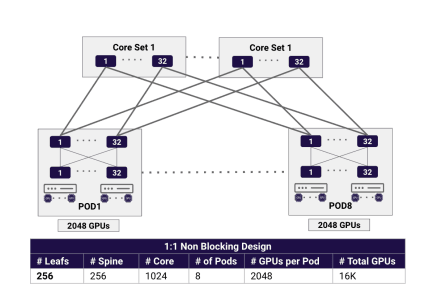
Nonblocking Design for 16K GPUs - Overview
- The diagram illustrates a non-blocking design for managing 16,000 GPUs (Graphics Processing Units).
- The goal is to efficiently distribute computational tasks across these GPUs while minimizing latency and maximizing throughput.
Network Components
- Core Sets: There are two core sets labeled as "Core Set 1" and "Core Set 32". These core sets manage the data flow within the network and play a critical role in directing traffic between different pods and GPUs.
- Pods: Pods are groups of GPUs. Two types of pods are shown: "Pod1" and "Pod64". Each pod contains 64 GPUs, resulting in a total of 2048 GPUs per pod. Pods are interconnected with the core sets.
- GPUs: The entire network comprises 16,000 GPUs. These GPUs are distributed across the pods.
- Switches: Leaf switches: 256 in total. Spine switches: 256 in total. Core switches: 1024 in total. These switches facilitate communication between different components. The network has a total of 2048 switches.
Data Flow and Operations
- Data flows from the GPUs within the pods to the core sets. The core sets manage the routing of data between different pods.
- The nonblocking design ensures that there are no bottlenecks or blocking points in the network. Parallel processing occurs across the GPUs, enabling efficient computation.
- The design is highly scalable, allowing for additional GPUs to be seamlessly integrated. Parallelism is achieved by distributing workloads across multiple GPUs simultaneously.
Best Practices
- Latency: Minimize communication delays between GPUs.
- Throughput: Optimize data transfer rates.
- Monitoring: Regularly monitor network performance and diagnose any issues.
Remember that this topology is specifically designed for large-scale AI workloads, where parallel processing and efficient communication are crucial. It's a complex system, but when properly configured, it enables powerful AI computations!
TCO Advantage
With the increasing complexity and expense of AI workloads, it's important to implement a vendor-agnostic, open AI fabric that is flexible enough to connect and manage multi-vendor GPUs, DPUs, and network components. Not only is this critical for ensuring optimal performance, flexibility, and scalability in AI infrastructure, but it's also important to manage costs. Aviz' ONES management platform is essential to deliver the lowest cost, as it provides a unified framework for orchestrating, managing, and optimizing heterogeneous AI resources. An examination of the costs of AI networking fabric shows that there are multiple dimensions for potential savings: NOS fees, hardware costs, management overhead, and flexibility are the key areas. Let's explain how savings can be gained in each of these areas.
NOS Fees
One of the most vexing frustrations in the networking industry is high-priced proprietary operating systems with complex licensing schemes. With a proprietary NOS, you are locked-in to pay for huge legacy overhead that you may not even be using. Many proprietary NOSs are more expensive not just because of development costs, but because of the cost the organization has to support legacy versions of NOSs and code you may not even be using. In addition to the annual licensing fee, you may also incur additional costs such as upgrades and mandatory support fees. There is also management overhead associated with managing and maintaining the license on your devices. Because many large proprietary NOS vendors are most concerned with maximizing the revenue of their licensing stream, that means you are insured to pay the highest possible cost for the NOS.
Hardware Costs
In addition to paying for the NOS, you have to pay for the hardware. In a vertically oriented, proprietary system, for the same reasons you are insured to pay the highest cost for the NOS, you are guaranteed to pay the highest cost for hardware. It's baked into the overhead of the vendor and their margins. Most of them are public companies that have shareholders to please (or maybe they have to pay dividends). With the combination of an open-source NOS and open hardware, you assure the flexibility of pursuing economies of scale to find the most economical hardware possible. In addition, switching costs are low ensuring the most flexibility for your business.
Management Overhead
Another cost to look at is overhead. When managing devices and NOSs, how easy are they to set up and manage? Is there a consistent operational model to deploy and manage them? Most proprietary systems have higher management, including inconsistent systems for upgrades and maintenance. A legacy environment also carries a high training tax, requiring users to master the intricacies of a complex code base. Aviz's ONES ensures a consistent operational model across all devices, enabling automation and simplicity of operations.
Multi Vendor Flexibility and Future-proofing
Aviz's ONES ensures a consistent operational model across all devices, enabling automation and simplicity of operations. The use of a proprietary system has a high switching cost, or in some cases—switching is very difficult. This can cause an organization's significant expense as it gets "locked in" to one vendor and its inherently higher costs.
With a proprietary technology stack, customers are also often stuck in a set upgrade cycle and cannot add feature or network improvements between cycles. In addition, it is hard to predict the future cost of new features updates. It's a big question to ask: What is the cost of freedom? The chart below shows the potential TCO savings using Aviz.
Network Operations: Managing Vendor Agnostic AI Fabrics
The increasing complexity of AI workloads necessitates a robust, vendor-agnostic AI fabric that can seamlessly integrate and manage multi-vendor GPUs, DPUs, and network components. This is critical for ensuring optimal performance, flexibility, and scalability in AI infrastructure. A system like ONES is essential for this purpose, as it provides a unified framework for orchestrating, managing, and optimizing heterogeneous AI resources.
- Vendor Agnosticism: The AI fabric must support various hardware from different vendors, ensuring compatibility and interoperability. It should allow for seamless integration of new technologies and hardware as they emerge.
- Orchestration: Efficiently manage and schedule AI workloads across diverse hardware resources. Ensure load balancing and resource allocation to maximize performance and minimize latency.
- Management: Provide centralized control and monitoring of all components within the AI fabric. Implement robust management tools to handle the complexity of multi-vendor environments.
- Optimization: Dynamically optimize resource utilization based on workload demands. Incorporate advanced algorithms for predictive analytics and proactive management.
- Network Integration: Ensure high-bandwidth, low-latency networking between components. Support for advanced networking technologies like RDMA and NVMe over Fabrics to enhance data transfer speeds.
By implementing a system like ONES, organizations can build a flexible, scalable, and efficient AI fabric that leverages the best technologies from multiple vendors, ensuring optimal performance and future-proofing their AI infrastructure.
Conclusion
Designing an AI network fabric with SONiC using RoCEv2 and integrating features such as PFC, ECN, oversubscription management, and fat-tree topology is crucial for optimizing network performance and scalability in AI environments. By following the best practices outlined in this white paper and exploring the provided use cases, organizations can effectively meet the demands of modern AI workloads and unlock new levels of performance and efficiency.
By leveraging SONiC's network management capabilities and integrating RoCEv2 for high-performance data transfer, organizations can build robust network infrastructures capable of meeting the challenges of modern AI applications. Through the use of detailed use cases tailored to GPU workloads, organizations can gain insights into the practical implementation of SONiC with RoCEv2 and unlock new levels of performance and efficiency in their AI infrastructure.
References
- SONiC Documentation: https://github.com/Azure/SONiC
- RoCEv2 Specification: https://www.mellanox.com/products/ethernet-adapters-and-controllers/ethernet-roce
- NVIDIA GPU Cloud (NGC): https://www.nvidia.com/en-us/gpu-cloud/
Start building your networks for AI today, because with our SONiC and RoCE solutions, you can unlock significant performance improvements and cost efficiencies, just like TensorWave did!