





Streamline Telco Traffic | Discover Subscriber-Aware Load Balancing

Introduction
Subscriber-aware load balancing refers to the practice of distributing network traffic across multiple servers or network paths based on the specific characteristics and needs of individual subscribers or users. Unlike traditional load balancing, which typically focuses on distributing traffic based purely on factors like server load or network utilization, subscriber-aware load balancing takes into account subscriber-specific information. This approach is particularly important in environments like mobile networks, internet service providers, and enterprise networks where the needs and behaviors of users can vary significantly, and personalized traffic management can improve both user experience and network efficiency.
Subscriber Aware Load Balancing in Aviz Service Node (ASN)
The functionalities supported by ASN nodes are vital in achieving comprehensive network analytics in contemporary telecommunications networks, including 4G LTE, 5G-NSA, and 5G-SA architectures. It handles both control and user plane traffic, ensuring that user plane traffic is uniquely correlated against subscribers.
- Accurate Analysis:
Since traffic is routed based on subscriber attributes, it allows for more granular and accurate analysis of network performance and user behavior.
- Effective Troubleshooting:
With traffic properly distributed, issues can be identified and resolved more effectively, as the analytics tools can focus on specific subsets of traffic or subscriber types.
- Tailored Insights:
It enables the generation of tailored insights and reports based on subscriber profiles and traffic patterns, which can be used to improve network planning and optimization.
- Avoiding Traffic Saturation:
By spreading traffic according to subscriber characteristics, it prevents any single tool from receiving too much traffic at once, which could otherwise lead to performance degradation or failures.
- Improved Fault Tolerance:
If one tool becomes overloaded or fails, subscriber-aware load balancing can redirect traffic to other available tools, thereby maintaining network reliability and service continuity.
Load Balancing Options
Currently, two subscriber-aware load balancing options are available, which can be configured based on customer requirements:
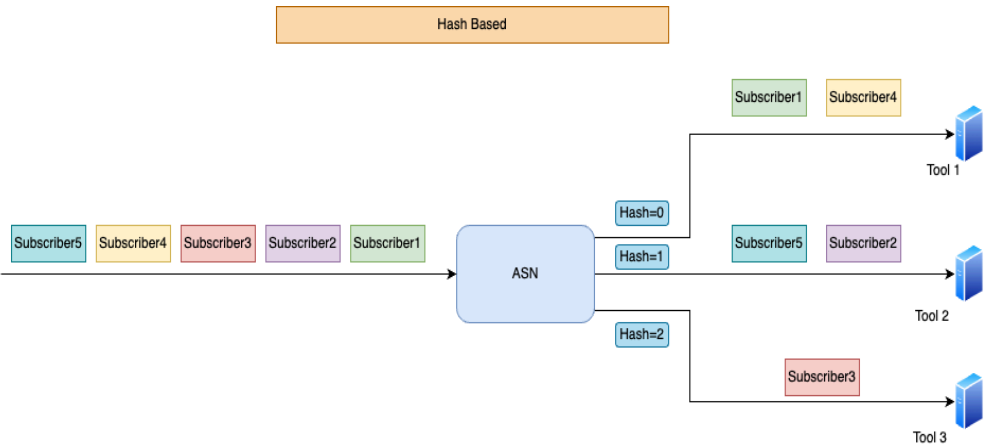
- Subscriber Aware Hash Based Load Balancing: Hash-based method that uniquely associates subscriber flows to tools using extracted parameters and probe count from the core network.
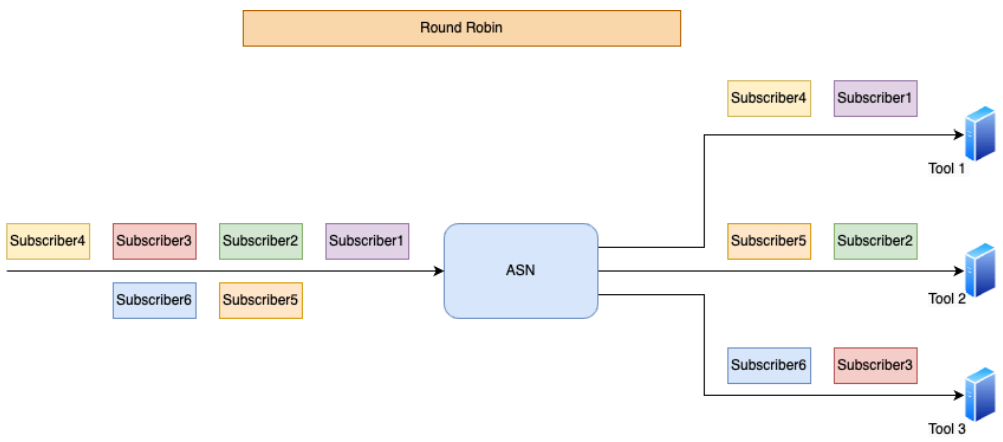
- Subscriber Aware Round Robin Based Load Balancing: Sequential distribution of flows to tools, ensuring even load distribution across all available tools regardless of subscriber parameters.
Subscriber Aware Hash Based Load Balancing
In this method, the control packet is parsed to extract the Subscriber information. The extracted parameters along with the probe count from the core network is employed in a hash function to compute a value that uniquely associates the subscriber flow to a tool. This hash value is established when the first request packet of a subscriber flow is received, and using correlation logic, all subsequent control and user packets associated with the same subscriber are directed to the same tool. This method ensures that traffic from a specific subscriber is consistently sent to the same probe, allowing for efficient and comprehensive analysis.
Subscriber Aware Round Robin Based Load Balancing
Alternatively, the ASN node can distribute control and user packets in a round-robin fashion. This method assigns flows to tools sequentially, ensuring an even distribution of load across all tools, regardless of the numerical value of the parameters extracted in the subscriber info. A hash table is utilized to maintain the tool ID associated with each subscriber, ensuring that all packets from the same subscriber are directed to the same tool throughout the session. This approach balances the network load effectively and is particularly useful in scenarios where elephantine traffic flows are involved.
Conclusion
Subscriber-aware load balancing in ASN nodes is crucial for efficient traffic management and network analysis in advanced telecommunications networks. By offering load balancing based on IMSI and round-robin distribution, network operators can choose the method that best suits their needs, ensuring optimal performance and insightful analytics. The integration of ERSPAN routing enhances the capability to monitor and analyze network traffic, providing a holistic solution for network performance management.
Transform Your Network Today
Contact us now to schedule a demo. Aviz Service Nodes bring precision to your network management, ensuring optimal performance and tailored user experiences.
Contact Us