





Connected Device Security in Healthcare: The Network Traffic Foundation
How packet-level visibility and intelligent traffic delivery strengthen IoMT, medical device, and OT security programs
Modern healthcare runs on devices that cannot defend themselves
A hospital network today connects far more than clinical workstations and EHR servers. Infusion pumps, MRI consoles, ECG monitors, ventilators, imaging archives, lab instruments, badge readers, HVAC controllers, and a growing fleet of cloud-connected telehealth endpoints all generate continuous traffic across the same fabric. Most of these systems cannot host security agents. Many run unsupported operating systems. Almost none can be patched on the same cadence as the IT infrastructure.
The scale is significant. A mid-sized hospital typically has between 10 and 15 connected medical devices per inpatient bed - meaning a 500-bed institution can have 5,000 to 7,500 IoMT devices on its network, in addition to its IT workstations, servers, and facility OT. The largest health systems operate hundreds of thousands. Most of these devices were deployed with clinical safety, not cybersecurity, as the primary design constraint.
Healthcare CISOs know this. The category of Connected Device Security, sometimes called medical device security or IoMT security, has emerged precisely because traditional IT controls do not work for these devices. Armis Centrix, Forescout, Nozomi Networks, Claroty, and Ordr lead this category - providing agentless device discovery, fingerprinting, FDA recall alignment, MDS² ingestion, vulnerability prioritization, and clinical-criticality risk scoring.
What every one of these platforms requires to do their job: the right network traffic, delivered at the right scale, with the right fidelity.
That is where Aviz Deep Network Observability fits.
Where Aviz fits in the connected device security architecture
Aviz does not compete with asset intelligence platforms. Aviz strengthens them. The Aviz Deep Network Observability pipeline Aggregate, Optimize, Enrich, DPU-Native Acceleration, Distribute delivers two outputs that make connected device security work at scale:
Optimized packet streams
Deduplicated, normalized, tunnel-aware traffic delivered to Armis, Forescout, Nozomi, and other asset intelligence platforms. The asset platforms get higher discovery fidelity, lower processing burden, and faster deployment because the traffic they receive is already optimized for their analytics, not raw firehose data from SPAN ports.
Enriched packet metadata
Structured evidence streamed to SIEM, NDR, and compliance platforms, capturing what the asset platforms do not deeply produce: cryptographic posture per device, encrypted-flow patterns, outbound vendor connections, and lateral movement traces.
What this looks like across the device categories
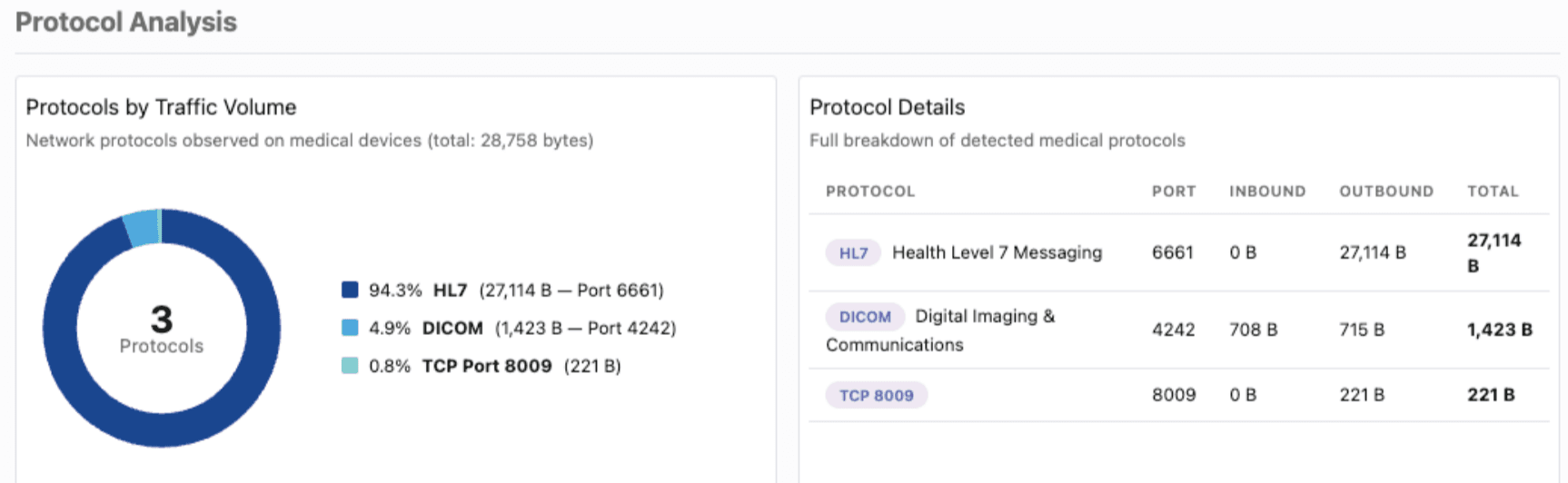
Medical Devices (IoMT)
Infusion pumps, MRI and CT scanners, patient monitors, ventilators, imaging consoles, and lab instruments are the devices most frequently profiled by Armis, Forescout, and Nozomi. Every one of them generates network traffic that carries clinical context HL7 messages for patient data, DICOM transactions for medical imaging, proprietary device-vendor protocols and the asset intelligence platform's job is to turn that traffic into device identity, behavior baselines, and risk scores.
Aviz captures every flow these devices generate and delivers it to the asset intelligence platform optimized for its analytics. On top of that, Aviz produces what the asset platform does not natively derive: cryptographic posture per device, outbound communication patterns (which cloud services each device contacts), and lateral flow evidence (which devices talk to which clinical systems).Together, the institution can answer:"Is this imaging console cryptographically sound, talking only to its sanctioned vendor, and behaving normally relative to its peers?" a question neither tool answers alone.
Facility OT
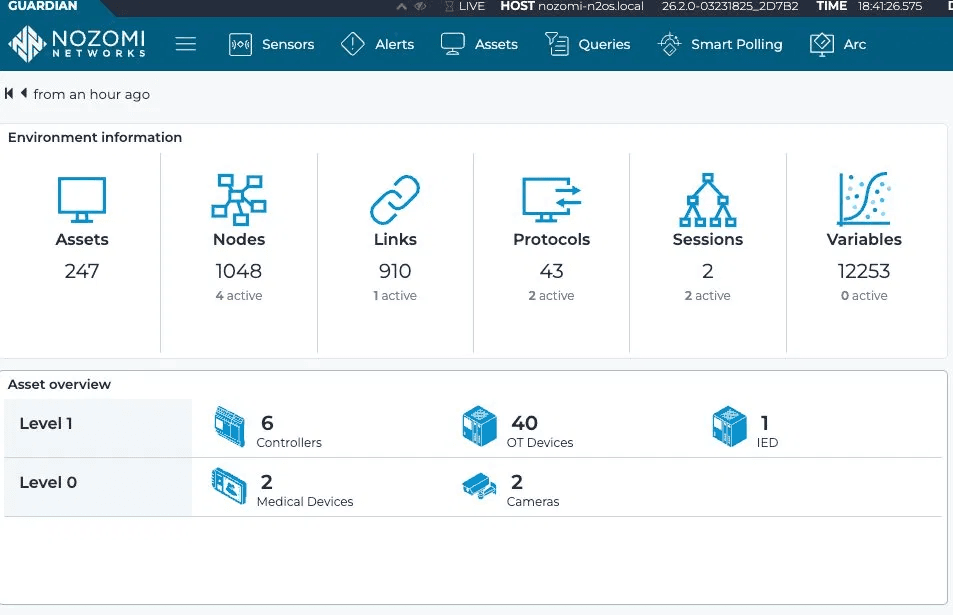
Badge readers, door locks, HVAC controllers, cameras, building management systems, elevator controls, and physical security infrastructure are now squarely part of the healthcare attack surface. HIPAA §164.310(a) Facility Access Controls is increasingly evidenced through the network, because these devices live on the network and their traffic is observable even when their internal logs are not.
Aviz captures the traffic; the asset intelligence platform identifies the device type, manufacturer, and behavior baseline. Nozomi Networks, in particular, brings deep OT-network expertise including the Purdue model leveling that distinguishes Level 0 field devices from Level 1 controllers and beyond. Together with Aviz, the institution gets continuous §164.310(a) evidence without deploying dedicated OT security infrastructure or instrumenting individual facility systems.
Clinical Workstations
EHR-access endpoints, imaging review stations, lab workstations, and clinical mobile devices. Unlike medical devices and OT, these endpoints often can host security agents EDR, DLP, and UEBA tools own the user-and-application policy layer here.
Aviz adds the network-layer behavior dimension: what each workstation talks to, how often, with what encryption posture, and whether outbound flows match the expected clinical pattern. When a clinical workstation begins reaching out to consumer-grade AI services, partner APIs without BAAs, or unsanctioned cloud storage, the network sees it first.
Cloud and Telehealth Endpoints
Cloud-hosted EHRs, telehealth platforms, remote patient monitoring services, and partner cloud integrations. The asset intelligence platforms in this category face a structural challenge most were designed for on-premises networks and now have to extend to hybrid and multi-cloud environments.
Aviz extends the same packet-derived visibility across hybrid, multi-cloud, and Kubernetes environments using SPAN, physical, and virtual taps. The connected device security program does not break at the cloud boundary the traffic foundation is consistent whether the workload runs in the hospital data center, a public cloud VPC, or a Kubernetes cluster.
What this means for the connected device program
Asset intelligence platforms are the right answer for device identity, vulnerability prioritization, criticality scoring, and FDA-aligned compliance dashboards. They are not the right answer for cryptographic hygiene, encrypted-traffic visibility, lateral movement evidence, audit trails, or hybrid-cloud traffic capture and they are only as accurate as the traffic they receive.
A connected device security program that pairs Aviz Deep Network Observability with an asset intelligence platform Armis, Forescout, Nozomi, Claroty, Ordr, or others gets:
Connect with our experts to explore how Aviz can simplify and scale your AI infrastructure