





CISO's Guide to DORA Compliance in Financial Services
How packet-level network visibility closes the DORA compliance gap
DORA Has Made Operational Resilience a Daily Discipline
For decades, European financial regulation graded institutions on capital, liquidity, and conduct. Operational resilience was assumed a footnote in audit reports, a paragraph in board packs. DORA changed that.
Since enforcement began in January 2025, the EU's Digital Operational Resilience Act has placed every regulated financial entity banks, insurers, investment firms, payment institutions, crypto-asset providers, and the critical ICT third-party providers serving them under a unified, technically prescriptive framework for managing ICT risk. The regulation reaches roughly 22,000 entities. The supervisory expectations are explicit, the technical
standards are detailed, and the obligation is continuous, not periodic. For CISOs, DORA is no longer a project to prepare for. It is the framework against which every ICT decision is now graded and the framework auditors and regulators are actively using to question the institution's evidence base.
The challenge for most institutions is not the policies. It is the evidence. DORA assumes the institution can demonstrate, at any moment, what is happening across its ICT estate. That assumption breaks down quickly when the evidence is self-reported logs, agent telemetry from compromised hosts, or third-party attestations updated quarterly.
Where Aviz Fits in a DORA Program
DORA is built on five pillars: ICT risk management, ICT-related incident reporting, digital operational resilience testing, ICT third-party risk management, and information sharing. Aviz Deep Network Observability does not address all five with equal directness, and this guide is honest about that. Aviz strengthens three of the five pillars in particular - the pillars where evidence quality, continuous monitoring, and third-party visibility are foundational:
Pillar 1 - ICT Risk Management
Continuous monitoring across every ICT asset, including East-West and lateral flows that endpoint and gateway tools structurally cannot see.
Pillar 2 - ICT-Related Incident Reporting
Forensic evidence captured out-of-band, independent of any compromised workload, available for incident reconstruction and regulatory reporting within DORA's tight timeframes.
Pillar 3 - ICT Third-Party Risk Management
Continuous visibility into every outbound connection partner APIs, payment networks, cloud providers, AI services turning third-party oversight from contractual assertion into observed reality.
How Aviz DNO produces DORA-aligned evidence
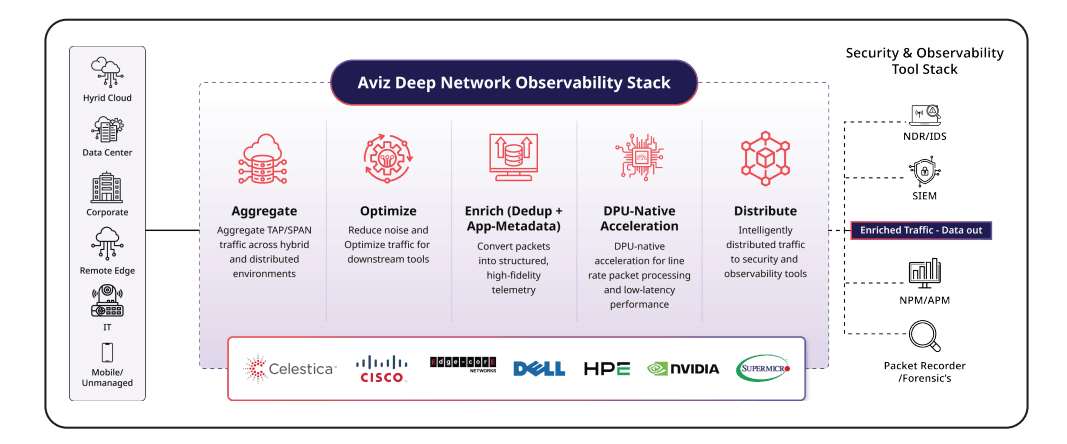
Aviz Deep Network Observability is a five-stage pipeline → Capture → Normalize → Enrich Stream → Integrate - running on open white-box switches and commodity x86 with DPU-native acceleration up to 400G. Traffic is sourced directly from the network fabric itself across on-premises, data centers, hybrid, multi-cloud, Kubernetes, and containerized workloads via SPAN, physical, and virtual taps. The result is structured, packet-level metadata covering every ICT flow on the network captured out-of-band, independent of the workload,
immutable from the moment the session crosses the wire.
Aviz is vendor-agnostic by design and streams enriched metadata in open formats (JSON and Kafka) into whichever observability or SIEM platform the institution already runs Splunk, Elastic, Datadog, Dynatrace, New Relic, Kentik, Chronicle, Sentinel, and others. The DORA evidence the platform generates is the same regardless of where the customer chooses to consume it.
What Aviz Delivers for the DORA-Impacted CISO
The questions below are the ones financial services CISOs ask most often when they are sitting in front of their DORA program - and the ones recent supervisory guidance shows most institutions cannot fully answer today.
Continuous ICT Monitoring Across the environment
"Can I prove our ICT monitoring is genuinely continuous not just point-in-time snapshots?"
DORA's first pillar asks for something most ICT programs are not architected to deliver: continuous visibility into every asset, every flow, and every dependency in the institution's ICT environments. The supervisory expectation is not that the institution monitors most of the time, but that it can demonstrate observation at any moment. For environments spanning on-prem data centers, multiple clouds, Kubernetes clusters, and branch environments, continuous monitoring is structurally hard. Endpoint agents miss workloads they're not installed on. Cloud-native flow logs miss intra-VPC and intra-host traffic. Application logs are self-reported and incomplete.
For a CISO, the gap is not a policy gap. It is an evidence gap - and DORA auditors are increasingly trained to find it.
The cost of getting this wrong:
- Supervisory findings on continuous monitoring obligations under the RTS on ICT Risk Management Framework
- Inability to evidence East-West and lateral activity during routine reviews
- Extended detection windows that breach DORA's 24-hour and 72-hour incident-reporting thresholds
- Fragmented monitoring across tools, with gaps that surface only during incidents
What Aviz DNO delivers. Aviz produces enriched flow metadata through its DPI engine - capturing every flow on the network across hybrid cloud, multi-cloud, on-premises, and Kubernetes environments. Each flow is recorded with a timestamp, source, destination, application, protocol, bytes, and packets, covering both North-South perimeter traffic and East-West lateral movement.
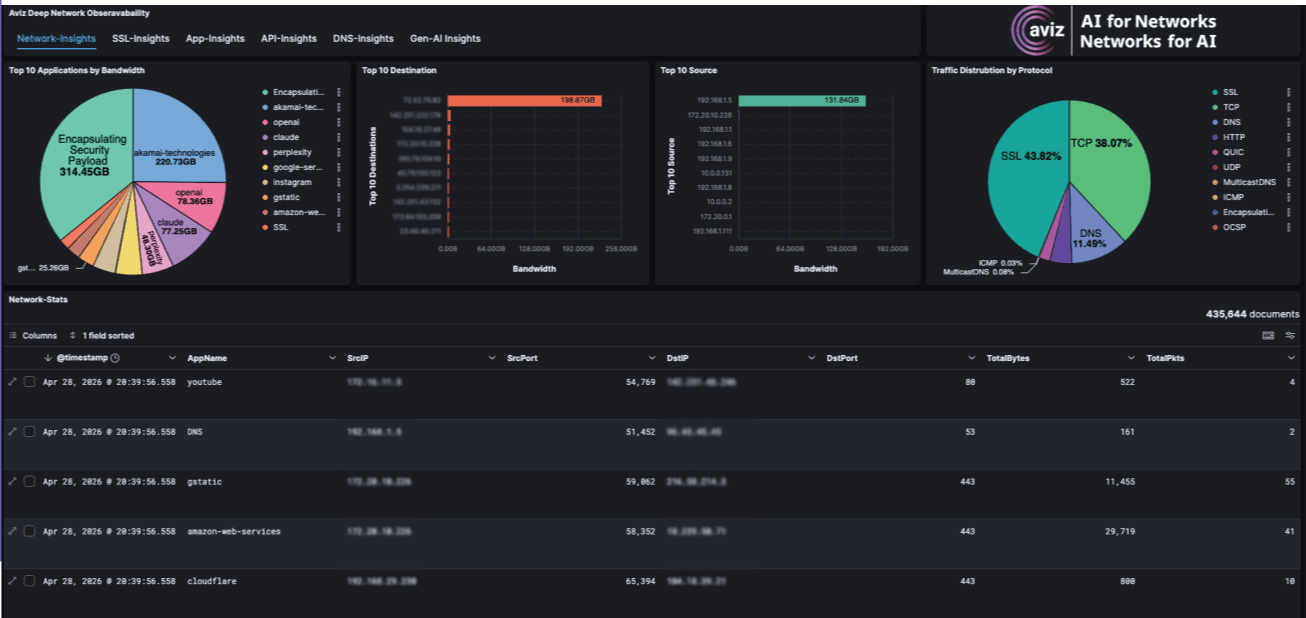
The visibility is continuous by architecture: there are no agents to deploy, no application instrumentation to maintain, and no monitoring gaps when a workload is unhealthy. The metadata streams in open formats into the SIEM or observability platform of choice - visualized in the Aviz Network-Insights dashboard or rebuilt anywhere consuming JSON or Kafka.
Why this matters for the CISO: Continuous ICT monitoring under DORA is not a feature that the institution claims. It is a property the institution demonstrates every day, across every environment. With Aviz, that demonstration becomes a continuously observed fact rather than a quarterly assertion.
Forensic Evidence That Survives a Compromise
"Can I reconstruct an ICT incident if the compromised system's logs are missing or modified?"
DORA's second pillar requires institutions to detect, contain, report, and recover from ICT-related incidents and to do all of it within tight regulatory windows. Major incidents must be classified within 24 hours, initial reports filed within 24 hours of classification, and intermediate reports within 72 hours. Each report must include forensic detail: what happened, when, how, with what impact.
The problem most incident-response teams know but rarely say out loud: the systems compromised in the incident are also the systems whose logs you're now relying on to reconstruct it. Application logs can be modified. Endpoint agents can be disabled. Audit trails on a compromised workload are not trustworthy after the fact. DORA implicitly assumes and supervisors increasingly require forensic evidence captured independently of the systems that may have been touched.
What Aviz DNO delivers. Aviz produces packet-derived forensic evidence captured out-of-band independent of any workload, immutable from the moment the session crosses the wire, and continuously streamed into the SIEM and forensic evidence store. Every API call, every TLS session, every DNS query, every flow across the environment is recorded with full context: timestamp, source, destination, protocol, application, bytes, headers. When an incident occurs, the IR team is not reconstructing from compromised logs they are querying an independent, tamper-resistant evidence layer captured at the network. Available for the entire investigation window, structured for export, and consumable in any SIEM.
The cost of getting this wrong:
- Missed regulatory reporting deadlines (24-hour, 72-hour, and one-month thresholds)
- Forensic reports built on partial or potentially tampered evidence
- Reputational and supervisory exposure when post-incident reviews surface visibility gaps
- Extended dwell time and recovery windows because the IR team is reconstructing rather than analyzing
Why this matters for the CISO. DORA's reporting timelines are unforgiving. The institution that can produce forensic evidence within hours and defend its provenance is the institution that meets the deadline. With Aviz, incident reconstruction stops depending on the integrity of the systems that just failed.
Third-Party ICT Oversight, Including AI Services
"Do I know every third-party our data is flowing to including the ones nobody asked permission for?"
Pillar 4 is the dimension of DORA that has caught the most institutions flat-footed. Demonstrable oversight of every critical ICT third-party provider including sub-contracting chains, cloud providers, payment networks, fintech connectors, and AI services is a regulatory requirement, not an optional governance practice. Most institutions discovered during their first DORA gap analyses that their third-party register was incomplete, their data flow maps were aspirational, and their outbound connections were not continuously monitored.
The challenge is not a missing policy. It is missing visibility particularly into the third-party connections that did not go through a formal procurement or DPIA process. Generative AI services are the sharpest current example: developers and employees consuming public AI services from corporate networks, often without IT awareness, moving sensitive data across a third-party boundary that was never reviewed.
What Aviz DNO delivers. Supervisory findings on the ICT third-party register and outsourcing oversight. Sensitive data flowing to unsanctioned third-party services with no audit trail. Vendor-risk programs operating on contractual attestations rather than observed reality. Reputational and regulatory exposure when an unmonitored third-party is compromised, and the institution cannot quantify the data flow.
The cost of getting this wrong:
- Supervisory findings on the ICT third-party register and outsourcing oversight
- Sensitive data flowing to unsanctioned third-party services with no audit trail
- Vendor-risk programs operating on contractual attestations rather than observed reality
- Reputational and regulatory exposure when an unmonitored third-party is compromised, and the institution cannot quantify the data flow
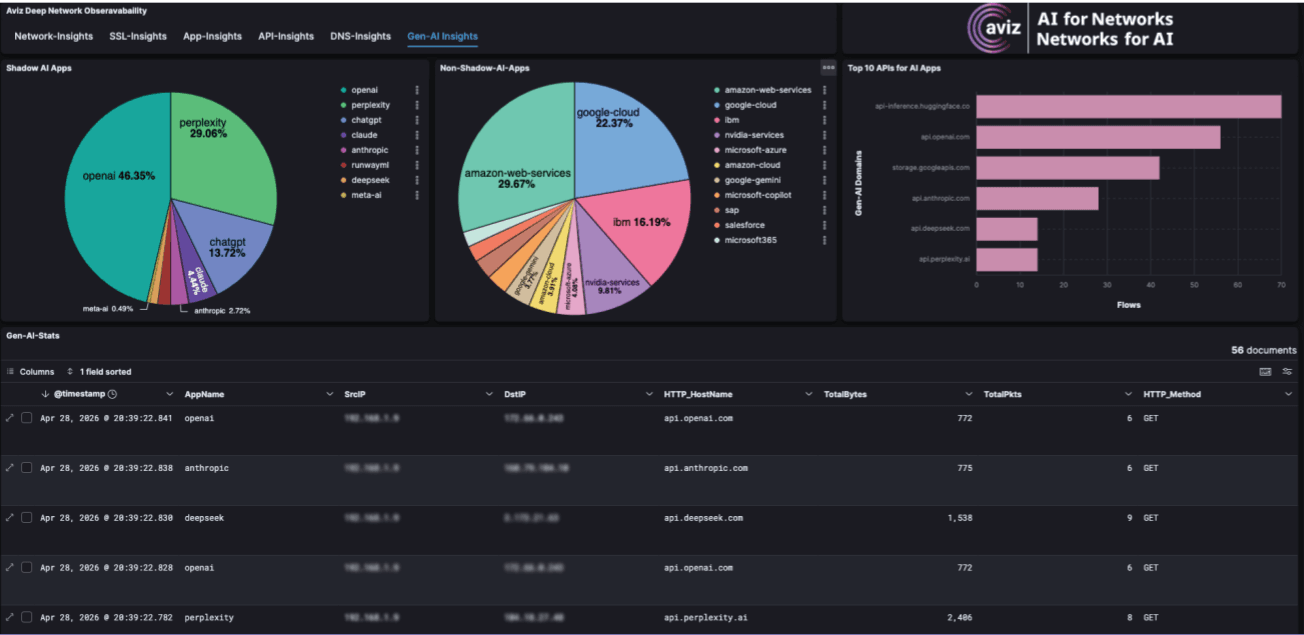
Why this matters for the CISO. DORA third-party oversight cannot be evidenced from contracts alone. With Aviz, the third-party register is no longer a quarterly self-report it is a continuously observed map of every external connection the institution actually has, AI services included.
Cryptographic Hygiene Across Every ICT Asset
"Can I evidence that encryption is enforced across every system, every endpoint, and every API?"
DORA's ICT risk management framework expects institutions to maintain demonstrable cryptographic controls across the entire ICT estate. Encryption-in-transit is one of the most-cited supervisory expectations under the RTS on ICT Risk Management and one of the most under-evidenced controls in practice. Each new ICT asset added to the estate is another TLS configuration to validate, another certificate to renew, another cipher suite to verify.
For a CISO, this concern is operational and reputational at once. The 94%-expired-certificate problem hidden inside most environments is a DORA finding, an outage waiting to happen, and a board-level concern all in one.
What Aviz DNO delivers. Aviz produces enriched SSL metadata through its DPI engine recording every TLS session crossing the network with App Server IP, SNI, version, issuer, common name, expiry, and flow count. Three views answer the cryptographic question completely: TLS version distribution across all assets, cipher suite ranking showing what is actually negotiated session-by-session, and certificate status broken down into valid, expired, and self-signed buckets. Weak protocols, deprecated ciphers, and expiring certificates are flagged the moment they appear visualized in the Aviz SSL-Insights dashboard or any platform of choice.
The cost of getting this wrong:
- Supervisory findings on encryption-in-transit and certificate management under the RTS on ICT Risk Management
- Customer-facing outages caused by expired or revoked certificates on critical ICT services
- Exposure to known cipher vulnerabilities long after they were disclosed
- Cross-cutting compliance gaps with PCI-DSS 4.0, GDPR, and regional banking frameworks that share these requirements
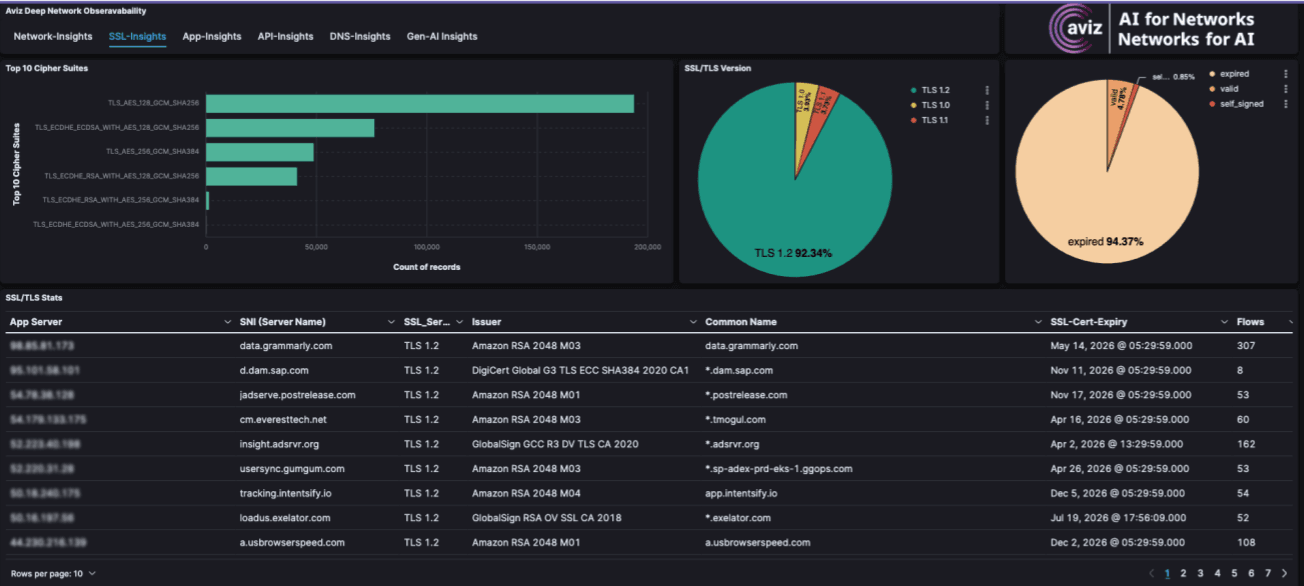
Why this matters for the CISO. Cryptographic posture is one of the rare areas where DORA, PCI-DSS, GDPR, and most regional regulations all converge on the same requirement. A continuously observed cryptographic evidence layer satisfies all of them at once turning what is usually a quarterly scramble into a passive, always-on stream of evidence.
Real-Time Detection That Beats the Reporting Window
"Can I detect an ICT incident fast enough to meet DORA's reporting deadlines and trace it accurately?"
DORA Pillar 2 incident reporting deadlines are tight: 24 hours to classify a major incident, 24 hours after that to file initial notification, 72 hours for an intermediate report. Behind these deadlines is an assumption: the institution can detect, classify, and characterize the incident in time. For most ICT incidents, that require real-time visibility into authentication anomalies, behavioral attacks, lateral movement, and outbound exfiltration - not a forensic reconstruction days later.
The reality is that behavior-based ICT attacks now dominate the threat landscape. Credential abuse, scraping, business logic exploitation, and lateral movement all happen at the application and network layer in real time, and they look like legitimate traffic to most rule-based controls. Without rich, packet-derived signals, the institution discovers the incident from the customer or the regulator rather than from its own systems.
What Aviz DNO delivers. Aviz produces enriched HTTP, DNS, and flow metadata through its DPI engine recording every transaction, every name resolution, and every connection with full context. Three classes of behavioral signal become immediately visible: HTTP error spikes indicating credential abuse or brute force; anomalous DNS queries signaling beaconing, data exfiltration via DNS, or contact with newly registered domains; and unusual flow patterns revealing lateral movement, SSRF exploitation, or volumetric abuse. The metadata feeds the SIEM, NDR, and detection platforms that turn these signals into action - visualized in the Aviz App-Insights, DNS-Insights, and Network-Insights dashboards or rebuilt anywhere.
The cost of getting this wrong:
- Missed DORA reporting deadlines that escalate supervisory attention
- Public disclosure that the institution was unaware of an incident already known externally
- Forensic gaps that prevent the classification of incident severity within regulatory windows
- Customer trust erosion when incidents become public before institutional response
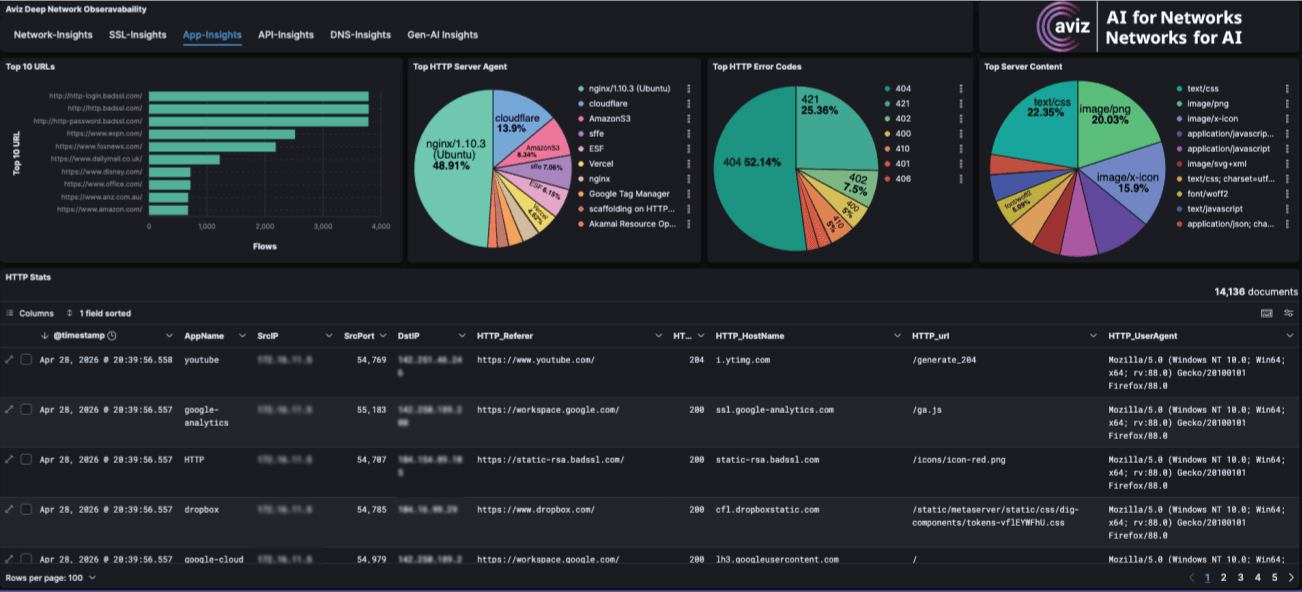
Why this matters for the CISO. DORA reporting deadlines are not negotiable. The institution that detects, classifies, and characterizes an incident from continuous packet evidence is the institution that meets the deadline confidently. With Aviz, detection and reconstruction happen on the same evidence layer closing the gap between what happened and what gets reported.
What this means for your DORA program
DORA elevated operational resilience from a good practice to a regulatory baseline. The institutions that will pass supervisory scrutiny over the next three years are those that treat continuous, packet-derived evidence as the foundation of their ICT risk and incident-reporting programs not as a feature, but as the substrate every other DORA capability runs on.
With that foundation in place, every other DORA dimension gets stronger: ICT monitoring becomes continuous by architecture, incident reporting
becomes timely and defensible, third-party oversight becomes observed reality rather than contractual assertion, cryptographic posture becomes an always-on evidence stream, and real-time detection meets the reporting deadlines.
DORA imposes. DORA does not name a specific technology. It specifies an outcome: continuous, evidenced, demonstrable resilience. Packet-derived visibility is the most direct path to that outcome.
See it on your traffic. Bring a day of real packet captures to the Aviz ONE Center. We will stand up the full Aviz DNO pipeline on your actual traffic profiles and walk you through the exact DORA evidence the platform generates — across your hybrid cloud, data center, third-party connections, and AI service consumption.