





CISO's Guide to API Security in Financial Services
How packet-derived evidence powers modern API defense for banks, insurers, and payment institutions
APIs Have Outgrown the Controls Protecting Them
APIs are now the connective fabric of every financial transaction. They link core banking systems with digital channels, insurers with partner networks, payment switches with fintech ecosystems, and every internal microservice with the next. They are also the fastest-growing attack surface in the industry.
Akamai documented 150 billion API attacks globally between January 2023 and December 2024, with 87% of organizations experiencing an API security incident in 2025, and daily API attacks per organization surging 113% year-over-year. According to the May 2024 Gartner Market Guide for API Protection
The average API breach leads to at least 10 times more leaked data than the average security breach.
The number that should worry every CISO: only 27% of enterprises have a complete API inventory that also identifies which APIs return sensitive data - down from 40% the year before. Radware's research adds a sharper edge: 84% of credential-stuffing scripts now target API endpoints, 26% of API-targeted attack configurations focus on older API versions, and only 6% of organizations maintain full documentation of all APIs.
Where Aviz Fits in the API Security Stack
Modern API security is not a single control. It is a layered system, and each component sees a different slice of reality. WAFs inspect North-South traffic in the application path. API gateways enforce policy on registered APIs - authentication, routing, rate limits. API security platforms analyze schemas, behavior, and runtime posture. Agents and MELT data reflect what applications choose to expose. Each is necessary. Each is scoped by design - to traffic that passes through it, workloads where it is deployed, or APIs that are formally registered.
Aviz Deep Network Observability operates below and across these controls, not in competition with them. The architecture is built to source traffic directly from the network fabric itself - across data centers, hybrid, multi-cloud, Kubernetes, and containerized workloads via SPAN, physical, and virtual taps as illustrated on Figure 1. This is not a single insertion point. It is a distributed collection layer across every environment where APIs exist.
Because of this, Aviz observes what no single perimeter or registered-traffic control can see on its own: North-South traffic alongside the WAF; East-West service-to-service API calls that workload-to-workload conversations and container-to-container flows are made of; shadow and unmanaged APIs that never registered with a gateway; and outbound API consumption, including third-party services and AI endpoints.
How Aviz DNO produces API-aware evidence
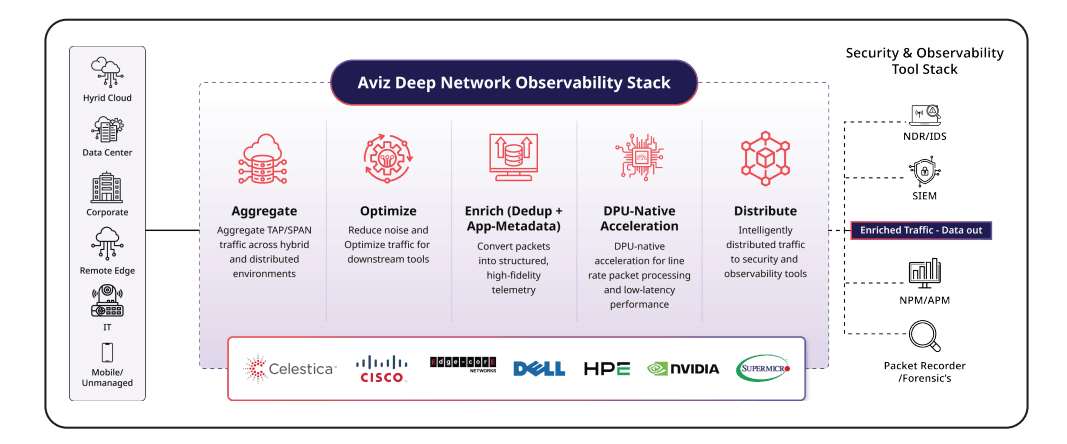
Aviz Deep Network Observability is a five-stage pipeline → Capture → Normalize → Enrich → Stream → Integrate - running on open white-box switches and commodity x86 with DPU-native acceleration up to 400G. TAP or SPAN traffic from hybrid cloud, data center, branch, and IT/OT is normalized, enriched with Deep Packet Inspection, and converted into structured, packet-level metadata - including HTTP method, URL, host, headers, response codes, TLS version and cipher, source and destination, bytes, and timing for every API call.
Aviz is vendor-agnostic by design and streams
enriched metadata in open formats (JSON and Kafka) into whichever observability or SIEM platform you already run - Splunk, Elastic, Datadog, Dynatrace, New Relic, Kentik, Chronicle, Sentinel, and others. The dashboards shown in this guide can be rebuilt natively in any of these platforms - the visualizations are downstream of the metadata, not the other way around. For customers who want a turnkey experience, Aviz also offers an Elastic Node visualization platform bundled with the pipeline. The packet-derived metadata and the API security evidence it produces are the same either way.
What Aviz Delivers for the CISO
The five questions below are the ones financial services CISOs ask most frequently - and the ones that recent industry research shows most institutions cannot fully answer today. For each, the same architecture applies: enriched packet metadata from the Aviz DPI engine, streamed in JSON formats, visualized in the Aviz dashboards or any SIEM and observability platform of choice.
Every API across the Estate
"Show me every API across our entire infrastructure - including the ones we forgot about."
For most financial institutions, the honest answer to this question is no, we cannot. APIs proliferate faster than the inventory processes that are supposed to track them. Shadow APIs accumulate during sprints. Old versions live on as zombies long after the migration was supposed to be complete.
Third-party integrations get demoed, deployed, and forgotten. The result is an estate that looks complete in the documentation and is full of holes in production - and recent industry research keeps surfacing the same uncomfortable pattern: leadership reports a complete inventory, while the AppSec team on the ground knows it isn't.
This concern is no longer just an AppSec problem. It is the first question regulators ask, the first finding auditors flag, and the first vector attackers probe.
The cost of getting this wrong:
- Audit findings on inventory completeness, scope definition, and third-party attestations
- Manual discovery cycles that consume weeks of analyst time and are stale before they're filed
- Surprise incidents on endpoints nobody was monitoring - and the forensic bills that follow
- Regulatory exposure when an undocumented API turns out to handle sensitive data
What Aviz DNO delivers. Aviz produces enriched API metadata through its DPI engine - observing every API on the wire across hybrid cloud, multi-cloud, on-premises data centers, and Kubernetes environments. The metadata captures every API call by version (v1, v2, v3, and beyond), URL, app server, source, destination, and traffic volume - and streams in open formats (JSON, Kafka) into the SIEM or observability platform of choice.
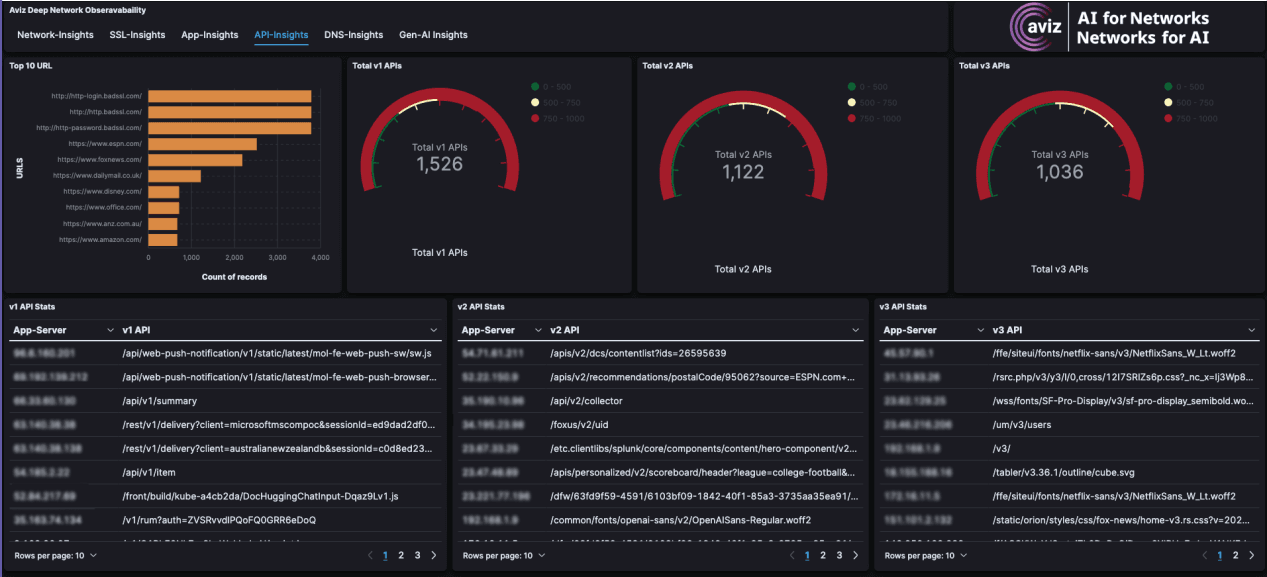
Three patterns become immediately visible: zombie versions still serving production traffic, shadow endpoints that never registered with the gateway, and drift between the documented inventory and the actual on-the-wire estate. Visualized in the Aviz API-Insights dashboard or rebuilt natively in Splunk, Elastic, Datadog, or any preferred platform - the underlying evidence is the same (addresses OWASP API9 - Improper Inventory Management, and scope-review obligations under PCI-DSS 4.0, DORA, and most banking regulations).
Why this matters for the CISO. Inventory is the foundation that every other API security capability stands on. You cannot secure what you cannot see; you cannot evidence what you cannot inventory; you cannot defend what you have not catalogued. With Aviz, the answer to "show me every API" moves from a quarterly self-assessment to a continuously observed fact.
Cryptographic Posture, Continuously
"Prove our APIs are cryptographically sound - every endpoint, every cipher, every certificate."
This is the question every auditor opens with, every regulator weighs heavily, and every CISO answers with quiet anxiety. Cryptographic hygiene on APIs is one of the most-cited audit findings in financial services - not because institutions don't take it seriously, but because the surface is too large to track manually. Each new API endpoint is another TLS configuration to validate, another certificate to renew, another cipher suite to verify. Most institutions know what their policy says. Far fewer can prove what their production traffic actually negotiates.
For a CISO, this isn't an abstract concern. The 94%-expired-certificate problem hidden inside most environments is a regulatory finding, an outage waiting to happen, and a board-level reputational risk all at once.
What Aviz DNO delivers. Aviz produces enriched SSL metadata through its DPI engine - recording every TLS session crossing the network with App Server IP, SNI, version, issuer, common name, expiry, and flow count. Three views answer the cryptographic question completely: TLS version distribution across all API endpoints, cipher suite ranking showing what is actually negotiated session-by-session, and certificate status, breaking down every certificate observed into valid, expired, and self-signed buckets. Weak protocols, deprecated ciphers, and expiring certificates are flagged the moment they appear. The metadata is consumable in the Aviz SSL-Insights dashboard or any platform of choice - the audit artifact filtered to scope, exported, and signed off (addresses OWASP API8 - Security Misconfiguration, and PCI-DSS 4.0 Req 4 in full).
The cost of getting this wrong:
- Audit findings on PCI-DSS 4.0 cryptography requirements (Req 4.2.1, 4.2.1.1, 8.3.2, 12.3.3)
- Customer-facing outages caused by expired or revoked certificates on critical APIs
- Exposure to known cipher vulnerabilities long after they were disclosed and fixed
- Compliance breaches under DORA, GDPR, and regional banking frameworks that require demonstrable cryptographic controls
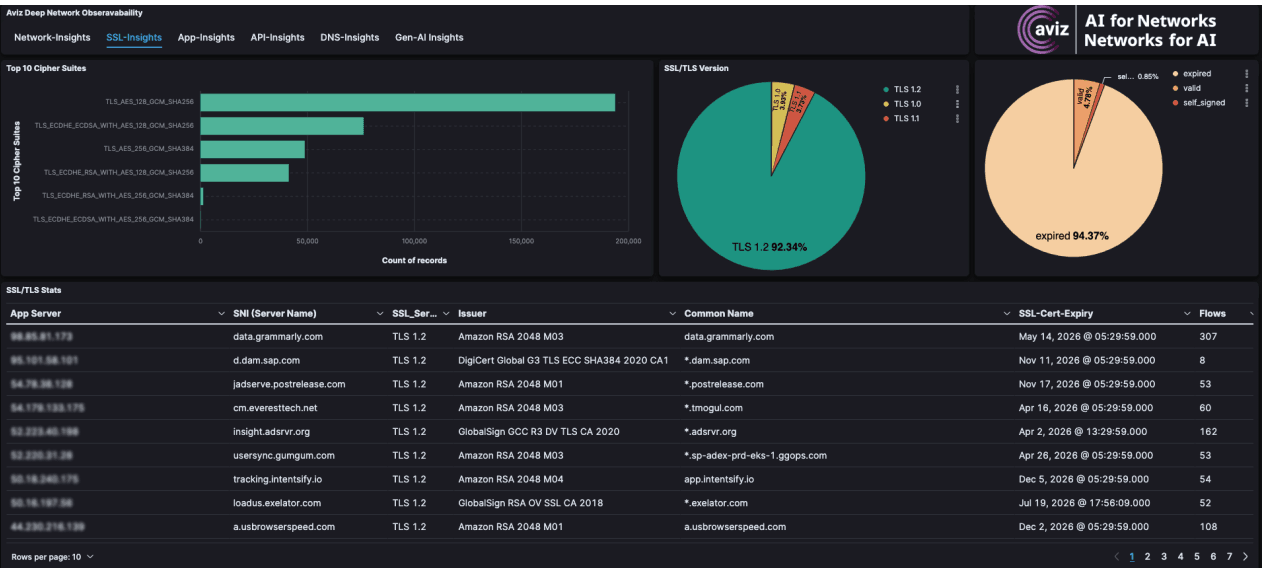
Why this matters for the CISO. Cryptographic posture is one of the rare areas where compliance and operational risk fully overlap. A continuously observed view of TLS, ciphers, and certificate health closes both gaps at once - turning what is usually a quarterly scramble into a passive, always-on stream of evidence.
Real-Time API Behavior
"Tell me what's actually happening on our APIs right now - before fraud or the regulator does."
This is the question that separates institutions with mature API security programs from those that simply have API security tools. A CISO can know how many APIs exist, can know they're cryptographically sound, and still not know what is happening on them at any given moment. Authentication abuse, credential stuffing, scraping, and behavioral attacks all happen at the API layer in real time - and they look like legitimate traffic to most rule-based controls. Industry data shows behavior-based attacks now account for the majority of API incidents, and the numbers are climbing.
For a CISO, the cost of being late to this evidence is not theoretical. It is fraud losses booked, customers compromised, and regulators asking why the institution did not see what was already in the data.
What Aviz DNO delivers. Aviz produces enriched HTTP metadata through its DPI engine - recording every HTTP transaction with timestamp, source IP, hostname, URL, response code, content-type, and user agent. Three behavioral signals become immediately visible: HTTP error spikes (a sudden rise in 401s or 403s indicating credential stuffing or brute force), unexpected response codes (suggesting broken authentication or authorization logic), and anomalous user-agent and request patterns (signaling bot or automation abuse). The metadata feeds the SIEM, NDR, and fraud platforms that turn these signals into action - visualized in the Aviz App-Insights dashboard or rebuilt anywhere consuming JSON or Kafka (addresses OWASP API2 - Broken Authentication and API4 - Unrestricted Resource Consumption).
The cost of getting this wrong:
- Account takeover and fraud losses that surface only after damage is done
- Reactive - not proactive - incident response, with extended time-to-detection
- Audit findings on continuous monitoring obligations (PCI-DSS Req 10, DORA ICT monitoring)
- Reputational and regulatory exposure following any public API incident
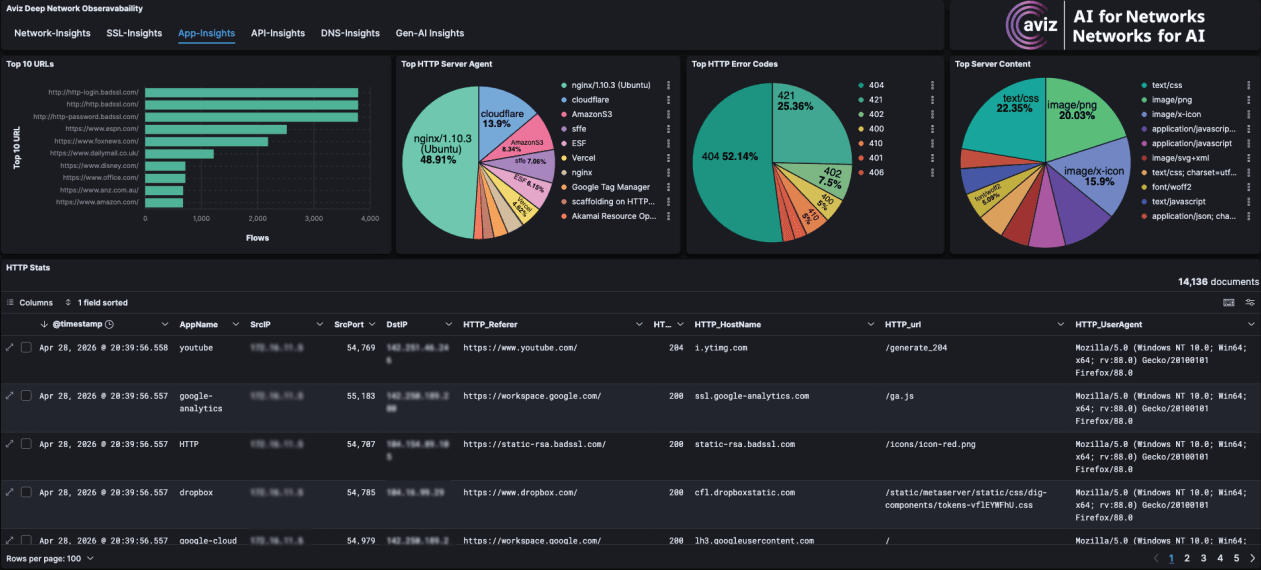
Why this matters for the CISO. Real-time API behavior is the difference between an incident the institution catches early and one the regulator or the customer surfaces first. With wire-level evidence flowing into existing detection engines, the SOC and fraud teams operate from a single source of ground truth instead of stitching together partial signals from gateway logs and endpoint agents.
East-West and Lateral Movement
"Show me what's moving laterally inside our environment - including SSRF and threats no perimeter tool sees."
The most damaging incidents in financial services do not arrive at the perimeter. They emerge inside it - when an already-compromised workload starts reaching out to places it should never reach, when a microservice begins making API calls outside its normal pattern, when SSRF exploitation triggers an internal app server to query cloud metadata endpoints. By the time the perimeter sees the impact, the attack has already moved. East-West visibility is no longer a nice-to-have; it is the question regulators and incident-response teams ask first when they want to understand what really happened.
For a CISO, this concern lives at the intersection of cyber resilience, DORA, and modern incident response. Without lateral visibility, an institution is responding to the symptom rather than the source.
What Aviz DNO delivers. Aviz produces enriched flow metadata through its DPI engine - capturing every flow on the network across hybrid cloud, multi-cloud, on-premises, and Kubernetes environments. Each flow is recorded with timestamp, source, destination, application, protocol, bytes, and packets - covering both North-South perimeter traffic and East-West lateral movement. Two patterns particularly matter to API security: outbound calls from internal app servers to unexpected destinations (the wire-level fingerprint of SSRF exploitation), and anomalous flow rates against specific endpoints (the network signature of resource consumption abuse). Both surface in real time, with full forensic context - visualized in the Aviz Network-Insights dashboard or any platform of choice (addresses OWASP API4 - Unrestricted Resource Consumption and API7 - Server-Side Request Forgery).
The cost of getting this wrong:
- Lateral movement during incidents goes undetected until significant damage is done
- DORA ICT-monitoring and incident-forensics obligations cannot be evidenced
- Audit findings on continuous network monitoring and segmentation testing
- Extended mean-time-to-detect on internal threats that perimeter tools structurally cannot see
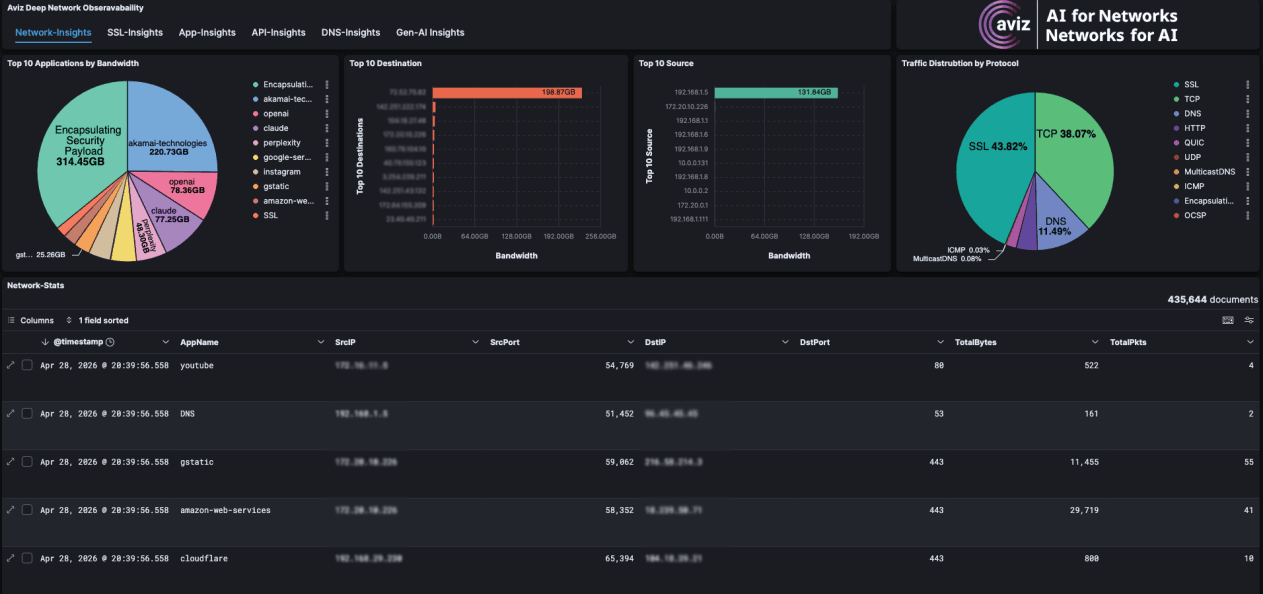
Why this matters for the CISO. East-West visibility is the difference between an incident that the institution understands and one it merely survives. With wire-level evidence covering both perimeter and lateral flows, the security team has the forensic depth to investigate, contain, and explain - before the regulator asks for that explanation in writing.
Outbound APIs and Shadow AI
"Tell me where our data is going - including the AI services our developers never asked permission to use."
This is the question that has moved fastest up the CISO concern list in the past two years. Financial institutions consume third-party APIs at an accelerating pace - fintech connectors, payment networks, identity services, partner banks, and increasingly, generative AI services. The risk profile of AI consumption is unlike anything before it. Developers paste proprietary code into AI assistants to debug them. Employees paste customer correspondence into chatbots to summarize it. Applications and microservices get integrated with AI APIs without going through procurement, security review, or DPIA. None of this shows up in conventional DLP or CASB telemetry, because the traffic moves over encrypted channels from managed and unmanaged devices alike.
For a CISO, this concern is no longer hypothetical. DORA explicitly requires demonstrable third-party ICT oversight. GDPR and regional privacy frameworks demand visibility into where personal data is transmitted. AI governance frameworks - emerging globally - assume the institution can answer the most basic question: which AI services has our data reached, and how much?
What Aviz DNO delivers. Aviz produces enriched Gen-AI metadata through its DPI engine - capturing every outbound API call from internal systems and separating traffic into two cleanly labeled categories: sanctioned services (consumption through approved cloud providers and enterprise SaaS platforms - AWS, Azure, GCP, Microsoft 365) and unsanctioned services - the public consumer-grade and developer-grade AI services accessed directly from corporate networks: ChatGPT, Claude, Perplexity, DeepSeek, Meta-AI, and any new AI tool that emerges next quarter.
The cost of getting this wrong:
- Sensitive data - source code, customer records, PII, credentials - leaks into public AI models with no path to retrieval
- DORA, GDPR, and AI-governance audit findings on third-party data flows
- Reputational exposure when a developer's AI prompt becomes the next viral data-leak headline
- Vendor-risk programs operate on contractual assumptions, while observed reality moves elsewhere
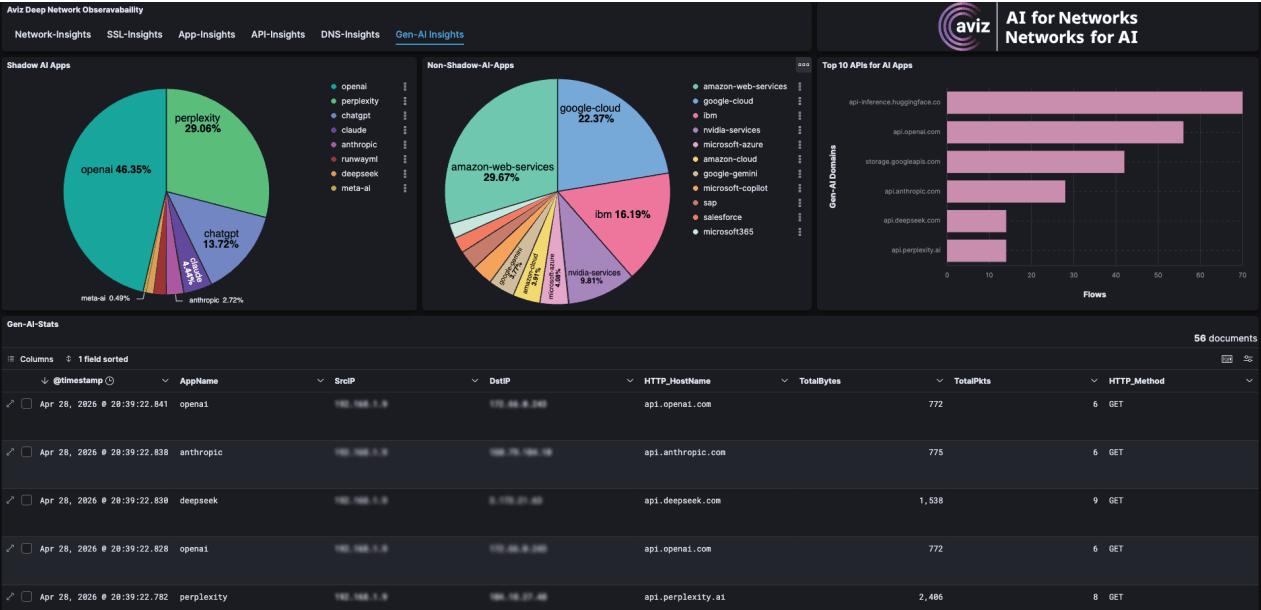
Every session is recorded at the network layer with timestamp, source IP, destination, hostname, bytes, and HTTP method - answering not just that AI is in use, but which services, from which hosts, by which volume. Critically, this visibility holds whether the user is on a managed device, an unmanaged device, or a personal device on corporate Wi-Fi - visualized in the Aviz Gen-AI Insights dashboard or any platform of choice (addresses OWASP API10 - Unsafe Consumption of APIs, and DORA, GDPR, and AI-governance third-party obligations).
Why this matters for the CISO. Shadow AI is the single fastest-growing exposure surface in financial services today, and the one most CISOs cannot currently quantify. With Aviz, "are our developers leaking data into AI?" moves from a question the CISO dreads being asked to a question the CISO can answer with continuously observed evidence.