




Why the AI Era Needs a New Network Software Stack - 6 Reasons
 June 9, 2026
 AI Factory
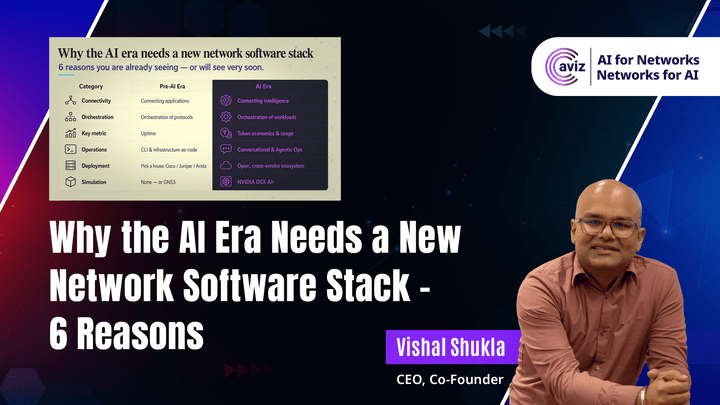
For the last two decades, networks were built to do few things well: connect applications and keep them up. Five-nines. Clean configs. Stable protocols. Trusted vendor stacks.
That job is not gone but AI has added a much bigger one.
The cables may look the same, but what we expect from the network has changed completely. In the AI era, the network is no longer just transport. It is part of the AI runtime.
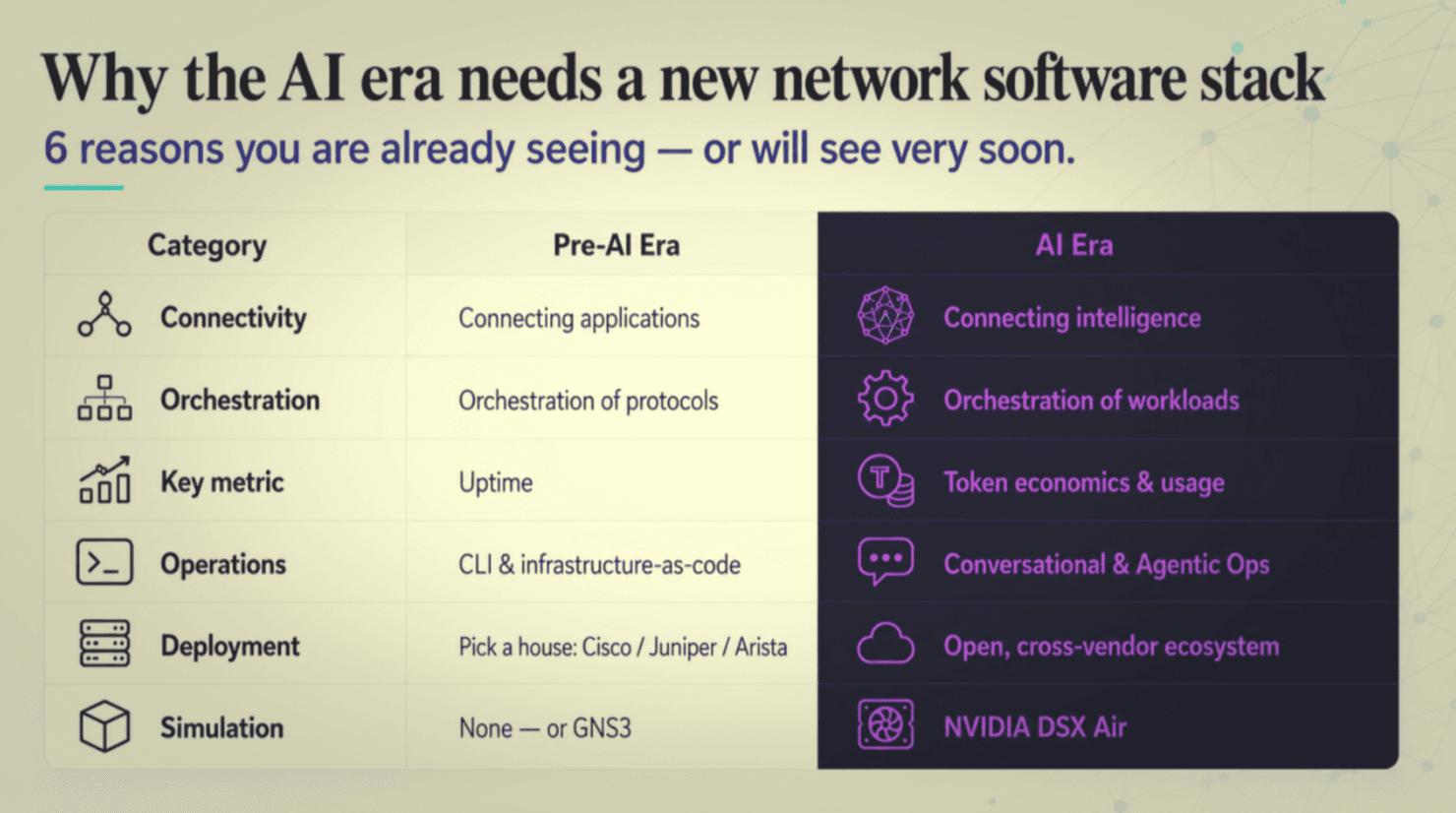
Here are the six shifts we see happening:
1. From connecting applications to connecting intelligence Traditional traffic was about users reaching applications. AI traffic is about GPUs, models, data, and distributed compute working together. The network is now part of how intelligence is built and delivered.
2. From protocol orchestration to workload automation It is no longer enough to configure thousands of protocols that only carry networking context. AI infrastructure needs tenants, policies, isolation, and resources to be created and changed on demand in the context of the workload.
3. From uptime to usage economics For years, the primary question was: "Is the network up?" Now the question is: "Who is consuming what, how much, and at what cost?" In AI infrastructure, token economics, GPU utilization, workload placement, and network usage are all connected.
4. From CLI to conversation The next generation of NetOps will not be driven only by commands and dashboards. Operators will ask the network questions in plain language, get correlated answers, and take action through AI agents.
5. From single-vendor stacks to open, multi-vendor ecosystems All the competitors of the past are now collaborating for AI Factories. AI infrastructure spans silicon, switches, optics, network operating systems, clouds, and orchestration layers. The stack has to work across vendors without locking customers into one house.
6. From lab testing to living digital twins AI networks cannot be deployed with a "push and pray" model. They need to be simulated, validated, and optimized before production. Platforms like NVIDIA DSX Air make it possible to test real deployment scenarios before the first switch is touched.
Here is the real challenge:
These shifts cannot simply be bolted onto a networking stack designed for a legacy era.
AI needs one integrated stack that can connect intelligence, automate tenants, understand usage, operate conversationally, support multi-vendor infrastructure, and validate designs in a digital twin.
That is why networking is hot again.
After years of being treated as plumbing, the network is back at the center of infrastructure strategy. GPUs may get the headlines, but the network determines whether AI infrastructure actually performs.
At Aviz, this is the problem we are focused on: building a cross-vendor networking stack for the AI era one that works across the infrastructure customers already own, brings AI into operations, and proves deployments before they reach production.
Frequently Asked Questions
Why is the traditional network stack no longer enough for the AI era?
For two decades, networks were built to connect applications and keep them up. AI changed the job entirely. The network is now part of how intelligence is built and delivered, not just how data moves. Bolting AI requirements onto a legacy stack does not work because the stack was never designed for any of what AI actually needs.
How is AI traffic different from traditional application traffic on a network?
Traditional traffic was users reaching applications. AI traffic is GPUs, models, data, and distributed compute all working together at the same time. The network is not just moving bytes between endpoints anymore. It is part of the AI runtime itself and has to behave accordingly.
Why has the primary network question shifted from uptime to usage economics?
In the legacy era the only question that mattered was whether the network was up. In AI infrastructure, token economics, GPU utilization, workload placement, and network usage are all connected. The real question now is who is consuming what, how much, and at what cost.
What does operating the network conversationally actually mean for NetOps teams?
The next generation of NetOps will not be driven only by commands and dashboards. Operators ask the network questions in plain language, get correlated answers back, and take action through AI agents. CLI is not disappearing but it is no longer the primary way people interact with infrastructure.
Why do AI networks need digital twins before production deployment?
AI networks cannot go live on a push-and-pray model. They need to be simulated, validated, and optimised before the first switch is touched. Platforms like NVIDIA DSX Air make it possible to test real deployment scenarios in a digital twin so problems get caught before they become production incidents.
Why are vendors who used to compete now collaborating on AI factory infrastructure?
AI factories span silicon, switches, optics, network operating systems, clouds, and orchestration layers all at once. No single vendor covers all of that. The stack has to work across vendors without locking customers into one house, which means former competitors have to collaborate or their customers simply cannot build what AI infrastructure actually requires.
Why does workload automation matter more than protocol orchestration in AI infrastructure?
Configuring thousands of protocols with only networking context is not enough anymore. AI infrastructure needs tenants, policies, isolation, and resources created and changed on demand in the context of the workload running on top. Protocol orchestration was built for a different job and does not map to how AI infrastructure actually operates.
Why is networking back at the centre of infrastructure strategy after years of being treated as plumbing?
GPUs get the headlines but the network determines whether AI infrastructure actually performs. Every shift described, from connecting intelligence to usage economics to multi-vendor ecosystems, runs through the network. After years of being background infrastructure, the network is now a strategic layer that directly affects what AI can and cannot do.
If these thoughts resonate with you and you would like to talk more about this topic, let’s connect


