





Why Aviz Mattered in NVIDIA’s GTC 2026 AI Factory Story
 March 24, 2026
 AI Factory
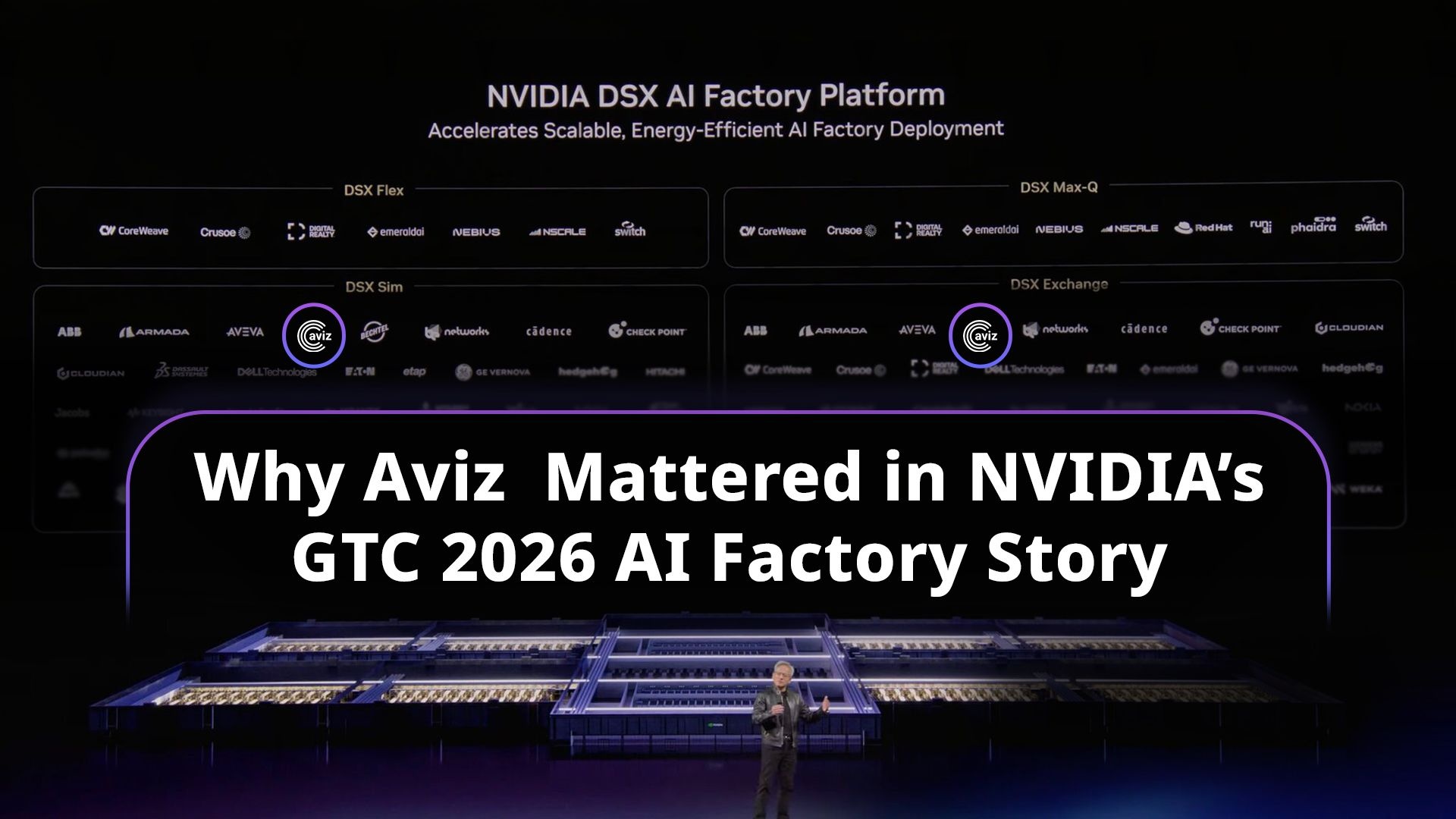
Being part of NVIDIA’s GTC story matters. But the bigger point is not that Aviz showed up. It is why Aviz showed up. At GTC 2026, Jensen introduced the NVIDIA DSX Air as part of the DSX platform, while NVIDIA also unveiled the Vera Rubin DSX AI Factory reference design and Omniverse DSX Blueprint. The message was clear: AI factories are full-stack systems spanning compute, networking, storage, orchestration, security, and operations.
That is exactly where Aviz fits
NVIDIA provides the infrastructure blueprint and the simulation environment. Aviz provides the operational layer that turns that blueprint into something teams can validate, deploy, share, and run at scale. The new ONES-in-DSX Air announcement matters because it changes the operating model. Instead of building first and discovering integration problems later, enterprises and ecosystem partners can design, simulate, and deploy AI factory networking with operational readiness. The workflow Aviz laid out is simple and important: define the design, simulate it end to end in DSX Air, then move into production with repeatable configuration and validated workflows already in place.
That shift-left model is a bigger deal than it sounds. AI factories do not usually break because teams picked the wrong GPU. They break because integration issues show up late, across north-south access, east-west GPU and storage traffic, orchestration layers, and tenant operations. Aviz ONES is explicitly positioned to validate both front-end and back-end fabrics and the surrounding ecosystem of compute, storage, orchestration, servers, NICs, and networking. That is exactly where production risk tends to hide.
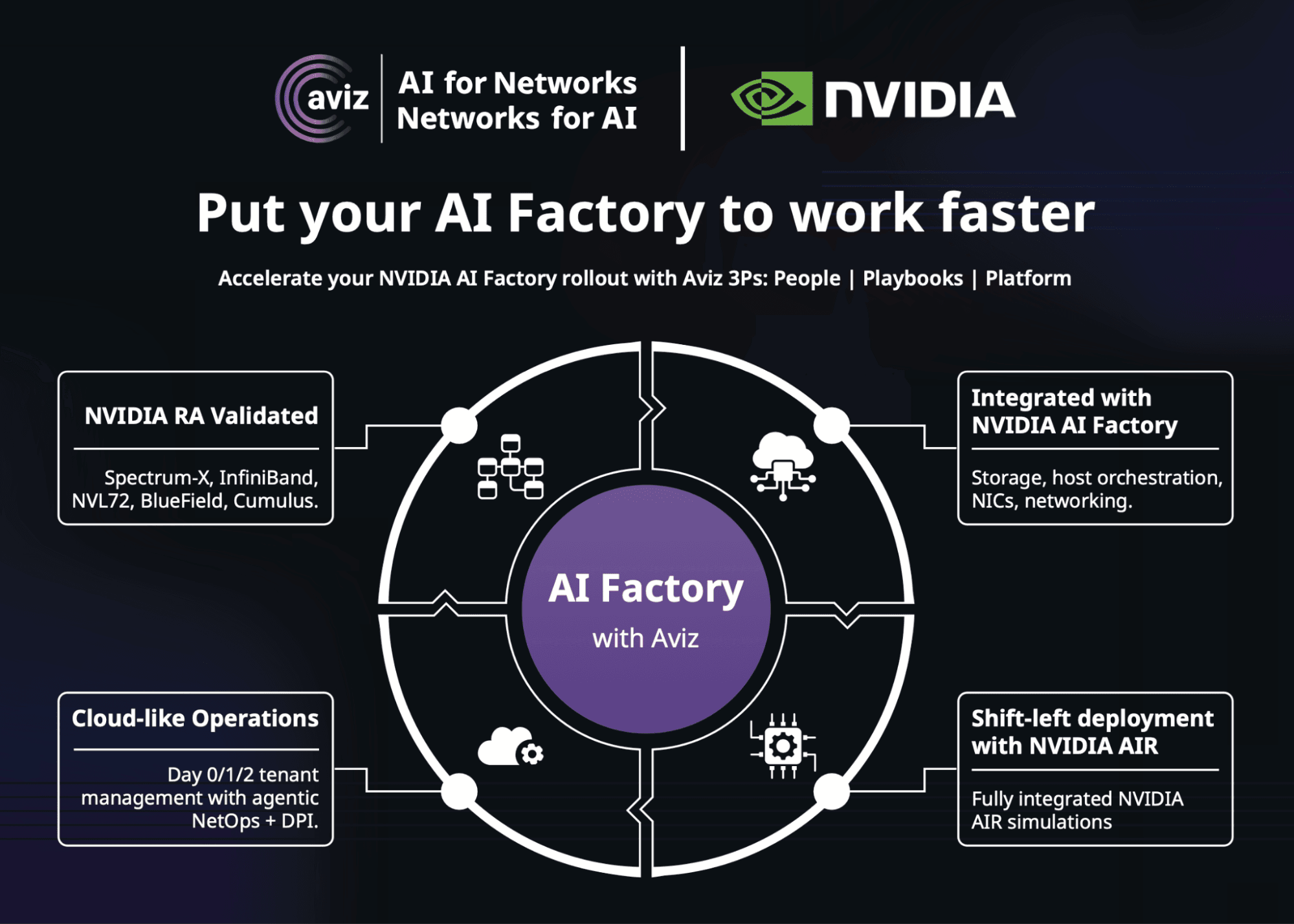
People. Playbooks. Platform. That is the real Aviz value in an AI factory. Not another dashboard. Not another isolated tool. A repeatable rollout model built around NVIDIA reference-architecture alignment, Day 0/1/2 tenant management, agentic NetOps plus DPI, shift-left deployment with NVIDIA AIR, and integration across storage, host orchestration, NICs, and networking.
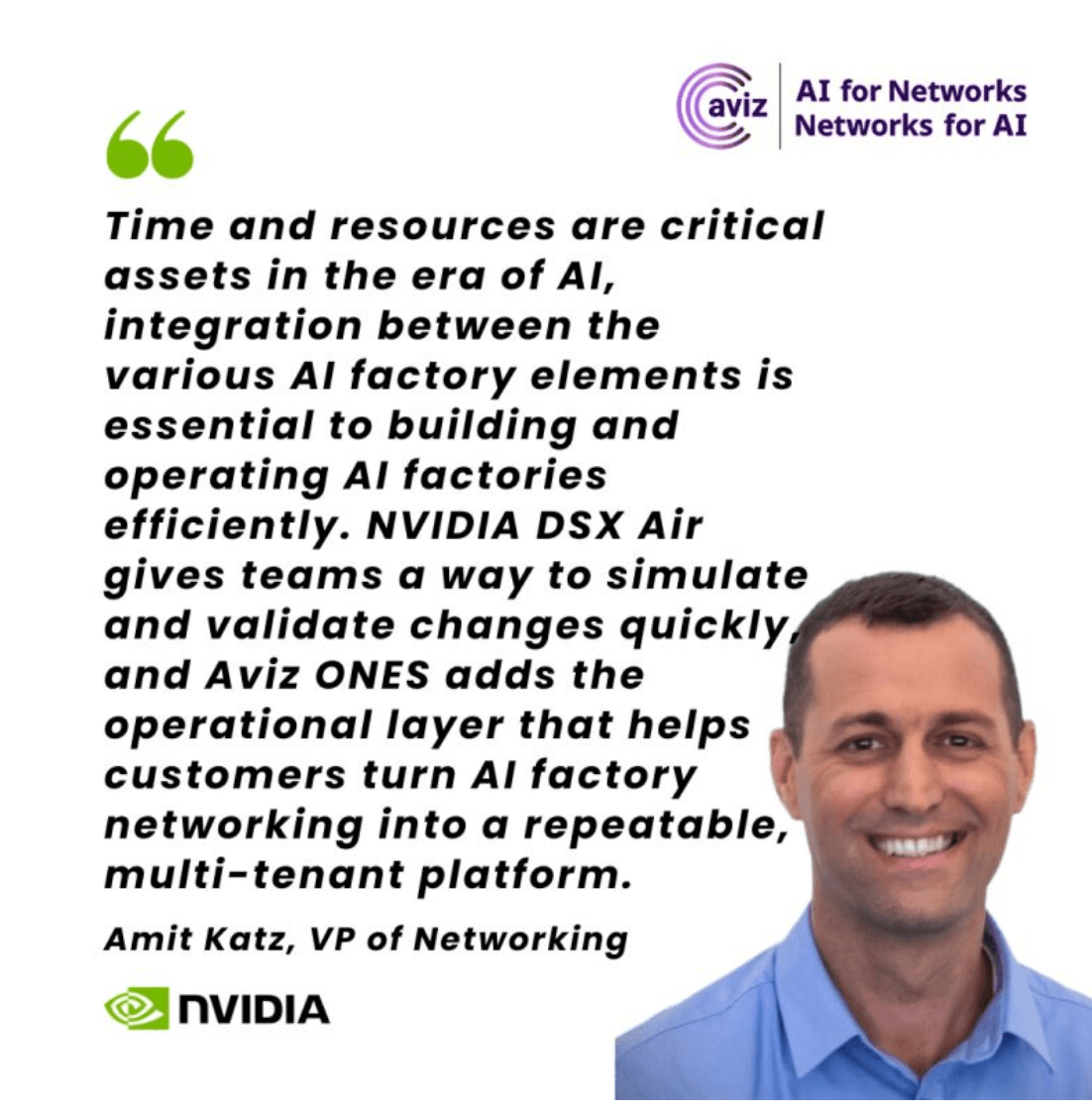
Amit Katz, VP of Networking at NVIDIA, captured the point in one line: "Aviz ONES adds the operational layer that helps customers turn AI factory networking into a repeatable, multi-tenant platform." That is really the center of gravity here. NVIDIA is making the AI factory architecture explicit. Aviz is helping make it operational.
This also explains why Aviz belongs in NVIDIA's broader AI factory ecosystem story. NVIDIA's Enterprise AI Factory validated design is already framed as a full-stack architecture built with Blackwell accelerated computing, BlueField DPUs, Spectrum-X Ethernet, NVIDIA AI Enterprise software, and a broad partner ecosystem. DSX Air extends that model by allowing ecosystem partners to bring their software images into the platform for deep integration and day-one interoperability across GPUs, NVLink, Ethernet switches, SuperNICs, DPUs, and complementary tools. Aviz is not adjacent to that motion. Aviz is part of what makes it deployable.
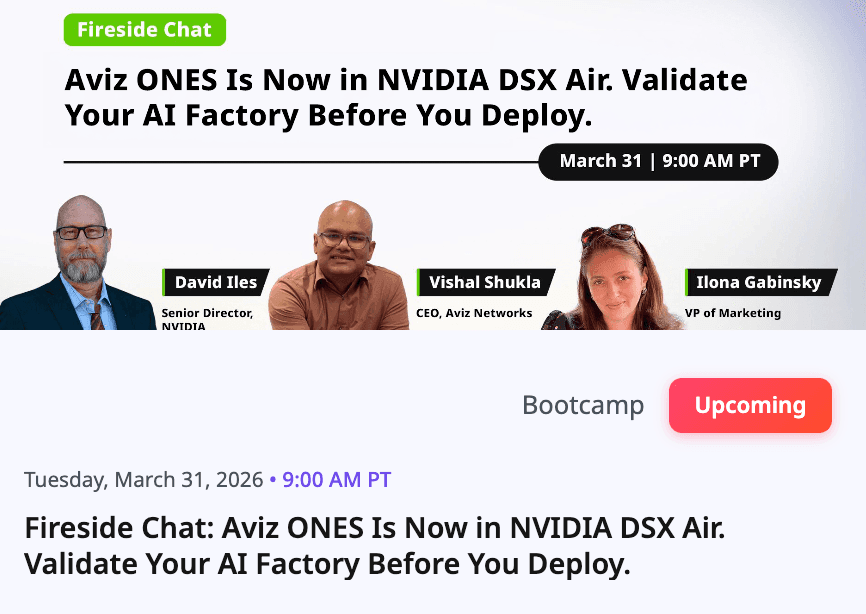
And this does not stop at the announcement. Aviz and NVIDIA are already taking the story into the field through a joint fireside chat focused on AI trends in networking, the Aviz-NVIDIA partnership and Day 0/1/2 operations.
Bottom line: NVIDIA is telling the market that AI factories are ecosystem systems, not component stacks. Aviz is in that story because closing the gap between architecture and operations is now one of the hardest parts of AI deployment. In this cycle, the winners will not just be the companies that build the hardware. They will be the ones that make the whole system repeatable.
Technical snapshot
- Deployment model: Aviz ONES in NVIDIA DSX Air lets teams design, simulate, and deploy multi-tenant AI factory networking aligned to NVIDIA reference architectures.
- Validated stack coverage: ONES is positioned across Spectrum-X, BlueField, InfiniBand, and NVLink, with broader validation across compute, storage, orchestration, servers, NICs, and networking.
- Lifecycle coverage: Day 0 is design and validation, Day 1 is tenant onboarding and fabric provisioning, and Day 2 is telemetry, health, troubleshooting, upgrades, and controlled change management.
- Observability: The Aviz-NVIDIA solution brief says ONES tracks 250+ network, server, and GPU metrics, provides end-to-end monitoring across switches, NICs, and GPUs, and includes RoCE telemetry such as PFC, ECN, and queue counters.
- Architecture: ONES is described as agentless and built on containerized microservices, with YAML templates plus validate/apply/verify workflows, alerting, and integration with customer tools.
- Operational outcome: NVIDIA frames DSX Air as a way to reduce time to first token by shifting integration and troubleshooting into simulation, cutting timelines from weeks or months to days or hours.
- Platform, plus NVIDIA RA-validated coverage across Spectrum-X, InfiniBand, NVL72, BlueField, and Cumulus, with cloud-like Day 0/1/2 operations and integrated NVIDIA AIR simulations.
Let’s talk about how Aviz can support your AI infrastructure goals.
1. What problem does the ONES-in-DSX Air integration solve?
It shifts integration and troubleshooting left, helping teams identify networking and operational issues during simulation rather than after deployment.
2. What does "shift-left" mean in the context of AI factories?
Shift-left refers to validating networking, integration, and operational workflows during design and simulation instead of discovering issues late in production.
3. Which parts of the AI factory does Aviz ONES validate?
Aviz ONES validates both front-end and back-end fabrics, including compute, storage, orchestration, servers, NICs, and networking.
4. Why do AI factories typically fail according to this content?
Failures usually stem from late-stage integration issues across networking, storage, orchestration layers, and multi-tenant operations, not from GPU selection.
5. How does Aviz ONES support Day 0, Day 1, and Day 2 operations?
Day 0 covers design and validation, Day 1 handles tenant onboarding and fabric provisioning, and Day 2 focuses on telemetry, health monitoring, troubleshooting, upgrades, and controlled change management.
6. What observability does Aviz ONES deliver in AI factories?
Aviz ONES tracks over 250 network, server, and GPU metrics, including end-to-end visibility across switches, NICs, GPUs, and RoCE telemetry such as PFC, ECN, and queue counters.
7. How does Aviz ONES align with NVIDIA's AI factory reference architectures?
ONES is positioned across Spectrum-X, BlueField, InfiniBand, NVLink, and broader AI factory components while aligning with NVIDIA reference architectures.
8. How does DSX Air impact time to deployment?
By moving integration and troubleshooting into simulation, DSX Air can reduce time to first token from weeks or months to days or hours.
9. Why is Aviz considered part of NVIDIA's AI factory ecosystem rather than adjacent to it?
Because Aviz enables operational readiness and repeatable deployment, making NVIDIA's AI factory architectures deployable at scale.
10. What role does Aviz play in NVIDIA DSX Air?
Aviz ONES enables teams to design, simulate, validate, and deploy AI factory networking with operational readiness before moving into production.


