




Where the AI Conversation Starts vs. Where the Real Change Happens
 April 20, 2026
 AI Factory
During the Thanksgiving holidays last year, I got some time to reflect on the many conversations I’ve had over the past few years with executives, investors, engineers, and analysts. Each conversation was granular in its own way, but together they formed a much bigger and more complete picture. I wanted to put those thoughts into perspective and share them with others like me, so I spent that holiday writing a book, which has now been published. Most of the illustrations in the book started as sketches I drew on a piece of paper. For my friends here on LinkedIn, I’m going to write a series of blogs 29 to be precise that walk through the book through those pictures, while also connecting them to what leaders in this space are thinking today.
So here is goes - my first sketch of the book Deciding the Future, building New Networks in AI Era, and a quick blog attached to that.
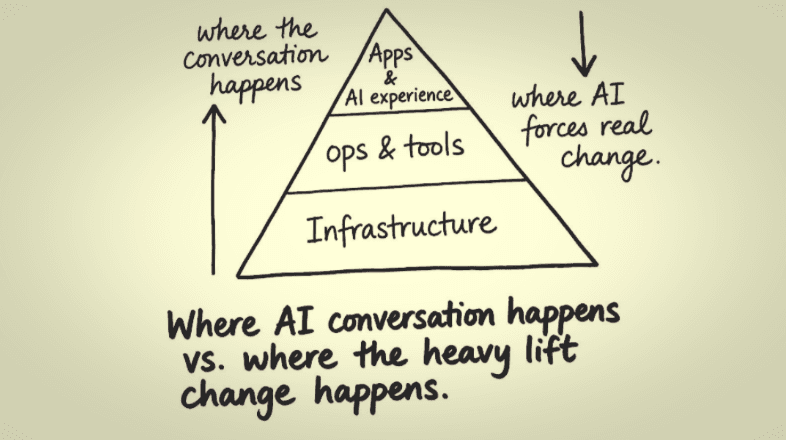
This sketch separates where the AI conversation happens from where the heavy lift happens. Most teams start with applications, copilots, and user experience. But the real change shows up lower in the stack in data movement, network design, operational telemetry, and the systems that keep inference and training stable.
That gap matters because AI performance is cumulative. A fast model on a slow or fragmented network still feels slow. A clever assistant on top of brittle operations still creates friction. Leaders who recognize this early stop treating networking as background plumbing and start treating it as part of the AI system itself.
I recently read the blog written by Jeetu Patel Cisco Powers AI-Ready Data Centers, where he says: “This is the agentic era of AI.” and, "“As billions of AI agents begin working on our behalf, the demand for high-bandwidth, low latency and power efficient networking for data centers will soar." To me, these lines up with this image because Agentic AI may be the visible headline, but network design is one of the enabling conditions.
AI leadership will be decided as much by invisible network readiness as by the visible application experience.
Most AI conversations happen in the application layer. Most AI bottlenecks appear in infrastructure. That gap is where many strategies break.
Frequently Asked Questions
1. Why does network design matter for AI performance?
AI performance is cumulative. A fast model running on a slow or fragmented network still feels slow, and advanced assistants built on brittle operations continue to create friction.
2. How does Cisco describe the demands of the agentic AI era?
Cisco describes the agentic era of AI as driving increased demand for high-bandwidth, low-latency, and power-efficient networking in data centers.
3. Why do many AI strategies break between applications and infrastructure?
Most AI conversations happen in the application layer, while most AI bottlenecks appear in infrastructure, creating a gap where strategies often fail.
4. What will determine AI leadership according to the network-first AI infrastructure perspective?
AI leadership will be determined as much by invisible network readiness and infrastructure stability as by visible application experience and user-facing AI capabilities.
5. How does the book connect AI discussions with network and infrastructure design?
The Book uses sketches to show the gap between AI conversations at the application layer and the real work in networks, data movement, and operational systems.
Enough with the AI hype. If you’re ready to see how this actually works in a real-world network, let’s connect


