





How VXLAN-Enabled Aviz Packet Broker Delivers Full Data Center Visibility
 January 16, 2026
 Deep Network Observability
Summary
VXLAN is a key technology for building scalable and flexible data center networks. When combined with an Aviz Packet Broker, VXLAN enables centralized traffic aggregation, filtering, and distribution for monitoring, security, and operations. Aviz Packet Broker supports VXLAN encapsulation, decapsulation, and advanced VXLAN stripping to maintain full visibility across modern virtualized environments.
Introduction
As data centers grow more virtualized and distributed, maintaining visibility into network traffic becomes increasingly challenging. VXLAN plays an important role by extending Layer 2 networks over Layer 3 infrastructure, allowing organizations to scale while maintaining segmentation.
Aviz Packet Broker integrates VXLAN support to transform how packet monitoring is performed. By handling VXLAN encapsulated traffic directly, OPB enables efficient traffic management, monitoring, and security analysis across complex network environments.
What Is VXLAN?
VXLAN, or Virtual Extensible LAN, is a network virtualization technology that extends Layer 2 networks over a Layer 3 IP infrastructure. It works by encapsulating Ethernet frames within UDP packets, enabling the creation of large, isolated virtual networks.
Each VXLAN segment is identified using a 24 bit VXLAN Network Identifier, also known as VNI. This allows multiple logical networks to coexist across shared physical infrastructure, making VXLAN ideal for modern data centers and cloud environments.
Key Benefits of VXLAN with Aviz Packet Broker
Centralized Traffic Management
- Aviz Packet Broker uses VXLAN to collect and manage traffic from multiple sources.
- Traffic is encapsulated within VXLAN tunnels for efficient routing to monitoring or security tools.
Flexible Traffic Monitoring
- VXLAN enables OPB to monitor traffic across multiple network segments.
- This provides a complete view of network performance and security for real time issue detection.
Seamless Integration with Virtualized Environments
- VXLAN overlays Layer 2 networks on top of Layer 3 infrastructure.
- OPB operates smoothly in virtualized data center and cloud environments.
- Centralized monitoring is possible across multiple distributed Layer 2 domains.
VXLAN and Aviz Packet Broker Architecture
VXLAN operation is divided into two main processes.
- Encapsulation
- Decapsulation
VXLAN Encapsulation in a Packet Broker
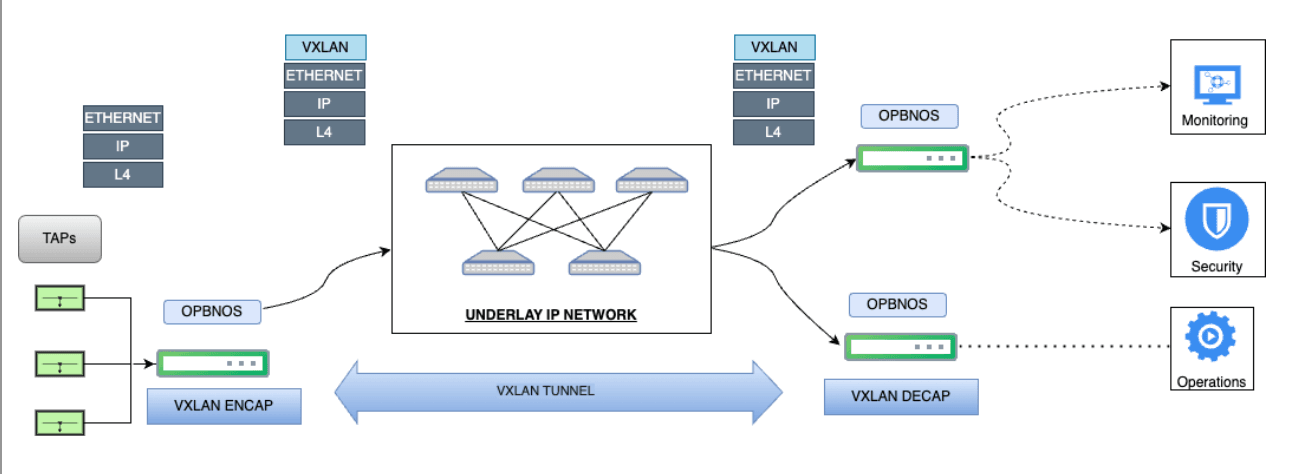
Encapsulation is the process of wrapping an original Ethernet frame inside a VXLAN header to create a VXLAN packet. This allows Layer 2 networks to extend over a Layer 3 IP based infrastructure.
By incorporating VXLAN within OPBNOS, a specialized network operating system designed for packet brokering, Aviz improves scalability and efficiency while enabling effective handling, routing, and monitoring of traffic across distributed environments.
How VXLAN Encapsulation Works
- Receiving the original Ethernet frame OPB receives tapped packets containing standard Ethernet frames that need inspection.
- Filtering the required packets Packet monitoring rules are applied to qualify only the packets that require encapsulation.
- Adding the VXLAN header A VXLAN header with the VXLAN Network Identifier is added to ensure correct routing.
- Encapsulation with IP and UDP headers New IP and UDP headers are added so the packet can traverse the Layer 3 network.
- Transmission across the network The encapsulated packet moves across the IP network without exposing the original Layer 2 frame.
- Delivery to the destination VTEP The packet is delivered to the destination Virtual Tunnel Endpoint managed by OPB.
Benefits of Encapsulation in OPB
- Traffic isolation between virtual networks improves security.
- Efficient routing ensures packets reach their intended destinations across complex topologies.
VXLAN Decapsulation in Aviz Packet Broker
Decapsulation removes VXLAN encapsulation from incoming packets so traffic can be analyzed and forwarded appropriately.
How VXLAN Decapsulation Works
- Receiving the VXLAN packet OPB receives VXLAN encapsulated packets at the Virtual Tunnel Endpoint.
- Stripping the VXLAN header The IP, UDP, and VXLAN headers are removed when the VNI and MAC address match.
- Processing the inner Ethernet frame The original Ethernet frame is processed based on configured policies.
- Forwarding to the destination The packet is forwarded to monitoring tools, security appliances, or network segments.
Benefits of Decapsulation in OPBNOS
- Decapsulation provides visibility into traffic inside VXLAN tunnels.
- OPB supports complex and multi-tenant network environments.
Configuration and VXLAN Header Stripping
- Aviz Packet Broker provides CLI and GUI based configuration options.
- Users define which packets are encapsulated or decapsulated by creating VXLAN tunnels.
- Tunnels are linked to tool ports or network ports based on monitoring requirements.
VXLAN header stripping allows OPB to remove VXLAN headers from tapped VXLAN traffic without requiring VXLAN tunnels in the monitoring fabric.
- OPB applies traffic intelligence rules to identify VXLAN packets.
- The VXLAN header is stripped from incoming packets.
- The inner payload is forwarded to tools using configured map rules.
The Unique Advantage of VXLAN Stripping
- OPB decapsulates VXLAN packets marked specifically for monitoring purposes.
- Packets with identical source and destination MAC addresses are not ignored.
- This prevents visibility gaps that could pose security risks.
- OPB supports simultaneous IPv4 and IPv6 VXLAN packet stripping.
- Both traffic types can be handled within the same environment.
- VXLAN stripping at line rate is enabled through custom ASIC parsing logic.
- This logic is built into Aviz Packet Broker NOS for high performance monitoring.
Conclusion
VXLAN is essential for scalable and segmented data center networks, but visibility into VXLAN traffic is critical to maintain control and performance. Aviz Packet Broker aggregates, filters, and distributes VXLAN encapsulated traffic to monitoring tools, ensuring comprehensive visibility across modern virtualized environments.
FAQs
1. What is VXLAN and why is it important for data centers?
VXLAN (Virtual Extensible LAN) is a network virtualization technology that extends Layer 2 networks over Layer 3 infrastructure, enabling scalable and flexible data center networks with proper segmentation.
2. How does Aviz Packet Broker handle VXLAN traffic?
Aviz Packet Broker supports VXLAN encapsulation, decapsulation, and advanced VXLAN stripping to aggregate, filter, and distribute traffic for monitoring and security tools.
3. What is the difference between VXLAN encapsulation and decapsulation?
Encapsulation wraps Ethernet frames inside VXLAN headers for transport over Layer 3, while decapsulation removes these headers to analyze and forward the original traffic.
4. What is VXLAN header stripping in OPB?
VXLAN header stripping allows OPB to remove VXLAN headers from tapped traffic without requiring VXLAN tunnels in the monitoring fabric, enabling line-rate visibility.
5. Does Aviz Packet Broker support both IPv4 and IPv6 VXLAN?
Yes, OPB supports simultaneous IPv4 and IPv6 VXLAN packet stripping within the same environment through custom ASIC parsing logic.


