




The Cost of Waiting: Why Status Quo Becomes Strategic Risk
 April 22, 2026
 AI Factory
Continuing to my third post on my book - Deciding the Future: Building New Networks for the AI Era
In any era, status quo is a risk. In the AI era, that risk is much bigger because this shift is not marginal. It is monumental.
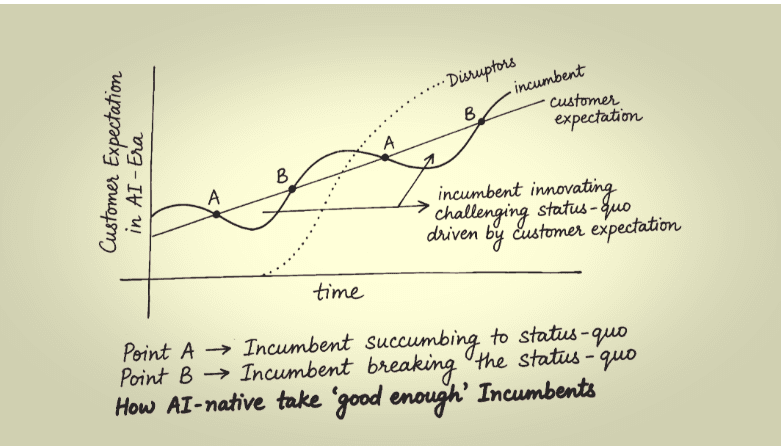
That is what this sketch shows. Incumbents keep improving the old path and feel safe because their end customer expectations are still being met. But disruptors are building on a different curve. They are changing the cost structure, the operating model, and the speed of execution.
That is why waiting is dangerous. “Let’s wait until it breaks” is a bad strategy in AI infrastructure. It will break faster than expected, and the penalty is a double hit: first you lose time while others compound, then you pay again in a rushed and expensive transformation.
Point A is when the incumbent is still trapped by the status quo. Point B is when it finally reacts. By then, disruptors are already ahead.
Gilad Shainer , Senior Vice President of Networking at NVIDIA, framed the urgency this way in one of the article published by NVIDIA: businesses need to “prioritize networking innovation to gain a competitive edge.”
AI is not a normal upgrade cycle. It is resetting what good infrastructure looks like. The real question is simple: do you move before the break, or after it?
Frequently Asked Questions
1. Why does keeping things the same become a risk in the AI era?
Keeping things the same becomes a risk because the AI era is a really big change, not a small one. This means that the ways we do things now will not work well with the technology we will have in the future.
2. How are new companies changing the way AI infrastructure is done compared to companies?
New companies are doing things differently by changing how much things cost, how they operate and how fast they can do things. Old companies are just making improvements to the ways they already do things, which only meets what customers want right now.
3. What is wrong with waiting for infrastructure to fail in the AI era?
Waiting for infrastructure to fail is an idea because it means you will lose time. While you are waiting your competitors will get ahead of you. Then when the infrastructure finally fails you will have to make changes quickly which will be expensive.
4. What do Point A and Point B mean in the AI infrastructure change?
Point A is where companies are stuck doing things the old way. Point B is where companies finally start to make changes. Only after new companies have already done things differently and gotten ahead.
5. Why is coming up with networking ideas important for being competitive, in the AI era?
Coming up with new networking ideas is important because AI is changing what we think of as good infrastructure. Companies need to come up with ideas to stay competitive. Gilad Shainer, Senior Vice President of Networking at NVIDIA says this is really important.
Enough with the AI hype. If you’re ready to see how this actually works in a real-world network, let’s connect


