




How Can Subscriber-Aware Load Balancing Improve Network Efficiency?
 November 13, 2025
 Deep Network Observability

Summary
Subscriber-Aware Load Balancing (SALB) helps mobile operators correlate control- and user-plane traffic per subscriber, ensuring accurate analysis, balanced tool utilization, and reduced CPU load. Running on NVIDIA BlueField®-3 (BlueField-3) DPU, the Aviz Service Node delivers line-rate performance, enabling high-throughput, energy-efficient observability across 5G networks.
Introduction
Mobile operators face growing complexity in balancing and correlating subscriber traffic across performance tools. Control-plane packets such as GTP-C, PFCP, and N11 and user-plane packets like GTP-U often travel separately through the network core. Without proper correlation, operators risk losing context, accuracy, and efficiency.
The challenge is to maintain subscriber-level coherence between these traffic types while minimizing CPU overhead and preventing probe overload.
Aviz Networks, in collaboration with NVIDIA, addresses this with Subscriber-Aware Load Balancing (SALB) on the NVIDIA BlueField®-3 (BlueField-3) DPU. The solution provides full-fidelity traffic steering, real-time correlation, and exceptional throughput, all at line rate.
What Is Subscriber-Aware Load Balancing (SALB)?
Subscriber-Aware Load Balancing (SALB) is a feature within the Aviz Service Node that correlates control- and user-plane packets for each subscriber, ensuring both flow types are processed together. This enables accurate analytics, balanced tool performance, and scalability without additional CPU strain.
How Does Aviz's SALB Work on NVIDIA BlueField-3 DPU?
Aviz and NVIDIA built SALB as part of the Aviz Service Node running on the BlueField-3 DPU. It processes control-plane packets on Arm cores and steers user-plane traffic through the DPU's P4 pipeline for line-rate performance.
This hybrid design maintains subscriber coherence and maximizes efficiency.
How It Works:
- Control-plane packets: Processed on the BlueField-3 DPU's Arm cores.
- User-plane packets: Subscriber context is extracted, and P4 tables are programmed for line-rate handling within the DPU datapath.
This setup allows operators to keep both traffic planes aligned per subscriber, balancing probe utilization while maintaining visibility.
What Does the Architecture Look Like?
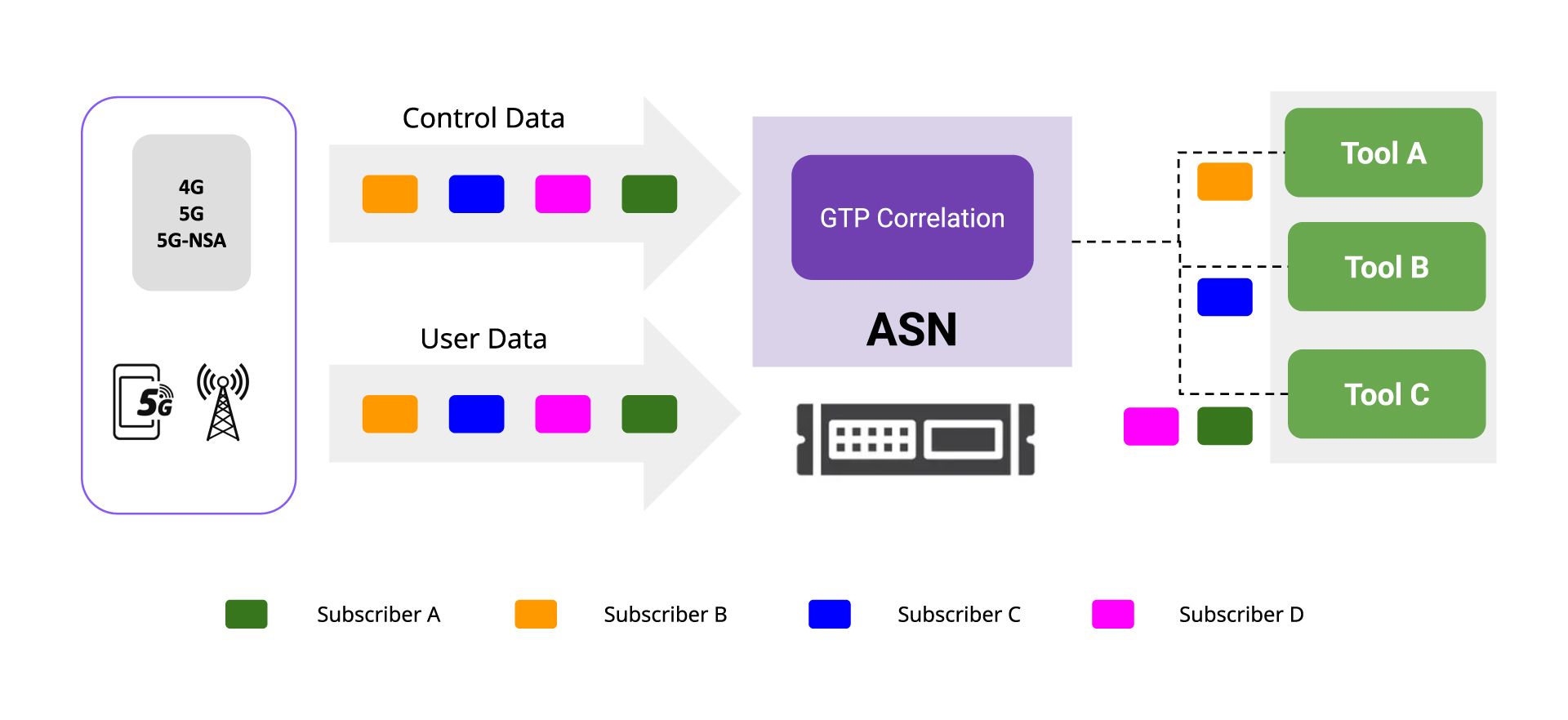
- DPU Mode: BlueField-3 is configured in DPU mode for running the Aviz Service Node.
- Traffic Handling: Control packets are processed on the DPU Arm cores, while user-plane flows are offloaded to the P4 pipeline.
- Proactive Programming: ASN leverages the NVIDIA P4 DPL SDK to install rules proactively for fast-path processing.
This design ensures subscriber-coherent steering, high throughput, and minimal CPU usage.
How Does SALB Improve Performance Compared to x86 Servers?
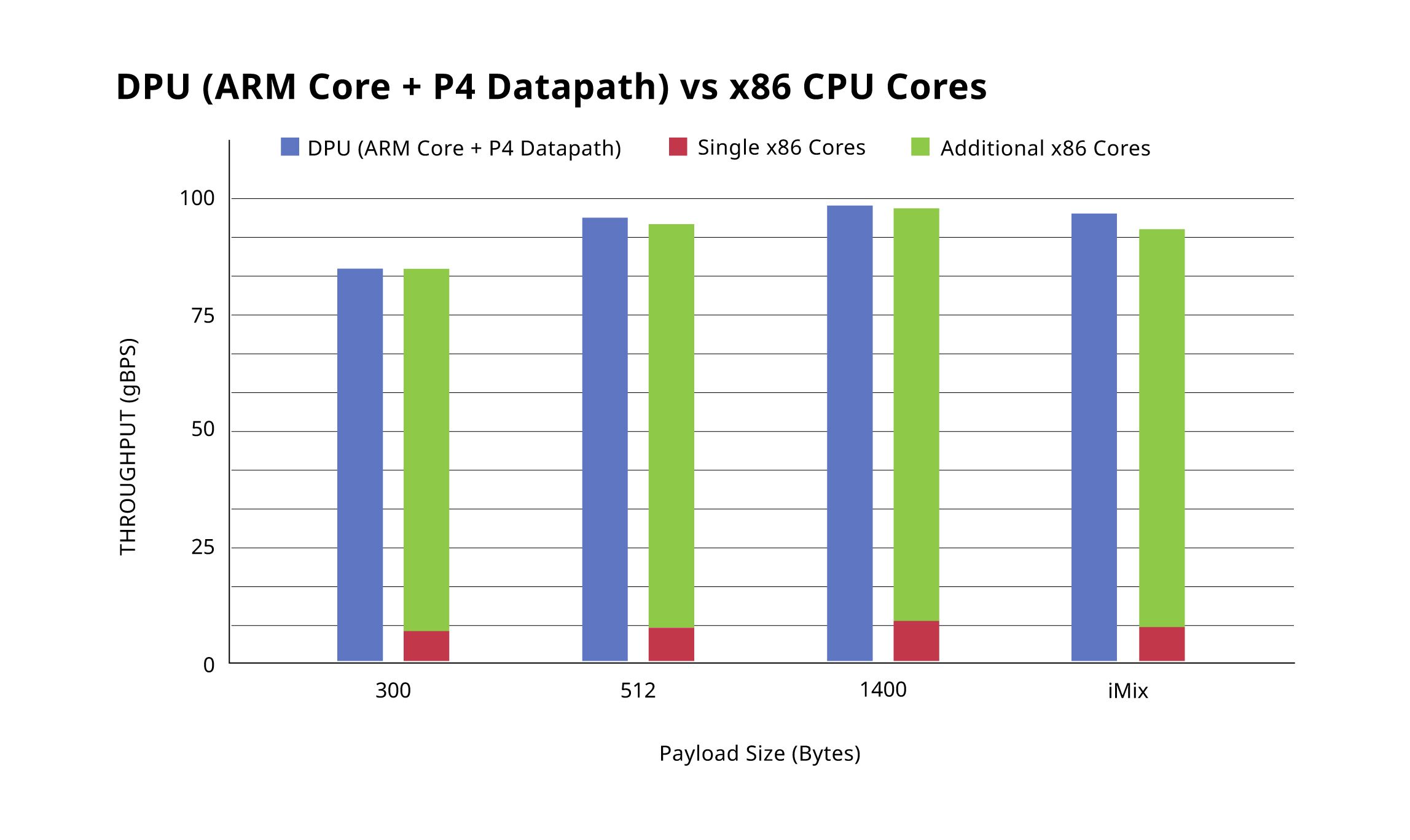
Testing shows that the BlueField-3 DPU can deliver line-rate 100 Gbps throughput while using only one Arm core and P4 datapath, compared to roughly 20 x86 CPU cores needed for the same performance.
This proves a massive efficiency gain in both throughput and power consumption.
Validated Results
| Feature / Metric | BlueField-3 DPU (Test Setup 1) | x86 Baseline (Test Setup 2) |
|---|---|---|
| Hardware | BlueField-3 DPU (Arm + P4) | Dual-Socket Xeon (2.3 GHz) |
| Network Interface | Dual-port 100 GbE (200 Gbps) | Intel E810, 2×100 GbE |
| Traffic Generator | Keysight (Ixia) | Keysight (Ixia) |
| Traffic Type | GTP User and Control Plane | GTP User and Control Plane |
| Control Plane | Arm-CPU cores | x86 CPU cores |
| Data Plane | P4 Fastpath on DPU | x86 CPU cores |
| Throughput | 100 Gbps (1 Arm Core + P4 Datapath) | ~20 x86 CPU cores |
Result: A single DPU port handles line-rate 100 Gbps traffic, replacing about 20 x86 cores.
What Are the Power and Cost Benefits?
Using BlueField-3 significantly reduces total cost of ownership (TCO) and power consumption while boosting core efficiency.
| Category | 100 Gbps Scenario | 400 Gbps Scenario |
|---|---|---|
| Core Efficiency | 1 BlueField-3 (1 × 100G port) replaces ~20 x86 cores | 1 BlueField-3 (2 × 200G ports) replaces ~80 x86 cores |
| Power Consumption | BlueField-3 ≈ 110W; COTS x86 ≈ 160W → 50W saved | BlueField-3 ≈ 110W; COTS x86 ≈ 560W → 450W saved (~80%) |
Outcome: Operators can achieve major power savings and optimize infrastructure costs while sustaining full line-rate throughput.
What Did Aviz and NVIDIA Validate Jointly?
Aviz and NVIDIA jointly validated that Subscriber-Aware Load Balancing (SALB) can run on a single BlueField-3 DPU using its P4 programmable datapath and Arm cores.
This validation proves a scalable approach to Deep Network Observability, where control- and user-plane correlation occurs at line rate with minimal overhead.
What Industry Leaders Say
"With Subscriber-Aware Load Balancing on BlueField-3, we correlate control- and user-plane flows per subscriber and steer them at line rate. That lets operators balance probe capacity, preserve fidelity, and scale observability without scaling cores."
— Chid Perumal, CTO, Aviz Networks
What Do Operators Gain from SALB?
Operators benefit from three major outcomes:
- Subscriber-Coherent Analytics: Both control- and user-plane packets for a subscriber are always sent to the same tool.
- Improved Tool Efficiency: Probes are not overloaded, ensuring full visibility and accuracy.
- Performance per Watt: DPU offload enables high throughput and superior efficiency compared to CPU-only setups.
Conclusion
In summary:
- Mobile operators need precise correlation of control- and user-plane traffic for subscriber-level analysis.
- Aviz's SALB on NVIDIA BlueField-3 DPU ensures subscriber-coherent load balancing and visibility at line rate.
- DPU acceleration replaces tens of CPU cores, reducing power and cost.
- Joint validation confirms scalability for Deep Network Observability.
With SALB, operators can now maintain fidelity, balance performance tools, and scale observability efficiently — all with reduced compute overhead.
Ready to benchmark Subscriber-Aware Load Balancing in your network?
Let's set up a tailored session based on your traffic mix and tooling.


