





SONiC & Open Source in the Enterprise: 5 Myths Busted
 November 21, 2025
 ONES & SONiC
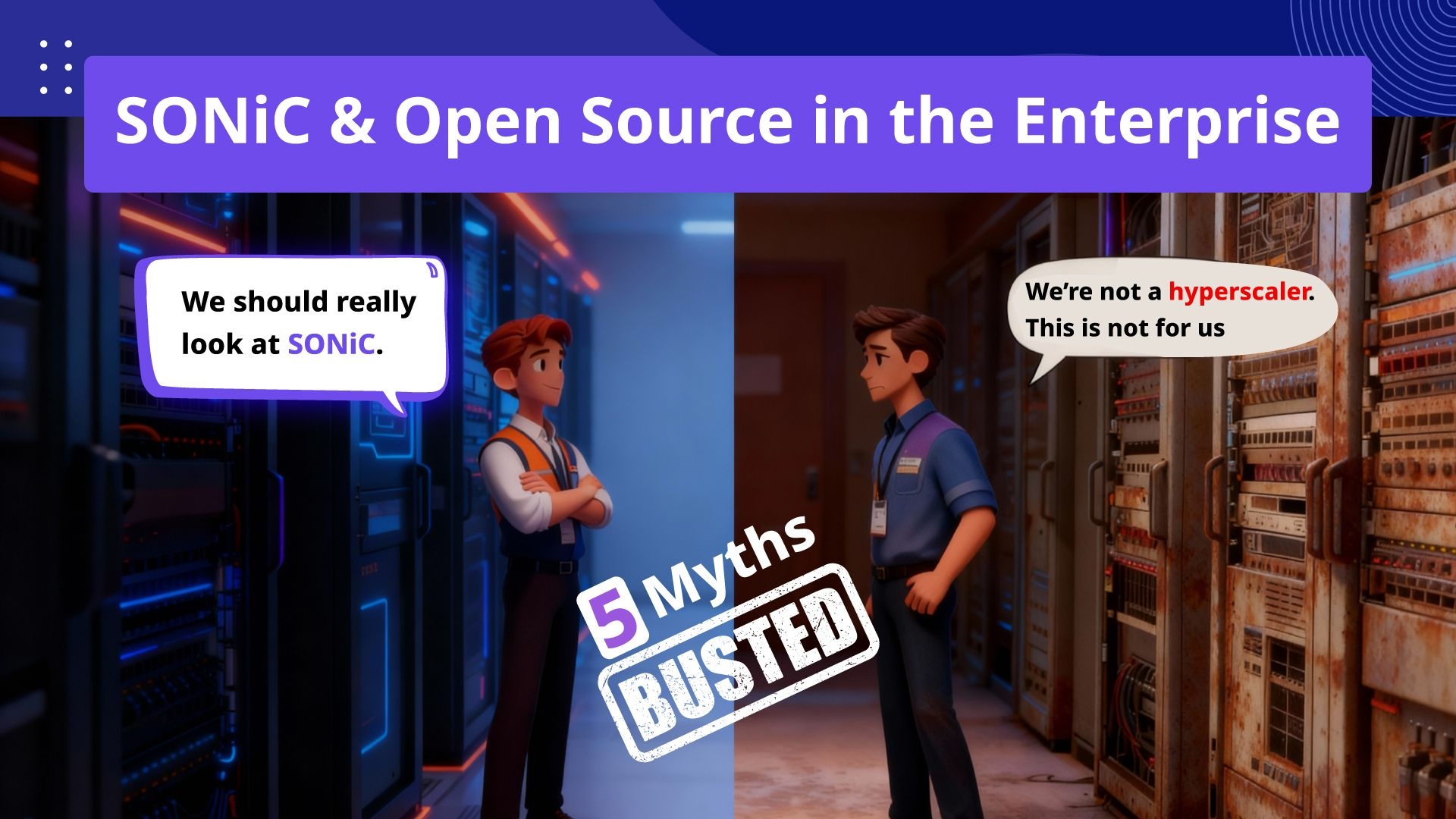
Somewhere in every networking team, someone has already said: "We should really look at SONiC."
…and someone else has replied: "We're not a hyperscaler. This is not for us."
If that sounds familiar, this post is for you. I'll walk through five common myths about SONiC and open-source networking — and how to approach them without betting the business.
Myth 1: "Open-source NOS is only for hyperscalers."
The belief
SONiC is a Microsoft thing. Hyperscalers can afford to experiment; enterprises can't.
Reality
SONiC has quietly become the Linux of Networking:
- It runs at a massive scale in production.
- Major vendors ship SONiC- or SONiC-based offerings because customers demand openness.
- Enterprises use it to standardize, regain control, and cut TCO, not as a science project.
What I see getting missed is where enterprises actually start. It's rarely "rip out the core" on day one. Many organizations begin with:
- Management networks
- Packet broker and visibility domains
- Lab fabrics or pre-production test environments
That's how teams build confidence: they learn SONiC and open networking while keeping mission-critical paths untouched.
How Aviz fits
Aviz lets you run:
- Community SONiC or Broadcom Enterprise SONiC
- On hardware from Cisco, NVIDIA, Edgecore, Dell, and more
- With ONES (Open Networking Enterprise Suite) and FTAS handling orchestration, observability, and automated qualification.
On top of that, Aviz provides:
- 24×7 SONiC support across 7+ major vendors
- Certified SONiC Quality Reports backed by FTAS
- Reference "recipes" from customers running from a few switches to tens of thousands
You get hyperscaler patterns with an enterprise wrapper, plus a partner standing behind SONiC so your leadership sees it as a safe, fully supported option - not just "free code from GitHub."
Myth 2: "Open networking needs an army of engineers."
The belief
To run SONiC and open networking, you need a hyperscaler-sized dev + NetOps team.
Reality
The modern SONiC ecosystem exists specifically to productize what hyperscalers learned, without forcing you to copy their org chart.
With the right stack:
- SONiC looks and feels like the NOS you already know.
- Automation and testing are pre-packaged, not handcrafted per deployment.
- You consume recipes, not reinvent them.
This matters even more for 3–5 person networking teams. They don't want to become a SONiC development shop; they want a "Cisco/Arista-like" experience with better economics and choice.
How Aviz fits
FTAS (Fabric Test Automation Suite) is your automated test bench: features, scale, day-2, chaos, with a certified SONiC quality report at the end.
ONES provides multi-vendor orchestration + telemetry + AI fabric views.
Aviz support acts as a SONiC platform team as-a-service, 24×7, coordinating with 7+ hardware vendors.
On top of that, Aviz:
- Provides a Cisco/Arista-style CLI experience to flatten the learning curve.
- Runs monthly SONiC bootcamps, so your team can get comfortable with about an hour a month.
- Builds custom workflows and automations for your environment when needed - so you don't have to write everything yourself.
You don't need an army; you need a partner who already built one and exposes it as a service.
Myth 3: "Community open source is too risky for production."
The belief
Open-source = "free code from GitHub" + mailing lists + no SLAs. Great for labs, scary for revenue.
Reality
There's a big difference between raw community bits and enterprise packaging:
- SONiC has more contributors than most proprietary NOSes.
- Linux-based kernels can meet demanding compliance (FIPS, etc.).
- The risk isn't the community; it's running community code without a proper owner.
Enterprises and regulated industries (regional banks, government, etc.) already run SONiC, but only after they have a clear story for:
- Who escalates bugs
- Who certifies releases
- Who owns integration with hardware vendors and their RMA processes
How Aviz fits
Aviz behaves like a "Red Hat for Networking":
- Curates community SONiC
- Adds SLAs, lifecycle & security practices
- Produces Certified SONiC Quality Reports via FTAS
- Owns escalation upstream and with hardware vendors
Beyond that, Aviz:
- Supports on-prem, air-gapped deployments where no data leaves your environment.
- Provides 24×7 enterprise-grade TAC, not "Google as support."
- Can help align SONiC with regulatory and reliability frameworks by running your specific test cases and delivering formal reports.
You get open-source evolution with commercial-grade accountability and compliance-ready packaging.
Myth 4: "We're a Cisco / Arista shop — we can't compromise on quality."
The belief
Moving to SONiC and open networking means stepping down in quality and support.
Reality
Quality isn't only about the software image—it's also about:
- Upgrade gates and regression testing
- End-to-end support (no vendor finger-pointing)
- Operational tooling that feels familiar to your teams
How Aviz fits
- FTAS enforces a repeatable upgrade gate: every release tested for features, scale, day-2 operations, and chaos.
- ONES provides a familiar, Nexus/CloudVision-style operational experience for SONiC and legacy NOS.
- Aviz coordinates support end-to-end, so you get a "single throat to choke" across vendors.
In practice, a common pattern I recommend is:
- Start with packet brokers or management networks
- Validate SONiC with FTAS in Aviz's OCP-certified lab using your configs
- Expand toward more critical domains once you're confident
You keep Cisco/Arista-class quality and add open-source flexibility, TCO savings, and multi-vendor leverage.
Myth 5: "We're not in a refresh cycle, so we can't start with SONiC now."
The belief
"Interesting, but we'll look at this when we refresh the network in a few years."
Reality
If you wait until the refresh date to start learning SONiC, you're guaranteeing a stressful project.
You can de-risk now by:
- Starting in management networks, packet broker domains, or labs.
- Letting someone else do the heavy lifting and test your configs against SONiC.
- Using AI and observability layers on top of your existing Cisco/Arista environment today.
This matters even if you're in a change freeze or under multi-year support contracts:
- You can still run POCs in Aviz Sonic One Center (their lab), using your configs and success criteria.
- You can start with Network Copilot™ on top of your existing Cisco/Arista/F5 tools, getting AI benefits without touching production configs.
How Aviz fits
Sonic One Center and AI Center: Aviz runs 24×7 POCs in its own lab. You send configs + requirements; Aviz returns a Grade-1 POC report.
Network Copilot™ can be deployed on top of your current Cisco/Arista/F5 tools to standardize operations before you change NOS.
When the refresh comes, your team already knows SONiC + ONES. Migration becomes an evolution, not a Big Bang—supported by proven migration "recipes," bootcamps, and configuration mapping (e.g., IOS/ACI → SONiC).
Bottom line
SONiC and open source aren't a risky side quest anymore. With the right packaging — SONiC + FTAS + ONES + Network Copilot™ — they're a practical way to:
- escape lock-in,
- cut TCO (often 40–60% overall),
- and get AI-ready networks,
without sacrificing quality or blowing up your team's capacity.
Frequently Asked Questions
Is SONiC only for hyperscalers like Microsoft?
SONiC has become the Linux of networking, with enterprises using it to standardize infrastructure, regain control, and cut TCO. Many organizations start in low-risk areas like management networks or lab fabrics before expanding to more critical domains.
Do you need a large engineering team to run SONiC?
The modern SONiC ecosystem is designed to productize what hyperscalers learned without requiring a hyperscaler-sized team. With the right tooling and a partner like Aviz, even small networking teams can get a familiar, Cisco/Arista-style experience backed by pre-packaged automation and 24x7 support.
Is community SONiC too risky for production environments?
The risk is not the community software itself but running it without a clear owner for bug escalation, release certification, and hardware vendor integration. Commercial distributions and partners like Aviz add SLAs, lifecycle management, and certified quality reports to make SONiC production-ready.
Can enterprises maintain Cisco/Arista-class quality when adopting SONiC?
Yes, because quality depends on upgrade gates, regression testing, and end-to-end support, not just the software image. Tools like FTAS enforce repeatable upgrade gates and ONES provides a familiar operational experience across SONiC and legacy NOS platforms.
What is a low-risk way for enterprises to start with SONiC?
Enterprises commonly begin with management networks, packet broker domains, or lab fabrics to build confidence while keeping mission-critical paths untouched. This approach lets teams learn SONiC without disrupting production operations.
Can enterprises start evaluating SONiC before a network refresh cycle?
Yes, waiting until a refresh to start learning SONiC guarantees a stressful project. Teams can run POCs in Aviz's Sonic One Center using their own configs, or deploy Network Copilot on top of existing Cisco, Arista, or F5 tools to gain AI benefits without touching production.
What cost savings can enterprises expect from adopting SONiC?
Enterprises adopting SONiC with the right packaging can typically reduce TCO by 40 to 60 percent overall. These savings come from escaping vendor lock-in, gaining multi-vendor flexibility, and standardizing operations.
What hardware does SONiC support in enterprise deployments?
SONiC can run on hardware from multiple vendors, including Cisco, NVIDIA, Edgecore, and Dell. This multi-vendor support is enabled through the Switch Abstraction Interface, which allows SONiC to program different ASIC platforms through a common API.
Contact Us to Evaluate SONiC for Your Network. Explore where SONiC fits safely, without ripping and replacing your existing infrastructure.


