





SONiC for Higher Education Explained: Open Networking, AI Scale, and Operational Control
 March 2, 2026
 ONES & SONiC

Summary
The Industry Insights Webinar, hosted in collaboration with EDUCAUSE, explores how universities can evaluate and adopt SONiC to modernize campus and research networks. The discussion highlights open networking benefits, AI driven bandwidth demands, hyperscale lessons, cost efficiency, observability, and structured migration planning. The session provides practical guidance for institutions seeking scalable, software-defined, and vendor-neutral network architectures.
Introduction
Higher education networks are evolving rapidly. AI research workloads, mission-critical systems, high-performance computing, hybrid learning models, and growing endpoint density are pushing traditional networking architectures to their limits.
In this session featuring experts from Aviz Networks and New York University, the panel explains how SONiC can help institutions scale predictably, reduce vendor lock-in, and gain deeper operational visibility.
What Is SONiC and Why It Matters
- Overview
SONiC, originally developed by Microsoft, is an open source network operating system built on Linux and microservices architecture. - Open and Vendor Neutral Architecture
SONiC runs across multiple hardware vendors, allowing institutions to avoid single vendor dependency and improve supply chain flexibility. - Proven at Hyperscale
Large cloud operators use SONiC in production to support AI clusters and high-density data center fabrics. These deployments demonstrate stability at extreme bandwidth and route scale. - Software Defined Control
Microservices architecture allows independent service upgrades, improved troubleshooting, and deep integration with automation frameworks.
AI-Driven Network Demands in Universities
- High Performance Requirements
AI research environments require extremely high throughput, low latency, and deterministic performance. - Rapid Bandwidth Growth
Panelists discussed how environments have evolved from 50G to 400G and beyond in only a few years due to GPU clusters and distributed model training. - Telemetry and Observability Requirements
AI workloads demand full visibility into switches, optics, and routing state. Open telemetry access allows integration with tools such as Prometheus and Grafana for advanced monitoring. - Infrastructure as Code
Software control enables automation-driven provisioning and faster recovery during incidents.
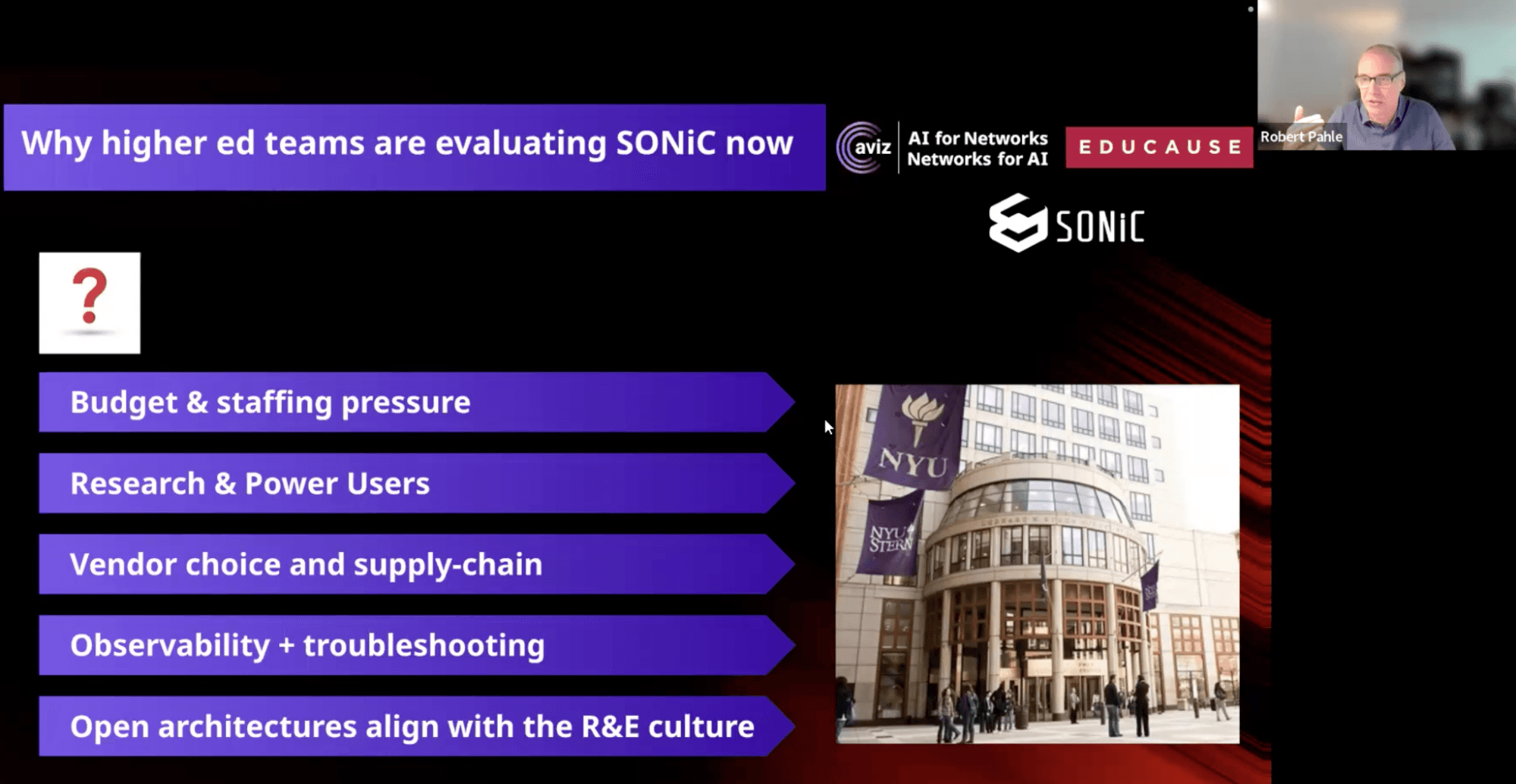
Why Universities Are Evaluating SONiC
- Cost Efficiency
Universities operate within strict grant budgets. Open networking reduces licensing overhead and hardware costs while maintaining performance. - Research Flexibility
Open source environments allow experimentation with EVPN, VXLAN, and advanced routing designs without proprietary limitations. - Supply Chain Independence
Multi-vendor hardware support minimizes procurement delays and improves long term flexibility. - Operational Transparency
Full access to control plane and data plane state reduces troubleshooting blind spots and accelerates issue resolution.
Hyperscale Lessons Applied to Higher Education
Hyperscalers adopt SONiC to gain:
- Full performance ownership
- Faster bug resolution
- Deep ASIC-level telemetry access
- Internal automation capabilities
- Lower total cost to serve
These principles increasingly align with research universities operating large scale data center environments.
Migration and Risk Mitigation Strategy
- Feature Validation
Institutions must validate ASIC capabilities and required feature support, especially for EVPN VXLAN environments. - Phased Deployment
Parallel pilots and lifecycle-aligned refresh cycles reduce operational risk during migration. - Community and Commercial Support
The SONiC ecosystem includes global contributors and commercial support providers, reducing the skills gap barrier.
Practical Evaluation Framework
The webinar outlines a clear adoption path:
- Define use cases and required features
- Validate hardware compatibility
- Build a phased migration roadmap
- Deploy controlled pilot environments
- Collect telemetry and performance data
- Present the total cost of ownership analysis to leadership
Aviz Networks also demonstrated how lab-based validation and real-world topology testing can de-risk production rollout.
Conclusion
SONiC adoption in higher education is no longer experimental. Universities are leveraging open networking to achieve higher scalability, stronger observability, vendor flexibility, and improved cost efficiency.
As AI-driven workloads continue to expand, software-defined, open architectures are becoming foundational to resilient and future-ready campus and research networks.
Frequently Asked Questions
What is SONiC and where did it come from?
SONiC was originally built by Microsoft. It is an open source network operating system that runs on Linux with a microservices architecture. Large cloud operators use it in production to support AI clusters and high-density data center fabrics, which proves it holds up at extreme bandwidth and route scale.
Why are universities looking at SONiC specifically for research and campus networks?
Four things keep coming up: cost, flexibility, supply chain independence, and operational transparency. Grant budgets are tight so reducing licensing and hardware costs matters. Open source lets research teams experiment with EVPN, VXLAN, and advanced routing without hitting proprietary walls. Multi-vendor hardware support also means procurement delays hurt less when one supplier is slow.
How fast is bandwidth growing in university AI research environments?
Panelists said environments went from 50G to 400G and beyond in just a few years because of GPU clusters and distributed model training. That kind of growth in a short window is exactly why traditional proprietary networking struggles to keep up. The refresh cycles are not built for that pace.
What does a practical SONiC migration path look like for a university?
The webinar outlines six steps: define use cases and required features, validate hardware compatibility, build a phased migration roadmap, deploy controlled pilot environments, collect telemetry and performance data, then present a TCO analysis to leadership. Parallel pilots and lifecycle-aligned refresh cycles reduce risk during the transition rather than doing a full cutover all at once.
How does SONiC give universities better visibility into what is happening on the network?
SONiC gives full access to control plane and data plane state so teams are not flying blind when something breaks. Open telemetry access plugs directly into tools like Prometheus and Grafana for advanced monitoring. AI workloads specifically need visibility into switches, optics, and routing state and SONiC provides that without vendor restrictions on what data you can actually see.
What lessons from hyperscalers apply to university data center and research networks?
Hyperscalers use SONiC for full performance ownership, faster bug resolution, deep ASIC-level telemetry, internal automation, and lower total cost. Research universities running large-scale data center environments face the same pressures at a smaller but still significant scale. The infrastructure problems are similar even if the headline numbers are different.
Is SONiC still experimental for higher education or is it ready for production?
The webinar is clear on this point. SONiC adoption in higher education is no longer experimental. Universities are already using open networking for higher scalability, stronger observability, vendor flexibility, and better cost efficiency. The question is not whether it works. It is how to migrate without disrupting operations that are already running.
How does SONiC help universities avoid being stuck with one vendor's hardware and pricing?
SONiC runs across multiple hardware vendors so institutions are not locked into a single supplier's ecosystem. When one vendor is slow on delivery or raises prices, teams have options. Supply chain independence is a real operational advantage especially for universities that plan infrastructure around multi-year grant cycles and cannot afford surprise procurement delays mid-project.
Watch the full webinar on demand to explore the complete discussion, expert insights, and practical guidance shared during the session.


