





SONiC Adoption in the AI Era: How Enterprises Moved from Evaluation to Production
 January 13, 2026
 AI Factory
Introduction
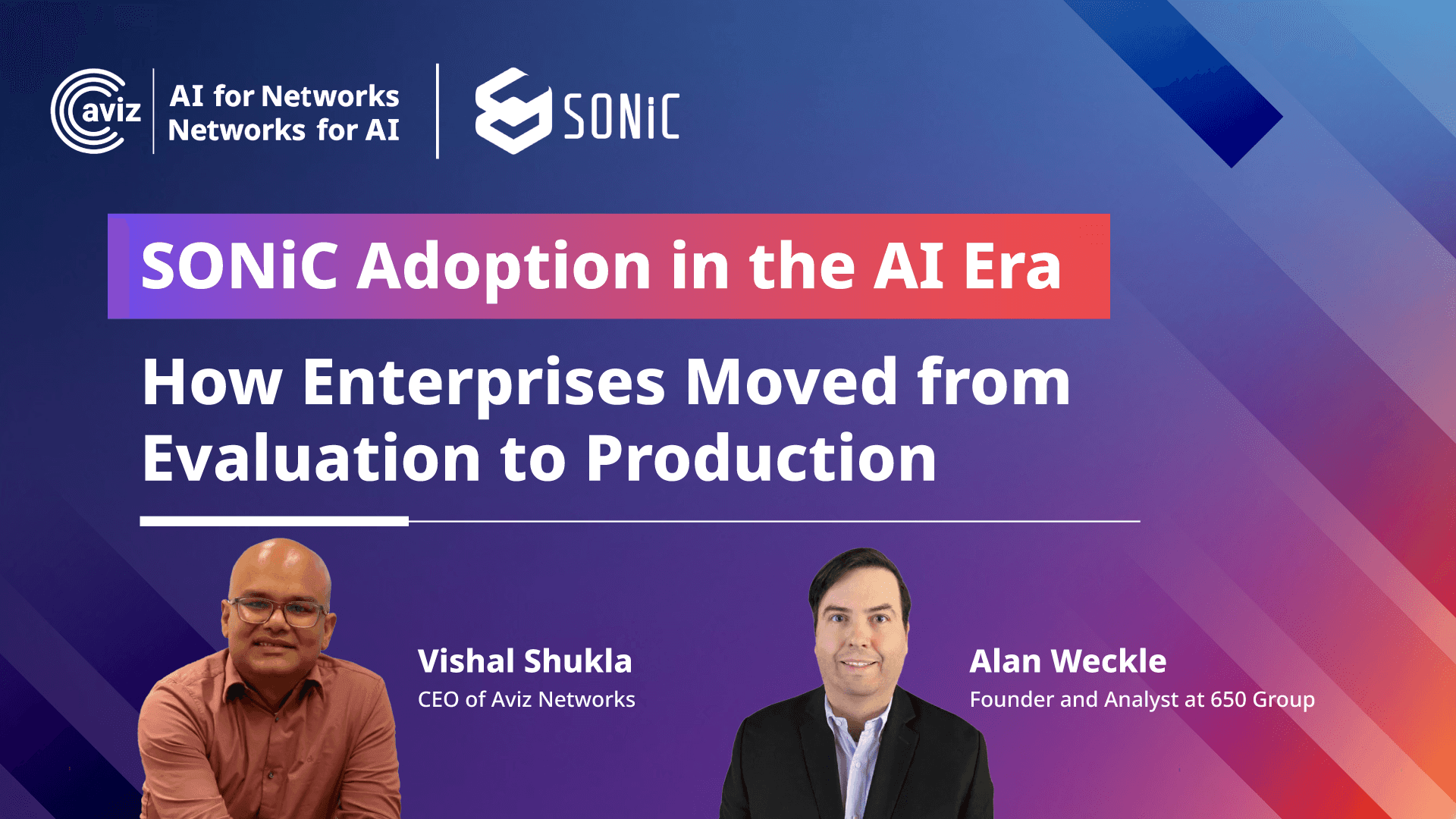
In this episode of the Aviz Networks Podcast, Alan Weckle, Co-Founder and Analyst at 650 Group, spoke with Vishal Shukla, CEO of Aviz Networks, about the rapid evolution of SONiC adoption and how networking was being redefined for the AI era.
Vishal shared insights drawn from close engagement with customers, enterprises, and the open networking community, highlighting how SONiC was being used in real-world environments.
The conversation focused on enterprise adoption trends, AI-driven networking requirements, real production deployments, and the growing need for standardization.
The episode showed how SONiC moved beyond early evaluation to become a serious production choice across data centers, enterprises, and edge environments.
What this episode was about
The discussion explored how SONiC adoption had accelerated as customers moved from passive evaluation to active proof-of-concepts and production planning. Vishal explained that enterprises were asking deeper questions around total cost of ownership, return on investment, and long-term future readiness.
The conversation also covered how AI workloads reshaped network design across scale-up, scale-out, front-end, and edge deployments, with SONiC emerging as a common foundation.
Key insights from the conversation
- SONiC adoption accelerated as enterprises moved toward production
- Customers evaluated SONiC based on ROI, TCO, and future-proofing
- AI workloads redefined data center and network architectures
- SONiC became common across new and greenfield deployments
- EVPN and VXLAN gaps were addressed with real enterprise use cases
- SONiC was deployed across retail, banking, healthcare, and technology sectors
- Edge deployments grew, including AI inference at the edge
- Inference workloads required a range of network speeds, not a single bandwidth model
- Standardization was critical as hardware and workload diversity increased
- SONiC enabled a single operating system across purpose-built network pods
Why this episode mattered
- Showed how SONiC moved from experimentation to production adoption
- Explained the role of SONiC in AI-driven network design
- Highlighted the importance of standardization in complex environments
- Provided real-world insights from active enterprise engagements
- Demonstrated how open networking supported future AI and infrastructure growth
Conversations that Shaped the Future
This episode offered a practical view into how SONiC evolved alongside AI-driven infrastructure demands.
By enabling standardization across diverse hardware, workloads, and deployment models, SONiC became a key foundation for networks built for the AI era.
Frequently Asked Questions
How did SONiC adoption shift from evaluation to real production deployments?
Enterprises moved past passive evaluation into active proof-of-concepts and production planning. Vishal explains that customers started asking deeper questions around total cost of ownership, return on investment, and long-term future readiness rather than just testing whether SONiC could work. That shift in the questions being asked is what signals evaluation turning into serious production intent.
Which industries are actually deploying SONiC in production environments today?
Retail, banking, healthcare, and technology sectors all come up directly in the episode. SONiC is not limited to hyperscalers or early adopter tech companies. Real enterprise deployments are happening across industries where the business case around TCO, ROI, and vendor flexibility proved strong enough to move beyond the lab and into live environments.
How did AI workloads change the way networks need to be designed and built?
AI workloads reshaped network design across scale-up, scale-out, front-end, and edge deployments. Inference workloads specifically require a range of network speeds rather than a single bandwidth model so networks cannot be designed with one fixed assumption about what traffic will look like. SONiC emerged as a common foundation across these different deployment types because it adapts across architectures rather than being built for one specific model.
Why is standardisation becoming critical as hardware and workload diversity grows in the AI era?
More hardware vendors, more workload types, and more deployment models all running at the same time creates a management nightmare without a common foundation. SONiC enables a single operating system across purpose-built network pods so teams are not managing a different OS for every hardware vendor or deployment scenario. Standardisation is what keeps complexity manageable as the environment keeps diversifying.
How is SONiC being used in edge deployments and AI inference at the edge?
Edge deployments grew significantly and AI inference at the edge is called out specifically. Inference workloads at the edge do not need the same bandwidth as large-scale training clusters but they still need a reliable, manageable network foundation. SONiC covering edge alongside data center and greenfield deployments means teams can run the same operating model across the full environment rather than managing edge infrastructure as a separate problem.
How were EVPN and VXLAN gaps addressed as enterprises pushed SONiC into real production use?
EVPN and VXLAN gaps were addressed with real enterprise use cases rather than theoretical fixes. The episode positions this as part of SONiC maturing from a hyperscaler-focused platform into something that handles the feature requirements enterprises actually need in production. Real deployments surfaced the gaps and real deployments drove the solutions rather than vendor roadmap assumptions about what enterprises would need.
What questions are enterprises actually asking when they evaluate SONiC for production now?
TCO, ROI, and long-term future readiness are the three areas Vishal highlights. Enterprises are not asking whether SONiC technically works anymore. They are asking whether it will save money over time, whether the return on investment justifies the transition, and whether the platform will hold up as AI workloads and infrastructure requirements keep evolving. The questions got more serious because the decisions got more serious.
Why did SONiC become a common foundation for new and greenfield network deployments specifically?
Greenfield deployments have no legacy constraints holding them back. When a team builds a new network from scratch they can pick the best option rather than working around what already exists. SONiC winning greenfield is significant because it means the teams with the most freedom to choose picked it. That momentum in new deployments is what accelerates broader adoption as more organisations build out fresh infrastructure for AI-era workloads.
Explore the full conversation and hear firsthand insights on SONiC adoption and AI-era networking by visiting the full podcast episode.


