





Powering Distributed Analytics: Multi-Destination Delivery for Network Data
 August 21, 2026
 Deep Network Observability

TL;DR
ASN can aggregate real-time session and flow data streams and send them to multiple separate destinations at the same time. Up to six Kafka clusters and six IPFIX collectors can be used. This way, the security, performance, fraud, compliance, and customer analytics platforms can receive network data in parallel, without replacing any existing exports.
Introduction
Each day, ASN exports millions of session records that capture users, control, PFCP, RADIUS and Diameter sessions, and priority events containing data and KPIs used for subscriber analytics and network monitoring and operational reporting.
More and more complex deployments are requiring the same session data to be delivered to multiple destinations simultaneously.
A customer may need session data to go to a security analytics cluster, a performance monitoring cluster, a fraud detection cluster, a service provider's Kafka cluster, an isolated customer cluster, and a compliance or regulatory reporting cluster all at the same time.
To support all of this without external replication tools, additional infrastructure, and no service gap during the transition, ASN expands its export pipeline to allow the simultaneous publication to multiple, independent Kafka clusters.
Why Isn't a Single Export Destination Enough?
If your company relies on just one export destination for network data, your operations will start to slow down as your data consumers increase.
A managed service provider may wish to duplicate the same data stream to their Kafka cluster as well as their customer’s cluster. An operations team may wish to provision a Kafka cluster for testing, while the production export continues to operate.
Having several independent destinations fulfills each consumer’s needs, without operational impacts between the analytics, security, compliance and customer operational domains.
How Does ASN Support Multi-Kafka and IPFIX Export?
ASN can now send session and flow data to up to six Kafka clusters and up to six IPFIX collectors at the same time, and this can all be centrally managed.
Each destination can operate independently, so an issue with a Kafka cluster will not affect any of the other collectors.
This means that if a credential rotation needs to be done or some maintenance on a collector has to be done, it will not affect the remaining collectors.
This is ideal for teams because if they add a new analytics cluster or retire an older one, or integrate a new customer, they can do all of this without any risks of creating a broken pipeline for others or creating a gap in the data for any of the other destinations.

How Does Multi-Destination Export Work in a Real-Time Environment?
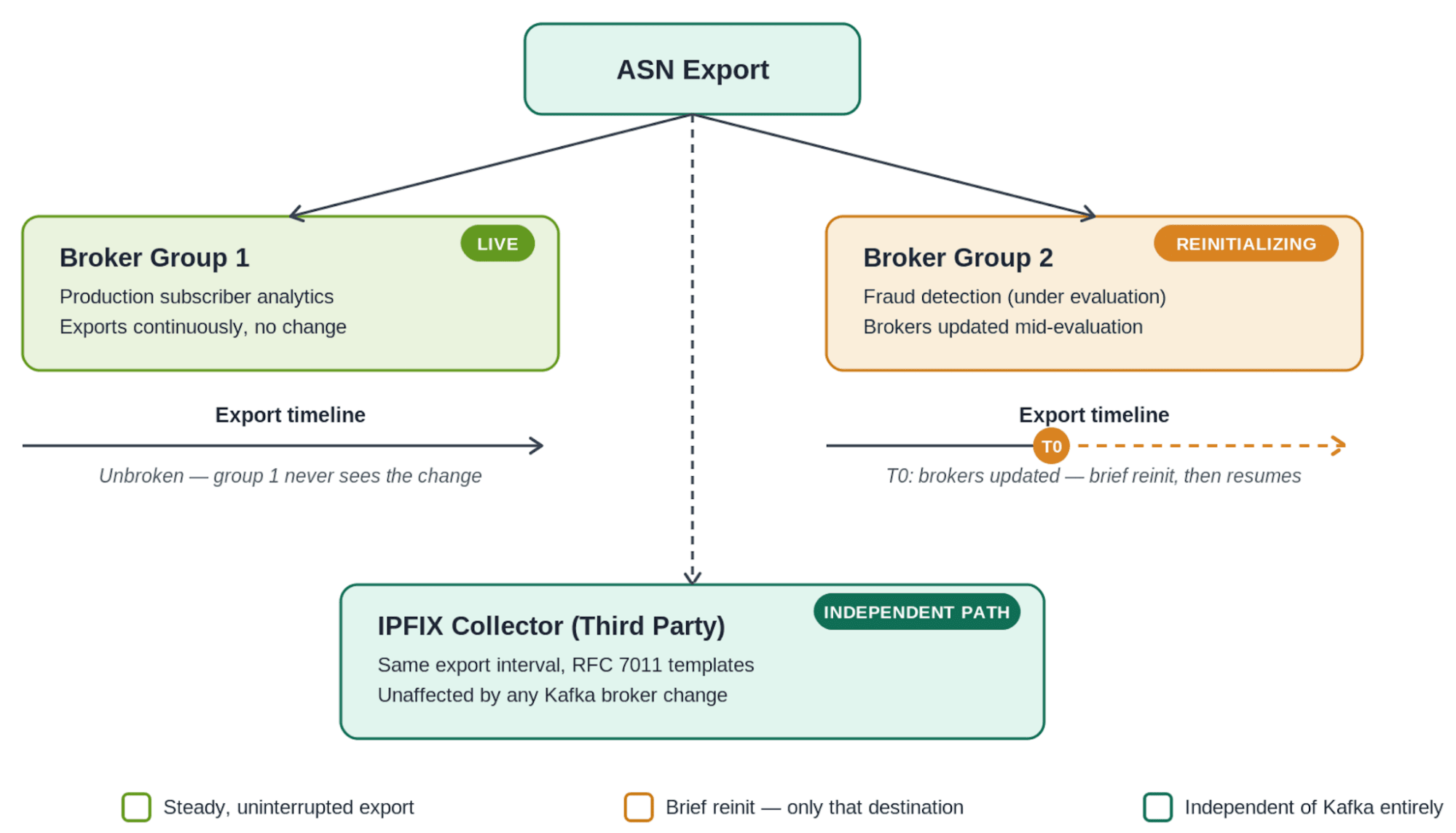
A network team is implementing live subscriber analytics on a production Kafka cluster (group 1) as they build a new fraud detection cluster for testing (group 2).
Using multi-Kafka export will allow session data to be sent to both clusters simultaneously.
As group 2 is being evaluated, it may even require a change to fraud detection cluster's broker addresses without any impact to group 1. This makes sure data analytics on production Kafka cluster continues uninterrupted.
Beyond Kafka, the same architecture is adopted on ASN. ASN's IPFIX export provides the capability of sending session and flow data to multiple IPFIX collectors, up to six, in real time using RFC 7011 templates.
IPFIX Export, like Kafka Export, is independent and uses the same metadata selection with an export interval of its own.
What Makes Multi-Destination Export Useful for Network Operations?
- How Can Multiple Clusters Receive Data in Parallel?
All Kafka clusters configured in the same way receive the same session stream at the same time. Configuration of each cluster remains independent of the others.
- How Does ASN Enable Zero-Downtime Reconfiguration?
Adding a new cluster or rotating brokers in one cluster does not interrupt any others. Any set of destinations can be changed at any time with services continuing to export data without a loss of coverage.
- How Does ASN Keep Configuration Predictable?
Each update provides a full description of the desired state for each destination. This leaves no guessing as to what changed and what remained the same.
- How Does Built-In Resilience Protect Exports?
If a destination fails to load, export will continue to the remaining successful destinations. A complete failure of all configured destinations is the only circumstance that halts ASN exports.
- How Can Kafka and IPFIX Work Together?
As with Kafka, consumers can combine IPFIX tools and add Kafka clusters based on their analytics and compliance demands.
Conclusion
Exporting session data to a single destination is becoming increasingly unworkable as an ever-increasing session data volume is generated by networks for an ever-expanding user base.
ASN's Kafka support allows for up to 6 independent broker groups that can be configured with high availability and replicated across multiple Kafka clusters. Session data can be replicated to multiple Kafka clusters without any disruption to consumers.
Frequently Asked Questions
What is ASN's multi-destination export capability?
ASN can send real-time session and flow data to up to six Kafka clusters and up to six IPFIX collectors simultaneously, all managed from a central configuration. This allows security, performance, fraud, compliance, and customer analytics platforms to receive the same network data in parallel.
Why would a team need to send data to multiple Kafka clusters at the same time?
Different teams often have separate needs, such as a security analytics cluster, a fraud detection cluster, and a compliance reporting cluster, that all require the same session data. Sending to a single destination forces consumers to share infrastructure, which can create operational conflicts and slowdowns.
Does an issue with one Kafka cluster affect the others?
No. Each destination operates independently, so a failure, credential rotation, or maintenance on one cluster does not interrupt exports to any of the remaining clusters. Exports only halt if every configured destination fails simultaneously.
Can a cluster be added or removed without disrupting active exports?
Yes. Adding a new cluster or retiring an existing one does not create a gap in data delivery for any other destination. Reconfiguration is designed to be zero-downtime.
Does ASN support IPFIX alongside Kafka for multi-destination export?
Yes. ASN supports up to six IPFIX collectors in parallel using RFC 7011 templates, with the same independent configuration model used for Kafka clusters. Teams can combine IPFIX tools and Kafka clusters based on their analytics and compliance needs.
How does ASN keep multi-destination configuration predictable?
Each configuration update provides a full description of the desired state for every destination, so there is no ambiguity about what changed or what remained the same.
Is external replication tooling required to send data to multiple Kafka clusters?
No. ASN's export pipeline natively supports simultaneous publication to multiple independent Kafka clusters, removing the need for external replication tools or additional infrastructure.
Deliver network intelligence wherever your teams need it. Explore how Aviz Service Node enables flexible, resilient, multi-destination Kafka and IPFIX exports.


