





Operating Sovereign AI: From Infrastructure Ownership to an Operational AI Factory
 October 5, 2026
 AI Factory
Artificial intelligence is rapidly becoming strategic infrastructure. Governments are investing in domestic compute capacity and sovereign AI programs, while healthcare systems, financial institutions, and other mission-critical organizations are bringing AI inside environments they control to meet requirements around data sovereignty, privacy, security, and governance.
At the same time, increasingly capable open and open-weight models such as Qwen, DeepSeek, and Llama give these organizations more choice in how and where AI is deployed. Models can run on-premises, in sovereign clouds, or even in fully air-gapped environments, keeping data and infrastructure within an organization’s own operational and governance boundaries.
But deploying GPUs and models inside your own data center does not automatically give you an AI cloud experience.
Once an organization moves from consuming AI as a service to providing it, it also takes on the operational responsibilities that an AI cloud provider normally handles behind the scenes. The infrastructure has to be provisioned and monitored, multiple tenants and workloads have to be supported securely, AI service usage has to be understood, and problems have to be diagnosed across the network, GPUs, workloads, and inference stack.
Sovereignty gives you control. But control also means operating the AI factory yourself.
Making the AI Factory Operational
Once the GPUs, network gear, and supporting infrastructure are in place, the challenge shifts from building the AI factory to operating it.
An AI factory can span high-performance Ethernet or InfiniBand fabrics, switches, NICs, DPUs, GPUs, storage, and workload platforms while supporting multiple tenants and applications. Managing this environment device by device quickly becomes complex as the factory grows.
Aviz ONES provides an operational layer across the AI network lifecycle:
- Design and validate: Validate the planned network architecture and, where needed, use NVIDIA DSX Air to test the design in a digital twin environment before deployment.
- Onboard and provision: Automate the onboarding of switches, NICs, and DPUs instead of bringing up infrastructure device by device.
- Operate multi-tenancy: Provision tenant segmentation and workload isolation through APIs and automated workflows.
- Monitor and troubleshoot: Bring network health and telemetry into ongoing operations for troubleshooting, forecasting, and capacity planning.
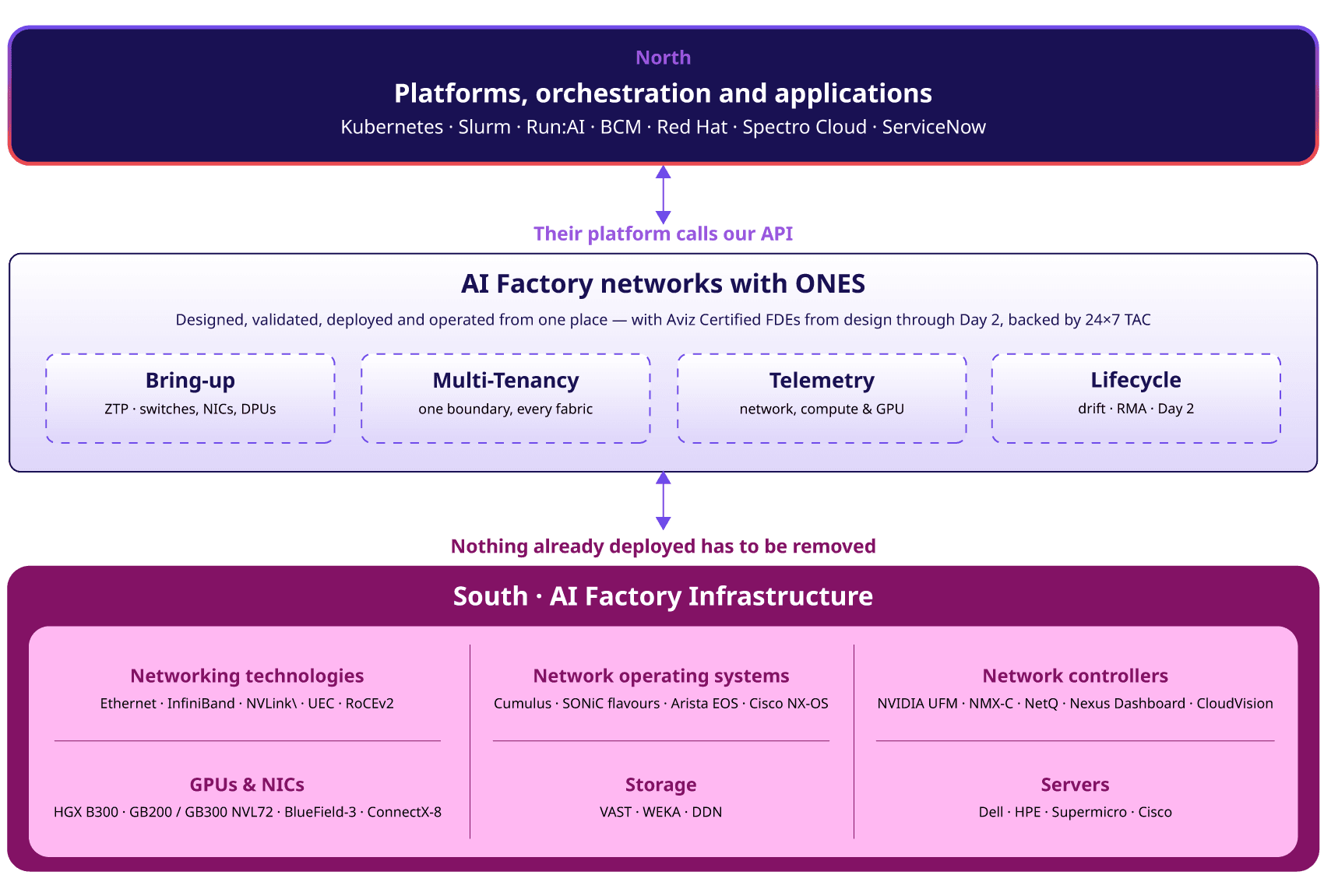
As the factory scales, that operational model also has to extend to the service edge. Tenants may need routing, policy boundaries, NAT, elastic IPs, stateful security, and controlled connectivity outside their isolated environments.
Aviz Service Gateway brings these services into the software-defined operational model, running on standard x86 infrastructure or NVIDIA BlueField-3 DPUs and allowing gateway capacity to scale horizontally as tenants and traffic grow.
Together, ONES and Service Gateway help turn the networking infrastructure already deployed in the AI factory into something that can be operated, consumed, and scaled as part of an AI service.
Understanding How the AI Service Is Being Consumed
Once the infrastructure is operational and applications begin consuming AI, another question emerges: what is actually happening at the inference layer?
Infrastructure metrics can tell an operator whether GPUs, servers, or networks are busy. But operating AI as a shared service also requires context around who is consuming that service, which applications and models are involved, how many tokens are being processed, and what performance the user is experiencing.
Self-hosted inference engines such as vLLM, TensorRT-LLM, TGI, SGLang, and Dynamo provide valuable information about their serving layer. Aviz AI-Parser complements that telemetry by adding an independent operational view of the AI traffic flowing through the inference environment.
AI-Parser provides visibility into:
- Token usage: Input, output, and total tokens across calls, applications, models, and tenants.
- Identity and activity: The tenant, application, IP, or API key associated with AI traffic.
- Inference performance: Time-to-first-token and end-to-end latency as experienced by the client.
- Usage context: Information that can support chargeback, capacity planning, SLA management, troubleshooting, and governance.
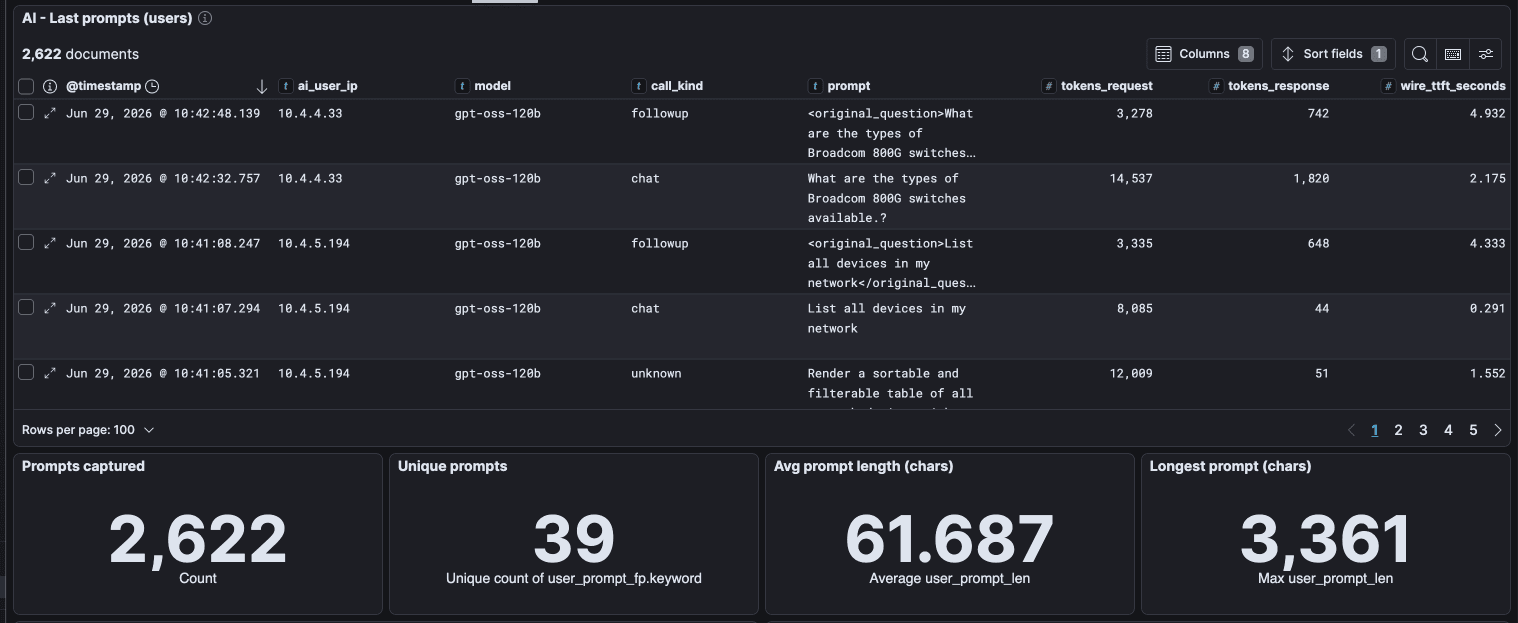
The distinction is important. A GPU metric may tell you that infrastructure is heavily utilized. Inference metadata adds context around which model, tenant, and application are driving that utilization and what experience the user is receiving.
AI-Parser does not replace the inference engine. It complements it with the service-level visibility needed to understand how AI capacity is being consumed.
AI-NOC - An operational platform for AI factories
The next challenge appears when something goes wrong.
An inference engineer may see time-to-first-token increasing while NVIDIA DCGM reports healthy GPUs, the workload platform shows healthy workloads, and the network has no links down. The issue may still involve network congestion, changes in inference traffic, workload behavior, or a combination of conditions across the stack.
The problem is not necessarily a lack of telemetry. The problem is that the telemetry lives in different operational domains.
Network and fabric health may come from ONES. GPU health comes from NVIDIA DCGM. Workload state comes from Kubernetes, Run: AI, or another orchestration platform. Inference activity comes from the serving stack and AI-Parser.
Each provides part of the answer.
Aviz AI-NOC brings those signals together through a conversational operational layer, allowing AI/ML engineers, inference teams, and NOC operators to begin with the question they actually need answered:
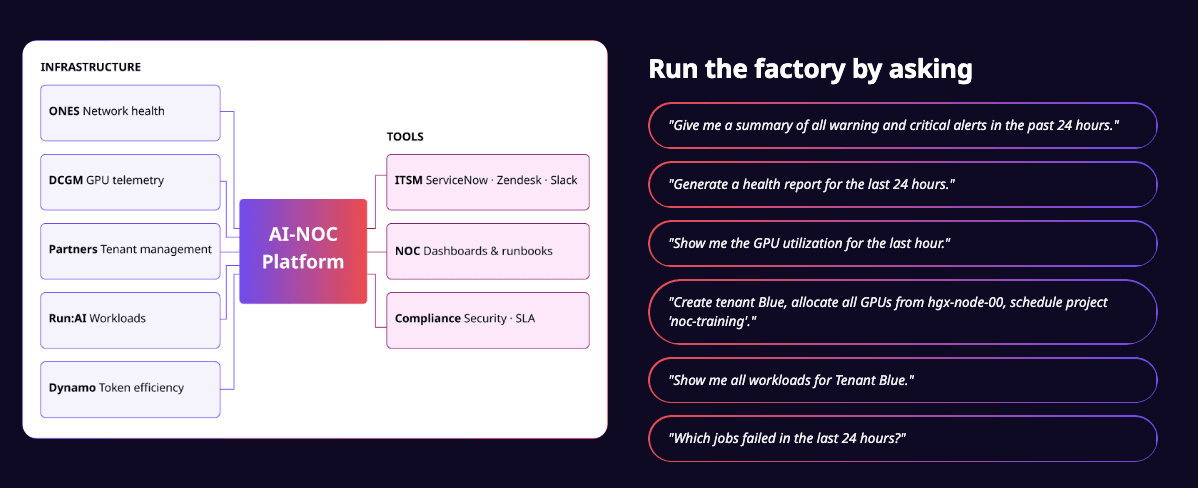
AI-NOC can correlate the available network, GPU, workload, and inference telemetry to help identify what changed and where the problem is occurring.
For example, inference telemetry might show increased request size and TTFT while GPU telemetry remains healthy and workload state appears normal. At the same time, ONES may identify congestion along the network path serving the inference hosts. Instead of treating those as separate observations, the operator gets a connected view of what is happening across the AI service.
This is AI for AI operations: using the telemetry already generated by the factory to make day-to-day operations and troubleshooting easier for AI/ML, inference, network, and infrastructure teams.
Where actions are authorized, that same operational layer can extend from understanding a problem to executing approved infrastructure and tenant workflows. For sovereign or air-gapped environments, AI-NOC can run on-premises against a private LLM so operational telemetry can remain inside the controlled environment.
From Infrastructure Ownership to Operational Sovereignty
Sovereign AI gives organizations greater control over their models, data, and infrastructure. But owning that infrastructure also means owning the responsibility for operating it.
For organizations providing AI from their own infrastructure, that means making the underlying network operational and multi-tenant, understanding how the AI service is being consumed, and giving AI/ML and infrastructure teams a way to troubleshoot across the factory rather than working through each layer in isolation.
This is where Aviz fits into the sovereign AI journey: ONES and Service Gateway help operationalize the network and tenant services, AI-Parser adds inference-level visibility, and AI-NOC brings infrastructure and AI telemetry together for day-to-day operations and troubleshooting.
The goal is not to replace the GPU stack, inference stack, or workload platform. It is to help make those systems easier to operate together.
Choose your models. Control your data. Own your infrastructure. Operate AI on your terms.
Frequently Asked Questions
What does it mean to operate sovereign AI infrastructure?
Operating sovereign AI infrastructure means an organization takes on the full operational responsibilities of running AI as a service from within its own environment, including provisioning, monitoring, multi-tenancy, and troubleshooting, rather than relying on a cloud provider to handle those tasks behind the scenes.
Why is deploying GPUs on-premises not enough to have a full AI cloud experience?
Deploying hardware inside your own data center gives you control, but it does not automatically provide the operational capabilities an AI cloud provider normally handles, such as tenant isolation, network management, usage visibility, and cross-stack troubleshooting.
How does Aviz ONES help manage AI factory infrastructure?
Aviz ONES provides an operational layer across the AI network lifecycle, covering design and validation, automated onboarding of switches and DPUs, multi-tenant provisioning, and ongoing monitoring and troubleshooting for capacity planning.
What visibility does Aviz AI-Parser provide at the inference layer?
AI-Parser adds an independent operational view of AI traffic, including token usage, tenant and application identity, time-to-first-token, and end-to-end latency, giving operators the service-level context that GPU and network metrics alone cannot provide.
How does Aviz AI-NOC help when something goes wrong across the AI factory?
AI-NOC brings together telemetry from the network, GPUs, workload platforms, and inference stack into a conversational operational layer, allowing teams to correlate signals across domains and identify the source of a problem rather than investigating each layer in isolation.
Can AI-NOC be used in air-gapped or sovereign environments?
Yes, AI-NOC can run on-premises against a private LLM so that operational telemetry stays inside the controlled environment, making it suitable for sovereign or air-gapped deployments.
What is the role of Aviz Service Gateway in a sovereign AI deployment?
Service Gateway extends the software-defined operational model to the service edge, providing routing, policy boundaries, NAT, elastic IPs, and stateful security for tenants, and it scales horizontally on standard x86 infrastructure or NVIDIA BlueField-3 DPUs as traffic grows.
Which open-weight models are mentioned as options for sovereign AI deployments?
The article references Qwen, DeepSeek, and Llama as examples of capable open and open-weight models that can run on-premises, in sovereign clouds, or in fully air-gapped environments.
What inference engines does Aviz AI-Parser complement?
AI-Parser is designed to complement self-hosted inference engines such as vLLM, TensorRT-LLM, TGI, SGLang, and Dynamo by adding an independent layer of service-level visibility alongside the telemetry those engines already provide.
Build and Operate Your Sovereign AI Infrastructure Simplify AI factory operations with unified visibility across networking, infrastructure, workloads, and inference.


