





ONES 4.2: Everything You Need to Know
 April 8, 2026
 ONES & SONiC
Introduction
We are excited to introduce ONES 4.2, a significant milestone in the evolution of the Open Networking Enterprise Suite (ONES). This release strengthens our vision of “Networks for AI and AI for Networks,” setting new standards in network fabric design, orchestration, and operations.
With enhanced support for hybrid fabric environments including NVIDIA SpectrumX and SONiC-based deploymentsONES continues to unify GPU, front-end, and storage networks into a single, intelligent platform. This release goes beyond incremental improvements, delivering deeper visibility, smarter automation, and improved operational efficiency.
More than just an upgrade, ONES 4.2 represents a step forward in building self-aware, performance-optimized network infrastructures. It reinforces our commitment to redefining how modern data center networks are designed, managed, and scaled for AI-driven workloads.
Key Features & Enhancements
Zero-Touch Bootstrapping (Day-0 Automation)
ONES 4.2 streamlines network onboarding with a robust Day-0 provisioning capability.
By simply providing the device MAC address and serial number, ONES automates the complete onboarding workflow, including DHCP configuration (IP pool and gateway setup), device IP allocation, and seamless Zero Touch Provisioning.
A dynamically generated ZTP script handles key provisioning steps such as NOS image installation, configuration restoration, and deployment of ONES telemetry and configuration agents ensuring devices are fully operational with minimal manual intervention.
The bootstrap process is complemented by a comprehensive UI that clearly visualizes each step of the onboarding workflow along with its completion status, enabling users to track progress in real time and identify the exact stage of the provisioning process.
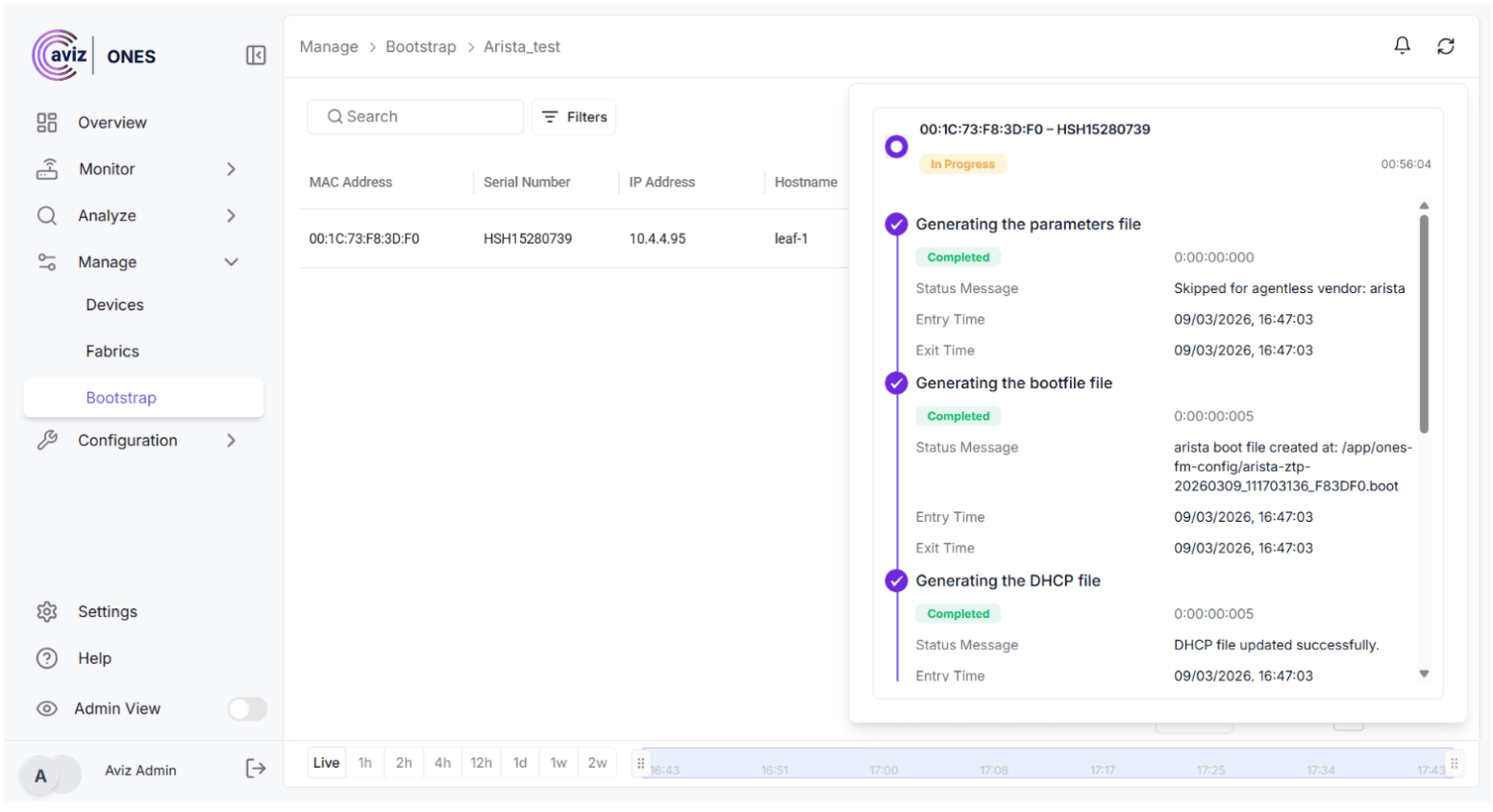
Bootstrapping progress indicator
This feature supports:
- Aviz CCS
- Broadcom SONiC
- Cumulus Linux
By eliminating manual intervention, ONES dramatically reduces the complexity and time required to bring up a network from scratch.
ONES Controller Resource Monitoring Enhancements
ONES 4.2 introduces advanced controller-level resource monitoring, enabling time-series visualization of CPU, memory, and disk utilization.
With integrated rule engine and alerting capabilities, operators can proactively monitor the ONES controller’s resource consumption and respond before performance degradation occurs.
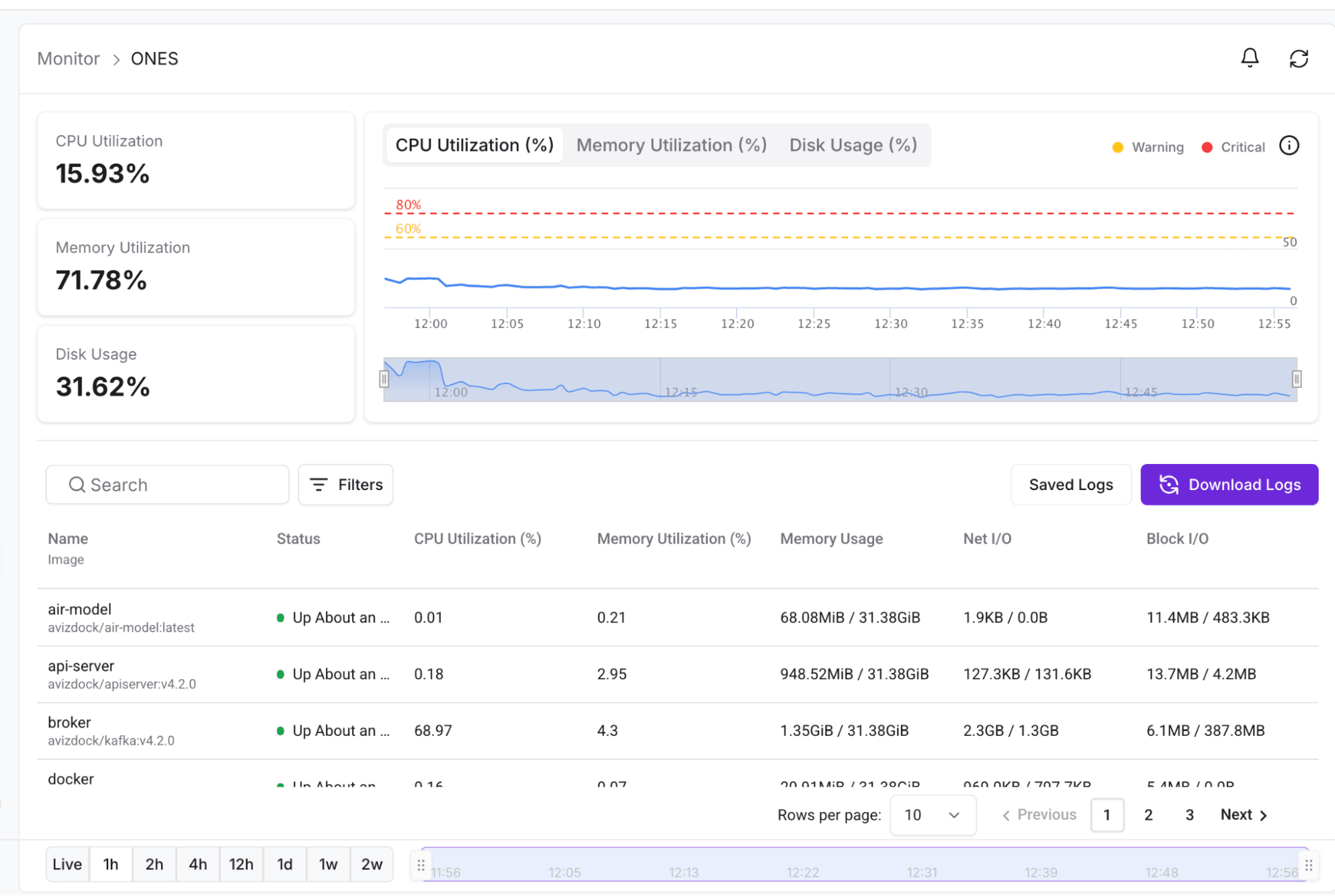
ONES controller resource utilization timeseries graphs
Additionally, container-level (Docker) monitoring and alerting has been introduced, giving granular visibility into individual ONES services running within the controller. This ensures better capacity planning and operational stability for large-scale deployments.
Flexible and Granular ONES Licensing
ONES 4.2 introduces a new, flexible licensing model designed to align with diverse customer needs.
Customers can now:
- Select licenses based on OS type (e.g., Aviz CCS, Broadcom SONiC)
- Choose based on switch port speeds
- Opt for separate fabric design licenses
This modular approach allows customers to scale incrementally adding licenses as their infrastructure grows.
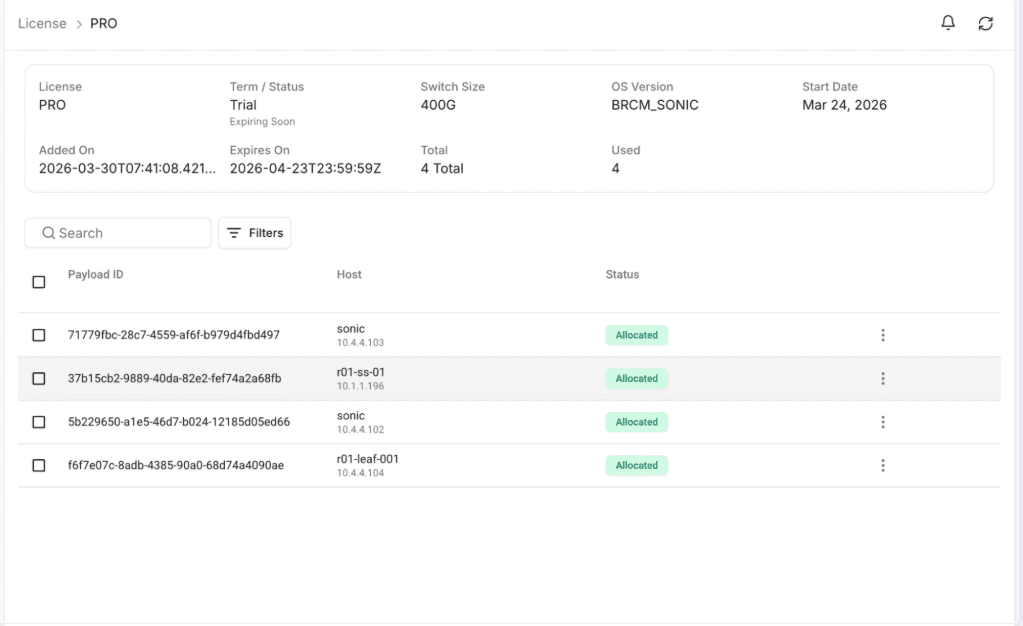
The enhanced ONES licensing dashboard provides:
- A complete overview of all licenses
- Visibility into used vs available seats
- Flexibility to reassign devices between licenses
This ensures better control, transparency, and cost optimization.
SSD Telemetry and Observability Enhancements
Storage reliability is critical to overall system stability, especially in AI and data-intensive environments where disk failures can directly impact performance and availability. Deep visibility into SSD health and lifecycle metrics is essential for early detection of degradation and preventing unexpected outages.
ONES 4.2 enhances storage observability with deeper SSD-level telemetry insights. In addition to previously available metrics such as temperature, health, and utilization, the platform now supports:
- Erase Fail Count
- SATA CRC Errors
- Power Cycles
- Unsafe Shutdown Events
- Unexpected Power Loss
- Late Bad Blocks
- Total Bad Blocks
- Spare Block Availability
- SSD Wear Level (Health Index)
- Total Host Writes / Reads
- Power-On Hours
These detailed metrics enable predictive failure analysis, helping operators take proactive action before storage issues impact workloads.
Interface Flap History Visibility
The interface monitoring experience has been significantly enhanced, delivering improved visibility and usability.
The interface down widget now includes time-based link flap history, allowing users to track and analyze intermittent connectivity issues over time.
This improvement helps network operators quickly identify unstable links, perform root cause analysis, and improve overall network reliability.
AI Infrastructure Orchestration Enhancements
Rethinking GPU Infrastructure: Multi-Tenant Compute VM Sharing & Fine-Grained GPU Allocation
Traditionally, ONES enforced strict tenant isolation at the physical server level, where all GPUs and compute resources on a server were bound to a single tenant. While this ensured strong isolation, it often led to:
- Underutilized compute capacity
- Stranded GPU resources, especially when workloads did not fully consume all available GPUs
ONES 4.2 removes this rigidity by introducing:
- Multi-tenant compute VM sharing on the same physical server
- Fine-grained GPU allocation at the individual GPU level
- Intelligent orchestration to ensure no cross-tenant interference
This enables:
- Multiple tenants to run compute-only VMs on shared servers
- Each GPU to be allocated to a specific tenant independently, instead of binding all GPUs on a server to a single tenant
- Strict enforcement that a single GPU is never shared across tenants
Programmable Networking: API-Driven Front-End ↔ Storage Connectivity
Modern PaaS platforms demand dynamic, API-driven connectivity across isolated networks.
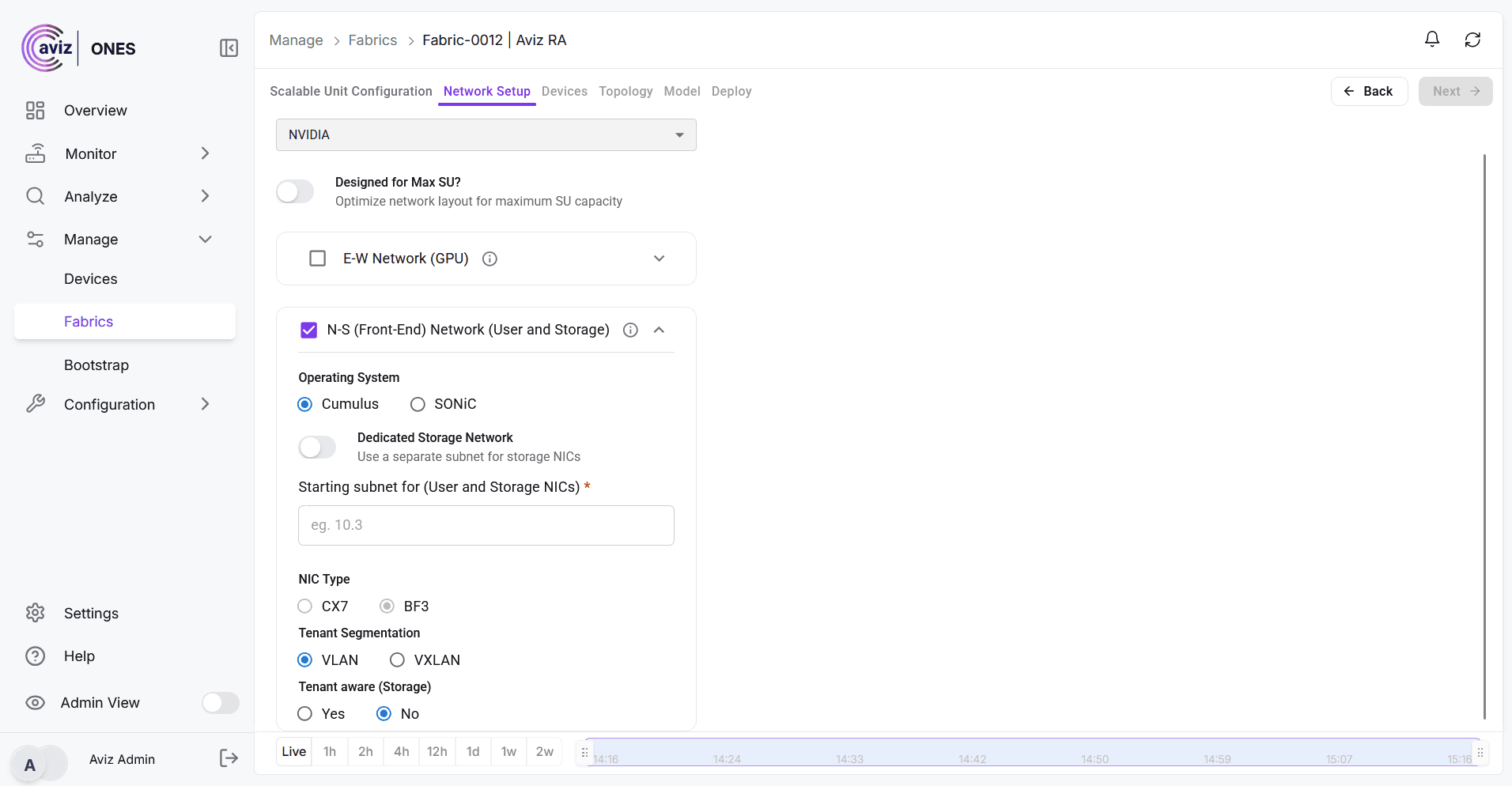
ONES 4.2 enhances programmable networking by introducing API-driven control over connectivity between front-end (North-South) and storage networks, built on strong tenant segmentation principles without relying on explicit peering constructs.
This release enables PaaS platforms to programmatically manage how tenants access storage networks, using flexible segmentation and controlled route propagation.
Key capabilities include:
- Full API support for front-end ↔ storage connectivity workflows
- Tenant segmentation using VxLAN or VLAN + VRF
- Support for:
1. Tenant-aware storage networks
2. Tenant-unaware storage networks
- Connectivity enabled via controlled route leaking
Unified Network Architecture Across Platforms
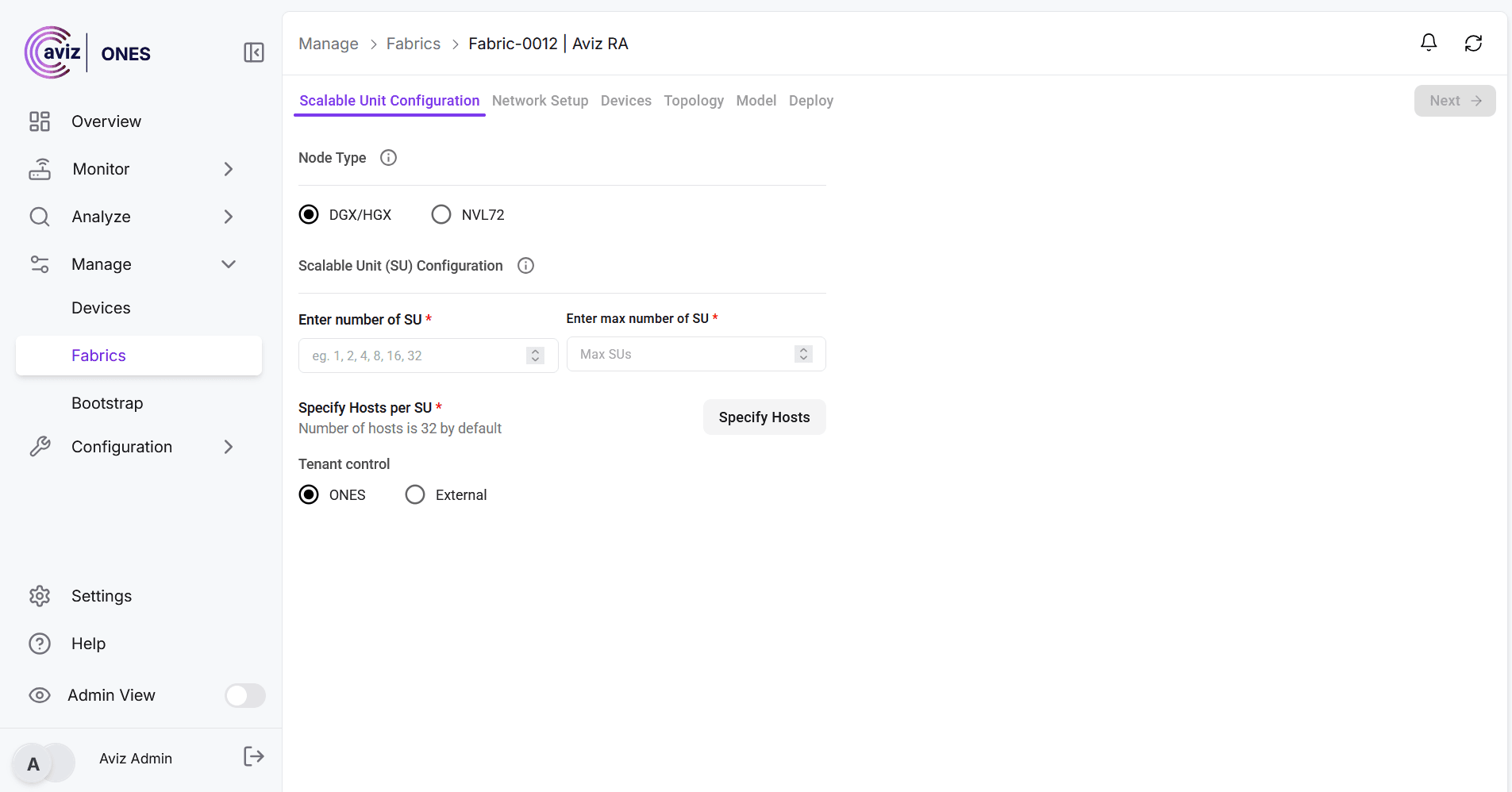
ONES 4.2 standardizes Front-End and Storage network behavior across:
- HGX (NVIDIA RA 1.3)
- DGX
- NVL72
Supported Models
- VxLAN-based tenant isolation (tenant-aware / tenant-unaware storage)
- VLAN + VRF-based tenant isolation (tenant-aware / tenant-unaware storage)
- Flexible deployment modes for diverse infrastructure needs
Note: DGX and NVL72 support North-South and Storage networks only.
Cumulus Telemetry Hybrid Model (NVUE + gNMI)
ONES 4.2 introduces a hybrid telemetry model combining NVUE and gNMI for enhanced data collection. Enables real-time streaming telemetry via gNMI for faster insights and monitoring. Leverages NVUE for detailed visibility across the infrastructure. This improves observability and troubleshooting in AI infrastructure environments.
Conclusion
ONES 4.2 marks a significant step forward in AI infrastructure orchestration by combining efficient GPU utilization, strong multi-tenant isolation, and fully programmable networking. With capabilities like fine-grained GPU allocation, API-driven connectivity, and unified network architecture, the platform enables operators to build scalable, flexible, and high-performance AI environments. Along with enhanced observability and Day-0 automation (bootstrapping), new license models. ONES 4.2 continues to advance the vision of an intelligent, self-optimizing network and compute infrastructure.
Discover how ONES 4.2 can transform your AI-driven network. Schedule a demo today and experience intelligent, self-optimising infrastructure in action.
1. What is ONES 4.2 and why is it important?
ONES 4.2 is a major release of the Open Networking Enterprise Suite that advances the vision of "Networks for AI and AI for Networks," delivering smarter automation, deeper visibility, and more efficient orchestration for AI-driven data center networks.
2. What problem does ONES 4.2 solve for AI infrastructure?
ONES 4.2 simplifies the complexity of operating hybrid AI networks by unifying GPU, front-end, and storage fabrics into a single intelligent platform with automation, observability, and programmable control.
3. What types of network environments does ONES 4.2 support?
ONES 4.2 supports hybrid fabric environments, including NVIDIA SpectrumX and SONiC-based deployments, enabling consistent operations across diverse AI and data center infrastructures.
4. What is Zero-Touch Bootstrapping in ONES 4.2?
Zero-Touch Bootstrapping automates Day-0 network onboarding by provisioning devices using only MAC address and serial number, eliminating manual configuration and significantly reducing deployment time and errors.
5. How does ONES 4.2 improve network operations visibility?
ONES 4.2 adds enhanced observability with controller-level resource monitoring, container-level visibility, SSD health telemetry, and interface flap history, enabling proactive issue detection and faster troubleshooting.
6. What licensing changes were introduced in ONES 4.2?
ONES 4.2 introduces a flexible, modular licensing model that allows customers to license by OS type, port speed, or fabric design, providing better cost control and the ability to scale incrementally.
7. How does ONES 4.2 improve GPU utilization in AI environments?
ONES 4.2 enables multi-tenant compute VM sharing and fine-grained GPU allocation, allowing individual GPUs to be assigned per tenant while maintaining strict isolation and preventing resource underutilization.
8. What is API-driven front-end to storage connectivity?
ONES 4.2 introduces programmable, API-driven control over connectivity between front-end and storage networks, enabling dynamic tenant access using segmentation and controlled route propagation without manual peering.
9. How does ONES 4.2 standardize networking across AI platforms?
ONES 4.2 delivers a unified network architecture across platforms such as HGX, DGX, and NVL72, standardizing tenant isolation models and network behavior for consistent deployment and operations.
10. How does ONES 4.2 support future-ready AI infrastructure?
By combining automation, open networking, fine-grained GPU orchestration, and deep telemetry, ONES 4.2 enables scalable, self-aware, and performance-optimized infrastructures designed for evolving AI workloads.


