





ONES 4.0: Proactive Network Assurance That Prevents Issues Before They Impact
 December 16, 2025
 ONES & SONiC
Summary
Modern networks demand precision, stability, and instant visibility. ONES 4.0 introduces proactive rule enforcement through configuration change detection and NTP drift monitoring. These capabilities help teams identify issues early, maintain operational accuracy, and prevent outages caused by misconfigurations or timing deviations.
Introduction
In high-performance network environments, milliseconds matter and every packet counts.
Today’s data centers combine high-speed switching with strict timing requirements. To keep such systems
running reliably, monitoring alone is not enough. Networks need proactive intelligence that can detect risks
before they become problems.
ONES Rule Engine in version 4.0 delivers this by adding configuration sanity
checks and NTP drift detection so that teams can maintain stability, improve visibility, and protect critical
operations
Config Change Detection for Improved Network Stability
Why Config Change Monitoring Matters
Network devices undergo frequent configuration updates. These changes may be planned, accidental, or unauthorized. Any incorrect modification can lead to performance issues, outages, or security gaps. ONES Rule Engine identifies configuration changes in real time so that engineers can respond immediately.
How ONES Helps
- Instant alerts when a configuration change occurs
- Clear diff reports that show added, removed, or modified lines
- Context such as device name, IP address, role, region, and timestamp
- Better visibility into what changed and when it happened
Why This Is Useful
- Eliminates long investigations into who performed a change
- Detects misconfigurations before they trigger outages
- Creates accurate audit trails that support compliance requirements
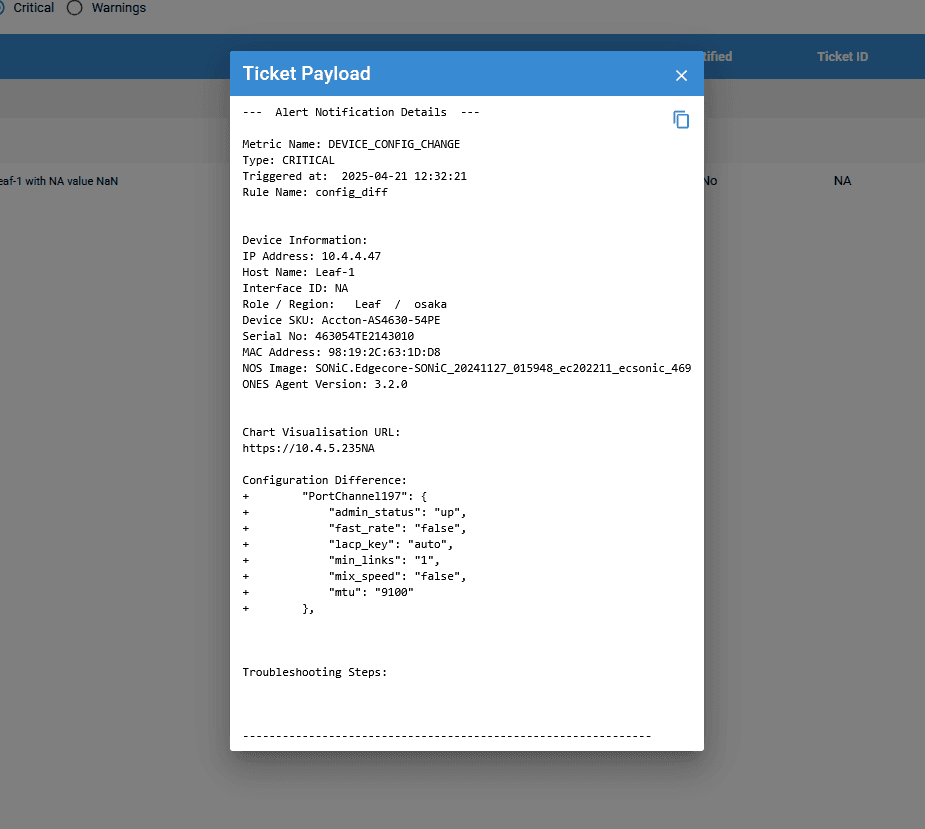
ONES ensures that no configuration change is missed and reduces the time required for troubleshooting.
Keeping Time Accurate with NTP Drift Monitoring
Why NTP Sync Is Important
Accurate time synchronization is essential for:
- Log correlation during debugging or security analysis
- Scheduled tasks such as backups and updates
- Accurate event timelines across distributed devices
If device clocks drift, these operations lose reliability. ONES 4.0 monitors actual NTP drift to maintain accuracy.
How the Rule Engine Detects NTP Drift
ONES monitors the clock offset between a device and its NTP server.
- A positive offset means the device clock is behind
- A negative offset means the device clock is ahead
- Thresholds can be configured based on timing accuracy requirements
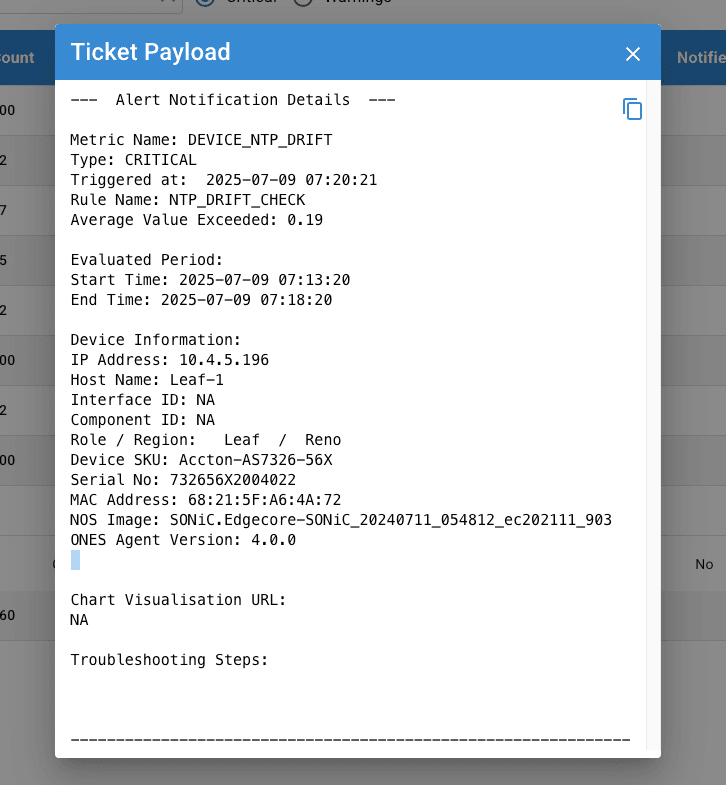
An example of drift: an offset of minus one hundred fourteen milliseconds.
If the
offset exceeds the threshold, ONES generates an alert.
When all devices are synchronized, there is no
measurable offset.
Real GNMI Output Example
Below is a sample GNMI subscription showing NTP offset metrics:
root@akashp:/home# gnmic -a 10.4.4.101:50052 -u admin -p YourPaSsWoRd --skip-verify subscribe --path "system/status" --stream-mode sample --sample-interval 20s --qos 0

{
  "source": "10.4.4.101:50052",
  "subscription-name": "default-1751974056",
  "timestamp": 1751974056316950462,
  "time": "2025-07-08T11:27:36.316950462Z",
  "updates": [
    {
      "Path": "system/agent/version",
      "values": {
        "system/agent/version": "0.90β"
      }
    },
    {
      "Path": "system/agent/enabled",
      "values": {
        "system/agent/enabled": true
      }
    },
    {
      "Path": "system/status/ntp/servers/server/offset",
      "values": {
        "system/status/ntp/servers/server/offset": -1.598
      }
    }
  ]
}
ONES 4.0 Means Proactive Reliability
With ONES 4.0 your network becomes more predictable and more resilient.
You gain:
- Change tracking that identifies issues early
- Precise time monitoring that protects operational workflows
- Better awareness of system behavior
- Stronger network stability
Your network is not only monitored. It is understood, protected, and optimized.
Frequently Asked Questions
What are the two new capabilities ONES 4.0 adds through the Rule Engine?
ONES 4.0 adds configuration change detection and NTP drift monitoring. Config change detection alerts teams instantly when any device configuration changes and shows exactly what was added, removed, or modified. NTP drift monitoring watches the clock offset between devices and their NTP servers and fires an alert when the offset crosses a configured threshold.
What information does ONES provide when a configuration change is detected?
Teams get an instant alert, a diff report showing exactly which lines were added, removed, or modified, and context including device name, IP address, role, region, and timestamp. That combination tells engineers what changed, when it changed, and which device it happened on without needing to dig through logs or ask around to piece the story together.
Why does NTP drift cause real problems in data center and network environments?
Log correlation during debugging and security analysis depends on accurate timestamps across all devices. Scheduled tasks like backups and updates rely on device clocks being correct. When clocks drift, event timelines across distributed devices go out of order and investigations become unreliable. An offset of even a hundred milliseconds throws off the sequence of events enough to make troubleshooting significantly harder.
How does ONES 4.0 detect and report NTP drift on network devices?
ONES monitors the clock offset between each device and its NTP server. A positive offset means the device clock is behind, a negative offset means it is ahead. Teams configure thresholds based on their timing accuracy requirements and ONES fires an alert when any device exceeds them. When all devices are properly synchronised, there is no measurable offset and no alert.
How does configuration change detection support compliance and audit requirements?
Every configuration change is captured with a timestamp, device details, and a clear diff of what changed. That creates an accurate audit trail automatically rather than relying on engineers to document changes manually or trying to reconstruct a timeline after something goes wrong. Compliance audits that require proof of change management have the evidence already in place.
Why is monitoring alone not enough to protect modern high-performance network environments?
Monitoring tells you what is happening right now. It does not catch a misconfiguration before it causes an outage or flag a clock drift before it corrupts log correlation. ONES 4.0 adds proactive intelligence that detects risks before they become problems. The difference is catching a misconfiguration the moment it happens versus discovering it an hour later when something stops working.
What kinds of configuration changes create the most risk and why does instant detection matter?
Changes can be planned, accidental, or unauthorised. All three can cause performance issues, outages, or security gaps. The problem with detecting them slowly is that the longer a misconfiguration sits unnoticed, the harder it is to trace back to the root cause and the more downstream impact it creates. Instant detection with a diff report means engineers respond before the change cascades into something bigger.
How does NTP drift monitoring protect scheduled operations like backups and updates?
Scheduled tasks depend on device clocks being accurate. If a device clock has drifted significantly, a backup job or update window may fire at the wrong time or fail to coordinate properly with dependent systems. ONES 4.0 catches drift before it reaches the point where it disrupts those operations rather than discovering the timing problem after a scheduled task has already failed or run at the wrong moment.
Ready to bring proactive reliability into your network operations?
Reach out to
the ONES team to learn how ONES 4.0 can secure your configuration accuracy and timing precision.
Contact us


