





How Does Network Copilot™ Deliver a Unified NLP Interface for Your Private AI?
 December 18, 2025
 Network Copilot ™
Summary
Network Copilot™ by Aviz Networks provides a unified natural language interface that breaks down controller silos across modern data centers. It enables engineers to query inventory, security, compliance, performance, and topology across multiple controllers using plain English. By combining contextual AI, deep data connectors, and multi-vendor intelligence, Network Copilot reduces MTTR, improves operational efficiency, and future-proofs network operations.
Introduction
Modern data centers are inherently multi-controller environments. Platforms like Nexus Dashboard manage Cisco ACI fabrics, Cisco DNA Center orchestrates campus and WAN networks, Open Networking Enterprise Suite supports SONiC and Cumulus deployments, while tools such as IP Fabric and SolarWinds provide monitoring and automation.
This architecture introduces operational complexity. Engineers must constantly switch between tools, interfaces, and data models to understand network health, performance, and compliance.
Network Copilot™ (NCP) addresses this challenge by acting as a unified AI-powered search and observability layer, allowing operators to interact with their entire network infrastructure using natural language.
What Problem Does Network Copilot™ Solve?
Network Copilot eliminates fragmented visibility caused by multiple controllers by providing a single NLP-based interface that queries and correlates data across all connected platforms.
Why Fragmented Search Slows Network Operations
Operational Inefficiency
Traditional network operations require engineers to:
- Log into multiple controller dashboards
- Learn different CLI syntaxes
- Understand vendor-specific data models
- Manually aggregate results across platforms
Impact on MTTR
Fragmented workflows lead to:
- Slower incident triage
- Manual correlation delays
- Inconsistent interpretations
- Platform-specific knowledge silos
example:
Identifying vulnerable devices requires separate queries across DNA Center, Nexus Dashboard, SONiC CLI, and monitoring tools, followed by manual consolidation.
How Does Network Copilot™ Solve This with NLP?
Network Copilot introduces a natural language search layer that abstracts controller complexity while preserving the accuracy and depth of native queries.
Engineers focus on questions, not tools.
What Powers Network Copilot’s Contextual AI Engine?
Controller-Specific Schema Intelligence
Network Copilot understands:
- Inventory models across Cisco, Arista, Cumulus, and SONiC
- Interface and port abstractions
- Platform health metrics
- Traffic flows and protocol behavior
- Configuration hierarchies
Operating System Metadata Correlation
- IOS-XE, NX-OS, EOS, SONiC, Cumulus version mapping
- Feature availability across releases
- Command syntax equivalence
Topology and Path Intelligence
- Physical and logical connectivity mapping
- End-to-end reachability across controller boundaries
How Does Network Copilot Integrate with Existing Systems?
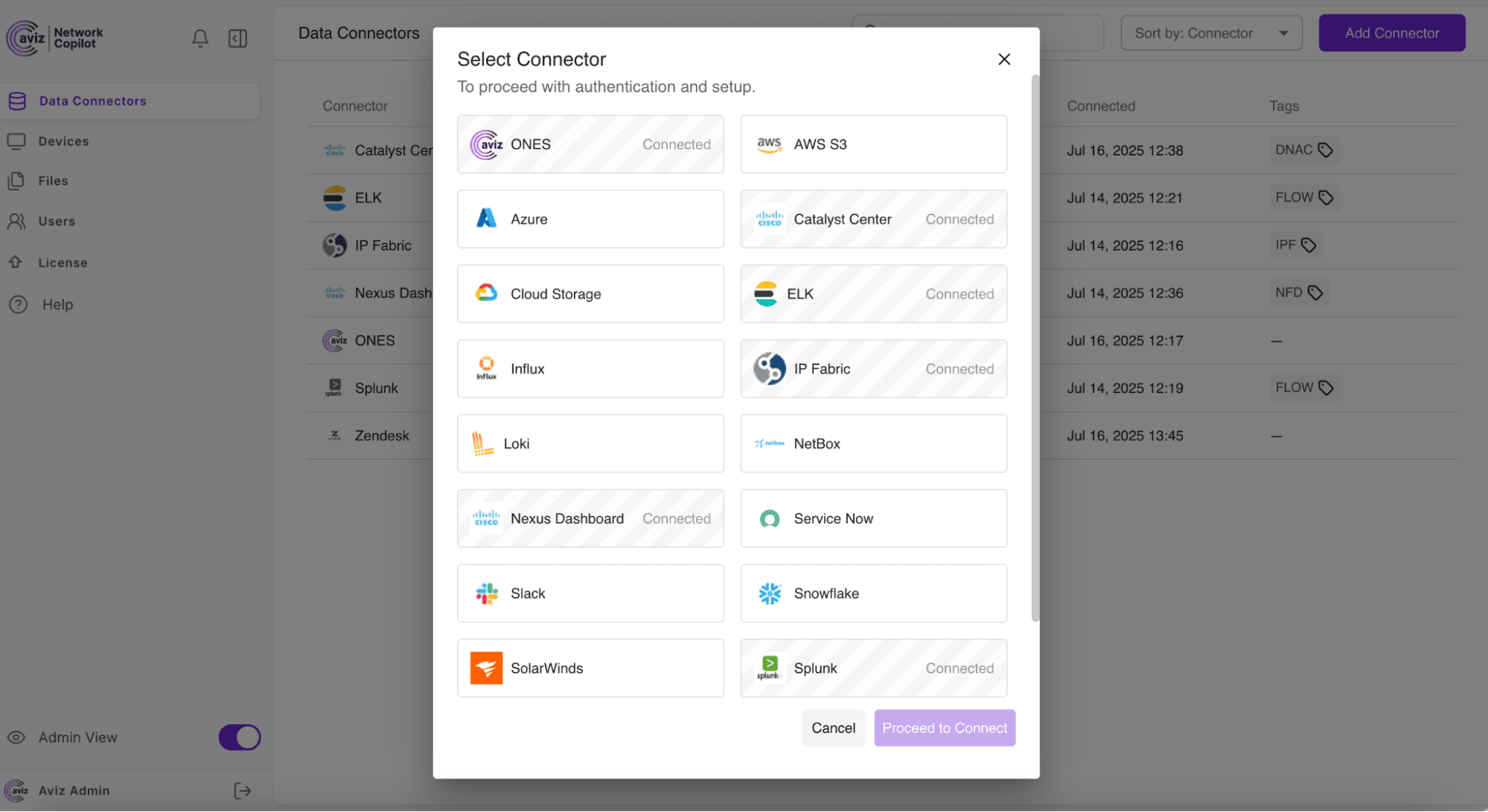
Network Copilot uses a flexible connector architecture to integrate APIs, devices, telemetry, files, and databases into a unified data model.
API-First Integration
- REST and gRPC APIs for DNA Center, Nexus Dashboard, ONES
- OpenConfig and YANG telemetry
- Vendor-specific deep integrations
Direct Device Access
- SSH-based CLI access
- SNMP for broad compatibility
- gNMI streaming telemetry
File and Database Integration
- Offline config and log parsing
- Cross-system log correlation
- Export and import workflows
What Can You Do with Network Copilot™?
AI-Powered Reasoning and Correlation
Query:
"Show me all devices running IOS-XE 15.1(3)S3 with known CVEs"
Network Copilot automatically performs:
- Inventory discovery
- OS version correlation
- Vulnerability lookup
- Exposure timeline analysis
- Risk assessment based on network role
Advanced Inventory Intelligence
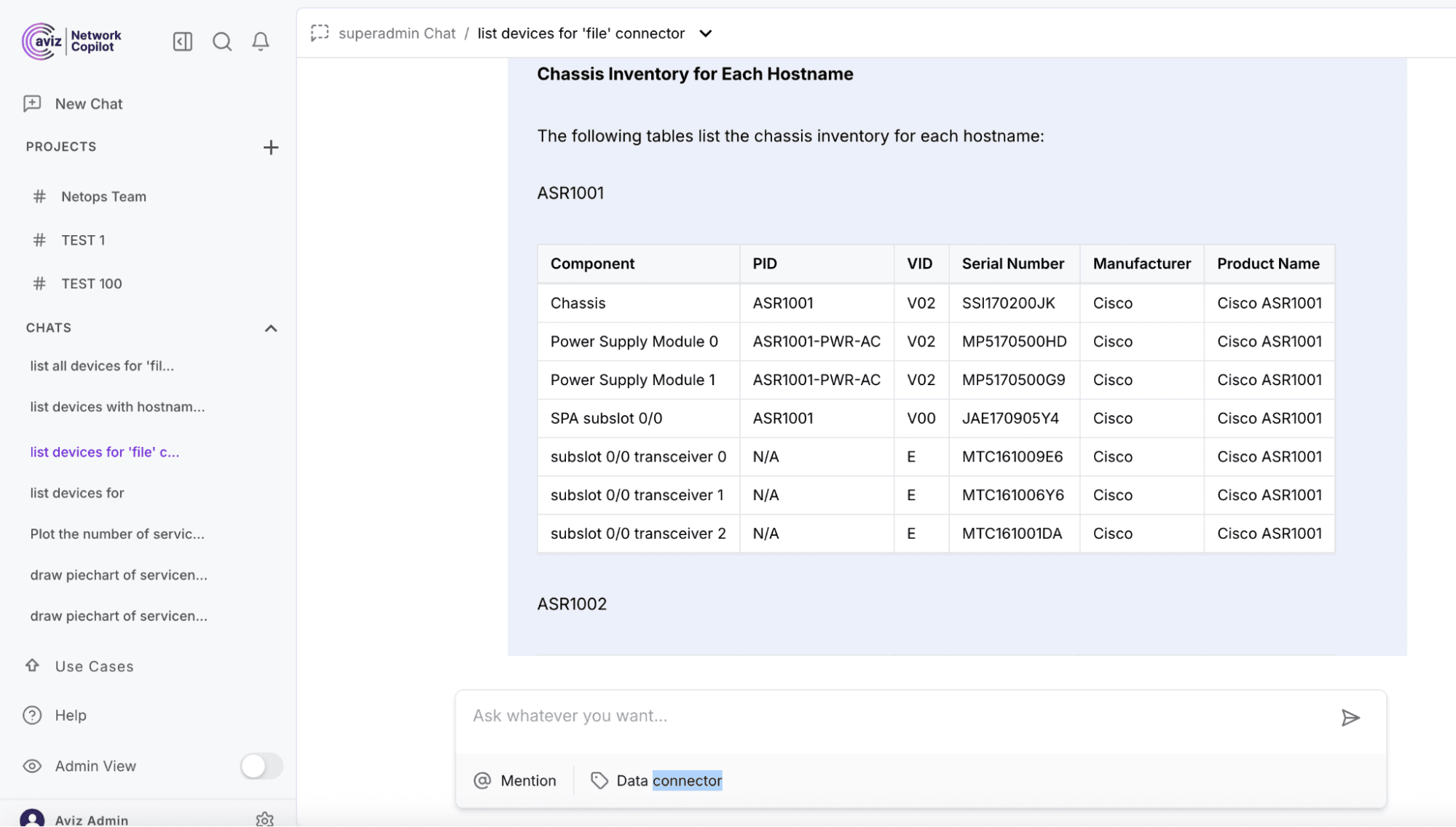
Network Copilot turns inventory queries into conversational workflows.
Example query:
"Show me all ASR1001 routers with CPU usage above 80% in the last 24 hours"
Network Copilot:
- Identifies devices across controllers
- Correlates real-time and historical metrics
- Applies intelligent thresholds
- Presents actionable insights
How Does Network Copilot Improve Security and Compliance?
Proactive Security Intelligence
Query:
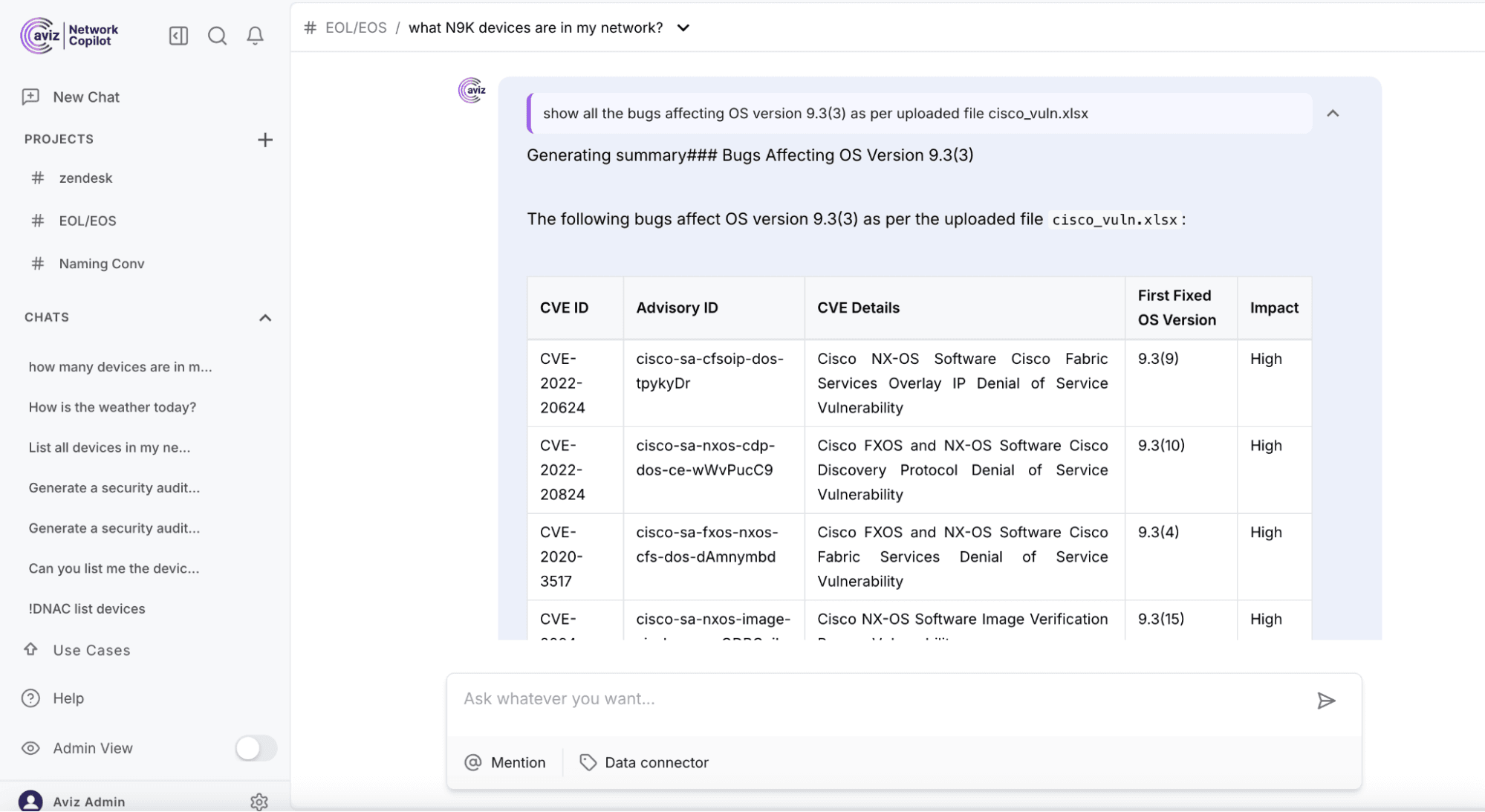
"Are any devices running software with known CVEs?"
Network Copilot provides:
- Platform-wide vulnerability assessment
- Risk scoring based on network position
- Prioritized remediation guidance
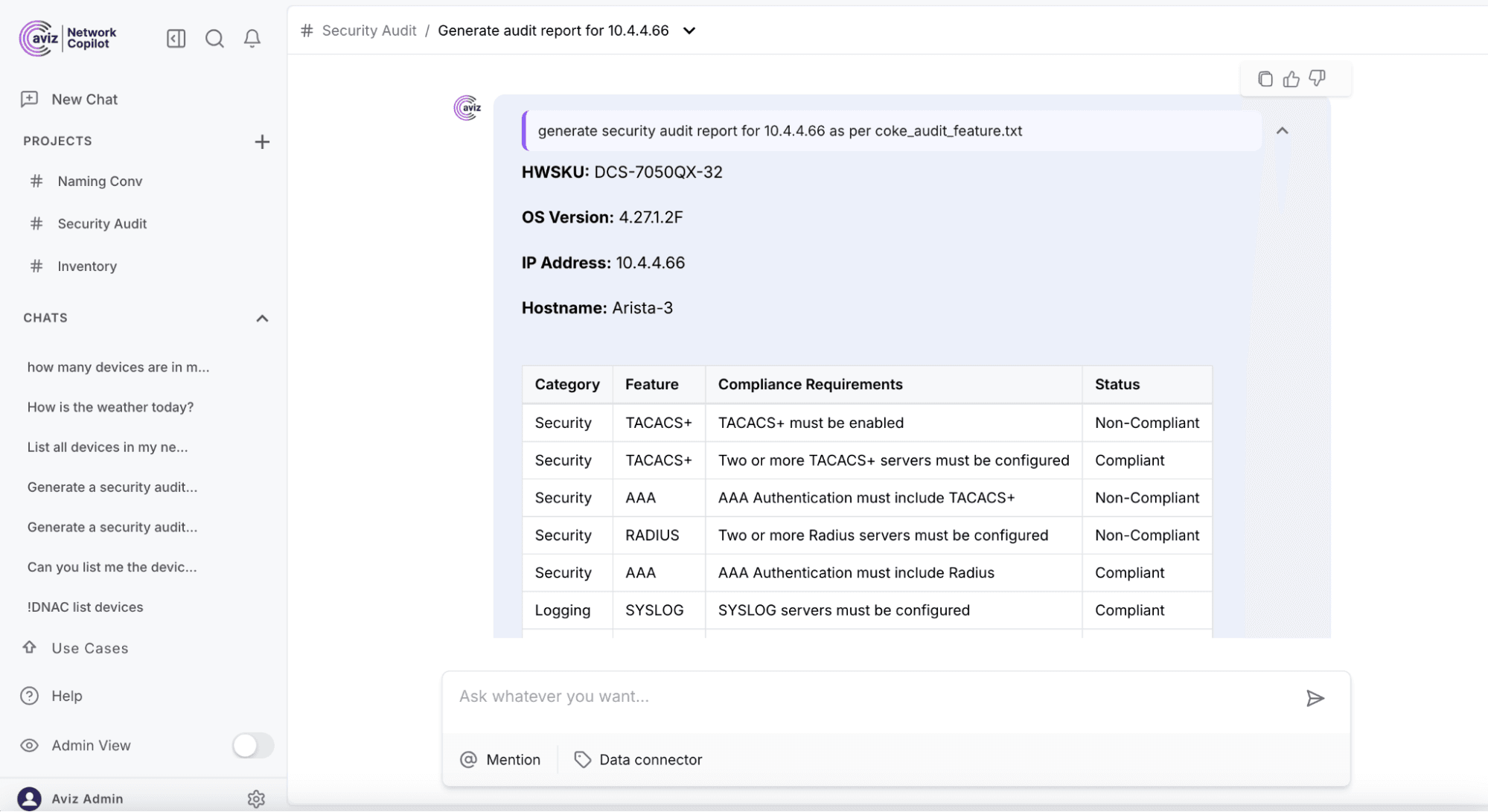
Operational Compliance Automation
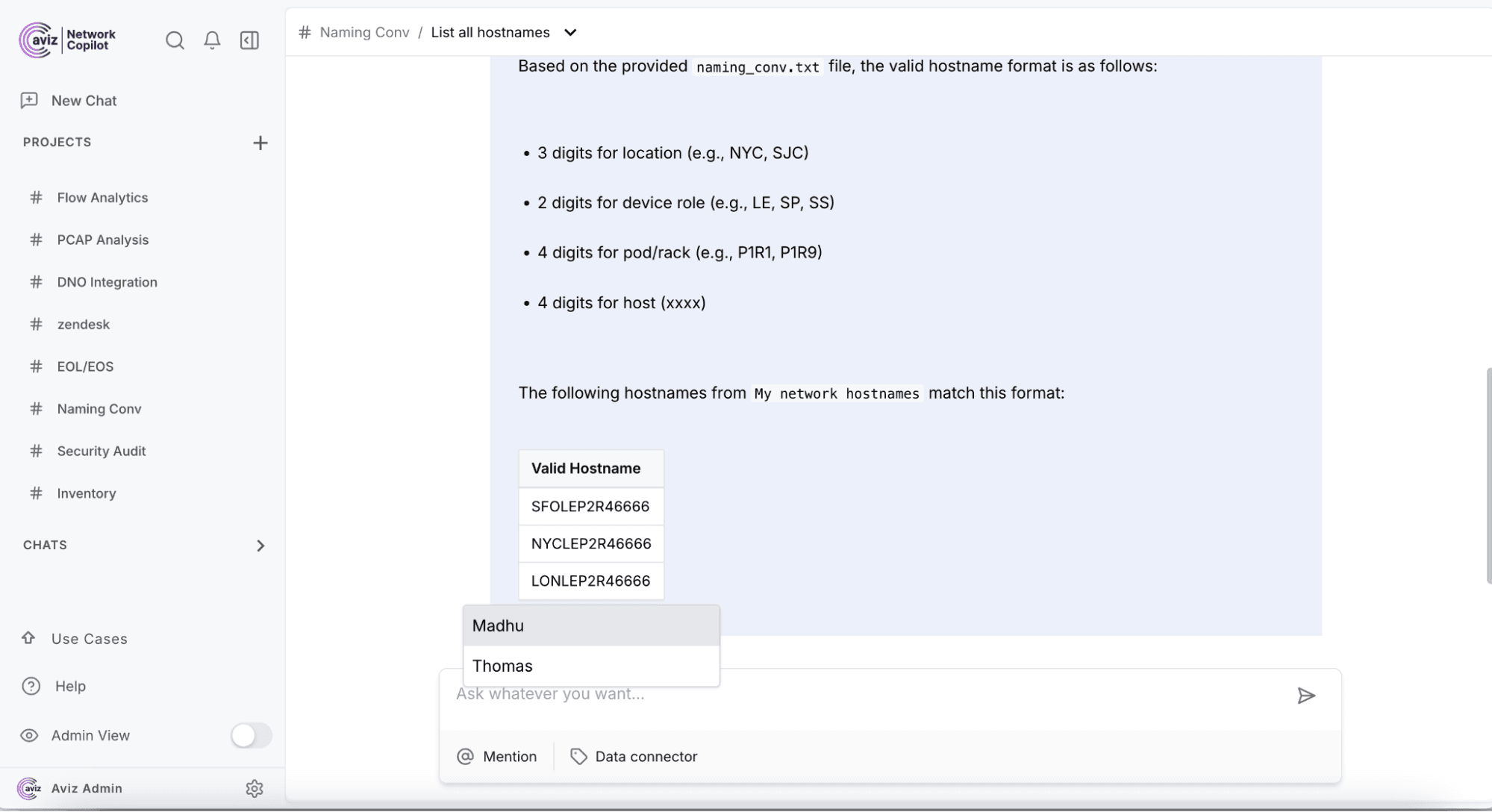
- Hostname convention validation
- Configuration drift detection
- Periodic audit checks
How Does Network Copilot Handle Real-World Data?
Real-World Integration Example
Traditional CLI output from a Cisco ASR1001 is parsed and mapped into structured schemas, enabling correlation with:
- Device identity and topology
- Hardware health and lifecycle
- Software compliance and security posture
- Service dependencies and traffic paths
What Are the Business Benefits of Network Copilot™?
Zero-Click Operational Insights
- No need to memorize CLIs
- Faster troubleshooting
- Reduced operational overhead
Cross-Controller Query Execution
- Single-query visibility across platforms
- Faster incident response
- Simplified compliance audits
Intelligent Summarization and Recommendations
- Context-aware RCA
- Policy and best-practice alignment
- Risk-based prioritization
Why Network Copilot Excels in Multi-Vendor Environments
Unified Operational Model
Queries such as:
- "Identify BGP peers flapping in the last week"
- "Validate hostname consistency across fabrics"
Work seamlessly across Cisco, Arista, Cumulus, SONiC, and mixed environments.
Best-of-Breed Adoption
Organizations can adopt new platforms without increasing operational complexity or retraining overhead.
Future-Proofing Network Operations
Network Copilot provides a stable, AI-driven operational interface that adapts as networks evolve toward intent-based and AI-native architectures.
Integration Roadmap Includes
- Security orchestration systems
- Infrastructure-as-code platforms
- GitOps workflows
Conclusion
Network Copilot™ represents a shift from tool-centric operations to question-driven network intelligence.
By breaking down controller silos and applying contextual AI across multi-vendor environments, Network Copilot enables teams to:
- Reduce MTTR
- Lower operational complexity
- Improve security and compliance
- Scale best-of-breed architectures confidently
The future of network operations is not about mastering more tools.
It is about asking better questions and getting precise, trusted answers.
Network Copilot makes that future available today.
Frequently Asked Questions
What did Aviz demonstrate at Cisco Live Melbourne and why was it different from a typical vendor booth?
Aviz ran two live working demos: ONES for evaluating and managing SONiC across multi-vendor environments, and Network Copilot for AI-assisted network operations. Visitors could get hands on with both immediately without any hardware, approvals, or production risk. Most vendor booths show slides. Aviz let engineers actually test the technology on the spot.
What could attendees actually do inside the ONES demo at the booth?
Engineers could see SONiC running across different switching platforms, explore real configuration visibility, and watch live network behaviour and validation. All of it was available without touching a production network or waiting for a lab to be set up. Attendees walked away with a practical understanding of how SONiC behaves rather than a slide-based impression of it.
What did the Network Copilot demo show about AI in network operations?
Visitors saw AI-driven assistance for operational tasks, troubleshooting scenarios played out through demo videos, and how AI logic improves decision-making before any production deployment. Teams could explore what AI actually does in a real NetOps context without needing a large AI rollout first. The demo made the value concrete rather than theoretical.
Why does evaluation of SONiC and AI keep getting delayed for most network teams?
Hardware availability, budget dependencies, and production sensitivity are the three blockers called out directly. Getting approval to test something new in a live environment takes months. Hardware for a dedicated lab takes budget and time. Aviz removed all three by making working demos available instantly at the booth so the evaluation could start the same day.
What was the practical benefit for network teams who visited the Aviz booth at Cisco Live Melbourne?
Teams could start evaluating SONiC and AI immediately instead of waiting months for approvals, budget, or lab resources. Faster understanding of real value, no setup delays, no production risk, and practical learning over slide-based assumptions. The goal was accelerating the journey from interest to readiness before any large project, hardware purchase, or change window was needed.
Why is hands-on evaluation more valuable than slides and presentations for SONiC adoption decisions?
Slides describe what a product does. A working demo shows how it actually behaves. Engineers evaluating SONiC for production need to see real configuration visibility and live network behaviour before they can make a credible recommendation internally. Theoretical conversations extend the evaluation timeline. Hands-on experience shortens it because teams leave with concrete answers rather than follow-up questions.
How does exploring AI for NetOps in a demo environment reduce risk for teams considering adoption?
Teams that see how AI logic handles troubleshooting scenarios in a safe demo environment develop realistic expectations before any production deployment. They understand what the AI actually does rather than assuming capabilities based on marketing language. That clarity reduces the chance of a failed rollout driven by mismatched expectations about what AI-assisted operations looks like day to day.
What does it mean for a network team to begin evaluating before large projects or hardware purchases?
Most evaluation cycles get stuck waiting for budget approval to buy lab gear or waiting for a project to justify the investment. Starting evaluation without those dependencies means teams build familiarity and confidence while those processes are still in motion. By the time hardware arrives or a project gets greenlit, the team already knows how the technology works rather than starting from zero at the point of deployment.
Want a single AI interface for your entire network?
Talk to the Aviz team to see how Network Copilot™ simplifies multi-vendor operations
with contextual AI.
Contact us


