




Is Your Network Ready for AI Traffic Explosions?
 May 5, 2026
 AI Factory
TL;DR
- AI networking is fundamentally different from traditional traffic patterns.
- Open networking with SONiC is emerging as a cost-efficient, scalable solution.
- Automation, observability, and AI-driven operations are becoming critical for speed and performance.
Introduction
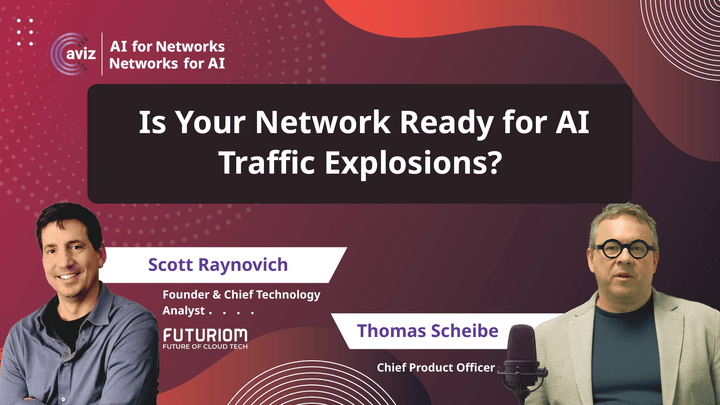
In this podcast conversation, Scott Raynovich and Thomas Scheibe break down what is really changing in networking as AI workloads scale. This is not just another infrastructure upgrade. AI introduces entirely new traffic patterns, operational challenges, and cost pressures.
If you are building AI clusters, managing data centers, or exploring GPU infrastructure, this discussion highlights what actually matters. From SONiC adoption to AI-driven operations, you will understand how modern networks are evolving and what you should prioritize next.
What Makes AI Network Traffic Fundamentally Different?
AI traffic is high-volume, latency-sensitive, and dominated by machine-to-machine communication rather than human-driven requests.
Unlike traditional client-server models, AI workloads generate massive east-west traffic between GPUs. These flows are bursty and require ultra-low latency. On top of that, AI environments often involve multiple network layers such as frontend access, backend GPU communication, and storage pipelines. Data is constantly moving in and out of clusters, making timing and efficiency critical.
Quick breakdown
| Traffic Type | Traditional Apps | AI Workloads |
|---|---|---|
| Direction | North-South | East-West dominant |
| Trigger | Human requests | Machine-driven flows |
| Pattern | Predictable | Bursty |
| Latency Sensitivity | Moderate | Extremely high |
Why Is SONiC and Open Networking Gaining Traction in AI Environments?
Open networking reduces cost and complexity by standardizing operations across multiple hardware vendors.
SONiC allows organizations to run a single network operating system across different hardware platforms. This creates flexibility in vendor choice and significantly lowers costs. More importantly, it standardizes operations. Teams no longer need to manage different tools or workflows for each vendor. As AI clusters scale and hardware evolves, this consistency becomes a major operational advantage.
Key benefits
- Flexibility in hardware procurement
- Reduced vendor lock-in
- Unified operational model
- Lower long-term costs
How Do Automation and AI Ops Improve Deployment Speed and Operations?
Automation and AI-driven operations drastically reduce deployment time and improve issue detection and resolution.
In AI environments, time equals money. Once GPUs are installed, delays in deployment directly impact revenue. Automation enables rapid setup using validated blueprints and pre-tested configurations. AI Ops takes it further by analyzing network behavior, predicting issues, and even suggesting fixes based on historical data.
Operational lifecycle simplified
| Stage | What Happens |
|---|---|
| Day 0 | Design and planning using templates |
| Day 1 | Automated deployment and configuration |
| Day 2 | Monitoring, optimization, and troubleshooting |
Key Takeaways
- AI workloads demand a complete rethink of network design and operations.
- SONiC and open networking are enabling cost efficiency and flexibility.
- Automation and AI Ops are essential to keep up with deployment speed and complexity.
Conclusion
AI is not just transforming applications. It is redefining the network itself. Organizations that adapt to these new requirements will deploy faster, operate more efficiently, and unlock the full value of their AI infrastructure. Those that do not will struggle with cost, complexity, and performance.
Frequently Asked Questions
How is AI network traffic different from regular app traffic?
Traditional apps generate north-south traffic triggered by human requests and follow predictable patterns. AI workloads flip that completely. Most traffic flows east-west between GPUs, it is machine-driven, it comes in bursts, and latency sensitivity is extremely high. Add storage pipelines and frontend access layers on top and the network is doing something completely different from what it was designed for.
Why is SONiC picking up momentum in AI data center environments?
SONiC lets teams run one network operating system across different hardware vendors instead of managing separate tools and workflows for each one. That consistency cuts costs, removes vendor lock-in, and makes operations much easier to scale. As AI clusters grow and hardware keeps changing, having a unified operational model matters a lot more than it did in traditional data centers.
What does automation actually change about deploying AI network infrastructure?
In AI environments, every day GPUs sit idle before the network is ready costs money. Automation cuts that time down by using validated blueprints and pre-tested configurations to set everything up fast. Teams are not manually configuring switches one by one. The network goes from Day-0 planning through Day-1 deployment to Day-2 operations in a fraction of the time it used to take.
What does AI Ops do that regular network monitoring cannot?
Regular monitoring tells you something broke. AI Ops watches network behaviour over time, spots patterns that point to a problem before it happens, and suggests fixes based on what worked in similar situations before. Instead of reacting after something fails, teams get a heads up early enough to actually do something about it.
What are the three network layers that AI cluster environments typically run across?
AI environments usually involve a frontend access layer for external connectivity, a backend GPU communication layer where the heavy east-west traffic lives, and a storage pipeline layer moving data in and out of clusters constantly. Each layer has different performance requirements and timing sensitivities, which is why managing them with traditional single-layer thinking creates problems at scale.
Why does vendor lock-in become a bigger problem in AI networking than in traditional networks?
AI hardware evolves fast. What is state of the art today gets replaced in 18 months. If the network is locked to one vendor's hardware and tools, every upgrade cycle becomes a painful expensive process. Open networking with SONiC lets teams swap hardware without rebuilding workflows or retraining on new management tools each time the underlying silicon changes.
What happens to organisations that do not adapt their networks for AI workloads?
They end up fighting cost, complexity, and performance problems at the same time. AI workloads push networks in ways they were never designed to handle. Teams that try to run AI traffic on traditional network designs will hit walls around latency, throughput, and operational overhead. Deploying slower and running less efficiently than competitors compounds over time into a real disadvantage.
Why does latency matter so much more in AI workloads than in regular enterprise applications?
In regular apps a few extra milliseconds rarely matters to the end user. In AI training jobs, hundreds of GPUs are constantly passing data back and forth between each other. Any latency in that communication slows the whole job down. Bursty machine-driven flows with tight timing requirements mean even small latency spikes have a direct impact on how long a training run takes and how much it costs.
If you are planning or scaling AI infrastructure, start evaluating your network strategy today. Explore open networking, invest in automation, and rethink how your operations team manages AI-driven environments.


