




If You Bought a Ferrari, Don’t Starve It
 June 18, 2026
 AI Factory
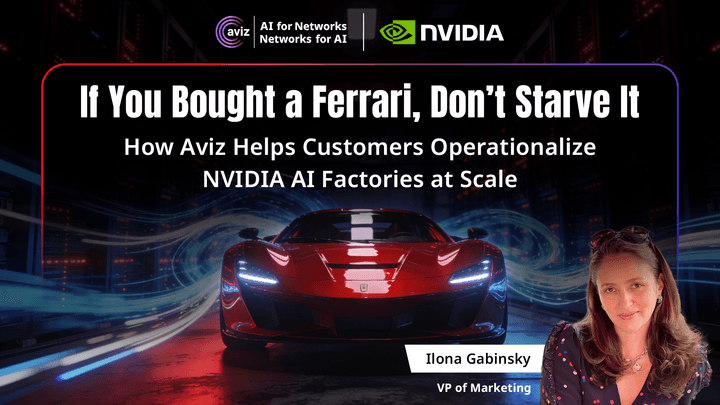
How Aviz Helps Customers Operationalize NVIDIA AI Factories at Scale
Over the past few weeks, I had the privilege of being on the road with NVIDIA and our ecosystem partners, meeting customers, solution architects, infrastructure leaders, system integrators, and teams building the next generation of AI factories.
The energy in these conversations was unmistakable.
NVIDIA has created the foundation for the AI factory era: accelerated computing, high-performance networking, DPUs, reference architectures, simulation environments, software, and a world-class ecosystem that is helping customers move from AI ambition to AI production.
One thought stayed with me throughout the tour:
If you bought a Ferrari, don’t starve it.
A Ferrari is engineered for performance. But to experience that performance, it needs the right fuel, the right telemetry, the right operating discipline, the right environment, and the right team around it.
NVIDIA AI Factory infrastructure is similar. Customers are investing in some of the most advanced AI infrastructure in the world. To realize the full value of that investment, they need to operationalize the entire environment: networking, multi-tenancy, validation, observability, automation, security, and Day-2 operations.
That is where Aviz is proud to work with NVIDIA and the broader ecosystem.
NVIDIA provides the AI factory platform. Aviz helps customers operationalize that platform with the software workflows needed to deploy faster, operate reliably, onboard tenants securely, validate changes safely, and continuously improve performance.
In this metaphor, NVIDIA is the Ferrari. Aviz helps customers make sure that Ferrari is fueled, tuned, observed, validated, and operated at scale.
The AI Factory Era Is Here
The AI factory era is not coming. It is already here.
AI is changing how every industry thinks about infrastructure. Enterprises, cloud providers, service providers, research organizations, and digital-native companies are all racing to build platforms that can support training, fine-tuning, inference, simulation, and the next generation of AI applications.
But the conversation has evolved.
The question is no longer only:
Can we build a GPU cluster?
The more important question now is:
Can we operate an AI factory as a repeatable, multi-tenant, production platform?
That distinction matters.
A GPU cluster can be built as a project. An AI factory has to run as a platform. It has multiple tenants, policy boundaries, shared infrastructure, performance expectations, operational runbooks, upgrade cycles, security requirements, and business-critical workloads.
The infrastructure has to be fast, but it also has to be predictable.
It has to be powerful, but it also has to be observable.
It has to be shared, but it also has to be isolated.
It has to evolve quickly, but it also has to be validated safely.
This is why operationalization is becoming one of the most important conversations in AI infrastructure.
NVIDIA has built the foundation that makes this era possible: accelerated computing, AI networking, DPUs, simulation, software, reference architectures, and a world-class ecosystem.
Now customers are asking the next question:
How do we operate this at scale?
That is where Aviz is excited to contribute.
What Aviz and NVIDIA Are Doing Together
NVIDIA is defining the AI factory architecture for the industry.
From accelerated computing to Spectrum-X Ethernet, InfiniBand, BlueField DPUs, NVIDIA NVLink, digital-twin simulation, and enterprise and cloud provider reference architectures, NVIDIA is giving customers the foundation to build high-performance AI infrastructure at scale.
Aviz complements this foundation by helping customers operationalize NVIDIA AI Factory networking across the full lifecycle.
Our focus is on the operational workflows that infrastructure teams need every day:
Design and validation before deployment.
Fabric orchestration and tenant onboarding during deployment.
Telemetry, observability, troubleshooting, and change control after deployment.
AI-assisted operations to help teams move faster and reduce operational risk.
Together, NVIDIA and Aviz help customers move from powerful infrastructure to repeatable AI factory operations.
This is especially important as AI factories become multi-tenant platforms. Enterprises, GPU cloud providers, service providers, and research environments all need to share expensive AI infrastructure safely and efficiently.
That requires deterministic networking, policy guardrails, clean telemetry, validation, automation, and a consistent operational model.
NVIDIA provides the performance engine. Aviz helps customers operate that engine with confidence.
DSX Air: Moving from Build-First to Validate-First
One of the most important parts of this collaboration is our integration with NVIDIA DSX Air, NVIDIA’s cloud-based digital-twin simulation environment for AI factory infrastructure.
This is a major step forward for customers and partners.
AI factories are integration-driven. They bring together accelerated networking, DPUs, switching, host orchestration, storage, servers, NICs, operational tooling, and workload requirements. The risk is no longer isolated to one component. The real challenge is integration, change velocity, and operational maturity across the full system.
That is why validation has to move left.
With NVIDIA DSX Air, teams can simulate and validate AI factory networking designs before they move into production. DSX Air enables cloud-based simulation by creating one-for-one replicas of real-world data center deployments, helping teams test topology, workflows, automation, and operational readiness in a digital twin.
With Aviz ONES available in NVIDIA DSX Air, enterprises and ecosystem partners can design, simulate, and deploy multi-tenant AI factory networking faster for NVIDIA Enterprise and Cloud Provider reference architecture-based designs, using NVIDIA accelerated computing infrastructure, including Spectrum-X Ethernet, BlueField DPUs, and NVLink.
The operating model becomes much stronger:
Design.
Define an AI factory networking design aligned to NVIDIA reference architectures, including multi-tenant segmentation intent, telemetry requirements, and operational guardrails.
Simulate.
Validate the design end-to-end in NVIDIA DSX Air. Test topology, workflows, automation, and Day-0 and Day-1 readiness without waiting for lab time or production windows.
Deploy with confidence.
Move to production with a proven design, repeatable configuration, and operational workflows already validated.
This changes the customer experience from lab-limited validation to digital-twin validation at production scale.
Before, teams often had to rely on partial stack testing, limited lab environments, and long validation cycles. With NVIDIA DSX Air and Aviz ONES, teams can validate full-stack integration readiness faster and keep pace with the evolution of the NVIDIA AI Factory platform.
That is exactly the value customers need: NVIDIA’s digital-twin simulation environment combined with Aviz operational workflows to help move from architecture to production with greater confidence.
What Gets Validated: Infrastructure, Integration, and Operations
The power of DSX Air and Aviz ONES is that the validation is not limited to basic connectivity.
AI factory networking has two critical domains:
Front-end networking, or North-South traffic, which supports user access, application access, management, and external connectivity.
Back-end networking, or East-West traffic, which supports GPU-to-GPU communication, distributed training, storage access, and high-performance AI workload movement.
Both matter.
A successful AI factory needs the front-end network to be accessible, secure, and operationally manageable. It also needs the back-end network to deliver predictable performance for demanding AI workloads.
Aviz ONES helps operationalize NVIDIA AI Factory networking across both domains.
Beyond fabric design, the Aviz and DSX Air workflow helps validate broader ecosystem readiness across compute, storage, orchestration, servers, NICs, and networking. That means customers and partners can identify integration gaps earlier, validate operational workflows sooner, and avoid discovering issues late in the deployment cycle.
This is what makes the model so powerful.
It is not just infrastructure validation.
It is integration validation.
It is operational readiness validation.
And for AI factories, that is the difference between a design that looks good on slides and a platform that is ready for production.
Why DSX Air Matters to the Ecosystem
The NVIDIA AI Factory ecosystem is one of the biggest advantages customers have as they move into production AI infrastructure.
System integrators, solution partners, cloud providers, OEMs, storage partners, and networking partners all play an important role in helping customers build and operate AI factories.
DSX Air makes that ecosystem more effective.
For system integrators and solution partners, the Aviz ONES integration with NVIDIA DSX Air changes the economics of joint delivery.
It enables faster joint proofs of concept without hardware bottlenecks. Partners can validate architectures and operational workflows in a digital twin before hardware is racked and stacked.
It enables repeatable solution packages. Partners can deliver customer-ready reference architectures, deployment configuration packages, validation evidence, and operational runbooks that shorten time to production.
It also helps increase customer confidence. Instead of presenting design slides alone, partners can show validated outcomes.
That is powerful.
It helps the ecosystem move faster.
It helps customers make decisions with more confidence.
It helps NVIDIA AI Factory designs move from reference architecture to real deployment more efficiently.
This is how the ecosystem turns innovation into repeatable customer success.
Why Operationalization Matters
AI factories are different from traditional infrastructure environments.
The workloads are more demanding. The scale is larger. The cost of underutilization is higher. The dependencies between compute, networking, storage, and software are tighter. And the business expectation is clear: customers want to move quickly from infrastructure investment to AI production.
This is where operations become strategic.
If the network is not deterministic, GPUs wait.
If telemetry is not clean, operators guess.
If tenants are not isolated, performance becomes unpredictable.
If changes are not validated, production becomes the test lab.
If operations are manual, scaling becomes fragile.
That is what I mean by starving the Ferrari.
The Ferrari is not the problem. The Ferrari is the opportunity.
The opportunity is to operate NVIDIA AI Factory infrastructure in a way that fully realizes its performance, efficiency, and business value.
Customers are not just buying infrastructure. They are building production systems for AI. Those systems need operational discipline from Day 0 through Day 2 and beyond.
Multi-Tenancy Is the Real Test
Many AI factory conversations eventually come down to one operational reality: shared infrastructure.
Enterprises want different teams to use the same AI infrastructure safely. GPU cloud providers and neo-cloud operators want to onboard customers quickly. Service providers want to expose AI capacity as a governed platform. Research teams, application teams, model builders, and inference teams all need access, but they cannot be allowed to interfere with one another.
That is why multi-tenancy is not only a compute or Kubernetes concept.
It is a network concept.
It is a DPU concept.
It is a telemetry concept.
It is a security concept.
It is an operational model.
NVIDIA AI Factory infrastructure provides the performance foundation for these environments. Aviz helps customers put operational guardrails around that foundation so shared infrastructure can be used safely, efficiently, and predictably.
This includes tenant isolation, policy templates, segmentation, fabric orchestration, observability, role-based workflows, and validation before changes are introduced into production.
A Ferrari needs a track.
An AI factory needs operational guardrails.
Day 0 to Day 2: One Continuous Lifecycle
In traditional infrastructure, teams could sometimes design separately, deploy separately, and then hand everything over to operations.
AI factories do not give teams that luxury.
The infrastructure is too valuable.
The workloads are too demanding.
The utilization targets are too important.
The pace of change is too fast.
That is why Aviz and NVIDIA ecosystem workflows are centered around the full lifecycle.
Day 0: Design and Validate
Before infrastructure is committed or changes are pushed, teams need to validate reference architectures, fabric designs, integration paths, policy models, and operational readiness.
With NVIDIA DSX Air and Aviz ONES, customers and partners can validate NVIDIA AI Factory networking designs in a cloud-based digital twin before production.
The output is a stronger starting point: validated designs, deployment-ready configuration packages, test results, operational guidance, and runbooks.
Day 1: Deploy and Onboard Tenants
Once the design is validated, teams need to deploy consistently.
That means provisioning fabrics, connecting GPU clusters, onboarding tenants, applying policy guardrails, and using standard configurations that can be repeated across environments.
The output is faster tenant onboarding, reusable policy templates, consistent deployment workflows, and operational repeatability.
Day 2: Operate and Improve
After deployment, the focus shifts to operations.
Teams need to monitor health, detect anomalies, troubleshoot faster, understand performance, validate changes, and continuously improve the environment.
With Aviz observability, packet intelligence, Network Copilot, and validation workflows, operators can move from reactive troubleshooting to more proactive, AI-assisted operations.
The output is stronger health signals, better incident workflows, faster root-cause analysis, and controlled change cycles.
AI factories are not one-time builds. They are living production systems.
AI for Networks. Networks for AI.
One of the most important shifts happening in infrastructure is that the network is no longer just connectivity.
For AI workloads, the network is part of the AI performance engine.
GPU-to-GPU communication, distributed training, storage access, inference traffic, congestion behavior, latency, packet drops, and workload isolation all affect how much value customers get from their AI investment.
That is Networks for AI: building deterministic, observable, high-performance fabrics that keep NVIDIA AI infrastructure productive.
At the same time, AI itself can help operate these networks better.
That is AI for Networks: using AI-assisted operations, copilots, telemetry, automation, and agentic workflows to help teams troubleshoot faster, validate changes, and reduce operational complexity.
Aviz brings these two ideas together in a single operational model for NVIDIA AI Factory environments.
A single operational plane across NVIDIA AI Factory networking, acceleration, validation, and observability helps customers simplify complexity while maintaining the performance, flexibility, and control they need.
What Customers Get with Aviz on NVIDIA AI Factory
When customers bring Aviz into NVIDIA AI Factory environments, they get a repeatable way to deploy, operate, validate, and evolve their infrastructure.
They get AI factory multi-tenancy with tenant isolation, policy guardrails, and shared infrastructure management.
They get fabric orchestration with Day-0 to Day-2 automation across networking domains.
They get deep observability with packet intelligence, metadata, telemetry, and health signals.
They get packet broker workflows that deliver the right traffic to the right tools, reduce tool overload, and improve signal quality.
They get Network Copilot operations with AI-assisted workflows for troubleshooting, change planning, root-cause analysis, and automation.
They get NVIDIA DSX Air digital-twin validation so teams can validate designs, policies, topology changes, upgrades, automation, and operational workflows before touching production.
Most importantly, they get confidence.
Confidence that the design is ready.
Confidence that tenants can be onboarded safely.
Confidence that the network can support demanding AI workloads.
Confidence that operators can see what is happening.
Confidence that changes can be validated before they impact production.
That confidence is critical as customers move from AI infrastructure projects to AI factory platforms.
Don’t Starve the Ferrari
When I say, “Don’t starve the Ferrari,” I mean this:
If you invest in NVIDIA AI infrastructure, give it everything it needs to perform at its best.
Feed it with high-performance networking.
Feed it with validated designs.
Feed it with clean telemetry.
Feed it with multi-tenant guardrails.
Feed it with automation.
Feed it with AI-assisted operations.
Feed it with NVIDIA DSX Air digital-twin simulation.
Feed it with an ecosystem that helps turn architecture into production.
The Ferrari is not the problem.
The Ferrari is the opportunity.
NVIDIA has delivered the performance platform for the AI factory era. Aviz is proud to help customers fuel that platform with the operational intelligence, automation, observability, validation, and lifecycle workflows needed to run it at scale.
That is what I saw on the tour.
I saw customers who understand that AI factories are becoming the new production plants of the digital economy. I saw NVIDIA solution architects and ecosystem partners aligned around one common goal: helping customers move from AI infrastructure ambition to AI production reality. I saw the market moving from one-off GPU clusters to repeatable, governed, multi-tenant AI platforms.
And I saw exactly where Aviz fits.
NVIDIA provides the AI factory foundation.
NVIDIA DSX Air helps customers validate that foundation in a digital twin.
Aviz ONES helps customers operationalize it from Day 0 through Day 2.
The ecosystem helps customers deploy and scale it.
Together, we help turn AI infrastructure into a production engine.
The organizations that win in AI will not only be the ones that buy powerful infrastructure. They will be the ones that operate it as a production system.
So, if you bought the Ferrari, don’t starve it.
Fuel it. Validate it. Observe it. Automate it. Operate it.
That is how AI factories move from promise to production.
And that is what Aviz, NVIDIA, and the ecosystem are helping customers achieve together.
Frequently Asked Questions
What does the Ferrari analogy actually mean for organisations investing in NVIDIA AI infrastructure?
NVIDIA AI Factory infrastructure is the Ferrari. Buying it is only the beginning. To get full performance out of it, organisations need the right fuel: validated designs, clean telemetry, multi-tenant guardrails, automation, and AI-assisted operations. Without those operational layers, the infrastructure underperforms no matter how powerful the hardware is.
What is the difference between building a GPU cluster and running an AI factory as a production platform?
A GPU cluster can be built as a project. An AI factory has to run as a platform with multiple tenants, policy boundaries, shared infrastructure, performance expectations, upgrade cycles, and business-critical workloads. The infrastructure has to be powerful and observable, shared and isolated, fast and validated. That operational maturity is what separates a project from a production platform.
How does NVIDIA DSX Air combined with Aviz ONES change how teams validate AI factory designs?
DSX Air creates one-for-one replicas of real-world data center deployments in a cloud-based digital twin. With Aviz ONES available in DSX Air, teams design, simulate, and validate multi-tenant AI factory networking before touching production hardware. The output is a proven design, repeatable configuration, and validated operational workflows rather than discovering integration gaps after infrastructure is already racked.
Why does multi-tenancy in an AI factory go beyond just Kubernetes and compute isolation?
Multi-tenancy in AI factories is a network problem, a DPU problem, a telemetry problem, a security problem, and an operational model. Enterprises, GPU cloud providers, and research teams all share the same expensive AI infrastructure and cannot interfere with each other. Aviz helps put operational guardrails around that shared infrastructure through tenant isolation, policy templates, segmentation, and validation before changes hit production.
What does Aviz actually deliver across Day 0, Day 1, and Day 2 in NVIDIA AI Factory environments?
Day 0 is design and validation in DSX Air before any hardware is committed. Day 1 is fabric provisioning, tenant onboarding, policy guardrails, and repeatable deployment workflows. Day 2 is observability, anomaly detection, faster troubleshooting, change validation, and AI-assisted operations through Network Copilot. The goal across all three is moving from reactive firefighting to confident, controlled operations at scale.
Contact us to operationalize NVIDIA AI Factory infrastructure at scale from validated design to Day 2 operations.


