





How GPU Shortages Are Driving Japan Towards Open Source AI Networking
 January 8, 2026
 AI Factory
Introduction
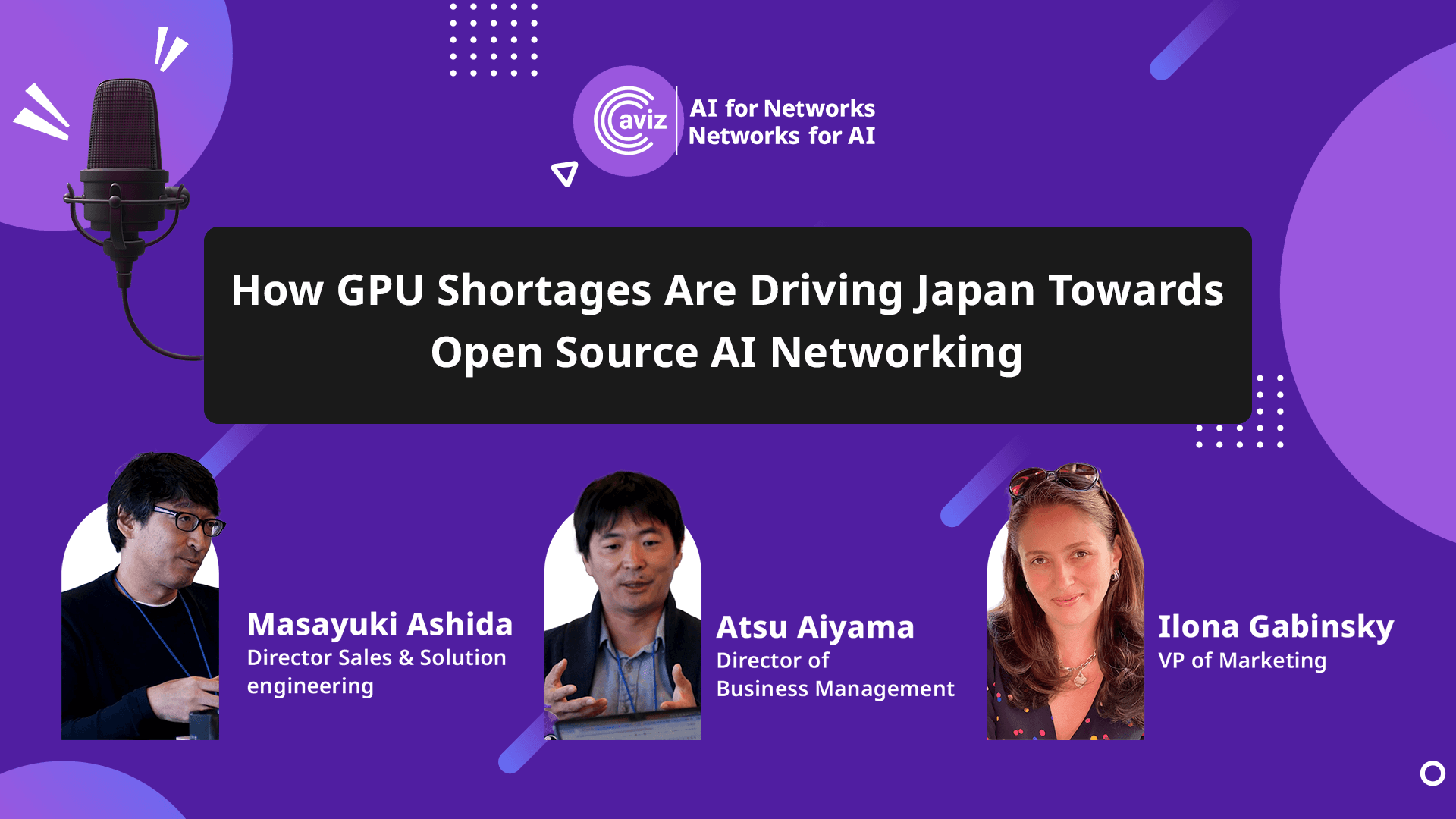
In this episode of the Aviz Networks Podcast, Ilona Gabinsky, VP of Marketing at Aviz Networks, is joined by Atsu Aiyama and Masayuki Ashida from Itochu Techno-Solutions America (CTC America) to discuss how networking is evolving in the AI era, with a special focus on the Japanese market.
Itochu Techno-Solutions America is a key Aviz partner in Japan and globally, working closely with customers adopting AI-driven infrastructure.
The discussion explores why AI adoption is accelerating in Japan despite the country's traditionally conservative approach to new technologies. The speakers explain how demographic shifts, GPU shortages, and strict privacy requirements are influencing networking decisions.
The episode also highlights why open-source networking and AI agents are becoming essential for modern network operations.
What this episode was about
The conversation focused on how Japanese enterprises are adopting AI under unique constraints. Limited GPU availability in cloud environments is pushing customers toward on premise AI deployments.
Speakers discussed how AI agents are becoming a digital workforce, helping organizations handle increasing infrastructure complexity.
The episode also explored why open source networking, Kubernetes, GPUs, and SONiC are well suited for these AI driven environments.
Privacy concerns and cost efficiency were highlighted as key factors influencing technology choices in Japan.
Key insights from the conversation
- Japanese customers face GPU shortages in public cloud environments
- On premise AI deployments are increasing due to privacy and resource constraints
- AI agents are acting as a digital workforce for network operations
- Aging demographics are accelerating the need for AI adoption
- AI is no longer optional and is seen as necessary for business continuity
- Japanese enterprises are moving past hesitation and committing to AI adoption
- Open source networking supports scalable AI inference environments
- SONiC plays a critical role in AI ready network architectures
- Kubernetes and GPU based systems are central to on premise AI strategies
Why this episode matters
- Explains why AI adoption in Japan is accelerating despite conservative tech culture
- Highlights real challenges around GPUs, privacy, and cloud limitations
- Shows how open source networking supports AI driven infrastructure
- Demonstrates why AI agents are becoming essential for network operations
Conversations that Shape the Future
This episode provides a clear view into why Japan is embracing open source and AI driven networking. From demographic challenges to infrastructure constraints, the discussion shows how necessity is driving innovation.
Frequently Asked Questions
Why is AI adoption picking up so fast in Japan when the country is known for moving slowly on new technology?
Three things hit at once. The workforce is shrinking due to aging demographics so AI went from being optional to being necessary for business continuity. GPU capacity in public cloud environments is limited in Japan so organisations cannot simply spin up cloud AI and get started. Strict privacy requirements mean sensitive workloads cannot move to external platforms. All three pushed enterprises past their usual caution faster than any technology enthusiasm would have.
Why are Japanese organisations building AI on-premise instead of using public cloud services?
Two reasons come up directly. GPU availability in public cloud environments is limited so organisations that need compute capacity for AI cannot always get it from cloud providers. On top of that, privacy requirements mean data that cannot leave a controlled environment cannot run on a public cloud AI platform. On-premise AI with Kubernetes and GPU-based systems is the practical answer when both constraints apply at the same time.
How are AI agents acting as a digital workforce in network operations?
As organisations build out AI-driven infrastructure, the volume and complexity of network operations tasks grows faster than headcount can keep up. AI agents handle that operational load. The episode frames them as a digital workforce rather than just automation scripts. Routine management tasks run automatically so the human team focuses on the decisions that genuinely need judgement rather than grinding through work that does not require it.
What role does SONiC play in the on-premise AI infrastructure being built in Japan?
SONiC plays a critical role in AI-ready network architectures because it supports scalable AI inference environments on open hardware. Japanese enterprises building on-premise AI around Kubernetes and GPU-based systems need a network operating system that works across that stack without proprietary constraints. SONiC fits because it is open, flexible, and adapts to the AI-driven environments where inference workloads need to scale reliably.
How do Japan's aging demographics make AI adoption a business continuity decision rather than a technology choice?
The available workforce is getting smaller over time. Organisations that used to rely on growing headcount to manage operational complexity now face the opposite. AI is no longer seen as optional in Japan. It is seen as necessary to keep functioning as fewer people are available to do the work. The episode makes clear that Japanese enterprises are moving past hesitation and committing to AI adoption because waiting is no longer a viable position.
How do privacy requirements specifically shape technology decisions for Japanese enterprises adopting AI?
Certain data in Japan simply cannot leave a controlled on-premise environment due to strict privacy requirements. Public cloud AI platforms process data outside the organisation's own infrastructure by design. For Japanese enterprises handling sensitive data, that boundary is non-negotiable. On-premise AI is not just a preference, it is the only compliant path available for workloads where privacy requirements apply and cloud GPU capacity is unavailable anyway.
Why does open source networking suit the AI-driven infrastructure being built in Japan right now?
On-premise AI environments built around Kubernetes, GPUs, and inference workloads need networking that is scalable, flexible, and not tied to one vendor's roadmap. Open source networking works across hardware from multiple vendors and integrates with the open stack that these environments run on. Proprietary networking would introduce dependencies that conflict with the flexibility and cost efficiency Japanese enterprises are looking for as they build out AI infrastructure under real budget and resource constraints.
What makes cost efficiency such a key factor in how Japanese enterprises choose their AI infrastructure technology?
Cost efficiency is called out alongside privacy as a primary driver of technology decisions in Japan. Building on-premise AI requires real investment and organisations under budget pressure need every layer of the stack to justify its cost. Open source networking and SONiC remove proprietary licensing overhead that would otherwise add up significantly across a large infrastructure deployment. Getting more capability for less cost is not just a preference in Japan right now, it is a requirement.
Watch the full podcast to hear firsthand insights on how Japanese enterprises are adapting networks for the AI era and building resilient, future ready infrastructure.


