





How does vASN deliver lightweight, cloud-native service intelligence?
 April 27, 2026
 Deep Network Observability
TL;DR
vASN delivers the full power of ASN in a lightweight, cloud-native form.
It enables deep packet intelligence, multi-environment deployment, and flexible data paths with lower resource usage.
Designed for cloud, edge, and virtualized environments, it reduces cost while maintaining full functionality.
Why is vASN important for modern network intelligence?
Powering High-Performance Network Intelligence with Fewer Resources, Full Flexibility At Aviz Networks, we continue to push the boundaries of software-defined packet intelligence. Building on the proven capabilities of our Aviz Service Node (ASN), a high-performance DPI engine for deep application identification, protocol intelligence, Telco Subscriber correlation, rich metadata extraction, traffic optimization, and real-time observability, we are excited to introduce vASN (Virtual ASN).
Whether you’re operating in data centers, telecom environments, or modern cloud infrastructures like AWS, vASN delivers the core power of ASN in a trimmed-down, resource-efficient package designed for virtual machines, containers, and non-DPDK environments.
What is vASN and what capabilities does it include?
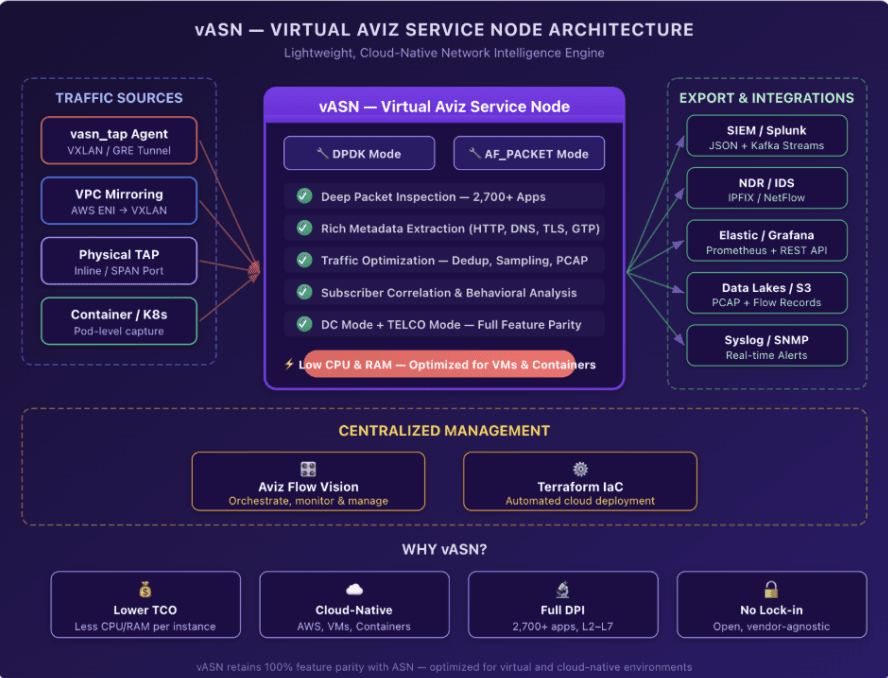
vASN is the virtualized, lightweight edition of the Aviz Service Node. It retains 100% of the core functionality found in the full ASN, supporting both DC (Data Center/Cloud) and TELCO modes with all existing features:
- Deep Packet Inspection (DPI) identifies 2,700+ applications and 9,000+ subcategories
- 4G, 5G-NSA, 5G-SA Correlation and exporting Subscriber-aware metadata
- Rich metadata extraction (HTTP, DNS, TLS, QUIC, subscriber intelligence, etc.)
- Traffic optimization: packet deduplication, flow sampling, and forensic packet capture
- Real-time behavioral analysis and dynamic signature updates with zero downtime
- Export of metadata via JSON + Kafka Streams, Syslog, REST APIs, and seamless integration with SIEM, analytics tools, Splunk, Elastic, Prometheus, Grafana, and data lakes
The big difference? vASN is optimized for efficiency. It requires significantly less CPU and RAM, making it ideal for cost effective Private/Public Cloud environments, virtualized deployments, edge locations, and environments where full bare-metal performance isn’t required.
What are the key highlights of vASN?
Key Highlights of vASN
- Resource-Efficient Design Runs efficiently on commodity x86 servers, VMs, or containers without sacrificing intelligence.
- Flexible Data PathsSupports high-performance DPDK where available, and falls back gracefully to AF_PACKET for broader compatibility.
- Cloud-Native ReadyNative support for AWS EC2 and other cloud/container environments.
- Centralized Management Fully managed through Aviz Flow Vision for orchestration, monitoring, policy enforcement, and unified visibility across your entire packet broker and service node fleet.
- Infrastructure as Code Deploy vASN and vasn_tap effortlessly in the cloud using Terraform scripts.
- Simple Configuration All settings, including instance type, data path, IP services, and interface selection, can be easily pushed from the Flow Vision UI.
How can vASN be deployed in AWS and other environments?
Deployment Options in AWS and Beyond
vASN shines in cloud environments. On AWS EC2 instances, it supports two operational modes:
- DPDK Mode (High-Performance Path)
For users needing maximum throughput, the AWS Elastic Network Interface (ENI) supports DPDK PMD drivers. Launch vASN in DPDK mode for line-rate packet processing. - AF_PACKET Mode (Broad Compatibility)
In environments where DPDK PMD isn’t available or suitable (certain AWS setups, containers, or other Linux-based deployments), switch to AF_PACKET. This mode leverages the native Linux network stack while still using optimized DPDK mechanisms for receiving traffic from the kernel.
How are configuration options managed in vASN?
Configuration Options Explained
All capabilities in vASN are fully controllable through the Flow Vision UI (no manual config file editing required):
asn_instance:"virtual"Optimized for VMs/cloud: dedicates CPU cores for packet processing while using pthreads for non-packet tasks (balanced resource usage)."onprem"(Available in full ASN) Pins everything to dedicated cores for maximum performance.
data_path:"dpdk"PMD-based RX/TX for highest performance."af_packet"Uses DPDK PMD to pull traffic from the Linux stack (ideal for non-DPDK or containerized setups).
ip_services:"true"Enables IPv4 address configuration on packet processing ports, making them reachable from external machines. This also enables Tunneling Support."false"Disables IP configuration for pure tapping/processing use cases.
selected_interfaces(AF_PACKET mode only) & Choose which Linux interfaces vASN should monitor.
This flexibility ensures vASN fits seamlessly into any environment from high-scale AWS workloads to lightweight container deployments.
Why should organizations choose vASN?
Why Choose vASN?
- Lower TCO Reduced CPU/RAM footprint means you can run more instances on the same hardware or smaller cloud instances.
- Broader Reach Works in non-DPDK and cloud-native setups where traditional high-performance nodes might struggle.
- Same Trusted Intelligence Full feature parity with ASN, including TELCO-grade Control-User Interfaces handling and DC east-west visibility.
- Easy Operations Deploy with Terraform, manage centrally via Flow Vision UI, and integrate with your existing observability stack.
Future-Proof Built on Aviz’s open, vendor-agnostic architecture: no lock-in, full scalability.
vASN is perfect for enterprises modernizing their network visibility, telcos scaling 4G/5G observability, cloud operators needing lightweight DPI, and teams building AI-driven networking pipelines.
How can you get started with vASN?
Get Started with vASN
Ready to experience lightweight yet powerful network intelligence in the cloud?
Visit aviznetworks.com/products/service-nodes to learn more about ASN and vASN. Check out our Terraform deployment guides, Flow Vision demos, and technical documentation.
Stay tuned for deeper technical blogs, deployment case studies, and performance benchmarks comparing vASN in DPDK vs. AF_PACKET modes.
Conclusion
vASN brings the full intelligence of the Aviz Service Node into a lightweight, cloud-native form that fits modern network environments. By keeping all core ASN capabilities while reducing CPU and memory requirements, vASN makes deep packet intelligence practical across cloud, edge, virtualized, and telecom deployments. Flexible data paths, centralized management through Flow Vision, and simple cloud-ready deployment options allow teams to scale visibility without adding complexity or cost. For organizations looking to modernize network intelligence while maintaining performance and flexibility, vASN offers a clear and efficient path forward.
Frequently Asked Questions
1. What is vASN and how does it differ from traditional ASN deployments?
vASN is basically a lighter version of the Aviz Service Node that does everything the original does, just without eating up your CPU and RAM. It's built for modern setups like cloud, containers, edge, and virtual machines where you can't always throw heavy hardware at the problem. Same features, smaller footprint.
2. Why does vASN matter for modern network intelligence?
Networks today are spread across clouds, edges, and virtual environments, and most visibility tools struggle to keep up. vASN was designed to go wherever your workloads go without demanding expensive resources. You get full network insight without the infrastructure headache.
3. What network intelligence capabilities does vASN include?
It covers deep packet inspection for over 2,700 applications, 4G/5G subscriber tracking, real-time behavioral analysis, and metadata export to your existing analytics tools. Basically everything you'd need to understand what's happening across your network. It all works out of the box without custom integrations.
4. How does vASN handle different deployment environments?
It runs on regular x86 servers, VMs, containers, or cloud instances with no special hardware needed. It supports both DPDK and AF_PACKET, so it adapts to whatever environment you're working in. One solution that works across private cloud, public cloud, edge, and telecom.
5. Can vASN be deployed on AWS?
Yes, and you get two options depending on your setup. DPDK mode handles high-speed packet processing using ENI support, while AF_PACKET mode works through the standard Linux network stack when DPDK isn't available. You pick what fits, not what the tool forces on you.
6. How is vASN managed and configured?
Everything is controlled through Flow Vision, one central place for all your configuration, monitoring, and policy settings. No digging through config files or jumping between tools. It keeps operations clean and straightforward for whoever's managing it.
7. Why should organizations consider vASN for network visibility?
It brings full ASN functionality at a lower cost with far more deployment flexibility. It's built on an open, vendor-agnostic architecture so you're not getting locked into anything. For teams that want solid network intelligence without overcomplicating their infrastructure, it's a practical choice.
Have questions about deploying vASN in AWS, Kubernetes, or integrating it with your existing tools? Reach out to the Aviz team for more information and guidance.


