





How Aviz Service Node Enables Seamless 4G to 5G Control Plane Handover for Continuous Subscriber Visibility
 December 16, 2025
 Deep Network Observability
Summary
Maintaining continuous subscriber visibility during 4G and 5G mobility is a major operational challenge for mobile operators. Aviz Service Node enables seamless control plane and user plane correlation during inter-RAT handovers by passively detecting, correlating, and upgrading sessions in real time. This ensures uninterrupted observability across EPC and 5GC without impacting live traffic.
Introduction
As mobile networks evolve toward hybrid 4G and 5G deployments, operators face increasing difficulty maintaining consistent control plane visibility when subscribers move across Radio Access Technologies. Traditional monitoring tools often lose session context during these transitions, creating blind spots in troubleshooting and analytics.
Aviz Service Node addresses this challenge by acting as a passive observability layer that maintains continuous, correlated subscriber session tracking across EPC and 5GC interfaces. It enables operators to gain end-to-end visibility into inter-RAT handovers without requiring any changes to network configuration or mobility procedures.
What Problem Does Aviz Service Node Solve?
Aviz Service Node ensures control plane and user plane continuity during inter-RAT mobility events between LTE and 5G networks.
When a subscriber session moves between 4G and 5G, multiple identifiers such as TEIDs, UE IPs, and QoS parameters change. Without intelligent correlation, these changes appear as new sessions, causing loss of end-to-end traceability.
In real-world deployments, handover triggers are not always explicitly exposed. What appears as a new session request may actually be part of an ongoing subscriber session. Aviz Service Node validates incoming requests against existing EPC and 5GC contexts and internally treats them as handovers when appropriate.
This eliminates session blind spots and preserves continuity across interfaces such as S11 and N11 for the control plane, and S1-U, N3, and N4 for the user plane.
How Aviz Service Node Manages Seamless Control Plane Handover
Aviz Service Node automatically detects inter-RAT handovers using IMSI-based session matching and applies in-place session upgrade logic. This maintains a unified subscriber view throughout the transition.
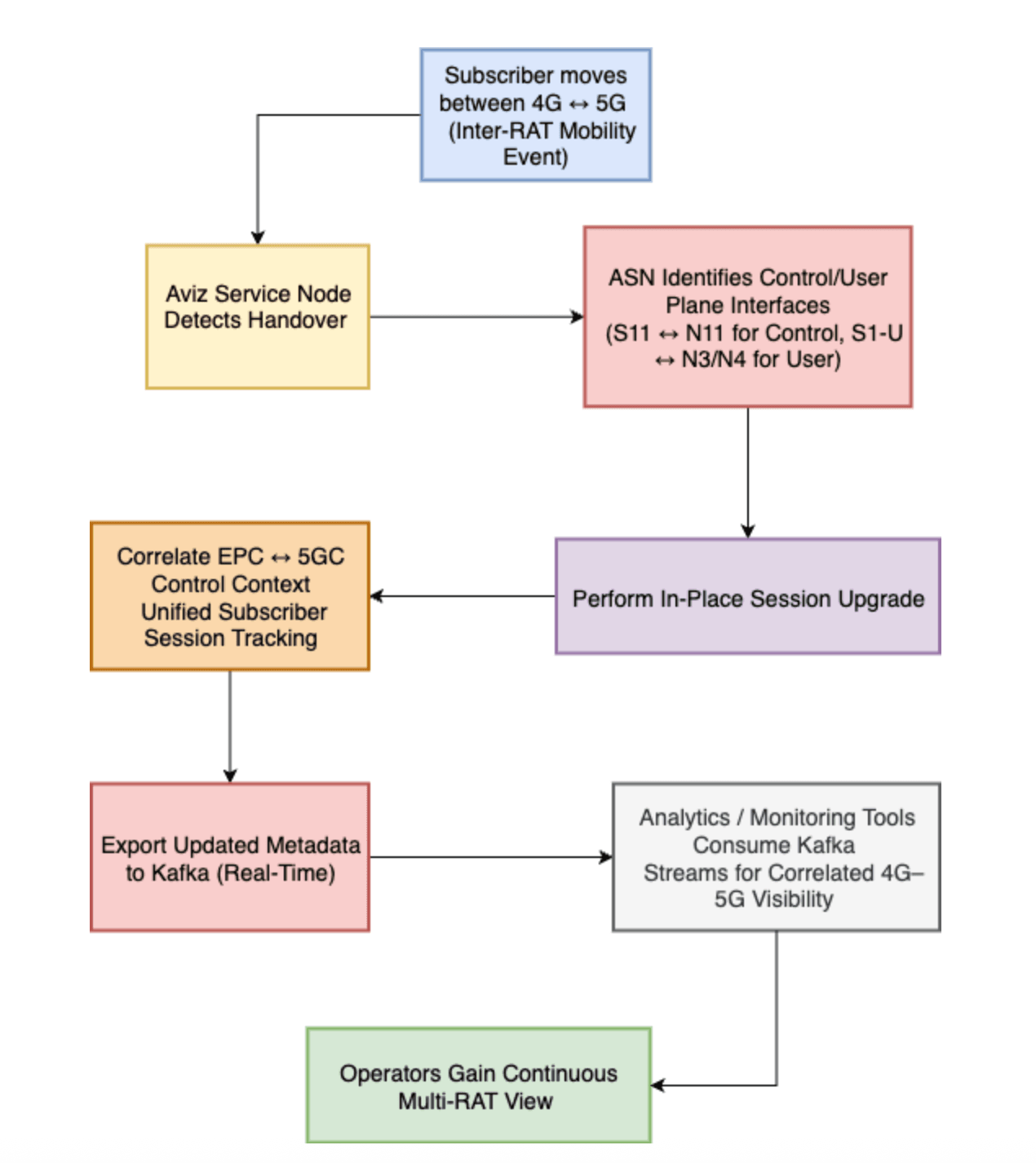
This visual illustrates how Aviz Service Node detects subscriber movement between 4G and 5G, identifies control and user plane interfaces, performs an in-place session upgrade, and exports updated metadata for analytics consumption.
Inter-RAT Handover Scenarios and Session Handling
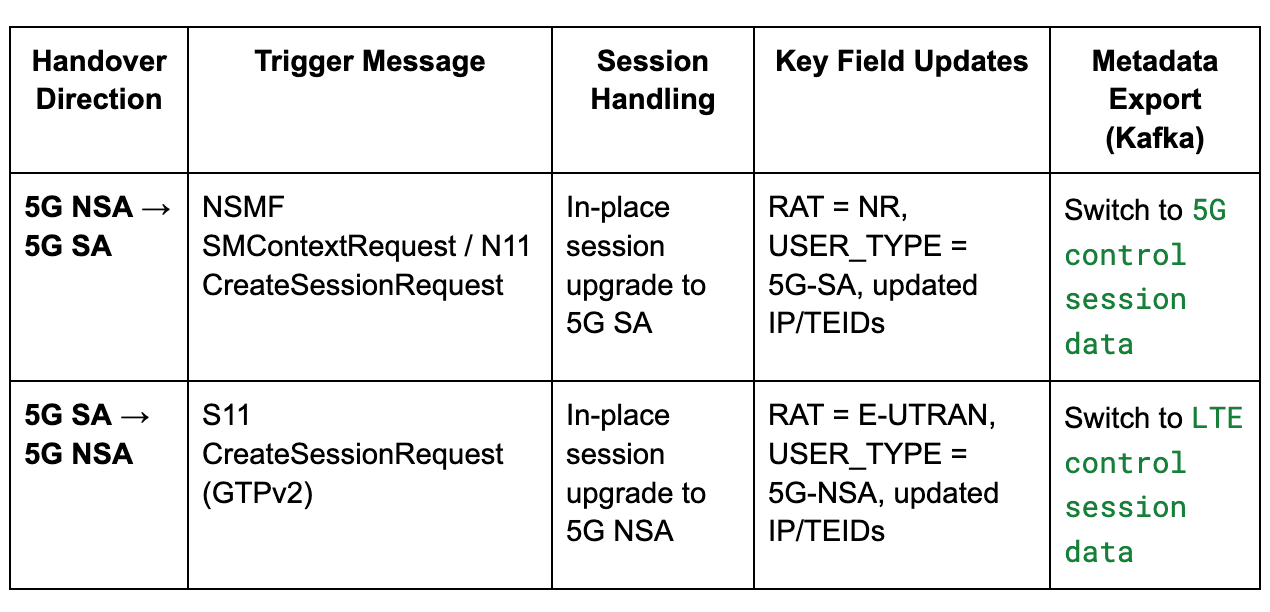
The table below summarizes how Aviz Service Node handles different handover directions while preserving session continuity and visibility.
What Makes Aviz Service Node Unique?
Aviz Service Node delivers observability without interference while maintaining real-time correlation across EPC and 5GC.
Passive and Non-Intrusive Operation
The service node ingests mirrored signaling from N11 and S11 interfaces and user plane traffic from N3, N4, and S1-U. This guarantees zero impact on live network performance.
Unified Correlation Engine
Control plane and user plane contexts remain linked even when anchor points shift between SGW and UPF during mobility events.
Real-Time Kafka Export
Normalized and enriched subscriber metadata is streamed continuously to Kafka for downstream analytics and monitoring platforms.
No Network Reconfiguration Required
Aviz Service Node works across inter-RAT handovers without requiring any changes to mobility procedures or control plane configuration.
Why This Matters for Operators
With Aviz Service Node, operators gain:
- Consistent visibility into multi-RAT subscriber mobility
- Faster troubleshooting of handover and tunnel mismatch issues
- Unified analytics across EPC and 5GC environments
- Continuity of KPIs such as latency, packet loss, and handover success rate
This allows operations and engineering teams to maintain high subscriber experience quality even in complex hybrid network deployments.
Conclusion
Aviz Service Node provides continuous subscriber session visibility across 4G EPC and 5G Core networks. It detects and correlates inter-RAT handovers without impacting live traffic, ensuring a unified control plane and user plane view.
By exporting real-time metadata and maintaining passive observability, Aviz Service Node enables operators to confidently manage hybrid 4G and 5G mobility scenarios while preserving service quality and operational clarity.
Frequently Asked Questions
What problem does Aviz Service Node solve when subscribers move between 4G and 5G networks?
When a subscriber moves between 4G and 5G, identifiers like TEIDs, UE IPs, and QoS parameters all change. Traditional monitoring tools treat those changes as brand new sessions and lose the thread of what was happening before the handover. Aviz Service Node correlates the incoming request against existing EPC and 5GC contexts and treats it as a handover internally so subscriber visibility stays continuous rather than breaking mid-session.
How does Aviz Service Node detect that an incoming session request is actually a handover rather than a new session?
Handover triggers are not always explicitly exposed in the signaling. What looks like a new session request may be part of an ongoing subscriber session. Aviz Service Node uses IMSI-based session matching to validate incoming requests against existing contexts and applies in-place session upgrade logic when appropriate. The detection is automatic and requires no changes to network configuration or mobility procedures.
Which interfaces does the Aviz Service Node monitor for control-plane and user-plane visibility?
On the control plane side, Aviz Service Node monitors S11 for EPC and N11 for 5GC. On the user plane side it covers S1-U, N3, and N4. The service node ingests mirrored signaling from these interfaces passively so live network performance is not affected at any point during monitoring or correlation.
How does Aviz Service Node keep analytics tools updated in real time during a handover?
During each handover transition, Aviz Service Node dynamically updates metadata exports to Kafka. Normalised and enriched subscriber metadata streams continuously so downstream analytics and monitoring platforms always receive synchronised real-time session data across both EPC and 5GC domains. Analytics tools never see a gap or a false new session entry during the transition.
Does Aviz Service Node require any changes to the network configuration or mobility procedures to work?
No changes are needed anywhere. Aviz Service Node works across inter-RAT handovers by ingesting mirrored traffic passively from existing interfaces. The correlation and session upgrade logic runs entirely within the service node without any modifications to the network's mobility procedures, control plane configuration, or live traffic paths.
Why do traditional monitoring tools lose session context during inter-RAT handovers between LTE and 5G?
When a subscriber moves from 4G to 5G, the session identifiers change at multiple levels simultaneously. A monitoring tool that tracks sessions by those identifiers sees the changed values as a completely new session rather than a continuation of the existing one. Without IMSI-based correlation that persists across those identifier changes, the subscriber's history and active session context disappear at the point of handover.
What specific KPIs can operators track continuously across handovers with Aviz Service Node?
Latency, packet loss, and handover success rate are all called out directly. These KPIs are maintained continuously because the service node keeps control plane and user plane contexts linked even when anchor points shift between SGW and UPF during mobility events. Operators get consistent KPI data across the full subscriber session rather than a broken view with missing data at the handover point.
How does passive operation make Aviz Service Node safer to deploy in a live mobile network?
Aviz Service Node ingests mirrored signaling and user plane traffic rather than sitting in the live traffic path. Nothing the service node does can affect how packets flow through the network because it never touches the live traffic directly. Operators get full inter-RAT visibility and real-time correlation without any risk of the observability layer introducing latency, drops, or errors into subscriber sessions.
Looking for uninterrupted visibility across 4G and 5G mobility events?
Connect with the Aviz team to see how Aviz Service Node simplifies observability in hybrid networks.
Contact us


