





How ASN Deep Packet Inspection Delivers Deep Network Visibility Using App Metadata
 January 21, 2026
 Deep Network Observability
Summary
ASN Deep Packet Inspection (DPI) enabled deep visibility into modern networks by identifying applications, protocols, and traffic categories at scale. By extracting rich protocol metadata, organizations gained actionable insights into user behavior, performance, and security. This intelligence helped telecom operators and enterprises optimize network operations, enforce policies, and adapt to evolving application landscapes.
Introduction
In today's digitally driven environment, organizations rely on hundreds of applications running over shared network infrastructure. Enterprises and telecom operators faced increasing pressure to manage, secure, and optimize these networks. Achieving this required deep visibility into actual network activity.
What Is DPI?
Deep Packet Inspection, or DPI, analyzes network traffic at the packet level by examining payload data in addition to headers. This enabled a detailed understanding of application behavior, protocol usage, and traffic patterns beyond basic flow statistics.
Application, Protocol, and Category Identification with DPI
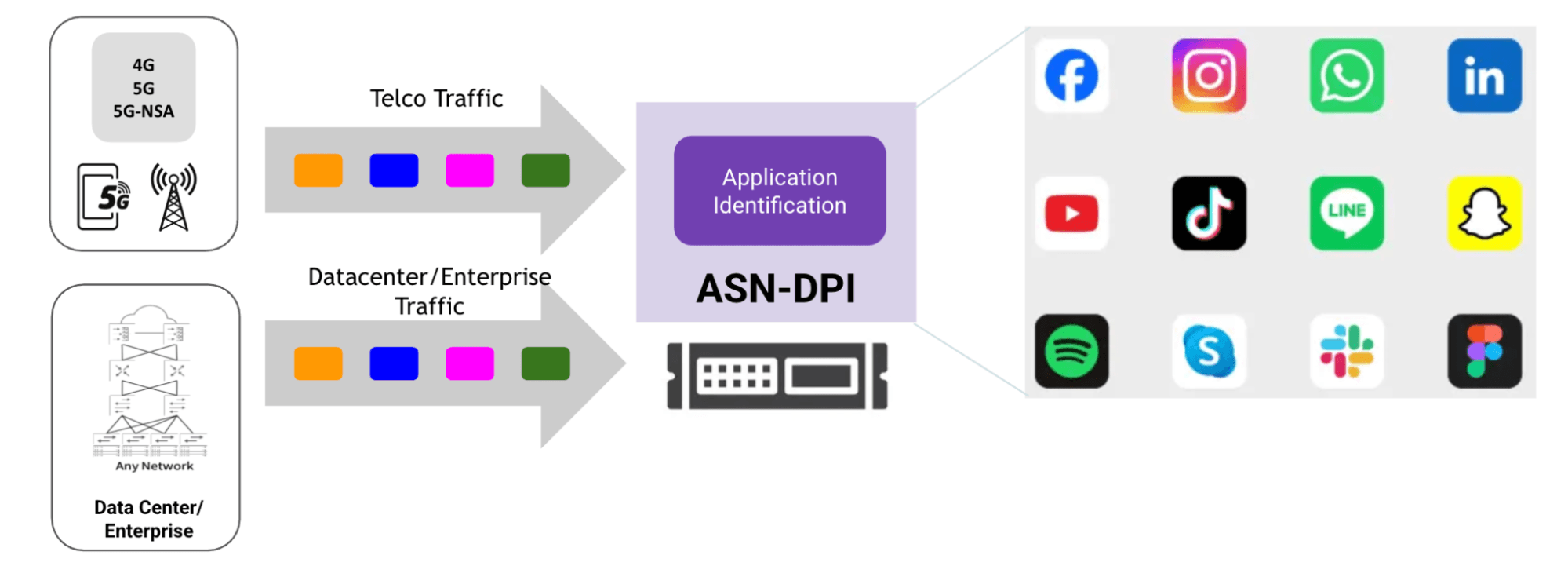
ASN Deep Packet Inspection enabled precise identification of more than 2,700 applications and 9,000 sub-category applications by analyzing network traffic in detail. This allowed organizations to identify which applications were running, such as video, audio, gaming, file transfer, or chat, along with the protocols they used.
Traffic categorization supported:
- Security policy enforcement
- Bandwidth allocation
- Compliance requirements
By understanding both application and category, enterprises and telcos optimized performance, enforced acceptable use policies, and gained insights into user behavior and traffic trends.
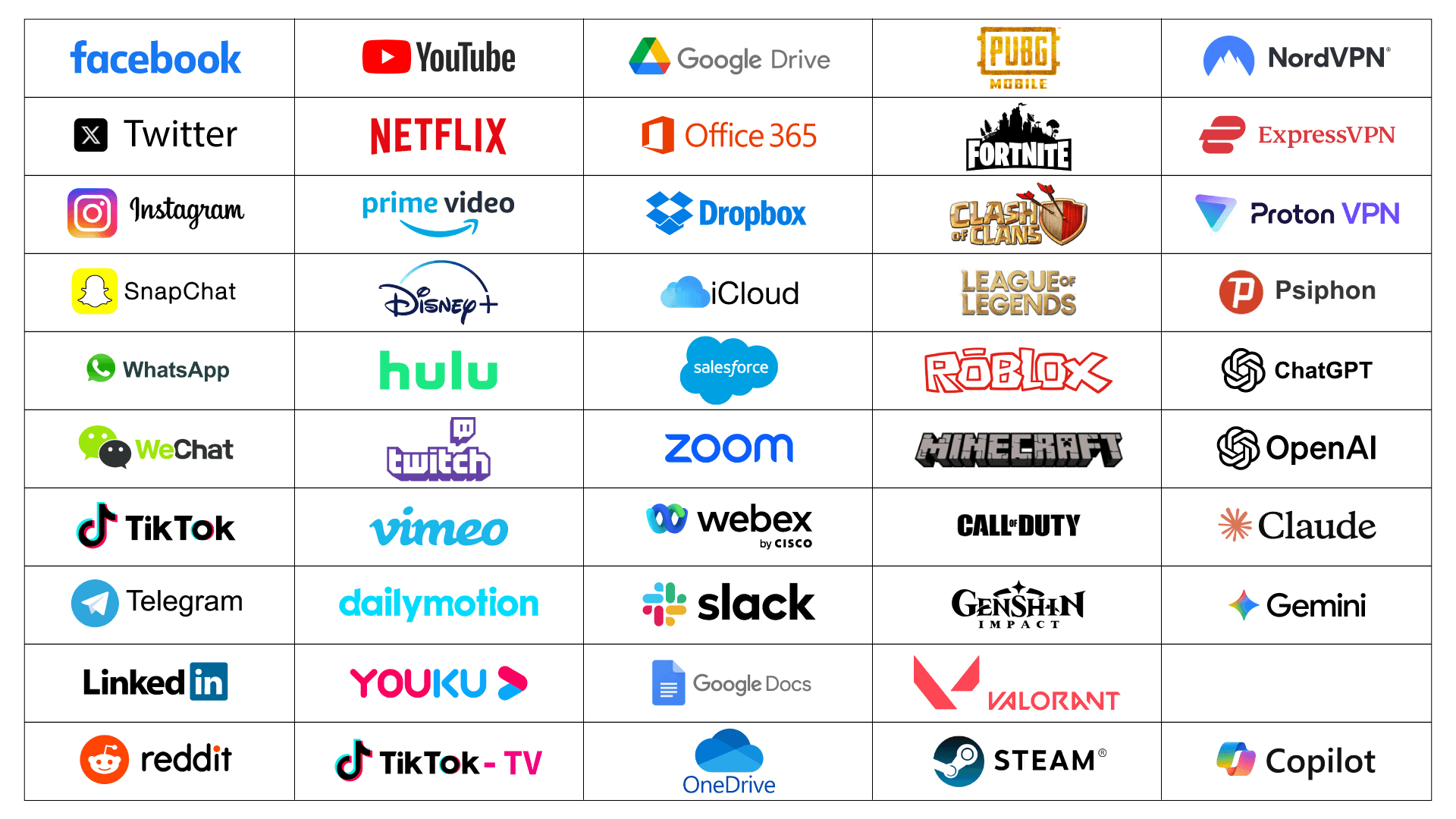
Supported Applications Identified by ASN-DPI
ASN-DPI supported identification of more than 2,700 applications across social platforms, streaming services, cloud productivity tools, gaming applications, AI platforms, and VPN services.
The table below visually represents a sample of supported applications.
The Power of Metadata and Why Protocol Insights Matter
DPI discussions often focused on application identification, but that represented only part of its value. A key outcome of DPI was rich protocol metadata extraction.
Metadata added context and intent to traffic flows, enabling visibility into why traffic occurred, who initiated it, and how it affected services and users.
Why Metadata Was Critical in Modern Networks
Modern networks spanned 4G and 5G cores, enterprise data centers, and cloud environments. Traffic volumes were large, encrypted, and dynamic, making basic counters insufficient.
Protocol metadata enabled:
- Subscriber-aware visibility in mobile networks
- Application-aware monitoring in enterprise environments
- Faster root-cause analysis through traffic correlation
- Improved security through anomaly detection
- Better operational and business decisions
Metadata allowed extraction of relevant intelligence at line rate without full payload inspection.
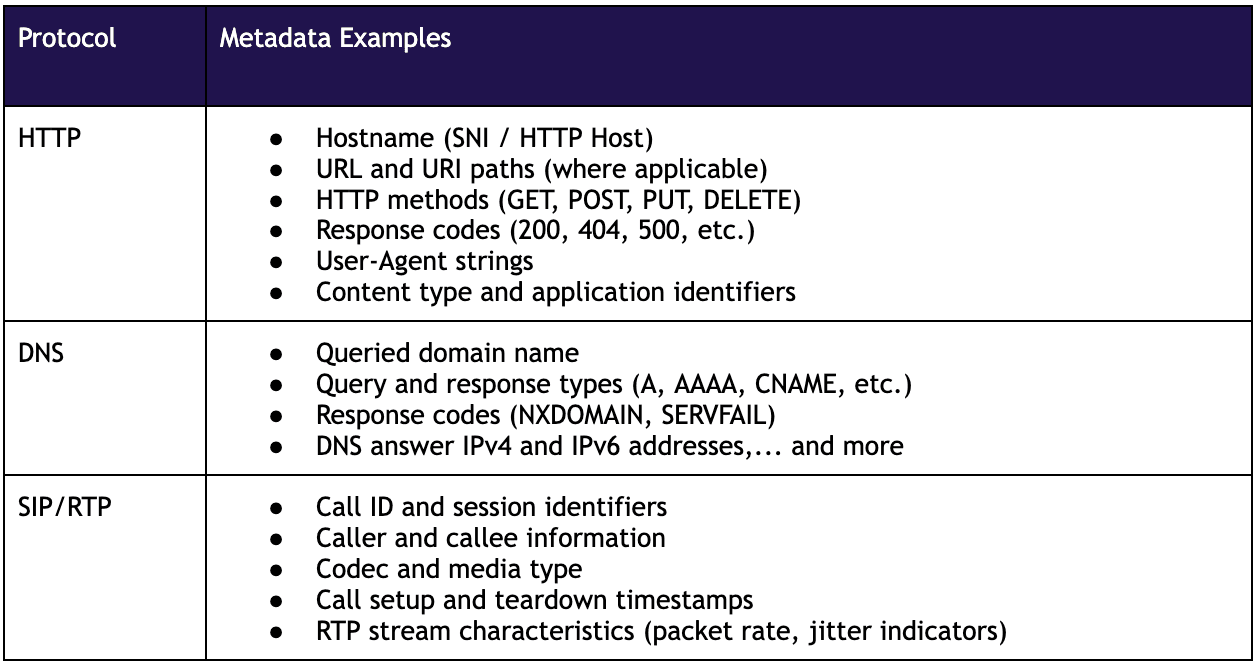
Protocol Metadata Extraction with ASN-DPI
ASN-DPI extracted rich metadata from multiple protocols to support troubleshooting, performance monitoring, security enforcement, and service optimization.
DPI Benefits for Telcos
ASN-DPI provided telcos with application, protocol, and category identification across more than 2,700 applications, along with session KPIs such as bandwidth usage, latency, and packet retransmissions.
This enabled real-time visibility into application usage, resource consumption, and network performance. Metadata such as HTTP hostnames and user-agent information supported improved subscriber analytics and efficient network management.
DPI Benefits for Data Centers and Enterprises
In enterprise and data center environments, ASN-DPI combined application identification with session metrics to deliver visibility into performance and user experience.
This helped teams:
- Track application usage and bandwidth consumption
- Identify latency and packet loss issues
- Detect network bottlenecks
- Enforce security and compliance policies
Protocol metadata further enabled efficient management of complex traffic flows.
DPI Dynamic Upgrade
ASN-DPI supported dynamic updates to detection engines and protocol signatures without service interruption or redeployment. This ensured continuous adaptation to new applications and protocols.
Conclusion
DPI became essential for informed network decision-making. ASN-DPI delivered deep visibility and real-time intelligence that helped telecom operators and enterprises manage modern networks with confidence.
Frequently Asked Questions
What is Deep Packet Inspection and how is it different from basic network monitoring?
Basic monitoring looks at headers and flow statistics. DPI goes deeper by examining the payload data inside packets. That extra layer tells you which application is running, which protocol it uses, and how it is behaving rather than just that traffic is moving between two IP addresses. The difference between knowing traffic exists and understanding what it is doing.
How many applications can ASN-DPI identify and what categories does it cover?
ASN-DPI identifies more than 2,700 applications and 9,000 sub-category applications. Coverage spans social platforms, streaming services, cloud productivity tools, gaming applications, AI platforms, and VPN services. Teams see exactly which applications are running across the network, which protocols they use, and which category they fall into without guessing from flow data alone.
Why does protocol metadata matter as much as application identification in DPI?
Application identification tells you what is running. Metadata tells you why the traffic happened, who started it, and how it is affecting services and users. HTTP hostnames, user-agent strings, session KPIs like latency and packet retransmissions all add context that raw identification alone cannot give. That context is what turns network data into something teams can actually make decisions from.
How does ASN-DPI help telcos manage subscriber traffic and network performance?
Telcos get application, protocol, and category identification across more than 2,700 apps alongside session KPIs covering bandwidth usage, latency, and packet retransmissions. HTTP hostnames and user-agent metadata support subscriber analytics and network management. Real-time visibility into what subscribers are doing and how much of the network they are consuming makes resource allocation and performance optimisation far easier to get right
What specific problems does ASN-DPI solve for enterprise and data center teams?
Teams can track application usage and bandwidth consumption, spot latency and packet loss issues, find network bottlenecks, and enforce security and compliance policies from the same platform. Protocol metadata handles the complex traffic flows that basic monitoring cannot make sense of. Performance problems and policy violations both show up clearly rather than hiding inside unclassified traffic.
How does ASN-DPI stay current as new applications and protocols keep appearing?
DPI detection engines and protocol signatures update dynamically without any service interruption or redeployment needed. New applications and protocols get picked up as soon as the update runs. The network keeps producing accurate identification and metadata without a maintenance window every time the application landscape changes.
Why did basic flow statistics stop being enough for modern network management?
Modern networks span 4G and 5G cores, enterprise data centers, and cloud environments all at once. Traffic volumes are large, encrypted, and constantly changing. Flow statistics show that traffic moved but cannot tell you what application generated it, whether it was legitimate, or why performance degraded. That gap is exactly what DPI fills by looking past the headers into what the traffic actually contains.
How does DPI support security policy enforcement across an enterprise network?
Without application and protocol awareness, security policies can only act on IP addresses and ports. DPI identifies the actual application and category so policies enforce against what traffic really is rather than what address it came from. Anomaly detection also improves because unusual behaviour in a specific application shows up clearly rather than blending into undifferentiated traffic volume.
Learn how ASN DPI helps unlock deep protocol-level visibility and actionable network insights for modern enterprise and telecom environments.


