





How AI Co-Pilots Are Transforming Network Operations: Insights from Aviz Networks
 January 5, 2026
 Network Copilot ™
Introduction
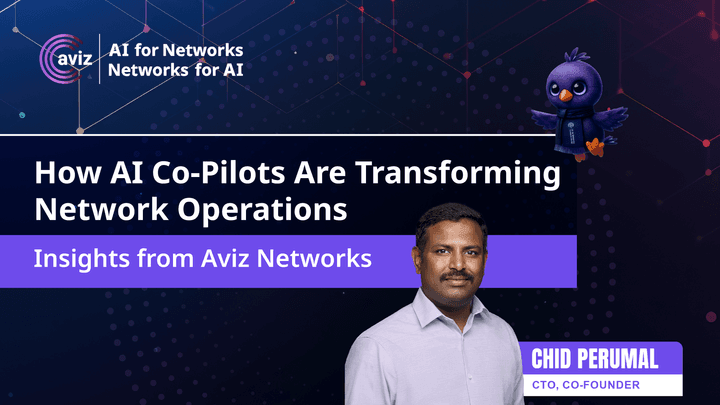
In this episode of the Aviz Networks Podcast, host Shruti Jha speaks with Chid Perumal, CTO and Co-founder of Aviz Networks, about the growing complexity of modern network operations and why traditional tools struggle to keep up at scale. Drawing on over 20 years of experience building enterprise and cloud networking software, including roles at Amazon AWS, Lenovo, IBM, and Blade Network Technologies, Chid explains how fragmented data and excessive noise make network operations increasingly difficult to manage.
The conversation focuses on the role of AI co-pilots in NetOps, highlighting how AI helps engineers cut through complexity, correlate data, and reason through issues more effectively. The episode underscores that AI is no longer optional for NetOps teams and clarifies that AI is designed to augment network engineers by supporting smarter decision making, not replacing human expertise.
What this episode was about
The discussion explored how network engineers operate in environments filled with dashboards, logs, alerts, and tools that show only partial truths. Chid explained how constant context switching impacts accuracy, increases mistakes, and leads to burnout.
The episode also examined how different teams interpret the same network data differently and how AI can unify these perspectives by adding context and explanation.
Chid outlined what a true AI co-pilot should see, understand, and reason through to support real-world network operations.
Key insights from the conversation
- Network engineers troubleshoot distributed systems using fragmented tools and data
- Constant context switching reduces accuracy and increases burnout
- Different teams interpret the same network signals in different ways
- AI is needed to synthesize and contextualize growing telemetry volumes
- AI will not replace engineers but will augment their capabilities
- Effective AI co-pilots need end-to-end network visibility
- Compliance checks, anomaly summarization, and alert correlation are ideal AI tasks
- Vendor-agnostic AI avoids creating new operational silos
- Model flexibility enables cost, privacy, and performance optimization
- Clean and scalable data pipelines are the foundation of AI adoption
Why this episode matters
- Explains why traditional network operations no longer scale
- Clarifies AI's role as an augmentation layer for engineers
- Shows how AI reduces noise and improves decision-making
- Highlights the importance of vendor-neutral and flexible AI architectures
- Provides practical guidance on where to begin AI adoption
Outro
This episode offers a grounded perspective on how AI co-pilots are reshaping daily network operations. By augmenting engineers with context, reasoning, and shared understanding, AI helps teams manage complexity without sacrificing control.
Frequently Asked Questions
Why do traditional network operations tools struggle to keep up as environments grow more complex?
Engineers operate in environments filled with dashboards, logs, alerts, and tools that each show only part of the picture. Constant context switching between those tools reduces accuracy, increases mistakes, and leads to burnout. The data is all there but it is fragmented across systems that were not designed to talk to each other, so engineers end up doing the correlation work manually rather than having it done for them.
How does AI actually help network engineers rather than replacing them?
AI augments what engineers can do rather than substituting for their expertise. It synthesizes growing telemetry volumes, adds context to alerts, and helps teams reason through issues faster. The episode is direct that AI is not optional for NetOps anymore but it is also clear that the goal is smarter decision-making by engineers, not removing engineers from the decisions.
What tasks are the best fit for an AI co-pilot in network operations?
Chid calls out three specifically: compliance checks, anomaly summarization, and alert correlation. These are all tasks that require pulling together data from multiple sources and applying consistent logic to it. They are time-consuming when done manually and prone to inconsistency when different engineers interpret the same signals differently. AI handles that synthesis reliably at a pace no human team can match.
Why do different teams interpret the same network data differently and what problems does that cause?
Network, security, and operations teams all look at the same signals through different lenses based on their priorities and experience. A metric that looks normal to one team is a red flag to another. That inconsistency slows down incident response and makes it harder to reach shared conclusions. AI adds context and explanation to the data so different teams are working from the same understanding rather than arguing about what a signal means.
Why does an effective AI co-pilot need to be vendor-agnostic rather than tied to one platform?
A vendor-specific AI co-pilot just creates another operational silo. If the AI only understands one vendor's data and tools, teams are back to manual correlation for everything outside that vendor's environment. Vendor-agnostic AI works across the whole environment so engineers get a unified view rather than a new fragmentation problem sitting on top of the old one.
Why is constant context switching between tools such a serious problem for network engineers today?
Every time an engineer switches between tools to piece together what is happening, they lose context and introduce the possibility of missing something. At scale with hundreds of alerts and multiple dashboards, that cognitive load compounds quickly. Accuracy drops, mistakes happen, and the sustained pressure leads to burnout. The episode frames this as one of the core reasons traditional operations no longer scales as environments grow.
Why are clean and scalable data pipelines described as the foundation of AI adoption in NetOps?
AI is only as useful as the data it reasons over. If the telemetry pipeline is messy, incomplete, or inconsistent, the AI co-pilot produces unreliable outputs and engineers stop trusting it. Clean and scalable data pipelines are what make AI adoption practical rather than a proof of concept that works in demos but fails in production where the data is noisy and the environment keeps changing.
What does model flexibility mean for NetOps teams choosing an AI co-pilot?
Model flexibility means teams can choose AI models based on their own cost, privacy, and performance requirements rather than being locked into one model chosen by the vendor. A team handling sensitive network data may need a private on-premise model. Another team may prioritise inference speed over cost. Flexibility lets the AI co-pilot adapt to what the environment actually requires rather than the environment adapting to the AI.
Watch the full podcast to hear firsthand insights on how AI is changing the way networks are designed, operated, and supported.
Watch now

