




From Hardware-First to AI-First: Standards Let Value Move Up the Stack
 April 23, 2026
 AI Factory
Continuing to my fourthpost on my book - Deciding the Future: Building New Networks for the AI Era
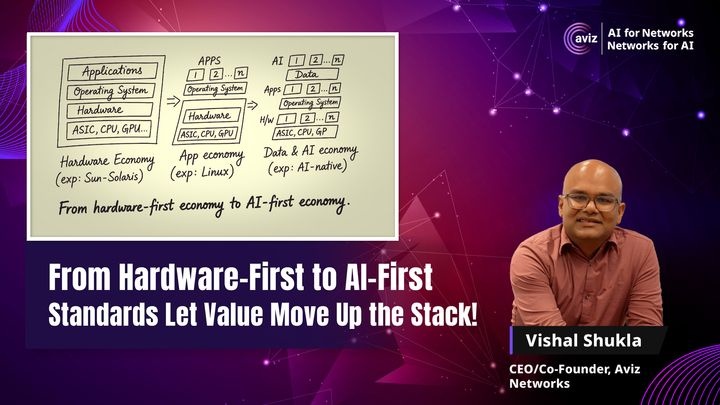
This picture captures a pattern our industry has repeated more than once. In the hardware-first era, most of the value sat close to the box: proprietary hardware, proprietary operating systems, and tightly coupled stacks. Then the app economy changed that. Once the lower layers became standardized enough, value started moving upward into applications. I believe AI is going through a similar transition now. Chips, fabrics, systems, and storage will keep evolving quickly, but the long-term value will increasingly move up into data, models, workflows, and AI-native applications.
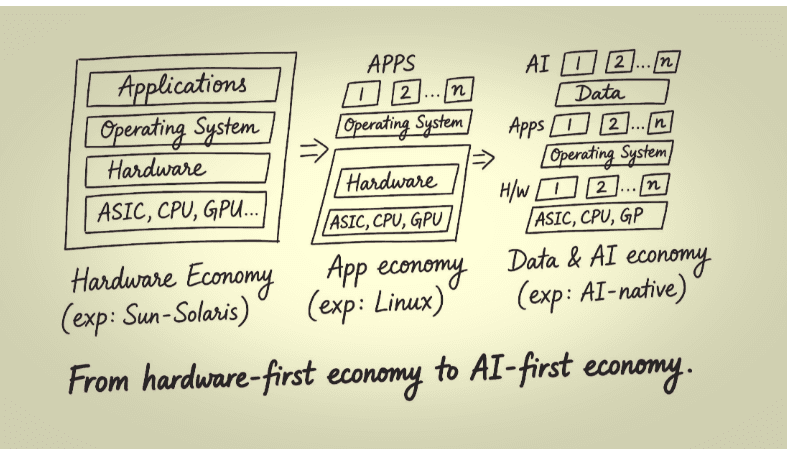
That is why I do not look at this image and conclude that hardware matters less.
Hardware matters a lot.
But this picture shows that hardware alone does not keep the value forever. The real advantage comes when the foundation is stable enough that you can keep improving what sits above it. In the AI era, that means designing infrastructure in a way that can absorb faster chip cycles, newer fabrics, and changing system designs without forcing a full rewrite every time the lower layer changes. When the base becomes more reusable, the business can move faster.
I recently came across a line from Michael Intrator, CEO of CoreWeave that fits this picture well. In CoreWeave’s Rubin platform announcement he said: “With CoreWeave Mission Control™ as our operating standard, we can bring new technologies like Rubin to market quickly.” That line stayed with me because the key idea is not just speed. It is operating standard. That is exactly what this image is about. When the lower layers become consistent enough, you can pull in new chip generations and new infrastructure advances without breaking the layer above them. That is how value starts climbing the stack.
For me, this picture is really about future leverage. The lower layers will continue to innovate, but the biggest and most durable advantage will belong to the teams that turn those lower layers into a reusable platform. Once that happens, the conversation changes. You stop optimizing only for the next hardware decision, and you start building for faster application delivery, better AI services, and a stronger data advantage.
Frequently Asked Questions
1. In a technology-stack context, what has happened to value over time from hardware-first to AI?
In hardware-first value resided in custom hardware and tightly coupled infrastructure. Through application development, value scaled upward into applications and with AI, long-term value will reside increasingly within data, models, workflows and ultimately AI-native applications.
2. With regard to AI infrastructure, why does hardware matter?
Hardware development continues at a rapid pace and is critical for future advancements. However, value does not reside solely with hardware, and there is an enduring advantage in having solid hardware support and infrastructure above that which can remain the focus of innovation.
3. How does the infrastructure layer of the stack allow the pace of change in chip/system architecture to be maintained?
With a stable and re-usable infrastructure foundation the pace of chip cycles and the new system architecture can be sustained. As long as the layers underneath remain constant the organization above will be able to absorb new hardware iterations without extensive re-coding.
4. What is the purpose of operating standards as new AI technologies are introduced to the market?
By providing uniformity in the underlying infrastructure layers operating standards ensure the quick adoption of new generations of chips and systems and eliminate dependencies in the application/workflow layer.
5. Where is the greatest leverage for long-term in an AI infrastructure strategy located?
Long-term leverage exists in using rapid evolving layers of the infrastructure to build a reusable foundation. Once built, an organization can afford to accelerate application delivery and deliver more valuable services and more distinct data advantages.
If these thoughts resonate with you and you would like to talk more on this topic, Let’s Connect


