





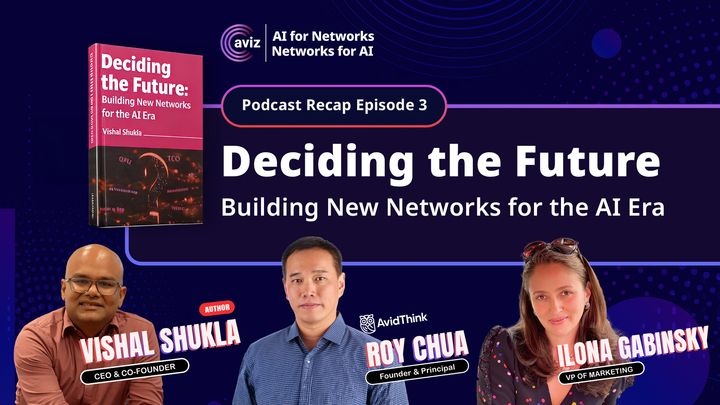
Podcast Recap Episode 3: Deciding the Future: Building New Networks for the AI Era
 April 29, 2026
 ONES & SONiC
TLDR
AI is reshaping networking in two ways: building AI-ready infrastructure and using AI to run networks.
Most organizations are rushing to build, but long-term success depends on how well they operate and optimize these networks.
Leaders must rethink KPIs, strategy, and speed of execution.
Introduction
In this episode of Aviz Networks’ podcast, Roy Chua and Vishal Shukla discuss how AI is fundamentally changing networking.
The conversation moves beyond hype to focus on real shifts in infrastructure, operations, and business priorities.
This is especially relevant for CIOs, network leaders, and enterprise decision-makers navigating AI adoption.
The discussion highlights what is changing, where the market is heading, and how leaders should respond.
What is actually changing in networking because of AI?
AI is reshaping networking across two dimensions: infrastructure and operations.
The discussion highlights the distinction between networks for AI and AI for networks. On one side, networks are being redesigned for AI workloads such as large GPU clusters and high-throughput data movement.
On the other side, AI is transforming network operations through automation, agentic systems, and autonomous decision-making.
These shifts are driven by new traffic patterns, massive compute demands, and evolving architectures in training and inference.
Which is moving faster: building AI infrastructure or using AI in operations?
The market is accelerating faster on building AI infrastructure than on operational transformation.
There is significant investment and urgency in deploying GPU clusters and AI-ready data centers.
Organizations are prioritizing rapid deployment due to capital availability and competitive pressure.
However, operational maturity is lagging.
The challenge of optimizing, managing, and extracting value from these systems is still evolving and becoming increasingly critical.
How are KPIs and network roles changing in the AI era?
Networking is no longer just about uptime; it is now tied directly to compute performance and business outcomes.
The discussion emphasizes a shift from uptime-based KPIs to usage and efficiency metrics. With GPUs acting as high-cost compute engines, underutilization becomes a major business risk.
Networks are now part of the compute system itself, influencing outcomes such as model efficiency, token generation, and overall performance.
This creates tighter coupling between networking, compute, and storage systems.
Where should enterprises choose openness vs vertical integration?
Organizations need a balanced approach between speed and control.
Vertically integrated solutions are preferred where time-to-market and rapid deployment are critical.
This includes adopting full-stack architectures for faster AI infrastructure rollout.
Openness becomes important in the operational layer, where flexibility, cost control, and future adaptability matter.
This allows enterprises to evolve with changing technologies and avoid long-term lock-in.
What are the signals that your network strategy is not AI-ready?
Leaders need to evaluate whether their current strategy supports speed, adaptability, and cost efficiency.
The discussion highlights key signals such as inability to scale efficiently, lack of flexibility for future technologies, and rising operational costs.
Another indicator is whether systems are being optimized as a whole rather than in isolated components.
The shift toward system-level thinking and co-design becomes critical in identifying readiness gaps.
Key Takeaway
AI is compressing the pace of change in networking from years to months.
Organizations that adapt faster through better design, operations, and strategy will gain a significant advantage.
Conclusion
AI is redefining networking at every level, from infrastructure to operations to business metrics. While the current focus is on building AI-ready systems, long-term success will depend on how effectively these systems are managed and optimized.
Leaders must start thinking now, experiment early, and prepare for continuous change.
Frequently Asked Questions
1. In what two ways is AI actually changing how networks are built and run?
AI is pushing networking in two directions at once. On one side, networks are being rebuilt from scratch to handle AI workloads like large GPU clusters and massive data movement. On the other side, AI is being used inside network operations to automate tasks, make decisions, and reduce manual work. Both are happening together, but most organisations are further along on the building side than the operations side.
2. Why is operational maturity lagging behind AI infrastructure investment?
Capital is flowing fast into GPU clusters and AI-ready data centers because competitive pressure and funding availability are pushing organisations to deploy quickly. The harder work of actually optimising, managing, and getting full value out of those systems takes more time and deeper expertise. Building gets the headlines. Operations is where the real long-term value either shows up or gets lost.
3. How are network KPIs shifting because of AI workloads?
Uptime used to be the main thing network teams were measured on. In an AI environment that is no longer enough. GPUs are expensive machines and leaving them underutilised is a direct business loss. Networks now influence how well models run, how fast tokens are generated, and how efficiently the whole compute system performs. That changes what success looks like for a network team.
4. When should enterprises choose a vertically integrated solution versus an open one?
Vertical integration makes sense when speed is the priority. Full-stack architectures let teams roll out AI infrastructure faster without worrying about integration across vendors. Openness matters more at the operations layer where teams need flexibility, want to control costs, and need room to adapt as technology keeps changing. Locking into a single vendor at the operations layer is the part that tends to create problems later.
5. What are the warning signs that a network strategy is not ready for AI?
A few signals stand out. If the network cannot scale efficiently as demand grows, that is a problem. If there is no flexibility to adopt new technologies without a major overhaul, that is another one. Rising operational costs with no clear path down is a third. The bigger pattern to watch is whether the network, compute, and storage systems are being designed together or still treated as separate problems by separate teams.
6. Why does GPU underutilisation become a network problem and not just a compute problem?
GPUs sit idle when the network cannot feed them data fast enough or move results between nodes quickly enough. In AI training jobs, a slow or congested network directly reduces how much work the GPUs can actually do. Since GPUs are among the most expensive parts of AI infrastructure, any underutilisation shows up immediately in the cost per model trained or per token served. The network is no longer a background pipe; it is part of the compute engine.
7. How fast is the pace of change in AI networking and what does that mean for leaders?
The discussion puts it plainly: AI is compressing what used to take years into months. Leaders who wait for things to settle before making decisions will find themselves behind. The advice is to start thinking now, run experiments early, and expect continuous change rather than a stable endpoint to plan around. Organisations that adapt faster through better design and operations will build a real advantage over those moving at the old pace.
8. What does system-level thinking mean for network and compute teams in practice?
For a long time, network teams, compute teams, and storage teams worked in silos and handed off problems at the edges. AI workloads do not respect those boundaries. Training a large model depends on all three layers performing well together. System-level thinking means those teams co-design the infrastructure from the start rather than each one optimising their own piece and hoping it adds up to something good.
Explore how your network strategy aligns with AI demands and start building a roadmap for both infrastructure and operations.


