





Inside Aviz Certified Community SONiC: Reliability, Interoperability, and Real-World Adoption
 January 16, 2026
 ONES & SONiC
Introduction
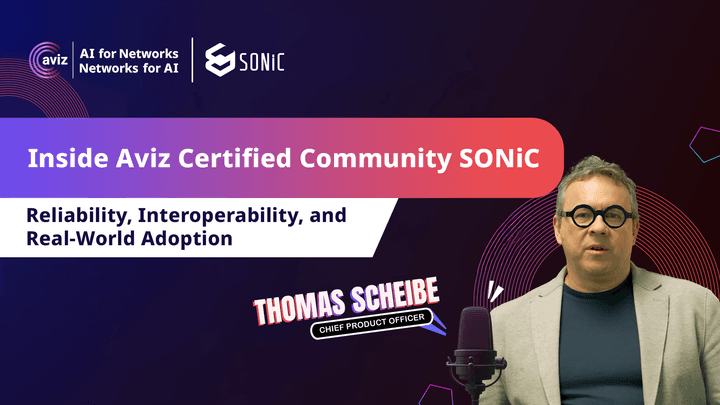
In this episode of the Aviz Networks Podcast, host Shruti Jha, Digital Marketing Manager at Aviz Networks, spoke with Thomas Scheibe, Chief Product Officer at Aviz Networks, about the growing enterprise adoption of SONiC and the role of open networking in modern infrastructure.
Thomas brought over 25 years of experience from Cisco and Intel, where he helped shape data center platforms, launched Cisco's first SONiC offering, and led innovation in AI infrastructure and DPUs.
The discussion focused on why SONiC adoption accelerated beyond hyperscalers, how enterprises evaluated production readiness, and how Aviz Certified Community SONiC addressed reliability, interoperability, and operational confidence. The episode highlighted how open networking was becoming essential as AI-driven innovation cycles shortened.
What this episode was about
The conversation explored why enterprises, cloud providers, and AI-focused organizations increasingly turned to SONiC for flexibility, hardware independence, and faster innovation. Thomas explained that while features mattered, production readiness depended more on ecosystem support, tooling, testing, and operational maturity.
The discussion also covered how Aviz Certified Community SONiC packaged real-world learnings into a validated, enterprise-ready distribution backed by extensive testing and support.
Key insights from the conversation
- SONiC adoption expanded beyond hyperscalers into enterprise and AI environments
- Open source enabled greater control over network operating system roadmaps
- Hardware and silicon abstraction reduced vendor lock-in
- Production readiness depended on support, tooling, and ecosystem maturity
- Aviz Certified Community SONiC provided pre-tested images across major ASIC vendors
- Interoperability was validated through standardized automated testing
- Over 500 automated tests ensured consistency, scale, and failover behavior
- Certified builds included transparency through software bills of materials
- Operational tools supported monitoring, migration, and troubleshooting
- Cost savings came from both capex and opex reductions, not hardware alone
Why this episode mattered
- Explained why SONiC was ready for real-world enterprise production
- Clarified how certification and testing reduced deployment risk
- Highlighted the importance of interoperability across vendors and silicon
- Showed how open networking aligned with faster AI-driven innovation cycles
- Provided practical guidance on cost savings and ROI expectations
Conversations that Shape the Future
This episode offers a practical view into how certified open networking helps enterprises adopt SONiC with confidence. By combining community SONiC with rigorous testing, operational tooling, and multi vendor support, Aviz demonstrates how open networking scales reliably for AI era infrastructure.
Watch the full episode to learn how Aviz Certified Community SONiC enabled reliable, interoperable, and production-ready open networking for modern enterprises.
Frequently Asked Questions
Why are enterprises adopting SONiC now when it started as a hyperscaler technology?
AI-driven innovation cycles are shortening and enterprises need the same flexibility and hardware independence that hyperscalers used SONiC to get. Open source gives organisations real control over their network OS roadmap rather than waiting on a vendor's release schedule. The technology matured and the ecosystem around it grew to the point where enterprise production use became practical rather than experimental.
What does production readiness actually mean for SONiC beyond just having the right features?
Thomas makes this point directly in the episode. Features are not the deciding factor. Ecosystem support, tooling, testing, and operational maturity are what determine whether a team can run SONiC in production with confidence. A feature-complete distribution that lacks proper testing and support is not production-ready no matter how good the code is.
What does Aviz Certified Community SONiC include that community SONiC alone does not?
Pre-tested images across major ASIC vendors, over 500 automated tests covering consistency, scale, and failover behaviour, interoperability validation through standardised automated testing, and software bills of materials for full transparency. Operational tools for monitoring, migration, and troubleshooting are also included. Community SONiC is the open foundation. Aviz wraps it with everything production teams actually need before they go live.
How does hardware and silicon abstraction in SONiC reduce vendor lock-in?
SONiC abstracts the network OS away from the silicon underneath so organisations are not tied to one vendor's hardware roadmap. When a better or cheaper switch comes along, teams swap the hardware without rebuilding their operational model. That freedom is what makes hardware independence a real practical advantage rather than just a marketing point.
Where do the cost savings from SONiC actually come from?
The episode is clear that savings come from both capex and opex, not just hardware costs. Capex drops because commodity hardware replaces proprietary gear. Opex drops because standardised operations, automation, and open tooling reduce the manual work and vendor support costs that add up over time. The hardware discount gets the headlines but the operational savings often matter more long term.
Why do AI-driven innovation cycles make open networking more important for enterprises right now?
AI infrastructure evolves fast. New silicon, new architectures, and new workload patterns arrive constantly. Proprietary networking stacks move on the vendor's timeline which is almost never fast enough to keep up. Open networking lets teams adopt new hardware and capabilities as they appear rather than waiting for a vendor to certify and package everything first. Speed of adoption becomes a competitive advantage when the technology landscape keeps shifting.
What background does Thomas Scheibe bring to the conversation about enterprise SONiC adoption?
Over 25 years at Cisco and Intel working on data center platforms. He launched Cisco's first SONiC offering and led innovation in AI infrastructure and DPUs. That combination of hyperscaler experience and enterprise product leadership means his perspective on what production readiness actually requires comes from having built and shipped these systems rather than just evaluating them from the outside.
How does interoperability testing reduce deployment risk when rolling out SONiC across multi-vendor environments?
Multi-vendor environments mean different hardware from different suppliers running the same network OS. Without standardised interoperability testing, teams discover compatibility problems after deployment rather than before. Aviz Certified Community SONiC validates interoperability through automated testing across ASIC vendors so the known-good configurations are documented before anything goes into production. Risk moves from the data center floor to the test lab where it belongs.


