





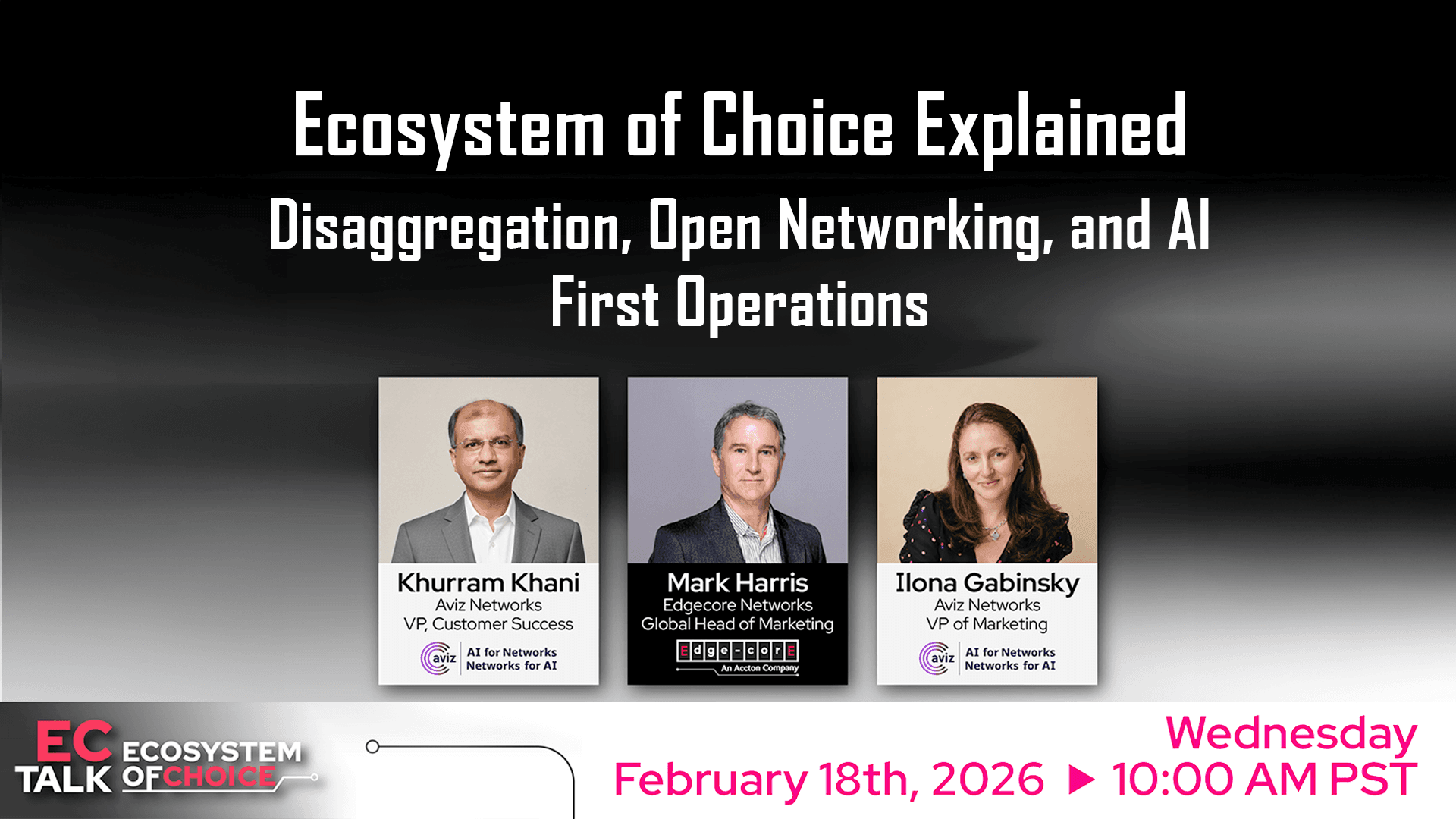
Ecosystem of Choice Explained: Disaggregation, Open Networking, and AI First Operations
 March 2, 2026
 ONES & SONiC
Summary
This webinar brings together Edgecore Networks and Aviz Networks to explain how ecosystem-driven disaggregation enables AI-ready infrastructure. The discussion covers hardware-software separation, SONiC validation, observability, AI-powered NetOps, and structured proof-of-concept deployment through One Center. The focus is on delivering production-ready open networking without turning it into a science project.
Introduction
Disaggregation began over a decade ago as an experimental idea that hardware and software from different vendors could work together. Over time, it evolved into a proven architecture that enables best-in-class selection across hardware, operating systems, and management layers.
Today, as AI transforms infrastructure from CPU-centric to GPU-centric architectures, the need for flexible, scalable, and operationally validated networking has become foundational.
1. Evolution of Disaggregated Networking
1.1 From Vertical Integration to Ecosystem Models
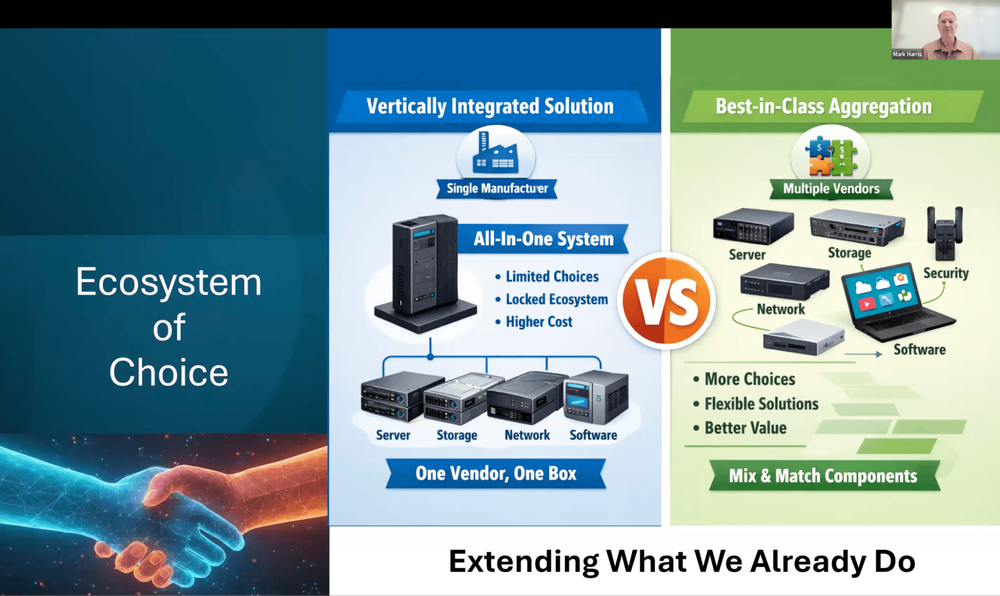
Decades ago, data centers were vertically integrated environments. Over time, enterprises adopted best-in-class storage, compute, and software from different vendors. Networking is now undergoing the same transformation.
Disaggregation enables:
- Hardware and software independence
- Competitive cost optimization
- Lifecycle and supply chain control
- Architecture level customization
- Faster innovation through focused engineering
1.2 Market Adoption Trends
According to Dell'Oro Group, disaggregated networking is growing rapidly, with adoption projected to double year over year.
Industry automation trends highlighted by Gartner reinforce that network automation, observability, and AI-driven operations are becoming mainstream operational models.
2. Infrastructure Shift in the AI Era
2.1 Compute Transition from CPU to GPU
AI workloads are accelerating infrastructure redesign. Data centers are transitioning from CPU-dominant architectures to GPU-intensive environments.
2.2 Bandwidth Acceleration
Networking speeds have rapidly evolved from 100G to 400G and now 800G within a compressed innovation cycle. Major silicon vendors, including Broadcom, Cisco, Marvell Technology, and NVIDIA, are driving this upward trajectory.
The shift requires validated open stacks that can keep pace with hardware evolution.
3. AIS Certified Community SONiC on Edgecore
3.1 Production Ready SONiC Validation
Aviz Networks provides an AIS Certified Community SONiC build validated on Edgecore Networks switches.
Certification includes:
- Feature-level validation
- System integration testing
- Scale and stress testing
- Long-duration validation
- Interoperability with third-party vendors
This ensures production readiness rather than experimental deployment.
3.2 Common Deployment Use Cases
Validated use cases include:
- IP Clos fabrics
- EVPN VXLAN
- Layer 2 leaf spine
- Edge SONiC deployments
- Data center interconnect
4. Open Networking Enterprise Suite
4.1 Configuration and Orchestration
Aviz One enables YAML-based intent-driven configuration for SONiC fabrics. It supports BGP configuration, MC-LAG, leaf-spine roles, NTP, IP pools, and automated deployment across Edgecore switches.
4.2 Observability and Telemetry
Streaming telemetry provides:
- CPU and memory utilization
- Port-level monitoring
- ASIC route capacity visibility
- IPv4 and IPv6 route tracking
- ACL and fabric utilization metrics
4.3 Support as a Service
24 by 7 support ensures enterprises are not operating open networking environments alone. The model mirrors the Red Hat approach for Linux but applied to networking.
5. Deep Network Observability Stack
5.1 Packet Broker on Edgecore Hardware
The Aviz Packet Broker runs on Edgecore switches and provides:
- Traffic aggregation
- Filtering and header manipulation
- Tunneling and packet slicing
5.2 Service Node Intelligence
Service nodes running on x86 platforms enable:
- Packet deduplication
- Application identification
- Load balancing
- Metadata extraction
- Packet capture
5.3 Toolchain Integration
The observability stack integrates with existing ecosystems, including:
- Network Detection and Responses (NDR)
- Intrusion Detection Systems (IDS)
- Network Performance Management (NPM)
- Application Performance Monitoring (APM)
- SIEM
- PCAP Recorder
This approach avoids rip-and-replace strategies.
6. AI First Operations with Network Copilot
6.1 Conversational Troubleshooting
Network Copilot enables operators to ask contextual questions such as performance anomalies or configuration changes.
6.2 Policy Guarded Automation
AI-recommended actions are validated against intent and policy frameworks before execution.
6.3 Cross-Tool Correlation
Copilot integrates telemetry, configuration, and observability layers into a unified operational interface.
By 2030, as projected by Gartner, AI agents are expected to handle significant portions of runtime networking operations.
7. One Center: Structured POC and Validation Lab
Aviz One Center hosts Edgecore hardware in a production-like OCP lab environment. Enterprises can:
- Run IP Clos or VXLAN proofs of concept
- Validate feature matrices
- Test packet broker deployments
- Evaluate AI NetOps workflows
- Access remote GPU-backed Copilot environments
This lowers entry barriers for organizations without hyperscaler-level lab resources.
Conclusion
The ecosystem of choice model brings together disaggregated hardware, validated SONiC builds, enterprise-grade observability, and AI-driven operations into a cohesive stack.
Rather than treating open networking as a science experiment, the combined Edgecore and Aviz approach delivers structured validation, operational assurance, and scalable infrastructure aligned with the AI era.
Frequently Asked Questions
What does disaggregated networking actually mean and why does it matter now?
Disaggregation means hardware and software from different vendors work together instead of being locked into one vendor's bundle. It started as an experiment over a decade ago and is now a proven architecture. With AI pushing data centers from CPU-heavy to GPU-heavy setups, having flexible validated networking underneath has gone from nice-to-have to foundational.
How does Aviz validate SONiC on Edgecore switches for production use?
The AIS Certified Community SONiC build goes through feature-level validation, system integration testing, scale and stress testing, long-duration runs, and interoperability checks with third-party vendors. The goal is production readiness not an experimental deployment teams have to babysit after it goes live.
What network use cases are validated and ready to deploy on Edgecore with Aviz SONiC?
Five use cases are covered: IP Clos fabrics, EVPN VXLAN, Layer 2 leaf-spine, edge SONiC deployments, and data center interconnect. Each one has gone through the full certification process so teams are not starting from scratch figuring out whether the configuration actually works at their scale.
How does Network Copilot help network operations teams day to day?
Operators ask contextual questions about performance anomalies or config changes in plain language and get answers back. AI-recommended actions are checked against intent and policy before anything gets executed. Telemetry, configuration, and observability all feed into one interface so teams are not jumping between tools to piece together what is happening.
What does the Aviz deep observability stack include and what tools does it connect to?
Packet Broker runs on Edgecore switches for traffic aggregation, filtering, tunneling, and packet slicing. Service Nodes on x86 platforms handle deduplication, application identification, metadata extraction, and packet capture. The stack plugs into NDR, IDS, NPM, APM, SIEM, and PCAP tools already in the environment so nothing has to be ripped out and replaced.
What is the Aviz One Center and who is it useful for?
One Center is an OCP lab in Fremont California that hosts Edgecore hardware in a production-like environment. Enterprises that do not have hyperscaler-level lab resources can run IP Clos or VXLAN proofs of concept, validate feature matrices, test packet broker setups, and try AI NetOps workflows there before committing to a full deployment.
Why is networking bandwidth jumping from 400G to 800G so fast and what is driving it?
AI workloads need more bandwidth between GPUs than traditional CPU-based workloads ever did. Broadcom, Cisco, Marvell, and NVIDIA are all pushing silicon faster than previous innovation cycles allowed. The result is that open networking stacks need to be validated and ready to keep pace with hardware that is moving faster than most enterprise refresh cycles were built to handle.
How does the 24 by 7 support model from Aviz work for open networking environments?
Aviz positions its support model the same way Red Hat handles Linux. Enterprises are not left running an open networking environment on their own. Round the clock support means there is always someone accountable when something breaks rather than the team posting on a community forum and hoping someone with the right answer happens to see it.
Key Takeaways
SONiC-based open networking for modern data centers and AI factories using Edgecore hardware and Aviz ONES
Deep network observability for security, compliance, and visibility with packet brokers and service nodes that normalize network data
AIOps in action with chat-based troubleshooting, audits, and AI-driven automation powered by Network Copilot™
Seamless integration with existing tools and workflows, no lock-in, no disruption
Real-world customer case study showcasing measurable ROI from a joint Aviz + Edgecore deployment
Join us to see how Aviz and Edgecore are building smarter networks, reducing repetitive work, increasing operational efficiency, and delivering tangible business outcomes, all while keeping your infrastructure entirely yours.
Watch the full webinar on demand to explore the complete discussion, expert insights, and practical guidance shared during the session.


