




From DPU to Fabric: Multi-Tenant Network Automation with NVIDIA NICo and Aviz ONES
 October 16, 2026
 AI Factory
Overview
Building a multi-tenant AI infrastructure requires coordination across two distinct networking domains: the GPU host and DPU layer, where tenant networking originates, and the data-center fabric, where that tenant must reach storage, shared services, and external networks.
NVIDIA Infra Controller (NICo) manages GPU hosts and their BlueField-3 DPUs, establishing the network identity associated with each tenant. Aviz ONES extends that tenant networking model into the broader AI fabric.
The architectural principle is straightforward: NICo remains the source of truth for tenant network identity, while ONES consumes that identity and programs the surrounding network infrastructure consistently. This avoids creating two independent sources of network configuration and provides a common workflow from GPU host provisioning through external connectivity.
Dividing Responsibility Between NICo and the Fabric
NICo operates closest to the workload. When a GPU server is allocated to a tenant, NICo configures the associated BlueField-3 DPU with the networking information required to identify and isolate that tenant. This includes parameters such as:
- VLAN
- VNI
- VTEP information
Because these values originate during workload and host provisioning, NICo naturally becomes the authoritative source for the tenant's network identity.
The important architectural decision is that the external fabric should not independently allocate another set of tenant identifiers. Instead, the network infrastructure should consume the identifiers already assigned by NICo.
This creates a clean ownership model: NICo owns the tenant identity at the host/DPU layer. ONES extends that identity across the network fabric.
Where Aviz ONES Fits
Aviz ONES manages the network infrastructure surrounding the GPU hosts, including the north-south portion of the AI fabric.
In the reference architecture, ONES manages:
- Front-end fabric (leaf/Spine)
- Border leaf switches
- Aviz Service Gateway
- Firewall connectivity
- Storage leaf
ONES connects to NICo as an infrastructure provider and retrieves the networking attributes associated with each tenant. It then uses those values to configure the rest of the fabric.
The objective is not for ONES to create a parallel tenant model. Instead, ONES translates the tenant definition established by NICo into the configuration required by the physical and virtual network infrastructure.
Extending Tenant Connectivity Beyond the GPU Host
The BlueField-3 DPU represents the first enforcement point for tenant networking.
From there, tenant traffic traverses the front-end leaf-spine fabric toward services such as storage, external networks, or other shared infrastructure.
The Aviz Gateway provides the point where tenant overlay connectivity can terminate before reaching external networks. It can also provide functions such as:
- Tenant-aware routing
- NAT & Firewall
- Load Balancer
- External network connectivity
Firewall policy can then determine which external destinations or services a tenant is permitted to access. ONES programs these infrastructure components using the tenant networking information obtained from NICo rather than independently assigning network attributes.
Reference Architecture
The reference topology illustrates the separation of responsibilities between the two control domains.
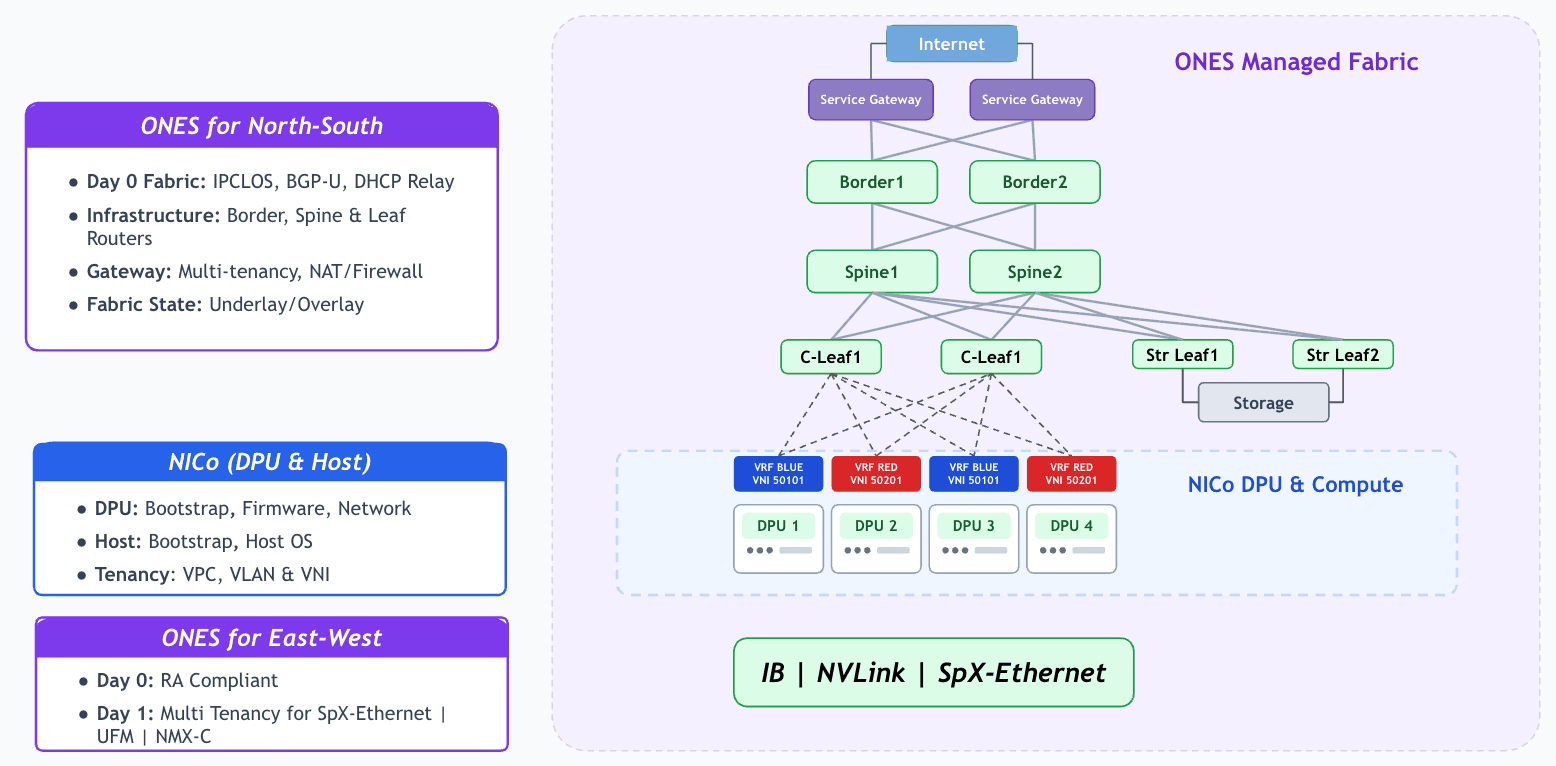
At the bottom of the architecture are GPU servers equipped with BlueField-3 DPUs. These systems are managed by NICo.The DPUs connect into the front-end leaf-spine network. Tenant traffic then traverses the fabric toward border leaf switches and the Aviz Gateway, which are managed through ONES. Storage is connected through a separate storage leaf network. The important point in the topology is not simply which controller manages which device. It is the continuity of tenant network identity across those domains. A tenant created at the GPU infrastructure layer must retain the same networking context as its traffic moves through the fabric. The diagram in the original blog captures this boundary: NICo manages the DPU and compute domain, while ONES manages the surrounding fabric infrastructure.
Control-Plane Workflow
The integration can be understood as a sequence of control-plane operations.
1. Build the AI Fabric
The operator first creates the network fabric in ONES. This establishes the physical fabric topology and the infrastructure ONES will manage.
2. Register NICo as a Provider
ONES connects to NICo using the NICo controller address and provider credentials.This integration gives ONES visibility into the tenant networking information managed by NICo.
3. Create the Tenant
The operator creates a tenant and assigns GPU server resources. NICo provisions the appropriate networking configuration on the BlueField-3 DPU associated with those servers.
4. Retrieve Tenant Network Identity
NICo returns the network identifiers assigned to the tenant.For example, this may include the VLAN, VNI, and VTEP information associated with the tenant.
5. Extend the Tenant Across the Fabric
ONES consumes these values and configures the corresponding network infrastructure, including:
- Border leafs
- Aviz Service Gateway
- Firewall
- Storage-facing network
The same tenant identifiers therefore remain consistent from the GPU host through the network fabric.
Why the Source-of-Truth Model Matters
Without this integration, two orchestration systems could independently maintain tenant networking information. For example:
NICo has Tenant A → VLAN 100 → VNI 10100 while the network controller separately maintains,
Fabric Tenant A → VLAN 200 → VNI 20200
Even if both configurations are individually valid, the overall system is no longer deterministic.
The better architecture is, Tenant Creation
→ NICo assigns network identity
→ ONES discovers the identity
→ ONES extends it across the fabric
This establishes a single authoritative source for tenant network parameters while still allowing separate systems to manage different infrastructure domains.
Architectural Takeaway
The interesting part of this integration is not simply connecting two controllers through an API. It is establishing a clear control-plane ownership model.NICo manages GPU infrastructure and establishes tenant networking at the BlueField-3 DPU. Aviz ONES consumes that tenant definition and extends it across the AI network fabric.
That separation allows each controller to operate within its natural domain while maintaining a consistent tenant network model end to end. For operators building multi-tenant GPU infrastructure, this provides a practical way to combine GPU infrastructure orchestration with fabric automation without introducing a second, independent source of tenant network identity.
Frequently Asked Questions
How do I automate multi-tenant networking for GPU clusters with NVIDIA BlueField-3 DPUs?
NVIDIA Infra Controller (NICo) configures each BlueField-3 DPU with the tenant’s VLAN, VNI, and VTEP information. Aviz ONES then retrieves those values from NICo and extends the same tenant identity across the AI fabric.
Which system is the source of truth for tenant network identity in an AI fabric?
NICo is the source of truth. It assigns the tenant’s network identity at the host and DPU layer, and ONES consumes that identity instead of creating a parallel tenant model.
Why shouldn’t the fabric controller assign its own tenant VLANs and VNIs?
If two systems keep separate tenant records, the same tenant can end up with different VLAN and VNI values in each. Even if both are valid on their own, the overall system is no longer deterministic.
How do I keep tenant VLAN and VNI consistent from the DPU to the data center fabric?
Build the AI fabric in ONES, register NICo as a provider, and create the tenant with its GPU servers. NICo returns the tenant’s VLAN, VNI, and VTEP information, and ONES uses those same values to configure the border leafs, gateway, firewall, and storage-facing network.
How does tenant traffic reach storage and external networks from the GPU host?
Tenant traffic starts at the BlueField-3 DPU, crosses the front-end leaf-spine fabric, and moves toward border leafs and the Aviz Gateway. Storage connects through a separate storage leaf network.
What manages the north-south network in a multi-tenant AI fabric?
Aviz ONES manages the network infrastructure around the GPU hosts, including the north-south portion of the AI fabric. This covers the front-end leaf-spine fabric, border leaf switches, the Aviz Service Gateway, firewall connectivity, and the storage leaf.
How do tenants in a GPU cluster connect to external networks?
The Aviz Gateway is where tenant overlay connectivity can terminate before reaching external networks. It can provide tenant-aware routing, NAT and firewall, load balancing, and external connectivity, while firewall policy decides which external destinations or services each tenant can access.
How does Aviz ONES integrate with NVIDIA NICo?
ONES connects to NICo as an infrastructure provider using the NICo controller address and provider credentials. This gives ONES visibility into the tenant networking information NICo manages, which it uses to configure the rest of the fabric.
Building multi-tenant GPU infrastructure? See how Aviz ONES works with NVIDIA Infra Controller to carry tenant network identity from the BlueField-3 DPU across your entire AI fabric.


