




Why Context Engineering Matters More than Prompt Engineering for Network AI Agents
 October 10, 2025
 Network Copilot ™
Summary
In network operations, AI agents succeed not because of clever prompts but because of accurate context. Context engineering ensures AI understands live network data, logs, configurations, and bug advisories to deliver precise troubleshooting, root cause analysis (RCA), and analytics across multi-vendor environments.
Introduction
AI in networking is no longer just about crafting clever prompts. It is about providing relevant context. While prompt engineering gained popularity as a way to guide large language models (LLMs), it quickly shows limitations in complex enterprise networks such as data centers, carrier networks, and multi-vendor infrastructures.
For critical network use cases like support, troubleshooting, RCA, and analytics, the difference between a demo AI and a production-ready agent comes down to context engineering.
What is the Difference Between Prompt Engineering and Context Engineering?
Prompt engineering controls style and format, while context engineering ensures accuracy, relevance, and trust.
Prompt Engineering: Carefully crafting instructions given to an AI model.
Example: "You are a Cisco support expert. Summarize the following log."
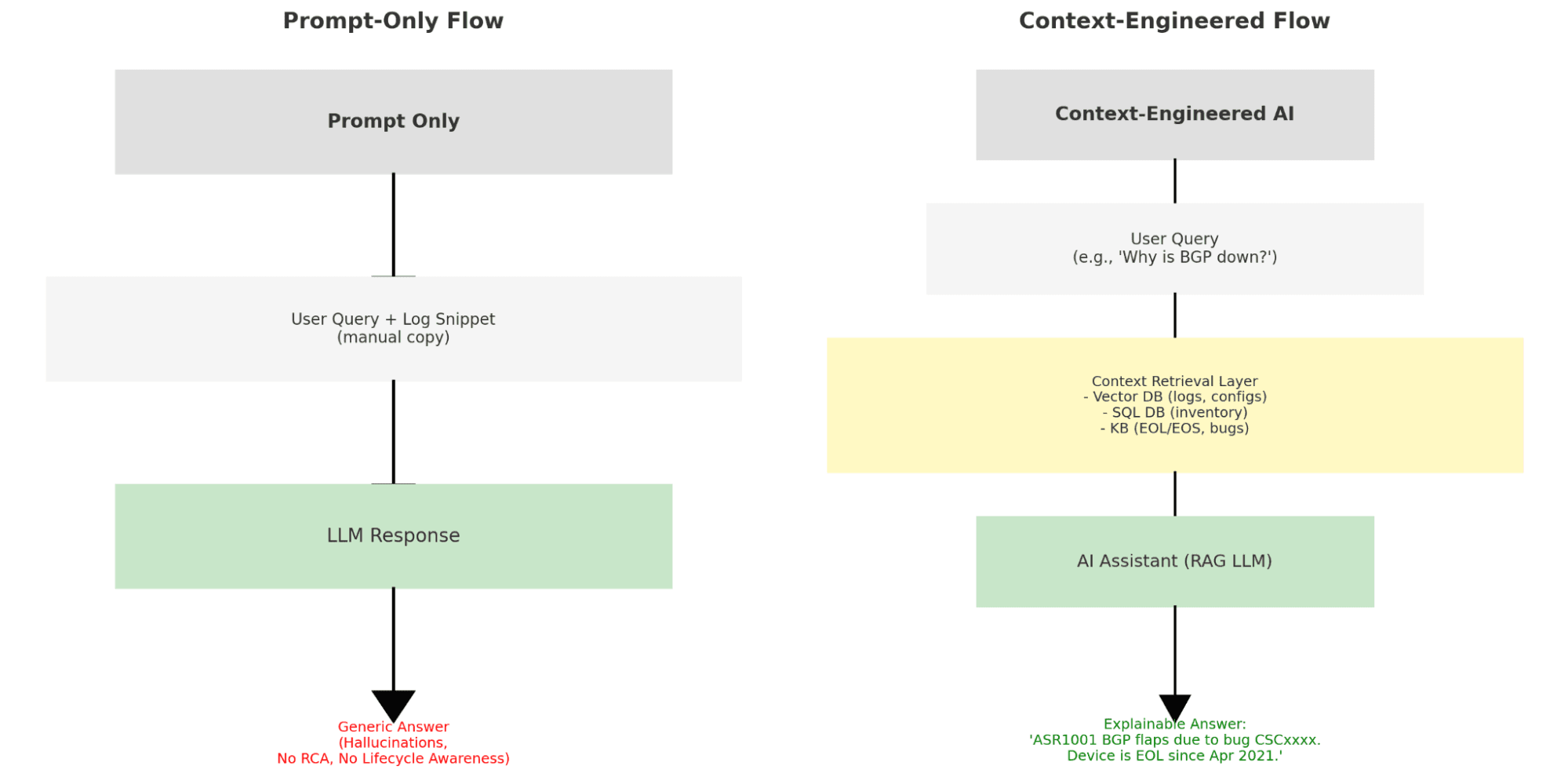
Context Engineering: Designing how the AI agent retrieves, filters, and feeds the right data, including logs, configurations, inventory, topology, bug advisories, and EOL/EOS notices, into the model so it can reason accurately.
Why Prompt Engineering Alone Fails in Networks
Prompts cannot capture dynamic, large-scale network data or domain-specific knowledge.
- Scale of Data: A TAC engineer may upload hundreds of MB of logs. No single prompt can cover all relevant details.
- Dynamic Environment: Device states change every minute (BGP neighbors, interface counters, errors). Static prompts cannot track live context.
- Domain-Specific Knowledge: RCA requires blending device logs, configs, vendor KBs, and known bugs. Prompts cannot embed all this knowledge upfront.
- Ambiguity of Natural Language: A query like "Why is BGP down?" requires contextual narrowing, from device to neighbor to the last log entry to the known bug, which prompt wording alone cannot resolve.
How Context Engineering Powers Network AI Agents
Context engineering retrieves and structures relevant network data, enabling AI agents to reason and act accurately.
- Data Retrieval and Filtering: Logs (e.g., show version, show BGP summary) are chunked and indexed in a vector database. Queries trigger semantic search to fetch only relevant chunks.
- Knowledge Fusion: Context is enriched with EOL/EOS bulletins, bug advisories, and PSIRTs.
Example: When OS version = 15.1(3)S3, automatically pull known caveats. - Dynamic Context Windows: AI agents fetch just-in-time context instead of entire configs.
Example: For a routing issue, fetch BGP logs, not fan tray inventory. - Contextual Correlation: AI correlates telemetry (errors), inventory (modules), and supports KBs (bug IDs) to produce explainable RCA.
Real-World Examples of Context Engineering
Support Query:
- Prompt Only: "Summarize this syslog" results in generic text.
- With Context Engineering: AI retrieves syslog, device inventory, and Cisco bug DB and outputs "Interface Gi0/1 flaps are due to bug CSCxxxx triggered in IOS-XE 15.1(3)S3. The device has been EOL since 2021."
Troubleshooting:
- Prompt Only: "Explain high CPU" results in "CPU usage is high, check processes."
- With Context Engineering: AI fetches show processes CPU, device platform info, and known bug advisories, producing "CPU spikes are due to ARP input process, matching Cisco Bug CSCyyyy, fixed in 15.2(1)S."
Benefits of Context Engineering
- Accuracy over Creativity: Grounding AI in device-specific data removes hallucinations.
- Repeatability: Every engineer gets the same RCA with the same context.
- Explainability: AI can cite which log snippet or KB it used.
- Scalability: Works across multi-vendor, multi-device environments without hand-tuning prompts for each case.
Implementing Context Engineering in Network Copilot (NCP)
NCP uses structured and unstructured data pipelines to feed AI agents with actionable context.
- File Ingestion Service: Parse offline logs and configs into structured databases with vector embeddings.
- Contextual Retrieval: RAG (Retrieval-Augmented Generation) pipeline feeds relevant snippets into the AI.
- Knowledge Base Connectors: Integrate EOL/EOS data, PSIRTs, and bug advisories.
- AI Orchestration Layer: Merge structured SQL data and unstructured logs into a unified context package.
- UI/Agent Layer: Interactive chat and dashboards show context-backed RCA to engineers.
Conclusion
Prompt engineering makes AI agents sound smart, but context engineering makes them act smart. For network operations, where precision and reliability matter, context engineering ensures AI agents deliver:
- Trustworthy support answers
- Actionable troubleshooting guidance
- Accurate root cause analysis
Without context engineering, AI risks being just another chatbot. With it, AI becomes a Network Copilot, ready for real-world enterprise network operations.
Transform Your Network AI Agents
Start building context-driven Network Copilots for accurate RCA and autonomous troubleshooting today.


