




Can AI Factories Be Built Faster Without Hardware? Here's What NVIDIA & Aviz Reveal
 April 14, 2026
 AI Factory
TLDR
- AI factories are becoming too complex for traditional deployment.
- Simulation platforms like DSX Air allow enterprises to design and validate infrastructure before hardware arrives, significantly reducing deployment time.
- The shift-left approach is becoming essential.
Introduction
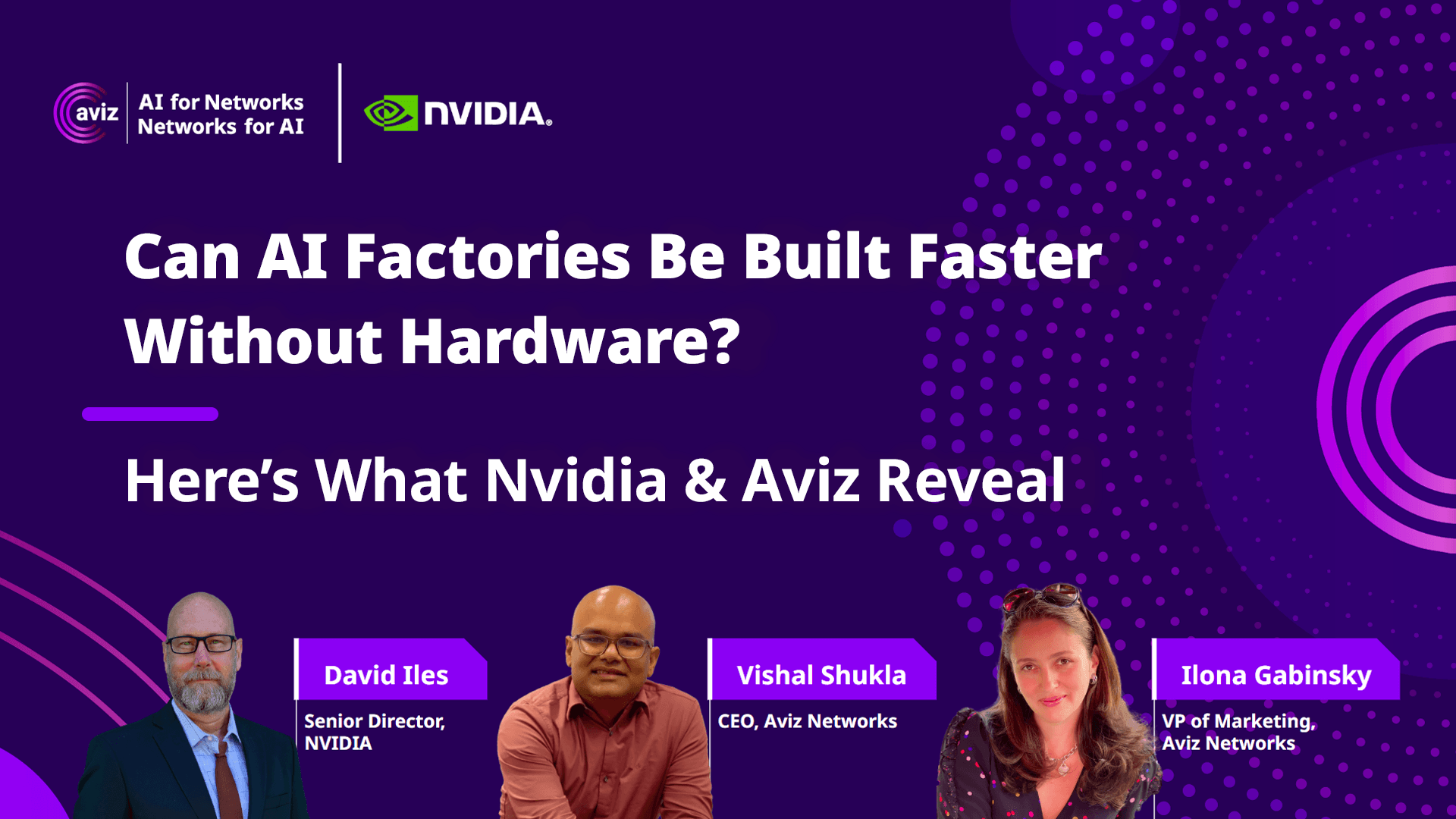
In a recent webinar hosted by Aviz Networks, key industry leaders discussed the shift toward simulation-first AI infrastructure.
Moderated by Ilona Gabinsky, the session featured David Iles from NVIDIA and Vishal Shukla, who explored how AI factories are evolving.
As AI adoption grows, the key question is:
How can enterprises deploy AI infrastructure faster and more reliably?
What is Changing in AI Infrastructure Today?
AI infrastructure is shifting from hardware-first deployment to simulation-first design.
Traditional setups required hardware before testing, leading to long deployment cycles. Simulation platforms now allow teams to test configurations, integrations, and workflows in advance, reducing delays and risk.
Why is "Shift Left" Becoming Critical for AI Factories?
Shift-left enables faster deployment by moving testing earlier in the lifecycle.
Instead of waiting months for a full setup, simulation enables early validation, significantly reducing time to production.
Framework
| Approach | Method | Outcome |
|---|---|---|
| Traditional | Hardware → Setup → Test | Slow, high risk |
| Shift Left | Simulate → Validate → Deploy | Faster, efficient |
Where Does Aviz Fit in the AI Factory Ecosystem?
Aviz enables orchestration, operations, and visibility across the AI factory stack.
Aviz Networks provides:
- Network orchestration (Day 0–Day 2)
- Multi-tenancy and automation
- Security and observability
- AI-driven operations
NVIDIA provides the infrastructure, while Aviz ensures it operates efficiently.
What Can Be Tested Before Hardware Arrives?
Most configurations and integrations can be validated before hardware arrives — except for raw performance.
Simulation enables testing of connectivity, configurations, security, and failure scenarios.
Checklist
- Connectivity and integration
- Configuration validation
- Security policies
- Upgrade workflows
- Failure scenarios
Not included:
- Hardware performance benchmarking
Misconception
"Simulation is optional."
Simulation is essential. Without it, deployments become slower and riskier, especially as infrastructure evolves rapidly.
Key Takeaway
- AI factories are complex systems requiring tight integration across multiple layers.
- Simulation enables faster deployment, better reliability, and improved scalability.
- Shift-left is becoming a necessary strategy.
Forward-Looking Insight
- AI adoption will continue to accelerate, making simulation a standard part of deployment.
- AI factories will increasingly rely on digital twin models for planning and operations.
Conclusion
- AI infrastructure is becoming more complex
- Traditional deployment methods are slowing progress
- Simulation enables faster and safer deployment
- Aviz plays a key role in operationalizing AI factories
- Shift-left will define successful implementations
Frequently Asked Questions
1. Why are traditional AI factory deployment models no longer sufficient?
AI factories have become too complex for hardware-first deployment. Waiting for hardware before testing leads to long timelines, higher risk, and delayed time to value.
2. What problem does simulation solve in AI infrastructure deployment?
Simulation allows enterprises to design, test, and validate AI infrastructure before hardware arrives. This significantly reduces deployment time and minimizes integration and configuration risks.
3. What does a simulation-first AI factory deployment model mean?
A simulation-first model validates configurations, integrations, and workflows before physical deployment. Teams identify issues early instead of discovering them during live rollout.
4. Why is early validation during the design phase critical for AI factories?
Early validation moves testing earlier in the lifecycle. This enables faster deployments and reduces the risk of costly changes late in the process.
5. How does early validation before hardware delivery compare to traditional deployment?
Traditional deployment follows hardware, setup, then testing, which is slow and risky. Early validation follows simulate, validate, then deploy, which is faster and more efficient.
6. How does Aviz Networks support simulation-first AI factory deployments?
Aviz provides orchestration, automation, security, observability, and AI-driven operations across Day 0 to Day 2. It ensures AI infrastructure operates efficiently once deployed.
7. What role does NVIDIA play in the AI factory ecosystem?
NVIDIA provides the AI infrastructure foundation. Aviz complements this by enabling operations, visibility, and lifecycle management across the AI factory stack.
8. What parts of AI infrastructure can be validated before hardware arrives?
Teams can validate connectivity, configurations, security policies, upgrade workflows, and failure scenarios. Only raw hardware performance benchmarking requires physical systems.
9. Why is simulation-based validation essential for modern AI factory deployments?
Without simulation-based validation, deployments become slower and riskier. As AI infrastructure evolves rapidly, skipping early validation increases operational and integration failures.
10. What is the main takeaway for enterprises deploying AI factories at scale?
AI factories require tight integration across multiple layers. Simulation-first deployment and early validation enable faster rollout, better reliability, and scalable operations.
Ready to See It in Action?
Learn how Aviz Networks is helping organizations simulate and operationalize AI infrastructure before hardware even arrives.
Watch the Fireside Chat: Aviz ONES + NVIDIA DSX Air — AI Factory Validation


