



Bringing AI Network Operations to Life in NVIDIA DSX Air with Aviz ONES and Network Copilot
 May 17, 2026
 Network Copilot ™
Introduction
AI factories are changing the way networks are designed, deployed, and operated. The network is no longer a passive connectivity layer. It is becoming a critical part of the AI infrastructure stack, directly influencing GPU utilization, workload placement, tenant isolation, application performance, and operational efficiency. In our previous blog, we discussed how NVIDIA DSX Air and Aviz ONES helped accelerate AI network design by allowing teams to validate AI fabric blueprints, topology choices, configurations, and operational workflows before deploying in production. That work showed a powerful shift: network architects no longer need to wait for physical hardware to begin designing and validating complex AI fabrics. Now, we are extending that same idea from design validation to operational readiness.
With Aviz ONES and Network Copilot running in DSX Air, customers can experience a complete AI network operations environment: Day-0 bring-up, tenant provisioning, telemetry collection, forecasting, event correlation, and AI-assisted Network Operations Center (NOC) workflows — all inside a realistic digital twin environment. This is where AI networking becomes more than a reference architecture. It becomes an operational model.
Why DSX Air Matters for AI Network Operations
AI infrastructure is complex because it brings together multiple domains:
- Frontend network for user, application, storage, and management access
- Backend network for scale-up, scale-out and scale-across GPU-to-GPU communication
- Tenant and workload isolation across shared infrastructure
- GPU, DPU, NIC, switch, optics, and host telemetry
- Rapid changes driven by workload placement and scaling
- High sensitivity to congestion, packet drops, latency, and misconfiguration
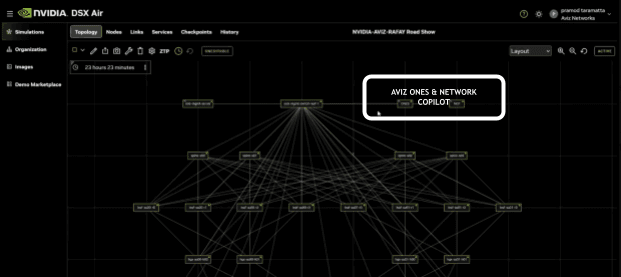
Traditional network validation environments are not enough for this new model. A static lab can validate configuration syntax. A physical staging environment can validate limited deployment scenarios. But AI factories need something more dynamic: an environment where design, deployment, operations, and troubleshooting can be exercised together. That is where DSX Air becomes powerful. DSX Air provides a high-fidelity simulated environment to demonstrate and validate how AI networks behave across their lifecycle. It gives infrastructure, platform, and operations teams a shared sandbox where they can model network topologies, onboard devices, provision tenants, collect telemetry, simulate issues, and test AI-driven workflows before those workflows reach production.
 Aviz ONES and Network Copilot" />
AI Fabric Bring-Up Is Table Stakes. ONES Delivers It
The first challenge in any AI network is getting the fabric built correctly. AI fabrics are not simple Layer-2/Layer-3 networks. They require careful coordination across topology, cabling, routing, RoCE, telemetry, and tenant segmentation. Small errors in Day-0 configuration can lead to serious Day-N problems such as congestion, packet drops, GPU underutilization, or unstable application performance.
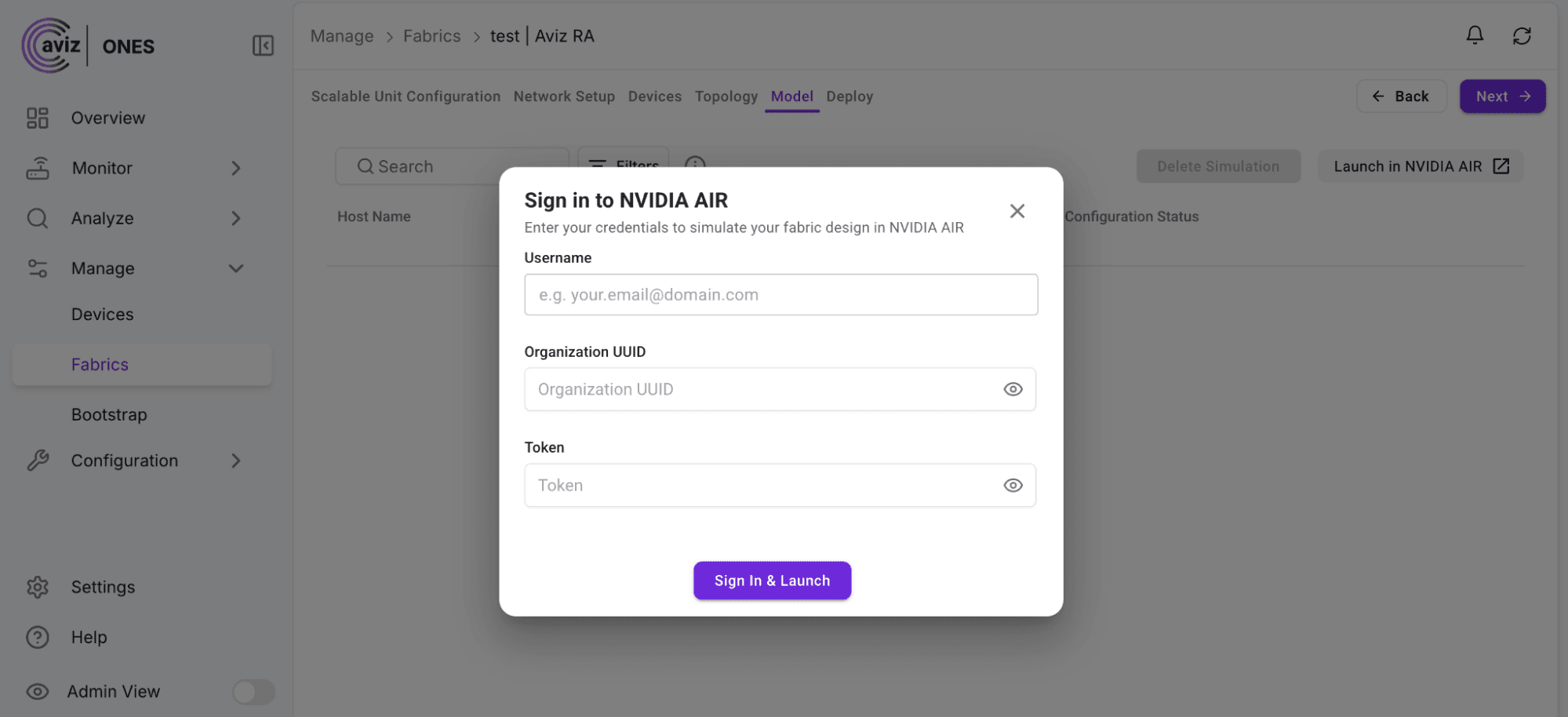
Aviz ONES, a member of the NVIDIA Inception program, addresses this by acting as the network operations and orchestration layer for AI fabrics. In the DSX Air environment, ONES can be used to demonstrate:
- AI fabric topology onboarding
- Day-0 device discovery and inventory
- Blueprint-driven fabric provisioning
- Switch configuration generation and deployment
- BGP/EVPN/VXLAN or fabric underlay setup
- Adaptive routing and QoS
- Tenant-aware network segmentation
This turns Day-0 from a manual, CLI-heavy process into a controlled, repeatable workflow. The key value is not just automation. It is validated automation. Teams can test the bring-up workflow in DSX Air, refine the blueprint, validate the operational state, and then use the same model as the foundation for production deployment.
AI NOC Is the Day-N Differentiator. Network Copilot Is Built for It
Once the network is deployed, the operational challenges begin. AI networks generate a large amount of operational data: interface counters, drops, discards, ECN marks, queue utilization, optics telemetry, routing state, device health, GPU/NIC metrics, tenant mappings, workload placement and alerts. The problem is not lack of data. The problem is turning that data into action. This is where Network Copilot becomes the AI NOC layer.
Network Copilot can sit on top of ONES and other operational data sources to help network teams ask questions, investigate issues, correlate events, and generate recommendations using natural language.
In DSX Air, Network Copilot can be demonstrated as an AI-assisted NOC tool for:
- Tenant management
- Fabric health queries with summarization
- Packet drop and congestion investigation
- Event correlation across switches, links, tenants, and workloads
- Configuration audit and drift detection
- Root-cause analysis workflows
- Change-impact analysis
- Executive and operator-level reporting
Instead of forcing operators to juggle multiple dashboards, logs, CLI sessions, and ticketing systems, Network Copilot provides a conversational and agentic interface for understanding what is happening in the network.
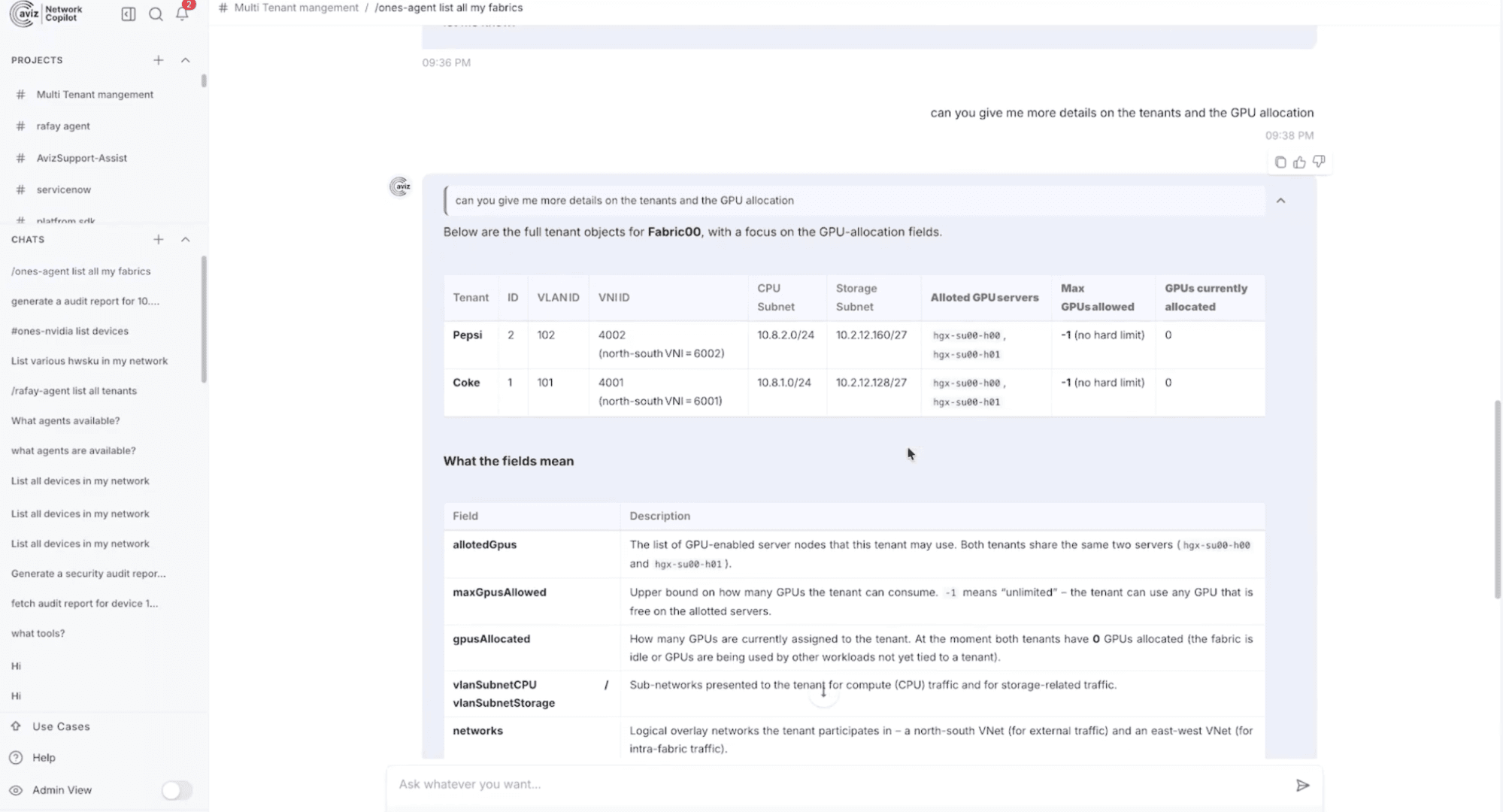
Example Workflow: From Tenant Creation to AI-Assisted Operations
A typical DSX Air demonstration can follow a complete lifecycle flow.
Step 1: Build the AI Fabric with ONES
The operator starts by using ONES to onboard the network topology in DSX Air. ONES discovers the devices, validates the topology, applies the required fabric blueprint, and brings up the underlay and overlay configuration.
At this stage, ONES handles the foundational Day-0 operations:
- Device onboarding
- Fabric configuration
- Interface validation
- Routing bring-up
- Telemetry enablement
- Policy deployment
The goal is to get the fabric into a known-good operational state.
Step 2: Create Tenants and Apply Network Segmentation
Next, Network Copilot is used to create tenants using APIs from ONES which then maps them to network constructs such as VRFs, VXLANs and VLANs. This is critical in AI factories because GPU infrastructure is increasingly shared across multiple teams, customers, or internal business units. Tenant isolation must be consistent, repeatable, and auditable.
ONES provides the operational control plane to define:
- Tenant identity
- Tenant network segments
- Tenant IP prefixes
- Tenant-to-tenant access policy
This makes tenant provisioning part of the network lifecycle instead of a one-off manual configuration task.
Step 3: Collect Telemetry Across the Fabric
Once the network and tenants are active, ONES begins collecting telemetry from the fabric. This includes key operational signals such as:
- Interface utilization
- Packet drops and discards
- Queue and buffer behavior
- Link health including optics power and temperature
- Tenant-level traffic visibility
- GPU/NIC-related infrastructure telemetry where integrated
This telemetry becomes the foundation for AI-assisted operations.
Step 4: Use Network Copilot for AI NOC Workflows
Network Copilot consumes the operational context from ONES and other data sources, allowing the operator to ask questions such as:
- “Can you show all the fabrics managed?”
- “Show me all the tenants and workload to GPU mapping.”
- “Show me the GPU utilization for the last 1 hour.”
- “Which interfaces are having high utilization?”
- “Give me a summary of all warning and critical alerts in the past 24 hours.”
- “Are there any anomalies in the transceiver temperature and power?”
- “Generate a health report for the last 24 hours.”
This is the shift from dashboard-driven operations to intent-driven operations. The operator no longer needs to know exactly where the data lives. Network Copilot helps gather the relevant evidence, correlate signals, summarize findings, and recommend next steps.
Why This Is Important for AI Factories
AI factories are measured by how efficiently they turn infrastructure into AI output. That means GPU utilization, job completion time, tenant fairness, network reliability, and operational speed all matter. A poorly operated network can silently reduce the return on GPU investment. Congestion, misconfiguration, poor isolation, or slow troubleshooting can leave expensive accelerators waiting on the network. By combining ONES and Network Copilot in DSX Air, customers can validate a better operating model before production:
- Bring up fabrics faster
- Standardize tenant provisioning
- Reduce manual configuration errors
- Improve telemetry visibility
- Correlate data across multiple domains
- Give NOC teams an AI assistant for investigation and reporting
- Build confidence before deploying into physical AI infrastructure
This is not just network automation. It is the foundation for AI-native network operations.
The Bigger Shift: From NOC Automation to AI NOC
The industry has spent years automating network configuration. That was necessary, but it is no longer enough. AI infrastructure needs networks that can be designed, deployed, observed, and operated with intelligence. The next step is not just pushing configs faster. It is understanding the relationship between network state, workload behavior, tenant policy, and infrastructure health.
That is the value of combining:
- DSX Air as the digital twin and validation environment
- Aviz ONES as the Day-0 through Day-N network operations platform
- Network Copilot as the AI NOC and reasoning layer
Together, they create a practical path for customers to operationalize AI networks before they deploy them in production.
Conclusion
AI factories need more than high-speed switches and GPUs. They need an operating model that can keep up with the speed, scale, and complexity of AI workloads. With ONES and Network Copilot running in DSX Air, customers can experience that operating model early. They can bring up AI fabrics, create tenants, collect telemetry, forecast issues, correlate events, and use AI-assisted workflows to operate the network with greater speed and confidence.
Design the AI network. Validate it. Operate it. Improve it continuously.
That is how Aviz ONES and Network Copilot help turn AI infrastructure into an AI-ready, operations-ready fabric.
Frequently Asked Questions
Q1. What is NVIDIA DSX Air and why does it matter for AI network operations?
NVIDIA DSX Air is a software platform for real-time AI processing on edge devices. It is designed to deliver high-performance AI inferencing and analytics capabilities at the edge of the network, where data is generated and where rapid decision making is often critical. NVIDIA DSX Air is a sophisticated digital twin platform that models AI network hardware in a virtual setting prior to actual installation. This is significant because AI factories integrate the front-end networks, the back-end GPU-to-GPU interconnects, and the separation of tenants, all with telemetry spanning GPUs, DPUs, NICs, switches, and optics. Such intricacy can't be verified in a fixed laboratory or a simplified physical simulation environment. DSX Air provides the network infrastructure and operations teams with a collaborative virtual environment where they can construct network topologies, add devices, assign tenants, and simulate AI-based workflows covering all stages of the network life cycle.
Q2. What methods does Aviz ONES use to speed up the Day-0 deployment of AI fabric?
Aviz ONES is the network operations and orchestration platform for AI fabrics. Converts a once manual, CLI-intensive deployment into a verified, repeatable automation. ONES manages the initial setup of the fabric topology (AI fabric topology onboarding), Day-0 discovery and inventory of the devices, provisioning based on the blueprint, creation of switch configurations, the setup of the BGP/EVPN/VXLAN underlay, adaptive routing, Quality of Service (QoS) and tenant-aware segmentation. Teams are able to simulate the full bring-up process within DSX Air, optimize the blueprint, confirm the working condition, and subsequently deploy the same blueprint in the production environment.
Q3. What is Network Copilot and how does it enable an AI NOC?
Network Copilot is a technology or system designed to facilitate the operation of an AI Network Operations Center (NOC). An AI NOC is an automated or AI-enhanced network management center that monitors, manages and optimizes network resources, performance and security. Network Copilot provides the necessary integrations and interfaces to a modern NOC and the underlying network infrastructure, enabling the automation, AI/ML-powered analysis and decision making, and, potentially, the orchestration of network tasks and services. Network Copilot is an AI-powered Network Operations Center (NOC) overlay designed to operate over Aviz ONES and other operational data feeds. Operators can query the system using everyday language examples include "list all tenants and how they're mapped to the GPU" or "are transceiver temperatures anomalous". Operators get all the correlated responses summaries and suggestions they need without switching between dashboards or CLI sessions. Network Copilot facilitates fabric status inquiries, packet loss diagnostics, event relationship analysis, detection of configuration deviations, identification of the root cause, evaluation of modification consequences, and high-level reporting.
Q4. How do Aviz ONES and Network Copilot approach the onboarding of tenants in a multi-tenant AI platform?
Segregation of tenants is essential in AI data centers as GPU resources are becoming more and more common being accessed by multiple teams customers or internal business units. Network Copilot uses APIs from ONES to create tenants and link these tenants to network objects such as VRFs VXLANs and VLANs. ONES provides the Operational Control Plane for defining the entity of the tenant, the segment of the tenant network, the prefixes of the tenant-IP, and the policy of the tenant-to-tenant access. Standardizes and automates tenant provisioning as a repeatable and documentable process during the network lifecycle removing the requirement for a one off manual configuration.
Q5. What telemetry data does Aviz ONES gather at the AI fabric level?
Once the fabric and tenants are up and running Aviz ONES collects the necessary operational metrics from the fabric. This encompasses interface performance, dropping and discarding of packets, performance of queues and buffers, status of links including optical power and temperature, traffic visibility at the tenant level, and any integrated GPU or NIC system telemetry. It forms the basis of AI-enhanced management and provides the data to Network Copilot for traffic prediction, anomaly detection, and cross-switch, cross-link, cross-tenant, cross-workload analysis.
Q6. What is the significance of moving from NOC automation to AI NOC for AI factories?
How successful an AI factory is is measured by how much input is turned into AI output. ROI is directly influenced by the utilization of the GPU the time it takes for a job to be completed the fairness among tenants and the robustness of the network. Traditional NOC automation focused on faster provisioning of configurations but AI powered networks require networks that are designed deployed monitored and operated intelligently Utilizing DSX Air in conjunction with Aviz ONES as the Day-0 to Day-N operational platform and Network Copilot as the AI reasoning layer establishes an operational paradigm enabling teams to accelerate the deployment of fabrics to provision tenants uniformly lower configuration errors enhance the telemetry coverage and visibility to NOC teams and /or provide NOC teams an AI assistant for troubleshooting and reporting
See how Aviz ONES and Network Copilot work together inside NVIDIA DSX Air to validate AI fabrics before they hit production.


