





Aviz Service Nodes Now Support NVIDIA ConnectX NIC for High-Speed Network Intelligence
 December 16, 2025
 Deep Network Observability

Summary
Aviz Service Nodes now support NVIDIA ConnectX NICs, extending beyond x86-only compatibility to deliver DPDK-accelerated, high-throughput packet processing. This enables line-rate 100 GbE and above performance, seamless multi-vendor deployment, and AI-ready observability without proprietary hardware lock-in. The result is a flexible and future-ready platform for telco, data center, and edge environments.
Introduction
Modern networks across telco cores, enterprise data centers, and edge sites must handle increasing traffic volumes and AI-driven workloads. High-speed packet intelligence is no longer optional. Aviz Service Nodes provide a software-defined approach to traffic analytics, application identification, and AI-powered insights on commodity servers.
With the latest release, Aviz Service Nodes introduce support for NVIDIA ConnectX NICs. Building on existing x86 platform compatibility, this enhancement enables higher throughput, lower latency, and scalable observability. From 4G and 5G traffic correlation to real-time flow analysis, Aviz Service Nodes with ConnectX help operators modernize network visibility without disruption.
What Makes Aviz Service Nodes Hardware Support Different?
Aviz Service Nodes follow a modular, hardware-agnostic design that now includes NVIDIA ConnectX support using DPDK for accelerated packet processing.
Key Differentiators
Aviz Service Nodes deploy on commodity servers from vendors such as Dell, Cisco,
SuperMicro, and Wistron.
They leverage ConnectX hardware offloads to achieve 100 GbE and higher
throughput.
They support advanced capabilities such as GTP correlation, subscriber-aware metadata,
application identification, and packet deduplication without vendor-specific dependencies.
When paired with Network Copilot, Aviz Service Nodes enable conversational AI insights, making them suitable for AI-ready and dynamic networks.
What Is Hardware Compatibility in Aviz Service Nodes?
Hardware compatibility in Aviz Service Nodes allows deployment on x86 servers with high-performance NICs such as NVIDIA ConnectX. DPDK is used to ensure efficient packet processing across telco, data center, and edge use cases.
Key Highlights
New support for NVIDIA ConnectX enables hardware-accelerated packet processing.
Cost efficiency is achieved by eliminating proprietary appliances, delivering more than fifty percent TCO
savings while allowing flexible hardware upgrades.
This open approach allows scaling without costly redesigns or vendor lock-in.
How Aviz Service Nodes Work with NVIDIA ConnectX
Aviz Service Nodes use DPDK with NVIDIA ConnectX to offload packet processing to NIC hardware. This ensures wire-speed performance for deep packet inspection, GTP load balancing, and flow distribution.
Step by Step Workflow
- Deployment Setup: Aviz Service Nodes are installed on x86 servers equipped with NVIDIA ConnectX NICs and integrate with existing infrastructure.
- DPDK Initialization: DPDK poll-mode drivers are initialized to access ConnectX high-speed queues.
- Packet Processing: Traffic is captured and processed at speeds exceeding 100 GbE, integrating seamlessly with packet brokers.
- Traffic Intelligence: Capabilities include application identification across more than two thousand applications, subscriber correlation, and GTP-aware load balancing.
- AI Integration: Processed insights are fed into Network Copilot for real-time queries, anomaly detection, and trend analysis.
This workflow ensures both high performance and easy adoption across diverse environments.
Exclusive Feature with NVIDIA ConnectX: VXLAN Header Stripping
Aviz Service Nodes introduce hardware-accelerated VXLAN header stripping through NVIDIA ConnectX. This capability is not available on Intel E810 NICs.
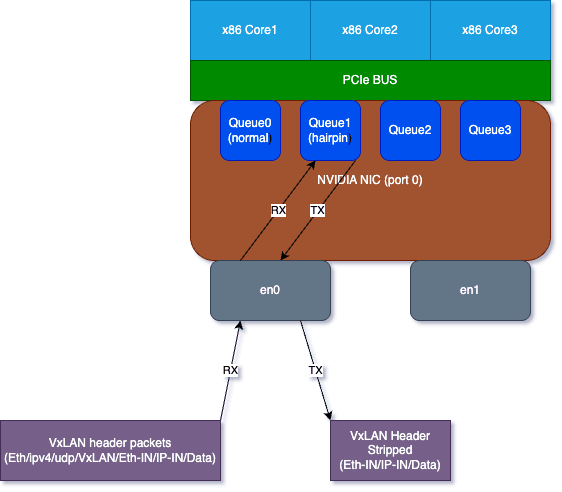
This feature allows ASN to offload the removal of fifty-byte VXLAN headers including Ethernet, IP, UDP, and VXLAN directly to ConnectX hardware engines. Configuration is handled through the ASN user interface.
Why This Matters
Hardware-based stripping achieves line-rate performance up to 200 Gbps with near-zero
CPU usage and sub-microsecond latency.
Software-based stripping on x86 cores requires significant resources,
with a single core handling only nine Gbps and requiring approximately twenty cores to match ConnectX
performance.
This capability enables operators to handle large-scale network overlays efficiently while improving deep traffic visibility and reducing operational costs.
Conclusion
With NVIDIA ConnectX support, Aviz Service Nodes unlock high-speed, AI-ready network intelligence on flexible, commodity hardware. This release reinforces Aviz’s commitment to open and scalable networking across telco, data center, and edge deployments.
By combining ConnectX hardware acceleration with Network Copilot AI insights, Aviz Service Nodes convert complex traffic challenges into actionable and cost-efficient solutions. The future of observability is open, fast, and built for modern networks.
Frequently Asked Questions
What does NVIDIA ConnectX NIC support add to Aviz Service Nodes?
ConnectX support adds hardware-accelerated packet processing using DPDK, enabling 100 GbE and above throughput. Previously Aviz Service Nodes ran on x86 servers only. ConnectX extends that to deliver higher throughput, lower latency, and scalable observability without switching to proprietary appliances. GTP correlation, subscriber-aware metadata, application identification, and packet deduplication all continue working on the same commodity server hardware.
How does DPDK work with NVIDIA ConnectX to achieve wire-speed packet processing?
DPDK poll-mode drivers initialise to access ConnectX high-speed queues directly, bypassing the standard kernel networking stack. Traffic gets captured and processed at speeds exceeding 100 GbE and flows directly into deep packet inspection, GTP load balancing, and flow distribution without software bottlenecks on the CPU slowing things down.
What is VXLAN header stripping on ConnectX and why does it matter?
VXLAN header stripping offloads removal of 50-byte VXLAN headers including Ethernet, IP, UDP, and VXLAN directly to ConnectX hardware engines. Hardware-based stripping hits line-rate performance up to 200 Gbps with near-zero CPU usage and sub-microsecond latency. Software-based stripping on x86 cores can only handle about 9 Gbps per core and needs roughly 20 cores to match what ConnectX does in hardware. This feature is not available on Intel E810 NICs.
What commodity server vendors does Aviz Service Node support for ConnectX deployments?
Aviz Service Nodes deploy on commodity servers from Dell, Cisco, SuperMicro, and Wistron. The hardware-agnostic design means teams use the infrastructure they already have or pick what fits their budget rather than buying proprietary appliances. More than 50 percent TCO savings comes from eliminating those appliances while keeping the same observability capabilities running on standard server hardware.
How does Network Copilot connect to Aviz Service Nodes running on ConnectX hardware?
Processed traffic insights from Aviz Service Nodes feed directly into Network Copilot for real-time queries, anomaly detection, and trend analysis. The combination turns raw packet intelligence into conversational AI insights so operators ask questions about network behaviour in plain language rather than digging through raw data. ConnectX provides the speed and Network Copilot provides the intelligence layer on top of it.
Why does software-based VXLAN header stripping on CPU cores become a bottleneck at scale?
A single x86 core handles only about 9 Gbps of VXLAN header stripping. To match what ConnectX hardware does in a single device, you need roughly 20 CPU cores dedicated to that one task. In a high-throughput environment those 20 cores are not available for anything else. Hardware offload to ConnectX frees those resources entirely while delivering 200 Gbps at sub-microsecond latency that software cannot get close to.
How does ConnectX support help telco operators with 4G and 5G traffic correlation at scale?
4G and 5G traffic correlation requires processing GTP tunnels at high speed to link control plane and user plane sessions for subscriber-aware analytics. ConnectX hardware acceleration handles that traffic at line rate without the CPU becoming the limiting factor as traffic volumes grow. Operators get GTP-aware load balancing and subscriber correlation across large traffic volumes without needing dedicated proprietary appliances to keep up with the throughput.
How does the hardware-agnostic design of Aviz Service Nodes protect against vendor lock-in?
The modular design supports x86 servers from multiple vendors and now NVIDIA ConnectX NICs without tying the software capabilities to any single hardware platform. Teams upgrade hardware independently as performance requirements grow without rebuilding the observability stack. No proprietary appliances, no vendor-specific dependencies, and no need for costly redesigns when the network scales or technology changes.
Want to see Aviz Service Nodes with NVIDIA ConnectX in action?
Reach out to the Aviz team for a
quick demo.
Learn More
Contact us


