





How Does Aviz Packet Broker Enable Software-Defined Network Visibility for Modern Infrastructure?
 April 20, 2026
 Deep Network Observability

TL;DR
Aviz Packet Broker (APB) replaces rigid, appliance-based packet brokers with a software-defined approach built on SONiC. It enables scalable, cost-efficient, and flexible network visibility across data center, cloud, and edge environments.
Introduction
Network Packet Brokers have long been a foundational component of enterprise and service provider infrastructures. However, traditional solutions are appliance-based, proprietary, and costly, limiting flexibility and scalability in modern environments.
With the rise of application-driven networking, overlay architectures such as VXLAN and GRE, and high-speed data flows across hybrid environments, organizations require a more agile and cost-effective approach to network visibility.
Aviz Packet Broker (APB) addresses this shift by delivering a software-defined packet broker built on SONiC, running on industry-standard white box switches. This enables enhanced visibility, intelligent traffic distribution, and reduced vendor dependency.
Why do traditional packet brokers fall short in modern environments?
Traditional packet brokers are rigid, expensive, and lack visibility into modern overlay networks.
Legacy solutions are built on proprietary hardware, which limits flexibility and creates vendor lock-in. They also struggle with modern traffic patterns such as VXLAN and GRE, while inefficient traffic distribution leads to tool overload or underutilization.
Checklist:
- Rigid, proprietary hardware
- High CapEx and OpEx
- Limited overlay visibility
- Inefficient traffic distribution
How does Aviz Packet Broker solve these challenges?
Aviz Packet Broker delivers a software-first, disaggregated approach that runs on SONiC-based white box switches.
APB transforms standard switching hardware into a high-performance network visibility platform. It aggregates traffic from multiple environments, filters and optimizes it, and distributes it intelligently to monitoring and security tools.
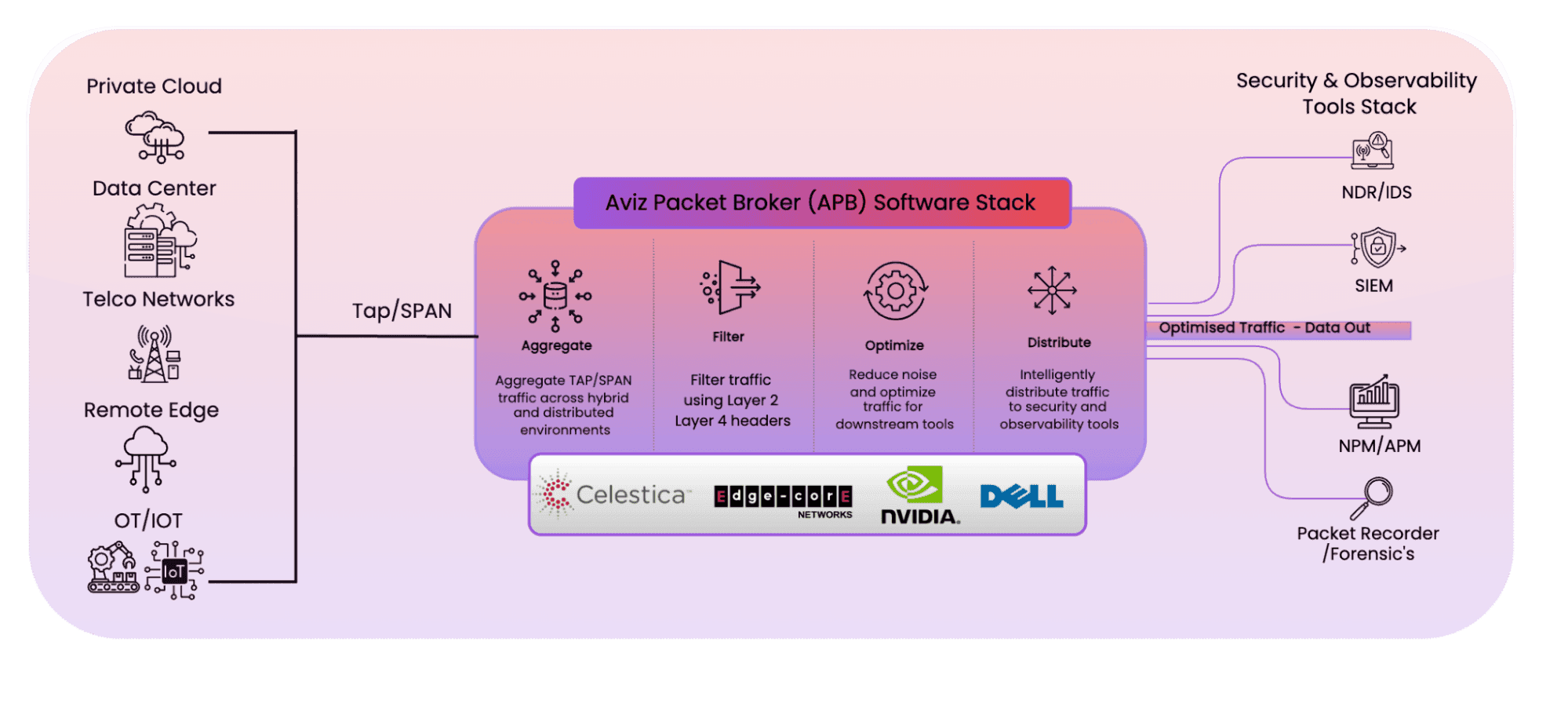
Framework:
- Runs on SONiC-based white box switches
- Aggregates traffic across data center, cloud, edge, and OT
- Filters traffic at Layer 2 to Layer 4
- Optimizes traffic by removing noise
- Distributes traffic intelligently
How does Aviz Packet Broker work?
APB operates as a software layer on white box switches, enabling a full traffic processing pipeline of aggregation, filtering, optimization, and distribution.
It collects traffic from TAPs, SPAN ports, and virtual sources, applies filtering, removes redundant data, and distributes optimized traffic using flow-aware load balancing. This transforms standard infrastructure into a scalable visibility platform.
Framework:
- Aggregate traffic from multiple sources
- Filter relevant traffic
- Optimize through deduplication and slicing
- Distribute using intelligent load balancing
What are the key capabilities of Aviz Packet Broker?
APB provides advanced traffic aggregation, filtering, optimization, distribution, overlay visibility, and security compliance.
It enables unified visibility across environments, deep inspection of overlay traffic, and secure operations aligned with compliance standards.
| Capability | Description |
|---|---|
| Traffic Aggregation | Consolidates TAP, SPAN, and virtual sources |
| Advanced Filtering | Layer 2 to Layer 4 filtering |
| Traffic Optimization | Packet slicing, truncation, noise reduction |
| Intelligent Distribution | Flow-aware load balancing |
| Overlay Visibility | VXLAN and GRE decapsulation |
| Security & Compliance | FIPS-aligned cryptographic enforcement |
What benefits does Aviz Packet Broker deliver?
APB delivers cost efficiency, flexibility, scalability, and simplified network visibility.
By eliminating proprietary appliances and enabling deployment on multiple platforms, APB reduces costs while supporting modern high-speed environments and simplifying operations.
| Benefit | Outcome |
|---|---|
| Cost Efficiency | Reduce infrastructure cost by up to 50%+ |
| Flexibility | Vendor choice across multiple platforms |
| Scalability | Supports 10GbE to 400GbE+ |
| Future-Ready | Supports cloud, AI/ML, and telecom |
| Simplified Visibility | Centralized control and intelligent distribution |
What platforms and use cases does APB support?
APB is supported across multiple SONiC-compatible platforms and addresses diverse network visibility use cases.
It runs on platforms from Celestica, Edgecore, Dell, and NVIDIA, and supports monitoring, security, observability, telecom, and deep packet inspection use cases.
Platform Support:
- Celestica
- Edgecore
- Dell
- NVIDIA
Use Cases:
- Network traffic monitoring and analysis
- Security tool integration and traffic distribution
- Data center and cloud observability
- 5G and telecom traffic visibility
- Deep Packet Inspection enablement
Are hardware packet brokers still necessary?
Traditional packet brokers are no longer sufficient for modern infrastructure needs. APB replaces appliance-based models with a software-defined approach that delivers greater flexibility, scalability, and cost efficiency while supporting modern traffic patterns.
What is the key takeaway from Aviz Packet Broker?
APB transforms white box switches into a powerful packet broker, enabling scalable visibility, efficient traffic processing, and reduced operational complexity. It provides a modern alternative to proprietary systems while supporting evolving infrastructure demands.
What does the future of network visibility look like?
Software-defined visibility platforms like APB will play a critical role in supporting cloud, AI/ML, and telecom environments. As traffic complexity increases, organizations will require flexible, high-performance solutions that eliminate vendor lock-in and scale efficiently.
Conclusion
Aviz Packet Broker (APB) delivers a modern, software-defined approach to network visibility.
- Replaces proprietary packet brokers with flexible software
- Enables deep visibility into overlay traffic
- Optimizes and distributes traffic efficiently
- Reduces cost and operational complexity
- Supports modern hybrid and high-speed environments
Frequently Asked Questions
1. Why do traditional packet brokers fail in modern network environments?
Traditional packet brokers rely on rigid proprietary hardware, incur high CapEx and OpEx, create vendor lock-in, and lack visibility into modern overlay traffic such as VXLAN and GRE, leading to inefficient traffic distribution.
2. How does Aviz Packet Broker differ from appliance-based packet brokers?
APB replaces proprietary appliances with a disaggregated, software-first model that runs on SONiC-based white box switches, enabling greater flexibility, scalability, and reduced dependency on single vendors.
3. How does Aviz Packet Broker process network traffic?
APB aggregates traffic from TAPs, SPAN ports, and virtual sources, applies Layer 2 to Layer 4 filtering, removes redundant data through optimization techniques, and distributes traffic using flow-aware load balancing.
4. What visibility challenges does Aviz Packet Broker address?
APB addresses limited overlay visibility, inefficient traffic distribution, tool overload, and lack of scalability in hybrid and high-speed environments by providing unified, software-defined network visibility.
5. What key capabilities are provided by Aviz Packet Broker?
APB delivers traffic aggregation, advanced filtering, packet slicing and deduplication, intelligent distribution, VXLAN and GRE decapsulation, and FIPS-aligned security and compliance support.
6. What benefits do enterprises gain from deploying Aviz Packet Broker?
Organizations benefit from reduced infrastructure costs by up to 50%+, increased deployment flexibility, scalable performance from 10GbE to 400GbE+, simplified operations, and future-ready support for cloud and AI-driven workloads.
7. Which platforms support Aviz Packet Broker deployments?
APB runs on SONiC-compatible platforms from Celestica, Edgecore, Dell, and NVIDIA, enabling broad hardware choice and deployment flexibility.
8. What use cases are supported by Aviz Packet Broker?
Supported use cases include network traffic monitoring, security tool integration, data center and cloud observability, telecom and 5G traffic visibility, and deep packet inspection enablement.
9. Are hardware packet brokers still required for modern networks?
Hardware-based packet brokers are no longer sufficient for modern infrastructure, as software-defined platforms like APB deliver better scalability, flexibility, overlay visibility, and cost efficiency while supporting evolving traffic patterns.
10. How does Aviz Packet Broker support the future of network visibility?
Aviz Packet Broker enables a software-defined visibility model that supports cloud, AI/ML, telecom, and high-speed hybrid environments by eliminating vendor lock-in, scaling efficiently on white box switches, and handling increasing traffic complexity with intelligent processing and distribution.
Explore Aviz Packet Broker to simplify and scale your network visibility.


