





ASN-DPI VoIP Visibility Using SIP and RTP Metadata for Real-Time Call Quality and Troubleshooting
 February 5, 2026
 Deep Network Observability
Summary
Modern enterprise voice environments rely on SIP signaling and RTP media streams for real-time communication. Troubleshooting voice quality remains difficult due to limited protocol visibility. ASN-DPI addresses this by exporting deep SIP and RTP metadata, giving enterprises real-time insight into call negotiation, media behavior, and voice quality without exposing payloads or deploying endpoint agents.
Introduction
Real-time communication platforms are essential to enterprise productivity and customer engagement. Issues like call drops, one-way audio, jitter, and poor call clarity can quickly disrupt operations and user experience.
VoIP troubleshooting is challenging because SIP handles call setup while RTP carries media, and traditional monitoring tools lack protocol awareness. ASN-DPI solves this by exporting real-time SIP and RTP metadata, enabling teams to understand when issues occur and clearly identify why they happen.
Why SIP and RTP Metadata Is Critical for Enterprise VoIP Visibility
Flow-level monitoring and synthetic probes provide limited insight into VoIP behavior. Without protocol context, enterprises struggle to diagnose call quality and signaling failures.
Enterprises need visibility into
- Call setup success and failure reasons
- Codec negotiation and compatibility
- Media path symmetry for uplink and downlink
- Root causes of jitter, packet loss, and reordering
- Impact of firewall, NAT, and SBC policies on RTP flows
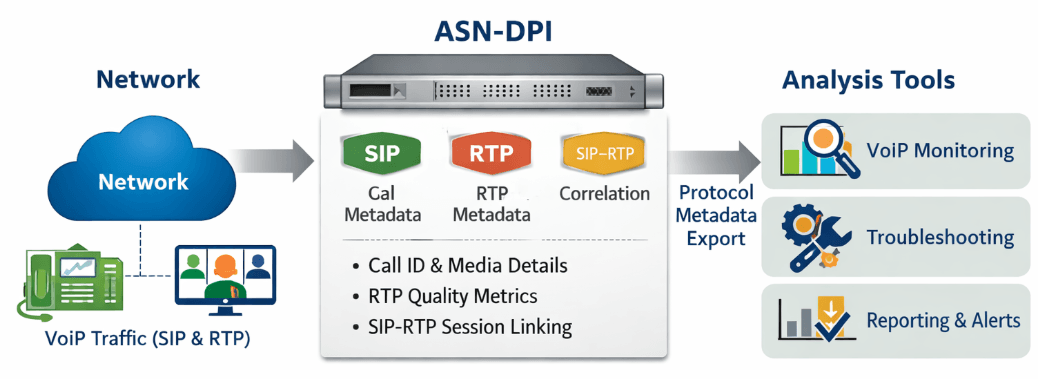
ASN-DPI addresses these needs by extracting and correlating SIP and RTP metadata without exposing voice payloads.
SIP Metadata Export for Call Setup and Negotiation Visibility
Rather than exporting raw packets or full signaling payloads, ASN-DPI extracts essential SIP and SDP metadata fields that describe call negotiation and expected media behavior.
For each SIP session, ASN-DPI provides visibility into
- SIP Call ID for end-to-end call tracking
- Traffic direction for uplink and downlink flows
- Media count negotiated in SDP
- Media type including audio and video
- Media transport protocol such as RTP AVP
- Media IP address and port extracted from SDP
- Number of supported formats offered
- Media payload formats identifying codecs such as G.711 and comfort noise
This metadata enables validation of codec negotiation, detection of misconfigurations, and rapid identification of issues involving firewalls, NAT, SBCs, and UC platforms.
RTP Metadata Export for Real-Time Voice Quality Analysis
While SIP defines call setup, RTP metadata reflects actual media delivery and voice quality during the call.
For each RTP stream, ASN-DPI exports
- SIP-RTP session correlation ID linking media to the call
- RTP session identifiers for sender and receiver
- Media type for audio and video streams
- Codec or encoding name used during the call
- Clock rate and channel count
- RTP sequence numbers and timestamps
- Expected versus actual packet interval
ASN-DPI continuously computes RTP quality metrics, including
- Packet loss impacting call clarity
- Jitter measured in milliseconds affecting audio smoothness
- Out-of-order packets caused by network reordering
- Duplicate packets indicating retransmissions or anomalies
These metrics help determine whether voice issues are caused by congestion, WAN instability, QoS misconfiguration, or infrastructure faults.
SIP and RTP Correlation for End-to-End Call Visibility
The key strength of ASN-DPI lies in correlating SIP signaling and RTP media streams using a shared session identifier.
This correlation provides
- Full call lifecycle visibility
- Faster and more accurate root cause analysis
- Clear separation of signaling versus media issues
- Agentless voice quality monitoring across the network
By linking call intent with media performance, ASN-DPI delivers comprehensive VoIP visibility across enterprise environments.
Enterprise Benefits of Metadata-Driven VoIP Monitoring
ASN-DPI enables enterprises to
- Monitor VoIP traffic in real time
- Proactively troubleshoot poor call quality
- Validate firewall, NAT, and SBC behavior
- Improve user experience without endpoint agents
- Gain protocol-level insight using metadata only
This approach transforms VoIP troubleshooting from reactive investigation to proactive operations.
Conclusion
Enterprise voice environments need deep protocol visibility, fast troubleshooting, and clear signaling to media correlation. ASN-DPI delivers this by exporting rich SIP and RTP metadata that turns VoIP traffic into actionable intelligence without exposing payloads or deploying agents.
With ASN-DPI, enterprises can observe call behavior, identify impairments, and consistently deliver high-quality voice experiences.
Frequently Asked Questions
How does Aviz Service Node give visibility into encrypted traffic without decrypting it?
Instead of opening the payload, ASN extracts metadata from the packet headers and handshakes. Over 95 percent of internet traffic is encrypted today so traditional monitoring just sees tunnel endpoints and byte counts. ASN pulls over 100 metadata fields from protocols like HTTP, DNS, TLS, QUIC, DHCP, and SIP RTP to show what applications are doing without ever touching what is inside.
What does DNS metadata from ASN actually tell operations teams?
DNS metadata shows queried domain names, record types, response codes like NXDOMAIN, returned IP addresses, TTL values, and unusual query patterns. That is enough to catch DNS misconfigurations, failed resolutions, and anomalous query behaviour that would otherwise look like a generic application problem until someone spent an hour correlating logs across multiple systems.
How does TLS metadata help with security without breaking encryption?
TLS handshake metadata gives teams the Server Name Indication, certificate details, TLS version, cipher suites, and JA3 and JA4 client fingerprints. Weak ciphers, deprecated TLS versions, and strange client behaviour all show up in the handshake data before any payload gets involved. Security detection shifts from matching known malware signatures to spotting behavioural anomalies instead.
What HTTP metadata does ASN extract and how does it speed up troubleshooting?
ASN pulls hostnames, URL paths, HTTP methods, user agent strings, response status codes, content types, and server software. When a user reports a slow or broken application, teams can immediately see whether the problem is a client-side error, a backend failure, or something tied to a specific user agent. No more correlating five different log sources to get that answer.
How does ASN help meet compliance requirements without storing actual payload data?
Regulatory frameworks need proof of encryption standards, service access patterns, and client interactions. Metadata gives structured queryable records that satisfy those requirements without exposing payload content or creating privacy risk. Compliance evidence moves from packet dumps with PII concerns to clean metadata logs that show what happened without showing what was said.
Why does ASN use a modular event-driven architecture instead of a single monolithic parser?
Separate protocol handlers with event callbacks mean adding support for a new protocol does not require rebuilding the whole engine. Each handler works independently, exports in a protocol-aware way, and gets updated without touching the others. As application ecosystems keep evolving and new protocols emerge, the platform adds them cleanly rather than accumulating technical debt in one big parser.
What visibility does ASN provide for QUIC traffic as apps move away from TCP?
QUIC metadata from ASN includes connection identifiers, version negotiation, transport parameters, flow control limits, client fingerprinting adapted for QUIC, and performance indicators like ACK delays. Traditional packet capture went blind as applications migrated to QUIC. ASN keeps visibility intact across that transition without requiring any changes to how traffic is collected or where it flows.
How is selective metadata configuration through FlowVision useful in practice?
Not every team needs every metadata field from every protocol all the time. FlowVision lets operators export only the fields relevant to what they are monitoring, which cuts storage consumption, reduces processing overhead, and keeps analytics focused on what actually matters. Operational, security, and compliance teams each get the data they need without everyone drowning in fields they never use.
Explore how Aviz Service Nodes power deep VoIP visibility and real time troubleshooting across modern networks.


