





ASN-DPI VoIP Visibility Using SIP and RTP Metadata for Real-Time Call Quality and Troubleshooting
 February 11, 2026
 Deep Network Observability
Summary
Modern enterprise voice environments rely on SIP signaling and RTP media streams for real-time communication. Troubleshooting voice quality remains difficult due to limited protocol visibility. ASN-DPI addresses this by exporting deep SIP and RTP metadata, giving enterprises real-time insight into call negotiation, media behavior, and voice quality without exposing payloads or deploying endpoint agents.
Introduction
Real-time communication platforms are essential to enterprise productivity and customer engagement. Issues like call drops, one-way audio, jitter, and poor call clarity can quickly disrupt operations and user experience.
VoIP troubleshooting is challenging because SIP handles call setup while RTP carries media, and traditional monitoring tools lack protocol awareness. ASN-DPI solves this by exporting real-time SIP and RTP metadata, enabling teams to understand when issues occur and clearly identify why they happen.
Why SIP and RTP Metadata Is Critical for Enterprise VoIP Visibility
Flow-level monitoring and synthetic probes provide limited insight into VoIP behavior. Without protocol context, enterprises struggle to diagnose call quality and signaling failures.
Enterprises need visibility into
- Call setup success and failure reasons
- Codec negotiation and compatibility
- Media path symmetry for uplink and downlink
- Root causes of jitter, packet loss, and reordering
- Impact of firewall, NAT, and SBC policies on RTP flows
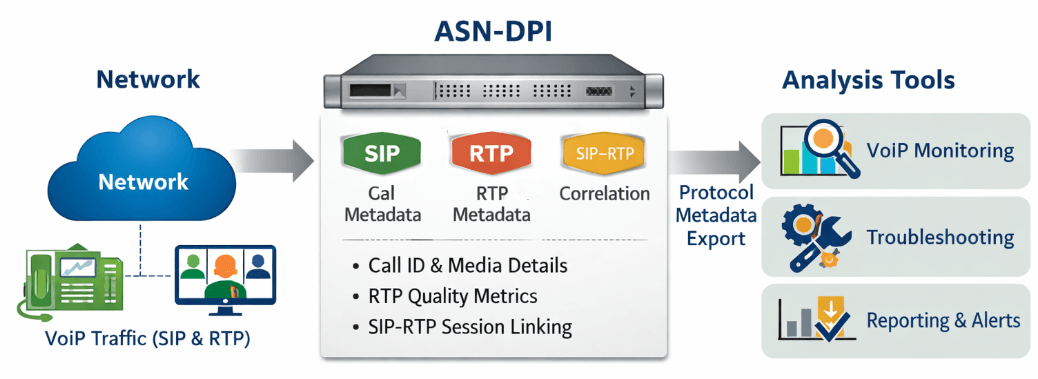
ASN-DPI addresses these needs by extracting and correlating SIP and RTP metadata without exposing voice payloads.
SIP Metadata Export for Call Setup and Negotiation Visibility
Rather than exporting raw packets or full signaling payloads, ASN-DPI extracts essential SIP and SDP metadata fields that describe call negotiation and expected media behavior.
For each SIP session, ASN-DPI provides visibility into
- SIP Call ID for end-to-end call tracking
- Traffic direction for uplink and downlink flows
- Media count negotiated in SDP
- Media type including audio and video
- Media transport protocol such as RTP AVP
- Media IP address and port extracted from SDP
- Number of supported formats offered
- Media payload formats identifying codecs such as G.711 and comfort noise
This metadata enables validation of codec negotiation, detection of misconfigurations, and rapid identification of issues involving firewalls, NAT, SBCs, and UC platforms.
RTP Metadata Export for Real-Time Voice Quality Analysis
While SIP defines call setup, RTP metadata reflects actual media delivery and voice quality during the call.
For each RTP stream, ASN-DPI exports
- SIP-RTP session correlation ID linking media to the call
- RTP session identifiers for sender and receiver
- Media type for audio and video streams
- Codec or encoding name used during the call
- Clock rate and channel count
- RTP sequence numbers and timestamps
- Expected versus actual packet interval
ASN-DPI continuously computes RTP quality metrics, including
- Packet loss impacting call clarity
- Jitter measured in milliseconds affecting audio smoothness
- Out-of-order packets caused by network reordering
- Duplicate packets indicating retransmissions or anomalies
These metrics help determine whether voice issues are caused by congestion, WAN instability, QoS misconfiguration, or infrastructure faults.
SIP and RTP Correlation for End-to-End Call Visibility
The key strength of ASN-DPI lies in correlating SIP signaling and RTP media streams using a shared session identifier.
This correlation provides
- Full call lifecycle visibility
- Faster and more accurate root cause analysis
- Clear separation of signaling versus media issues
- Agentless voice quality monitoring across the network
By linking call intent with media performance, ASN-DPI delivers comprehensive VoIP visibility across enterprise environments.
Enterprise Benefits of Metadata-Driven VoIP Monitoring
ASN-DPI enables enterprises to
- Monitor VoIP traffic in real time
- Proactively troubleshoot poor call quality
- Validate firewall, NAT, and SBC behavior
- Improve user experience without endpoint agents
- Gain protocol-level insight using metadata only
This approach transforms VoIP troubleshooting from reactive investigation to proactive operations.
Conclusion
Enterprise voice environments need deep protocol visibility, fast troubleshooting, and clear signaling to media correlation. ASN-DPI delivers this by exporting rich SIP and RTP metadata that turns VoIP traffic into actionable intelligence without exposing payloads or deploying agents.
With ASN-DPI, enterprises can observe call behavior, identify impairments, and consistently deliver high-quality voice experiences.
Frequently Asked Questions
Why is VoIP troubleshooting so hard without proper protocol visibility?
SIP handles call setup and RTP carries the actual media and they are two separate things. Traditional monitoring tools do not understand either protocol deeply so when a call drops or audio goes one-way, teams have no idea which layer broke or why. Flow-level monitoring and synthetic probes give a surface view but cannot explain codec mismatches, NAT failures, or jitter root causes.
What SIP metadata does ASN-DPI export for each call session?
For every SIP session ASN-DPI pulls the Call ID for end-to-end tracking, traffic direction, media count from SDP, media type, transport protocol, media IP and port, supported codec formats like G.711, and comfort noise identifiers. That information is enough to validate codec negotiation and spot misconfigurations involving firewalls, NAT, SBCs, and UC platforms without touching the actual call payload.
What RTP quality metrics does ASN-DPI measure during a live call?
Four metrics get computed continuously: packet loss which hits call clarity, jitter in milliseconds which affects audio smoothness, out-of-order packets from network reordering, and duplicate packets that point to retransmissions or anomalies. Together these tell teams whether a voice problem is coming from congestion, WAN instability, a QoS misconfiguration, or something deeper in the infrastructure.
How does ASN-DPI link SIP signaling data to RTP media streams?
A shared session identifier ties the SIP call record to its RTP streams. That correlation gives teams the full call lifecycle in one view, signaling on one side and actual media delivery on the other. Instead of debugging two separate data sources and guessing which one caused the problem, teams see exactly whether the issue was in call setup, in media delivery, or both.
Does ASN-DPI need agents installed on endpoints to monitor VoIP quality?
No agents needed anywhere. ASN-DPI works passively at the network level by extracting SIP and RTP metadata from traffic as it flows through. Voice payloads are never exposed. Teams get full call visibility, quality metrics, and signaling analysis without touching endpoints, installing software on phones or call servers, or changing anything about how the voice infrastructure is set up.
What enterprise VoIP problems can ASN-DPI actually help fix?
Call drops, one-way audio, jitter, poor call clarity, codec negotiation failures, and issues caused by firewall, NAT, and SBC policies blocking or mangling RTP flows. ASN-DPI gives teams real data on what went wrong during the call rather than a user complaint and a blank dashboard. Troubleshooting shifts from reactive guesswork to having the evidence already there when the ticket lands.
Why does monitoring VoIP at the metadata level work better than capturing full packets?
Full packet capture on voice traffic creates privacy concerns and compliance risk because call audio is in the payload. Metadata gives everything needed to diagnose quality and signaling problems without ever touching what was said. Codec, timing, sequence numbers, jitter, and loss data are all in the headers. The payload adds nothing useful to a troubleshooting workflow and creates serious risk carrying it.
How does SIP and RTP correlation change the speed of root cause analysis for voice issues?
Without correlation, teams check SIP logs in one tool and RTP stats in another and try to match them up manually for a call that happened hours ago. With a shared session ID tying both together, the full picture is right there the moment someone opens a ticket. Signaling issues and media issues show up in the same view and root cause analysis that used to take an hour takes minutes.
Explore how Aviz Service Nodes power deep VoIP visibility and real time troubleshooting across modern networks.


