





AI in Networking: Fundamentals, Automation, and Career Burnout Explained
 January 13, 2026
 Network Copilot ™
Introduction
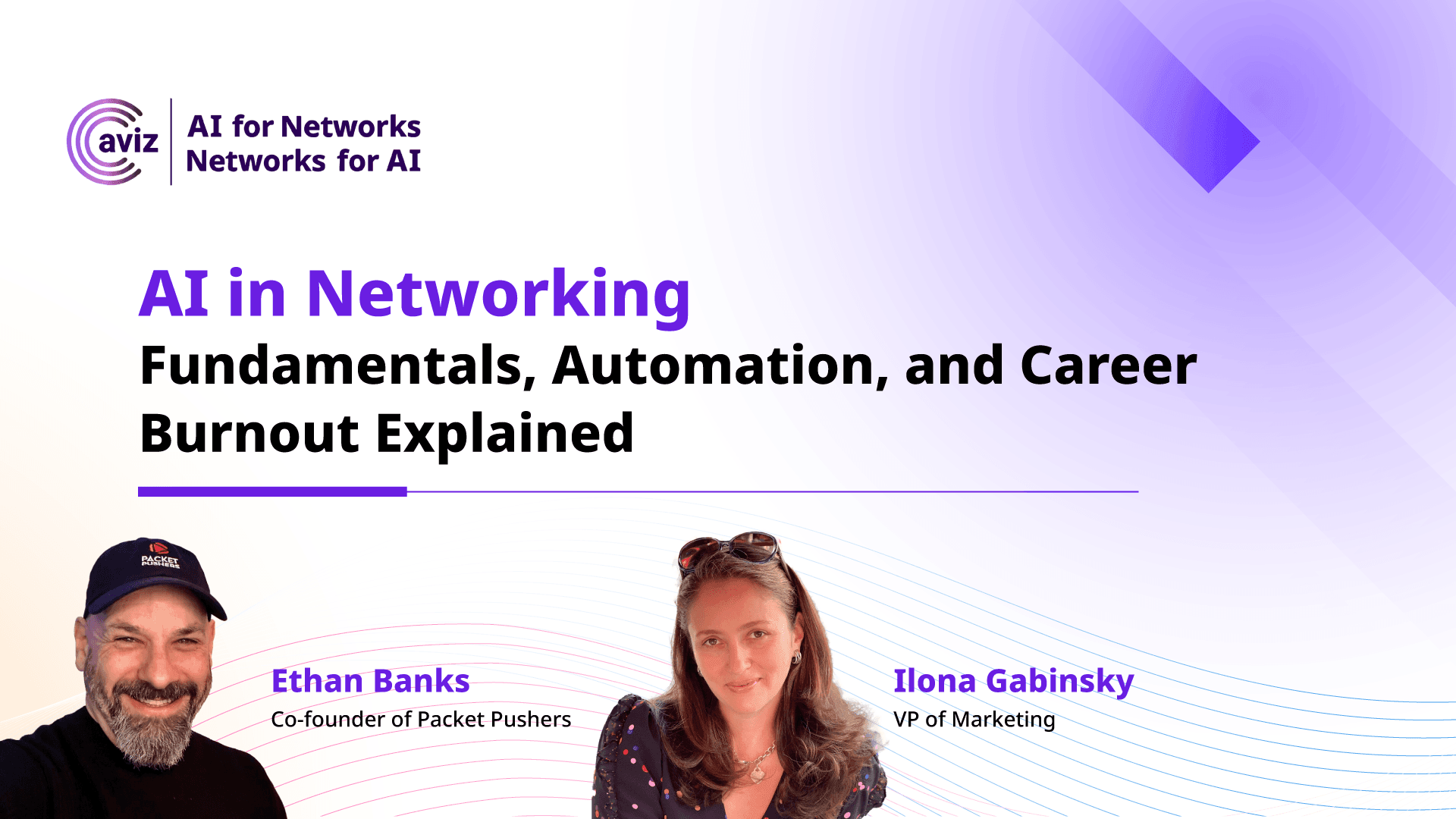
In this episode of the Aviz Podcast, Ilona Gabinsky, VP of Marketing at Aviz Networks, spoke with Ethan Banks, co-founder of Packet Pushers, about how networking careers evolved and where AI realistically fit into modern network operations.
Ethan Banks was a long-time voice in the networking community, widely known for his work in education, podcasting, and mentoring engineers across generations.
The discussion focused on how networking became more complex over time, why strong fundamentals still mattered, how automation should be applied thoughtfully, and how AI could support engineers without replacing them.
The episode also explored burnout, long career cycles, and practical ways engineers could sustain motivation and relevance throughout their careers.
What this episode was about
The conversation examined how networking had shifted from simple packet forwarding to layered systems involving overlays, automation, and large-scale fabrics. Ethan shared how younger engineers were often exposed to advanced technologies early, sometimes before fully understanding core fundamentals.
The discussion also addressed how AI and automation should support engineers by reducing repetitive work, improving troubleshooting, and helping teams focus on higher-value tasks.
Key insights from the conversation
- Networking became more complex, but fundamentals remained essential
- Skipping underlay and routing basics created long-term operational risk
- Automation without understanding workflows amplified failures
- Automation should follow process knowledge, not replace it
- AI in networking worked best as an assistant, not a replacement
- Every network was unique, limiting one-size-fits-all AI solutions
- AI could help with troubleshooting, documentation, and correlation
- Long tech careers often involved burnout and shifting priorities
- Technical expertise did not automatically translate to management skills
- Mentorship and community helped engineers navigate career growth
Why this episode mattered
- Provided a grounded view of AI beyond hype
- Reinforced the importance of networking fundamentals
- Highlighted risks of automation without understanding
- Addressed burnout and long-term career sustainability
- Offered realistic guidance for early and mid-career engineers
Conversations that Shape the Future
This episode delivered an honest perspective on networking careers, automation, and AI. By focusing on fundamentals, judgment, and mentorship, the conversation showed how engineers could adapt to change without losing sight of what truly mattered for long-term success.
Frequently Asked Questions
Why do networking fundamentals still matter even when so much gets automated today?
Younger engineers often jump straight into overlays, automation, and large-scale fabrics without learning the underlay and routing basics first. That works fine until something breaks. The engineer without fundamentals is stuck because the abstraction hiding the complexity cannot help them debug what is underneath it. Skipping the basics creates long-term operational risk that shows up at the worst possible moment.
What goes wrong when teams automate workflows they do not fully understand yet?
Automation without process knowledge does not save time. It makes failures happen faster and at larger scale. If an engineer cannot do the task manually and explain why each step matters, automating it just automates the wrong thing. The episode is direct that automation should follow process knowledge, not substitute for it.
How does AI fit into network operations without taking over from engineers?
AI works best as an assistant. It handles repetitive work, speeds up troubleshooting, helps with documentation, and correlates data faster than a person can. But every network is different so one-size-fits-all AI solutions hit real limits fast. Engineers bring the judgement that AI cannot replicate. That is what keeps the human in the loop rather than just watching the AI make decisions.
What day-to-day tasks can AI genuinely help network engineers with right now?
Three come up in the episode: troubleshooting by correlating signals across systems faster than manual investigation, documentation which most engineers skip because it is tedious, and event correlation across different parts of the network. These are real time drains. AI handles the repetitive low-value version of each so engineers spend their time on the parts that actually need them.
How has networking changed from what it used to be and why does that create new risks?
Networking shifted from straightforward packet forwarding into layered systems with overlays, automation, and large-scale fabrics. Each wave added complexity on top of the last. Engineers who built a solid foundation at each step adapted. Those who skipped straight to the advanced layer without understanding what sits underneath run into problems that take much longer to diagnose and fix.
Why do long networking careers often hit burnout and what helps engineers get through it?
Long careers in networking come with constant pressure to stay relevant, shifting technologies, and the grind of keeping up with change across decades. Burnout is a real pattern the episode acknowledges. Mentorship and community are called out as practical ways to navigate it. Having people around who have been through similar phases matters more over a multi-decade career than any single technical skill.
Does being technically strong in networking automatically prepare someone for a management role?
No. The episode says this directly. Technical expertise and management skills are different things. Being very good at networking does not mean someone is equipped to manage people or run a team. Engineers who assume management is the natural next step because they are technically strong often find it is harder than expected and sometimes not the right move for them at all.
What is the most practical advice from the episode for engineers early or mid-career in networking?
Build the fundamentals properly before reaching for advanced layers. Understand any workflow before automating it. Treat AI as a tool rather than a replacement for judgement. Find mentors and stay connected to the community. And be honest about whether management is actually what you want rather than just the assumed next career move. The episode gives grounded honest guidance rather than generic advice that sounds good but means nothing in practice.
Watch the full episode
Explore Ethan Banks' thoughts on AI, automation, career longevity, and the future of networking in greater depth.


