





Aviz Deep Network Observability InterOP Report

Aviz Deep Network Observability InterOP Report
AI for Networks. Networks for AI.
Introduction
Modern networks are complex, interconnected, require scale, and are unforgiving of blind spots.
Without deep observability, costs escalate, threats move laterally undetected, performance bottlenecks emerge, and troubleshooting cycles consume valuable time, while east-west blind spots and compliance challenges persist.
The Aviz Deep Network Observability Interop is a multi-vendor initiative built for today’s AI-driven infrastructure, delivering flexible, scalable, and cost-effective solutions with private AI at the core. It demonstrates real-world integration and performance across diverse ecosystems, helping networks close visibility gaps, eliminate bottlenecks, and safeguard performance, security, and resilience.
This self-assessment from the Deep Network Observability InterOP event helps organizations benchmark their readiness for AI-native, multi-vendor observability.
Key Points
-
Purpose
Benchmark readiness for AI-native, multi-vendor observability solutions.
-
Coverage
Enterprise and telco use cases across varied deep network observability scenarios.
-
Technology
Aviz Open Packet Broker and service nodes.
-
AI Integration
Network Copilot™ for faster troubleshooting and stronger security posture.
Objective
This self-assessment from the Deep Network Observability InterOP event helps organizations benchmark their readiness for AI-native, multi-vendor observability. We evaluated enterprise and telco use cases, benchmarking performance across diverse scenarios using the Aviz Open Packet Broker, service nodes, and the Private AI solution Network Copilot™ to enhance troubleshooting efficiency and strengthen security posture.
Open Packet Broker (OPB)
Open Packet Broker (OPB) is a high-performance, white-box-based traffic management fabric capable of traffic filtering, replication, aggregation, slicing, labeling, and tunneling. It facilitates granular L2-L4 filtering and supports advanced functions such as GTP header parsing for 5G environments and symmetric load balancing.
Technology Ecosystem Partners
-
Packet Broker Integration with Switch Partners
Dell, NVIDIA, Celestica, Edgecore
-
Service Nodes Integration with Server Partners
Dell, Supermicro, NVIDIA DPU (BlueField), Cisco UCS
-
AI Insights Integration with AI Partner
NVIDIA
-
Test Partner
Spirent
Use Cases Tested
Topology
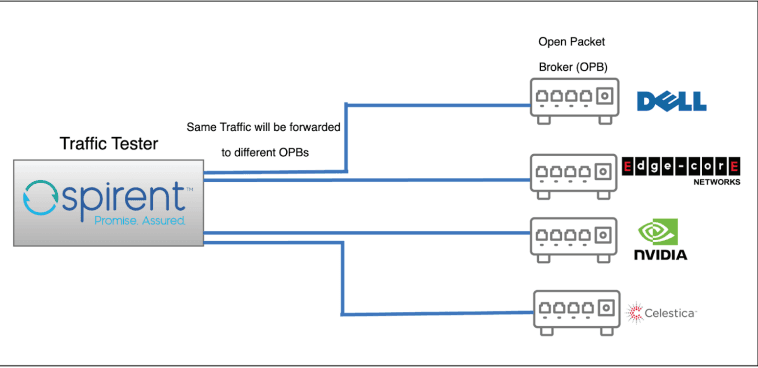
Spirent testers will simulate the use cases. The traffic will be forwarded to various Open Packet Brokers (OPBs) as depicted.
Functional Results
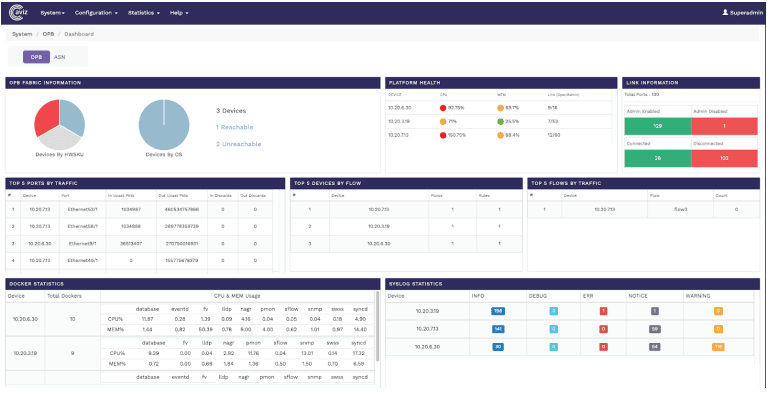
Simplified Management - Intuitive, Single Pane of Glass
Performance Tests & Results
This performance test validates that the Open Packet Broker processes traffic at 100 Gbps line rate across all tested use cases, with drop percentages as shown.
Note: All tests were conducted at a fixed line rate. As packet size increases, MPPS decreases because larger packets carry more data, so fewer packets are needed per second.
These results, measured on 100G ports, represent the maximum throughput achievable for different payload sizes under real-world network conditions.
VxLAN Header Stripping
Platform: Nvidia 4600C — Port Speed: 100G
| Packet Size | Tput | MPPS | Drop (%) |
|---|---|---|---|
| 128 bytes | 91.525 | 51.26 | 0.81 |
| 512 bytes | 96.774 | 20.161 | 0 |
| 1024 bytes | 98.233 | 11.042 | 0 |
ERSPAN Header Stripping
Platform: Nvidia 4600C — Port Speed: 100G
| Packet Size | Tput | MPPS | Drop (%) |
|---|---|---|---|
| 128 bytes | 91.525 | 51.26 | 0.81 |
| 512 bytes | 96.774 | 20.161 | 0 |
| 1024 bytes | 98.233 | 11.042 | 0 |
VxLAN Encapsulation
Platform: Nvidia 4600C — Port Speed: 100G
| Packet Size | Tput | MPPS | Drop (%) |
|---|---|---|---|
| 128 bytes | 74.23 | 40.09 | 1.2 |
| 512 bytes | 86.64 | 21.54 | 0 |
| 1024 bytes | 95.06 | 10.01 | 0 |
Aviz Service Node (ASN)
X86-based software appliances that perform deep packet inspection (DPI), metadata extraction, KPI generation, application identification, and deduplication.
-
Telco and Enterprise Support
ASN works for both Telco (4G-LTE, 5G-NSA, 5G-SA, CUPS) and Enterprise, providing Application and per-user/session visibility and reducing tool overhead by filtering out redundant packets.
Aviz Service Node Use Cases
Packet Deduplication
The objective of this test was to measure deduplication throughput under realistic traffic conditions. Traffic was generated by the Spirent Test Center and directed to the Open Packet Broker (OPB), where it was filtered to pass only relevant flows. The filtered traffic was then sent to the service node for duplicate packet removal before being forwarded to downstream analysis tools.
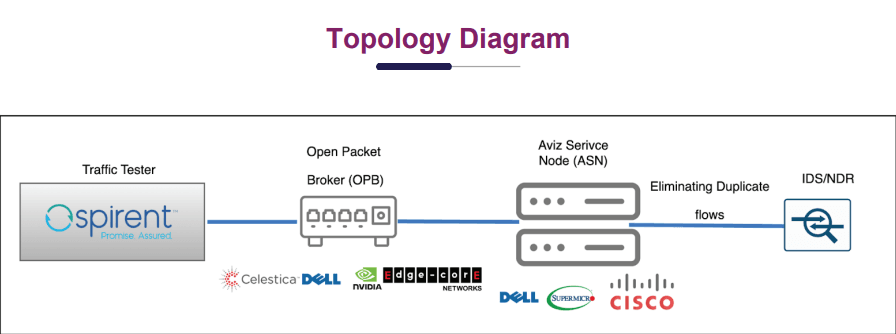
Deduplication performance is reported per processing core. The accompanying table highlights the correlation between CPU utilization and throughput, providing insight into efficiency and scalability under varying load conditions with different platforms.
| Use Case | Platform | IMIX Traffic Throughput Per Core |
|---|---|---|
| Deduplication | Dell, SuperMicro, Cisco UCS | 4G |
Deduplication CPU vs Throughput Trend
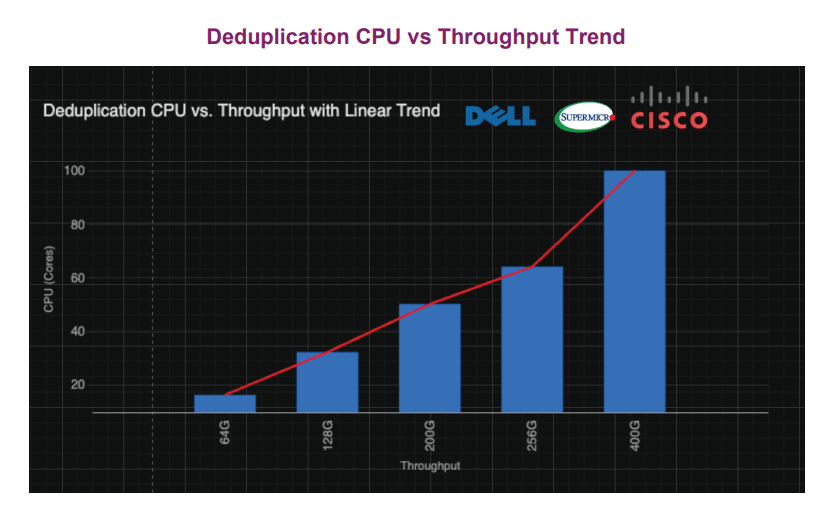
Deduplication performance is presented as per-core measurements. The provided graph illustrates the relationship between CPU utilization and throughput across Dell, Supermicro, and Cisco platforms.
Application Identification and Metadata Intelligence
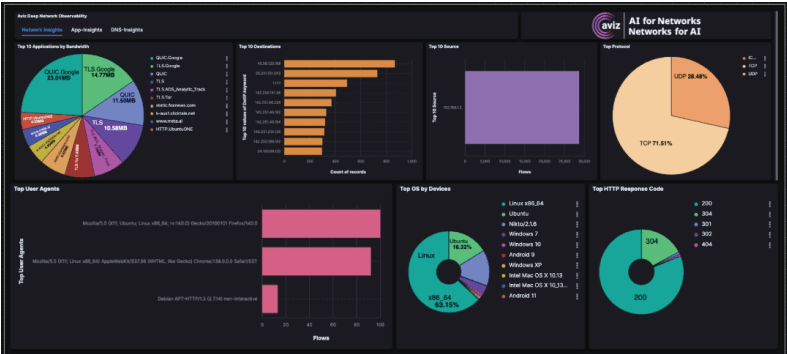
The Aviz Service Node delivers advanced Deep Packet Inspection (DPI) capabilities that identify both shadow and non-shadow AI applications. It generates rich metadata and seamlessly exports it to observability platforms such as Elastic, Splunk, New Relic, and Datadog for deeper analysis and insight.
Aviz Elastic Node - Application Insights
Performance Measurement - For Enterprise
Testing Application filtering and Metadata with IMIX traffic to measure throughput. The Traffic from the Spirent cyberflood was sent to the Open Packet Broker (OPB) for filtering the interested traffic and forwarded to the service node to generate metadata for the applications filtered using Deep Packet Inspection Application intelligence. The generated metadata is sent to the SIEM.
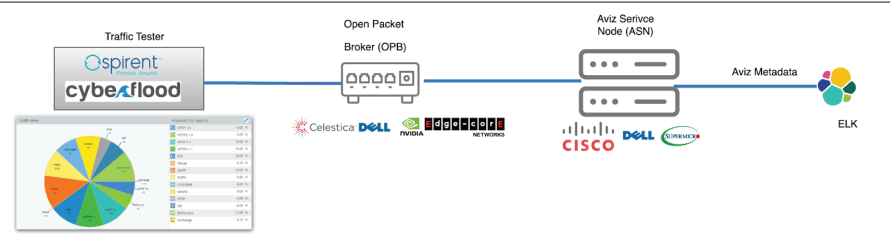
Throughout Emix Traffic
| Use Case | Platform | DC (Enterprise) Per Core - Tput (Gbps) | DC (Enterprise) Per Core - kpps |
|---|---|---|---|
| Application Metadata for Enterprise | Dell, SuperMicro, UCS | 4.8G | 80 |
Performance Measurement - For Telco
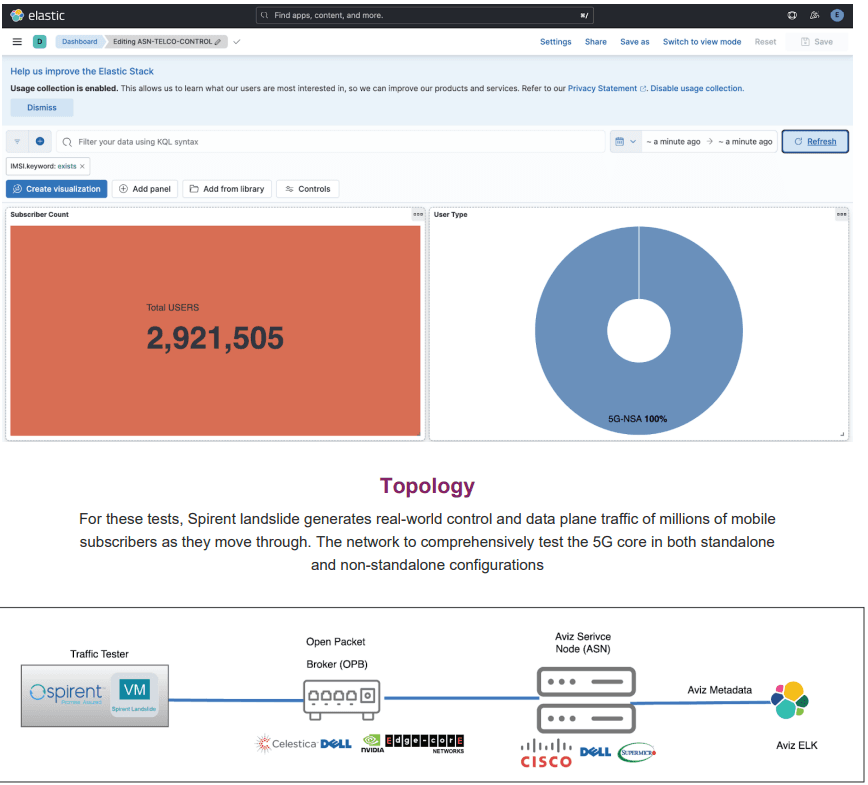
Testing Application Metadata Intelligence for telco using Spirent Landslide. The Traffic from the Spirent landslide was sent to the Open Packet Broker (OPB) for filtering the interested traffic and forwarded to the service node to generate metadata for the applications filtered using Deep Packet Inspection Application intelligence. The generated metadata is sent to the SIEM.
For these tests, Spirent landslide generates real-world control and data plane traffic of millions of mobile subscribers as they move through. The network to comprehensively test the 5G core in both standalone and non-standalone configurations.

Telco Per Core
| Use Case | Platform | Telco Per Core - Tput (Gbps) | Telco Per Core - kpps |
|---|---|---|---|
| Application Metadata for Enterprise | Dell, SuperMicro, UCS | 4.5G | 72 |
Network Copilot (NCP)
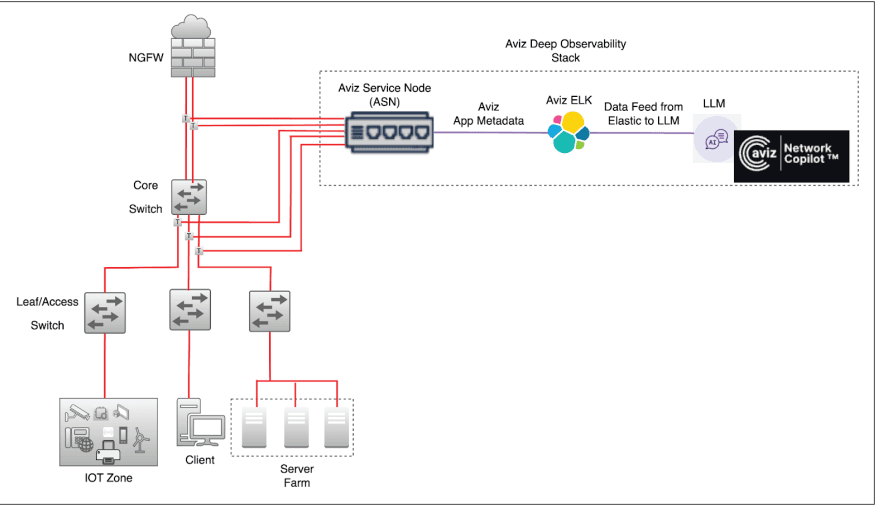
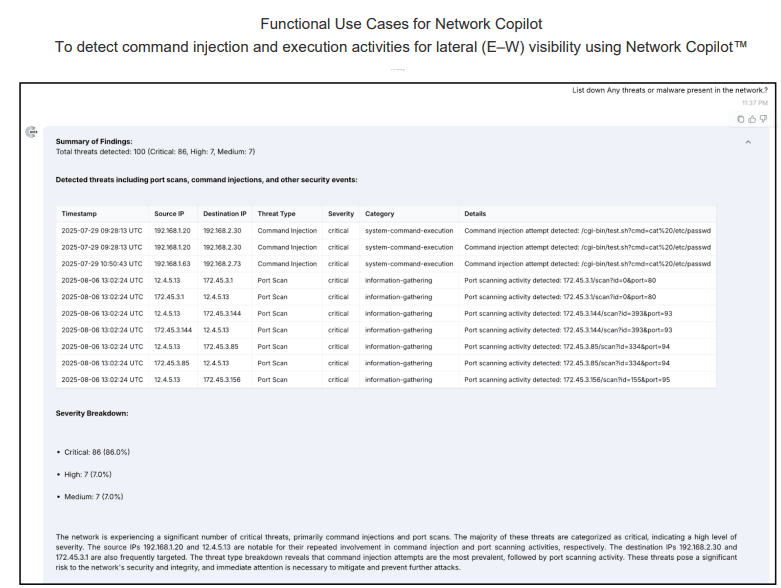
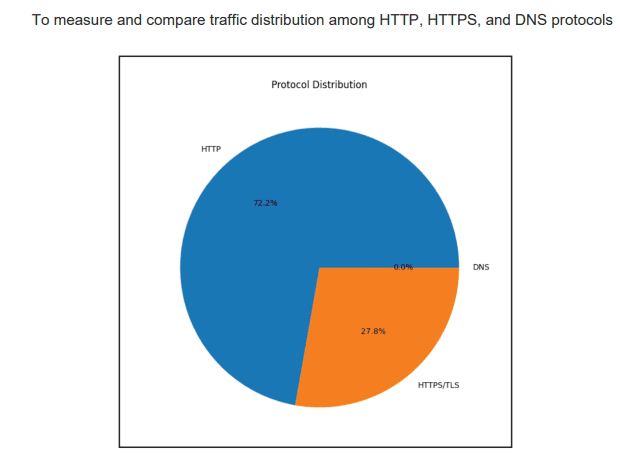
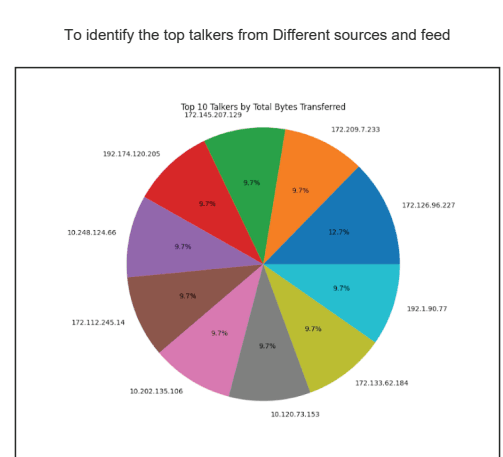
An AI-powered, on-premises assistant built on open-source LLMs. Network Copilot allows users to query real-time network data using natural language. It’s RAG-enabled, privacy-safe (runs locally), and avoids hallucinations by relying strictly on verified telemetry.
-
Architecture
Traffic from TAP and SPAN sessions is sent to the Service Node for metadata generation, which is then fed to Network Copilot™ for correlating logs from various network components, including NGFWs, switches, and other data sources.
Conclusion
The Aviz Deep Network Observability InterOP proved that AI-native, multi-vendor solutions can deliver unmatched visibility, scale, and performance, regardless of network speed or size. From massive, high-speed backbones to smaller, distributed sites, the Aviz Open Packet Broker, service nodes, and Network Copilot™ provide consistent, real-time insights that eliminate blind spots, accelerate troubleshooting, and strengthen security.
Simply put—if it’s on your network, Aviz will see it, understand it, and help you act on it.
Learn More About Aviz Deep Network Observability
Discover how Aviz can deliver AI-native, multi-vendor observability for your enterprise or telco network.