



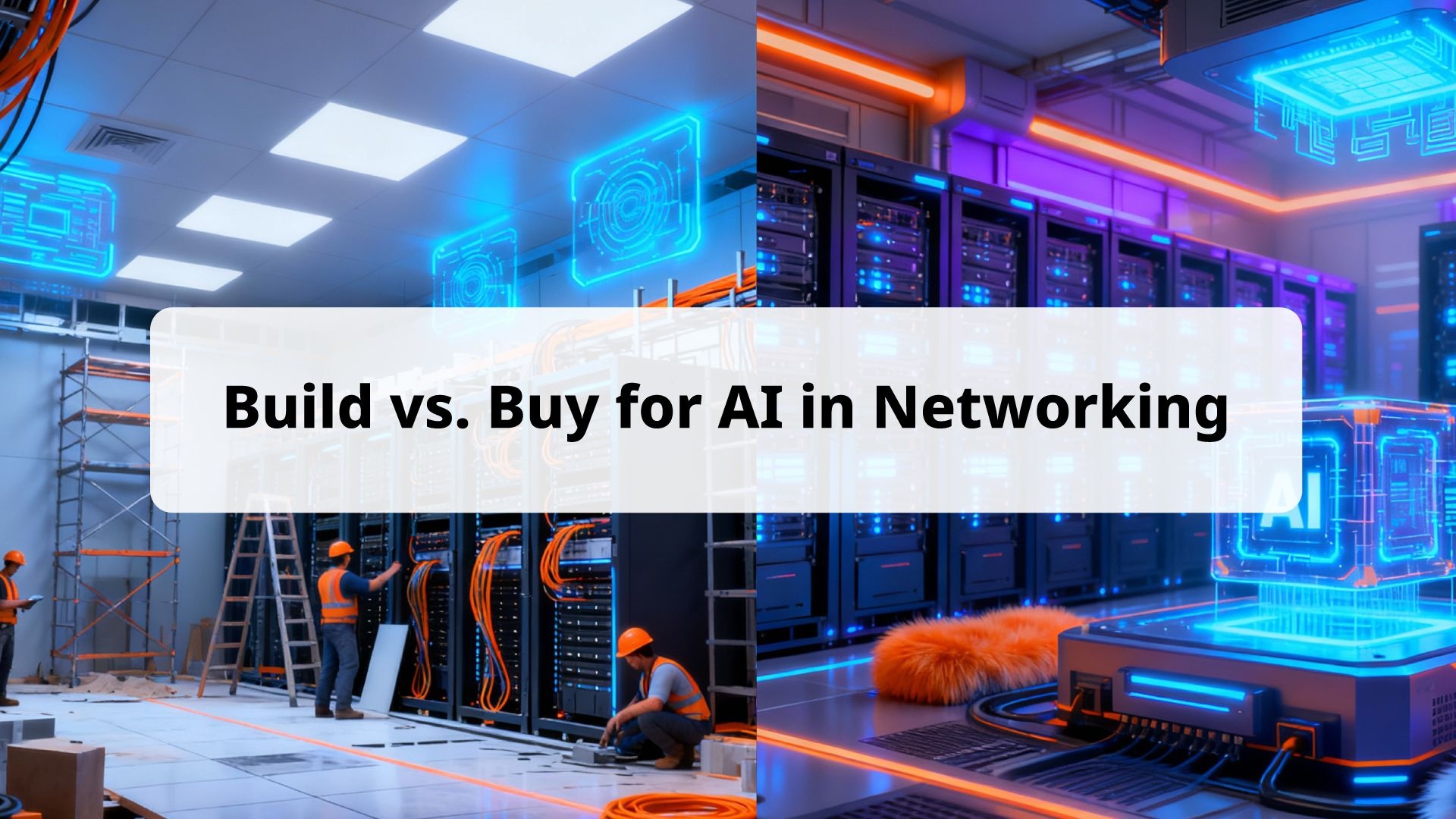
Both extremes fall short. Here's why
Building in-house gives full control, but it's slow, expensive, and comes with ongoing technical debt around data pipelines, drift, governance, and maintenance.
Buying a closed product is fast, but it rarely fits your architecture perfectly and often doesn't allow deep customization or use of your enterprise context.
The most practical and sustainable option is the Middle Path:
- Buy the AI platform (for ingest, normalization, governance, reliability, SLAs).
- Build your differentiators (your agents, workflows, policies, enterprise context)
This is the philosophy behind Aviz Network Copilot: giving enterprises a stable AI foundation while letting them build their own intelligence on top.
ML systems don't fail at the model; they fail around the model:
- Constant data dependencies
- Drift management
- Evaluations and monitoring
- Feature stores
- Orchestration and pipelines
These costs grow over time and become the majority of the workload.
A production AI platform needs:
- ML engineers
- LLM/RAG experts
- Data engineers
- Networking SMEs
- SREs to maintain SLIs/SLOs
Most enterprises spend months or quarters just trying to get a stable baseline.
You must prove your AI is safe, reliable, explainable, secure, and compliant. Building these controls yourself takes significant effort.

Fast Start, Rigid Limitations
Buying something ready-made gives you a fast start, but rigidity slows you down later. Closed AI products often don't fit your multi-vendor network, can't encode your runbooks, KB, and policies, and limit how much context you can bring.
Vendor Lock-in Risk
Closed products don't let you bring your own LLM, make you dependent on a vendor's internal roadmap, and increase long-term lock-in risk. AI for networking must understand your network, and generic tools usually can't go deep enough.
Network Copilot handles the heavy lifting:
- Ingest from multi-vendor environments
- Normalization and enrichment
- Retrieval, ranking, and long-context storage
- Agent runtime and guardrails
- Security, RBAC, audit trails
- SLIs/SLOs and 24×7 support
- Model abstraction (use or swap any LLM)
- Portability (open APIs, documented exit plan)
Think of NCP as the electricity grid: reliable, scalable, always on.
On top of NCP, you build:
- Your NOC co-pilot
- RCA and explanation agents
- Change validation and config linting agents
- Ticketing/ITSM integrations
- Automation workflows
- Your policies, intent models, and success metrics
This is where your enterprise's unique knowledge lives.
What You Control vs. What Copilot Handles
You get control without the operational burden.
You Control
Copilot Handles
Why the Middle Path Wins on Cost and ROI
This is why analysts (IDC, McKinsey, Forrester) recommend platform + customization as the enterprise GenAI model
If You Build Everything
High initial investment with growing maintenance costs
- •Most of your budget gets consumed by maintenance
- •30–40% (later up to ~65%) of spend goes to "keeping the lights on"
- •Less goes to actual agents and outcomes
- •Technical debt grows each year
If You Only Buy
Fast start but limited customization
- •You move fast initially
- •But hit product limitations
- •Context depth is shallow
- •Lock-in risk increases
- •Customization is limited
If You Take the Middle Path
Optimal balance of speed, control, and ROI
- •A predictable subscription (~$300–$400k of a $1M budget) covers the platform
- •The rest of your budget goes straight to agent development
- •Faster time to outcomes
- •Faster innovation
- •No lock-in
- •Long-term portability
- •Lower technical debt
- •Higher ROI
Conclusion
AI in networking isn't about choosing "build" or "buy."
Both extremes fall short.
The Middle Path gives you the best of both worlds:
Speed without losing control
Customization without technical debt
Portability without lock-in
Enterprise governance without slowing down innovation
Aviz Network Copilot provides the stable AI foundation, and your teams build the agents and workflows that represent your enterprise's unique intelligence.
This is the sustainable way to scale AI in networking, with reliability today and flexibility for tomorrow.